The Fall of Jericho Myth Meaning & Symbolism
A besieged city's walls crumble to the sound of sacred trumpets, a myth of divine intervention and the shattering of psychic fortifications.
The Tale of The Fall of Jericho
Hear now of the walls that fell not to sword, nor to ram, but to a sound woven from faith and silence.
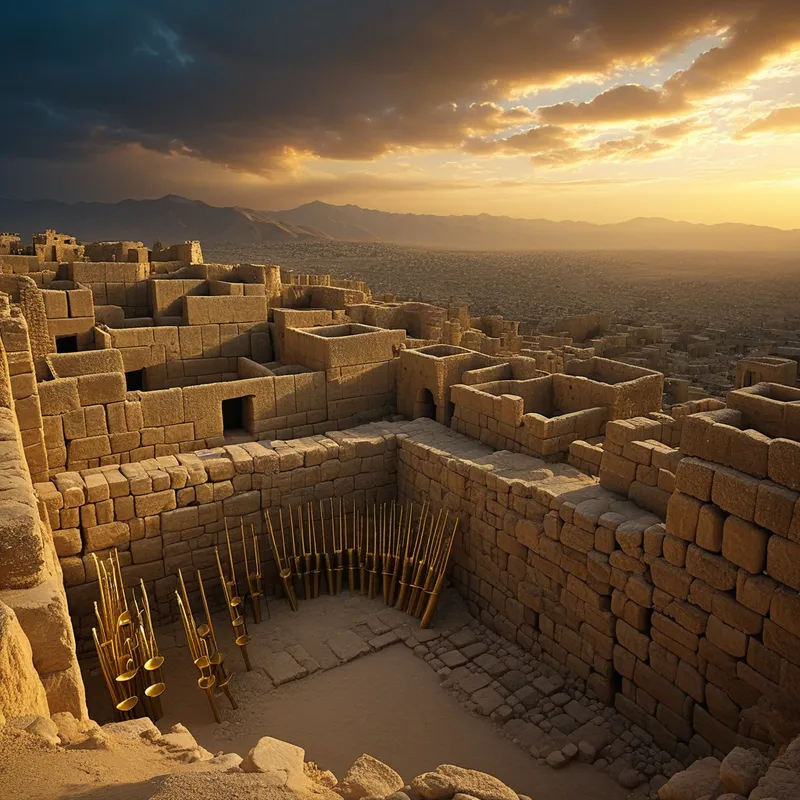
For forty years they had wandered, a people forged in [the desert](/myths/the-desert “Myth from Biblical culture.”/) furnace, children of a promise whispered to their ancestor Abraham. Now they stood on the plains of Canaan, their sandals dusted with the powder of hope, their eyes fixed upon the first great barrier: [Jericho](/myths/jericho “Myth from Biblical culture.”/). A city of palm and stone, ancient and proud, its walls were a legend—a double ring of stone so vast and thick they seemed a part of [the earth](/myths/the-earth “Myth from Hindu culture.”/) itself. Behind them, a kingdom held its breath.
Joshua, son of Nun, walked alone in the cool of the evening. A figure appeared before him, a man with a drawn sword. “Are you for us, or for our adversaries?” Joshua demanded, his hand on his own hilt. The figure replied, “No; but I am the commander of the army of the Lord.” Joshua fell on his face. The instruction was given, not in the language of siegecraft, but of ritual.
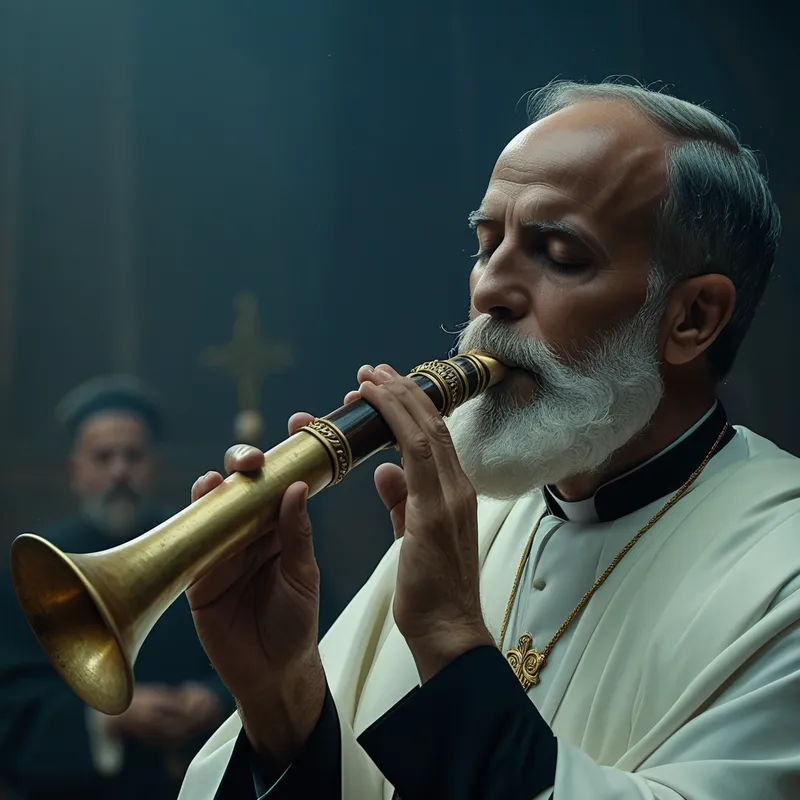
For six days, the army of Israel marched in a sacred, silent procession. At their head went the warriors, but behind them came the priests, bearing the Ark of the Covenant, the palpable presence of the Holy. Seven priests walked before the Ark, each holding a ram’s horn trumpet, a shofar. No war cry was uttered. Only the steady, mournful, commanding blast of the seven horns cut the morning air. They circled the city once, and returned to camp. The people of Jericho watched from their battlements, first in mockery, then in a creeping, silent dread. What madness was this?
On the seventh day, they rose at dawn. This day, they did not circle once, but seven times. The air grew thick with anticipation, the only sound the shuffle of feet and the relentless, cyclical blasts of the horns. On the seventh circuit, as the priests’ lungs burned and the army’s patience was stretched to its limit, Joshua’s voice shattered the ritual silence: “Shout! For the Lord has given you the city!”
A roar erupted from thousands of throats, a [thunderclap](/myths/thunderclap “Myth from Various culture.”/) of human sound joined to the final, piercing cry of the shofars. And the earth answered. A deep groan rose from the foundations of Jericho. The mighty walls, which had stood for generations, shuddered as if struck by an invisible fist. Stones ground against stones. Cracks, like black lightning, raced up the fortifications. Then, with a sound that swallowed the shouts and the trumpets, the walls fell inward, every man straight before him. The dust cloud rose to heaven, a brown shroud over the city’s pride. The impregnable had been opened. The impossible had been made passage.
Cultural Origins & Context
This narrative is anchored in the Torah book of Joshua, a text that sits at the fraught intersection of national foundation myth, theological treatise, and historical memory. For ancient Israel, emerging from tribal confederation into monarchy, the story of Jericho served a paramount function: it was the mythic “first fruits” of the conquest, a divine validation of their identity and their claim to the land. It established a pattern—victory comes not through superior force or technology, but through strict adherence to divine law and ritual purity.
The tale was likely preserved and recited by priestly and Levitical castes, for it centers on sacred objects (the Ark, the trumpets) and liturgical action. It transformed a potential military history into a theological drama. In the context of a people defining themselves against the established city-states and religious practices of Canaan, Jericho became the archetypal “other”—the fortified, pagan city that must fall so that a new order, based on covenant, can be established. Its telling reinforced communal identity, absolute faith in Yahweh’s power, and the severe consequences of disobedience, mirrored in the fate of the city itself.
Symbolic Architecture
At its core, [the Fall](/myths/the-fall “Myth from Biblical culture.”/) of Jericho is a myth about the collapse of a [paradigm](/symbols/paradigm “Symbol: A fundamental model or framework in arts and music that shapes creative expression, perception, and cultural understanding.”/). [Jericho’s walls](/myths/jerichos-walls “Myth from Biblical culture.”/) represent more than [military](/symbols/military “Symbol: The military symbolizes discipline, authority, and often the need for structure or control in one’s life.”/) [defense](/symbols/defense “Symbol: A protective mechanism or barrier against perceived threats, representing boundaries, security, and resistance to external or internal challenges.”/); they symbolize the rigid structures of the [psyche](/myths/psyche “Myth from Greek culture.”/) and the society we build for protection, which ultimately become our prisons.
The walls we build for safety are the very walls that shut out the future.
The [city](/symbols/city “Symbol: A city often symbolizes community, social connection, and the complexities of modern life, reflecting the dreamer’s relationships and societal integration.”/) is a closed [system](/symbols/system “Symbol: A system represents structure, organization, and interrelated components functioning together, often reflecting personal or social order.”/), a citadel of the old order, self-contained and seemingly permanent. The Israelite army, guided by divine command, represents the disruptive, transformative force—the new [consciousness](/symbols/consciousness “Symbol: Consciousness represents the state of awareness and perception, encompassing thoughts, feelings, and experiences.”/) that cannot be integrated into the old forms. The seven days of circling signify a complete, cyclical [period](/symbols/period “Symbol: Periods in dreams can symbolize cyclical patterns, renewal, and the associated emotions of loss or change throughout life.”/) of preparation, a ritualized containment of [energy](/symbols/energy “Symbol: Energy symbolizes vitality, motivation, and the drive that fuels actions and ambitions.”/) and [intention](/symbols/intention “Symbol: Intention represents the clarity of purpose and direction in one’s life and can symbolize motivation and commitment within a dream context.”/). The silence of the army is profound; it is the silence of focused will, of a power gathering itself not in [noise](/symbols/noise “Symbol: Noise in dreams signifies distraction, confusion, and the need for clarity amidst chaos.”/), but in potent, directed potential.
The [shofar](/symbols/shofar “Symbol: A ram’s horn trumpet used in Jewish rituals, symbolizing divine calls, repentance, and spiritual awakening.”/) blast is the key. In Hebrew tradition, the [shofar](/symbols/shofar “Symbol: A ram’s horn trumpet used in Jewish rituals, symbolizing divine calls, repentance, and spiritual awakening.”/) is the voice of God, the sound that announces [revelation](/symbols/revelation “Symbol: A sudden, profound disclosure of truth or insight, often through artistic or musical means, that transforms understanding.”/), coronation, and judgment. It is [vibration](/symbols/vibration “Symbol: A rhythmic oscillation or resonance, often representing energy, connection, or unseen forces. In dreams, it can signal awakening, disturbance, or spiritual communication.”/) made sacred. The walls do not fall from physical force, but from resonant [frequency](/symbols/frequency “Symbol: In dreams, frequency often represents rhythm, cycles, patterns, or the rate of occurrence of events, thoughts, or emotions.”/). Psychologically, this speaks to the power of a [truth](/symbols/truth “Symbol: Truth represents authenticity, honesty, and the quest for knowledge beyond mere appearances.”/), once its correct frequency is found, to shatter long-held defenses, dogmas, and neurotic patterns. The final collective shout is the [eruption](/symbols/eruption “Symbol: A sudden, violent release of pent-up energy or emotion from beneath the surface, often representing transformation or crisis.”/) of that contained potential into manifest [reality](/symbols/reality “Symbol: Reality signifies the state of existence and perception, often reflecting one’s understanding of truth and life experiences.”/)—the [moment](/symbols/moment “Symbol: The symbol of a ‘moment’ embodies the significance of transient experiences that encapsulate emotional depth or pivotal transformations in life.”/) of psychic [breakthrough](/symbols/breakthrough “Symbol: A sudden, significant advance or discovery that overcomes a barrier, often marking a transformative shift in understanding, ability, or situation.”/).
The Dreamer’s Resonance
When this myth stirs in the modern unconscious, it often manifests in dreams of impenetrable barriers, silent processions, or resonant sounds that cause structural collapse. To dream of walking in circles around a formidable wall or building signifies a period of incubation. The dreamer is in the “six days” phase—gathering resources, following an inner directive they may not fully understand, confronting the same problem repeatedly.
Dreams where a shout, a note of music, or a specific word causes a wall to crumble or a door to open point directly to the “seventh day” moment of integration. This is the somatic signal of a psychological defense—a wall of resentment, a fortress of pride, a barrier of fear—reaching its limit and collapsing under the weight of a new, acknowledged truth. The collapse in the dream is often accompanied by feelings of awe and terror, a liberation that is also a destruction. The dreamer is experiencing the death of an old self-structure, making way for a terrifying and necessary new openness.
Alchemical Translation
The alchemical process mirrored here is [solutio](/myths/solutio “Myth from Alchemical culture.”/)—the dissolving of rigid, fixed matter (the solve of “[solve et coagula](/myths/solve-et-coagula “Myth from Alchemical culture.”/)”). The psyche’s Jericho is any crystallized complex: a hardened trauma, a rigid identity, a defensive ideology that has outlived its purpose. The individuation journey requires its dissolution.
The first alchemical stage is the circumambulatio—the sacred circling. This is the conscious, patient work of analysis, of circling the complex, observing it from all angles without immediate assault. It is the discipline of holding tension. [The Ark of the Covenant](/myths/the-ark-of-the-covenant “Myth from Abrahamic culture.”/) represents the transcendent function, the guiding Self, which must be at the center of this operation. The seven priests are the archetypal energies marshaled in service of this work.
The true battle is not against the wall, but for the faithfulness to complete the ritual circles, to trust the process when no change is visible.
The final, simultaneous blast and shout is the coniunctio, the marriage of the conscious will (the shout) with the transcendent, numinous frequency (the shofar). This union produces the catalytic event—the collapse. In personal terms, this is the moment a lifelong pattern of anxiety suddenly loses its power when its core childhood wound is finally heard and resonated with at the correct emotional frequency. The wall of symptoms falls because its foundational myth has been shattered by a deeper truth.
The conquest that follows in the biblical narrative reminds us that the fall of the walls is not the end, but the beginning of a more difficult phase: entering the ruined city, confronting what was hidden behind the defenses, and building something new upon the leveled ground. So too in the psyche: breaking down a defense is merely the prelude to the arduous, ethical work of integrating [the shadow](/myths/the-shadow “Myth from Jungian culture.”/) elements that wall was protecting. The myth of Jericho gives us a map not for destruction, but for sacred, resonant transformation.
Associated Symbols
Explore related symbols from the CaleaDream lexicon: