The Faerie Ring Myth Meaning & Symbolism
A mortal enters a Faerie Ring, dances with the Sídhe for a night, and returns to find a century has passed, forever changed.
The Tale of The Faerie Ring
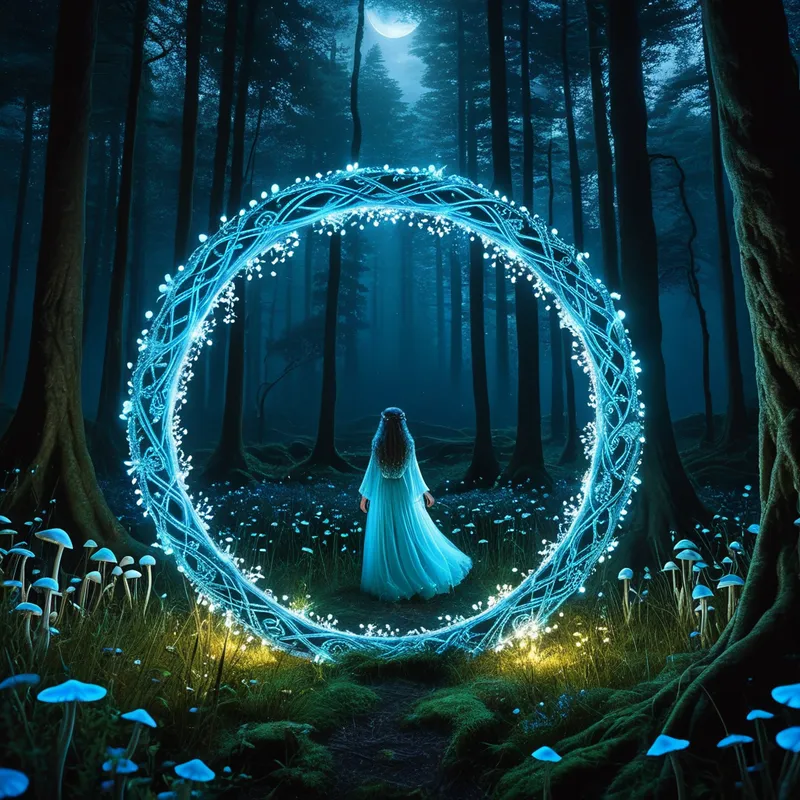
Listen, and let the peat-smoke carry you. Not to [the world](/myths/the-world “Myth from Tarot culture.”/) you know, of plough and hearth, but to the edge-lands, where the [hawthorn](/myths/hawthorn “Myth from Celtic culture.”/) grows thick and the evening mist does not lift. Here, in [the liminal hour](/myths/the-liminal-hour “Myth from Norse culture.”/) between dog and wolf, [the world](/myths/the-world “Myth from Tarot culture.”/) grows thin. And there, upon a hillock or nestled in the roots of an ancient oak, you might see it: a circle in the grass, a [ring of mushrooms](/myths/ring-of-mushrooms “Myth from Global Folklore culture.”/), darker and more vibrant than any other. This is an Fhána Sí. Step inside, and you step out of time.
It begins with a soul drawn by music—a melody that is not heard with the ear, but felt in the marrow. A young farmer, weary from the day, or a curious child straying from the path. They see the ring, a perfect circle of amanita or mousseron, glowing with a soft, internal light. From its center comes the sound of laughter like silver bells, and the sight of figures moving with a grace that aches the heart. They are the [Sídhe](/myths/sdhe “Myth from Celtic / Irish culture.”/), the people of the mounds, neither wholly god nor mortal, but beings of terrible beauty.
The mortal, entranced, places one foot across the fungal threshold. The air changes—it becomes sweeter, heavier, charged with static potential. A hand, cool as moonlit [water](/myths/water “Myth from Chinese culture.”/), takes theirs. They are pulled into the dance. And what a dance it is! It is the turning of the seasons, [the spiral](/myths/the-spiral “Myth from Celtic culture.”/) of the stars, the relentless push of sap in spring. There is no fatigue, only ecstatic motion. The dancer forgets hunger, thirst, home, and name. They are simply a note in the Sídhe song, a step in their eternal reel. Night deepens, or so it seems, though the light within the ring never fades.
Then, a crack. A crow’s call, perhaps, sharp as flint. Or the memory of a mother’s voice, faint as a cobweb. The spell shivers. The mortal stumbles, breaks the circle of clasped hands, and falls—not onto soft, enchanted grass, but onto hard, cold earth. The music cuts off. The light vanishes. They are alone in a grey dawn, the mushroom ring now just a mundane cluster of fungi. But the village is not as they left it. The thatch is different, the faces are strange. A century has passed in a single night. Their loved ones are dust, their world is gone. They are a ghost in their own life, forever marked by the touch of the Other, carrying the weight of lost time in their now-ancient bones.
Cultural Origins & Context
The myth of the Faerie Ring is not a single story, but a pervasive folk motif woven through the oral traditions of Ireland, Scotland, Wales, and other Celtic regions. It belongs not to the grand cycles of gods and heroes, but to the seanchas, the lore of the common people, passed down by fireside and at crossroads. These tales were warnings, maps of the psychic landscape. The Sídhe were understood as the old gods diminished, the Tuatha Dé Danann, who retreated into [the hollow hills](/myths/the-hollow-hills “Myth from Celtic culture.”/) (sídhe) when newer peoples arrived. They represented the untamed, pre-Christian soul of the land itself.
The function of the tale was profoundly practical and psychological. It taught respect for the unseen and established boundaries. The Faerie Ring physically marked the tairseach between the human world (an saol seo) and [the Otherworld](/myths/the-otherworld “Myth from Celtic culture.”/) (an saol eile). To enter was to violate a taboo, to risk being sí-bhruite. The story enforced social cohesion—don’t wander alone at twilight—while also explaining the unexplainable: the sudden disappearance of a person, or the appearance of a confused stranger claiming to be a long-lost ancestor. It was a narrative container for the deep human anxieties about time, memory, and the allure of oblivion.
Symbolic Architecture
At its core, the Faerie Ring is a [symbol](/symbols/symbol “Symbol: A symbol can represent an idea, concept, or belief, serving as a powerful tool for communication and understanding.”/) of the unconscious itself—vibrant, autonomous, and operating on a [logic](/symbols/logic “Symbol: The principle of reasoning and rational thought, often representing order, structure, and intellectual clarity in dreams.”/) [alien](/symbols/alien “Symbol: Represents the unknown, otherness, and the exploration of new ideas or experiences.”/) to the waking ego. The ring is the [mandala](/symbols/mandala “Symbol: A sacred geometric circle representing wholeness, the cosmos, and the journey toward spiritual integration.”/), a sacred circle representing wholeness, but one that is not yet integrated. It is a [portal](/symbols/portal “Symbol: In dreams, a portal symbolizes a passage to new experiences, dimensions, or aspects of the self.”/) to the psychic [underworld](/symbols/underworld “Symbol: A symbolic journey into the unconscious, representing exploration of hidden aspects of self, transformation, or confronting repressed material.”/).
The Ring is the maw of time, where chronology is digested into pure experience. To enter is to be consumed by the eternal present.
The Sídhe represent the archetypal contents of the unconscious: our latent potentials, our ancestral memories, our instincts, and our shadows. They are beautiful because the unconscious holds immense creative power; they are perilous because to identify with them—to dance forever—is to lose [the self](/myths/the-self “Myth from Jungian culture.”/), to become psychotic or utterly dissociated. The dance is the seductive pull of [inflation](/symbols/inflation “Symbol: A dream symbol representing feelings of diminishing value, loss of control, or expansion beyond sustainable limits in one’s life or psyche.”/), of numinous experience that promises transcendence but demands the sacrifice of individual [consciousness](/symbols/consciousness “Symbol: Consciousness represents the state of awareness and perception, encompassing thoughts, feelings, and experiences.”/).
The lost [century](/symbols/century “Symbol: A 100-year period representing vast spans of time, historical change, and human legacy. Symbolizes both continuity and transformation across generations.”/) is the ultimate price. It symbolizes the psychic cost of unconscious living. Every time we are “spellbound” by a complex—by rage, by addiction, by a mesmerizing [trauma](/symbols/trauma “Symbol: A deeply distressing or disturbing experience that overwhelms the psyche, often manifesting in dreams as unresolved emotional wounds or psychological injury.”/)—we “lose time.” We emerge from the [trance](/symbols/trance “Symbol: A state of altered consciousness, often involving deep focus, dissociation, or spiritual connection, where normal awareness is suspended.”/) to find our real-world [life](/symbols/life “Symbol: The symbol of ‘Life’ represents a journey of growth, interconnectedness, and existential meaning, encompassing both the joys and challenges that define human experience.”/) has atrophied, relationships have moved on, and we are strangers to ourselves. The returned dancer is [the ego](/myths/the-ego “Myth from Jungian culture.”/) that has touched the Self but cannot reconcile the two worlds. They are the [orphan](/symbols/orphan “Symbol: Represents spiritual abandonment, primal vulnerability, and the quest for belonging beyond biological ties. Often signifies a soul’s journey toward self-reliance.”/) [archetype](/symbols/archetype “Symbol: A universal, primordial pattern or prototype in the collective unconscious that shapes human experience, behavior, and creative expression.”/) incarnate, exiled from both the [human](/symbols/human “Symbol: The symbol of a human represents individuality, complexity of emotions, and social relationships.”/) [community](/symbols/community “Symbol: Community in dreams symbolizes connection, support, and the need for belonging.”/) and the faerie [paradise](/symbols/paradise “Symbol: A perfect, blissful place or state of being, often representing ultimate fulfillment, harmony, and transcendence beyond ordinary reality.”/), carrying the irreversible [mark](/symbols/mark “Symbol: A ‘mark’ often symbolizes identity, achievement, or a defining characteristic in dreams.”/) of their encounter.
The Dreamer’s Resonance
When the motif of the Faerie Ring appears in modern dreams, it signals a powerful encounter with the unconscious at a threshold moment. The dreamer is being invited, or warned, about crossing a psychic boundary.
Somatically, this might correlate with feelings of vertigo, a tingling at the skin’s edge, or a literal sensation of being pulled or danced. Psychologically, it often appears during periods of intense creative flow, spiritual seeking, or on the brink of a major life decision. The ring might manifest as a circle of colleagues, a recurring pattern in a relationship, or a literal ring of light. To dream of standing at its edge, hesitating, reflects ambivalence about delving into a deep part of the self. To dream of dancing within it suggests a state of enchantment by an idea, person, or emotion—a potentially fruitful but dangerous identification with an archetype. To dream of stumbling out, disoriented and aged, points to the aftermath of such an immersion: a feeling of having lost oneself in a project or passion and returning to find the “real world” alien.
The dream is asking: What unconscious content is so alluring it threatens to make you forget your own life? And what price is your waking self willing to pay for that knowledge?
Alchemical Translation
The myth models the perilous early stages of individuation, the [nigredo](/myths/nigredo “Myth from Alchemical culture.”/). The mortal’s journey is not one of heroic conquest, but of necessary, if devastating, insight. The alchemical process begins with a call—the haunting music. This is the stirring of the Self, inviting the ego into the transformative vessel.
The dance in the ring is the solutio—the dissolution of the ego’s rigid structures in the waters of the unconscious. One must be dissolved before one can be reconstituted.
The critical moment is not the entry, but the stumble. This is the [separatio](/myths/separatio “Myth from Alchemical culture.”/), the painful but essential act of differentiation. The ego must break the enchantment, must reclaim its boundaries from the mesmerizing embrace of the archetypal world. This break is never clean; it feels like a fall, a failure, a rupture.
The return to a changed world is the mortificatio, the death of the old personality. The life you knew is gone. This is the profound grief of transformation. Yet, in this death lies the seed of the new. The returned one, though orphaned, carries something back: the memory of the dance, the knowledge of the [Otherworld](/myths/otherworld “Myth from Celtic culture.”/). They are now the fear siubhail, one who has seen. The task of the later alchemical stages (albedo, [rubedo](/myths/rubedo “Myth from Alchemical culture.”/)) would be to integrate that faerie knowledge into the human world, to build a bridge between the two realms within the [psyche](/myths/psyche “Myth from Greek culture.”/), so that one is no longer a ghost in either, but a citizen of both. The myth, in its traditional form, stops at the warning. The alchemical translation challenges us to take the next, conscious step: to return to the ring not as a spellbound dancer, but as a sober witness, and to build a hearth on the borderland.
Associated Symbols
Explore related symbols from the CaleaDream lexicon: