The Faerie Folk Myth Meaning & Symbolism
A tale of the Sidhe, the luminous and perilous people of the mounds, who dwell in the borderlands between worlds and test the human soul.
The Tale of The Faerie Folk
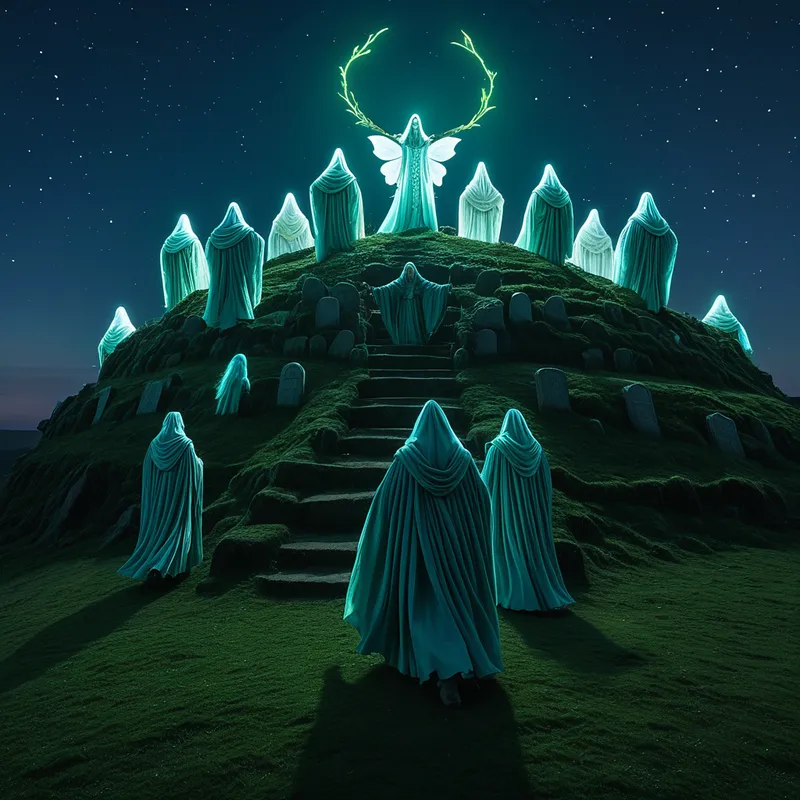
Listen, and let the fire’s glow dim. Let [the world](/myths/the-world “Myth from Tarot culture.”/) you know recede. We speak now of the time-between-times, when [the veil](/myths/the-veil “Myth from Various culture.”/) is thin as a moth’s wing. We speak of the Tuatha Dé Danann, who, defeated but unconquered, retreated. Not to death, but to [the hollow hills](/myths/the-hollow-hills “Myth from Celtic culture.”/). They became the Aos Sí, the People of Peace, though their peace is a storm of beauty and terror.
They dwell in the [sídhe](/myths/sdhe “Myth from Celtic / Irish culture.”/), those green, silent mounds that dot the land. From within, a light glows that is neither sun nor moon, but the light of a world that runs parallel to our own, a hair’s breadth away. On [Samhain](/myths/samhain “Myth from Celtic culture.”/) eve, or at the liminal hours of dusk and dawn, the doors of [the sídhe](/myths/the-sdhe “Myth from Celtic culture.”/) swing open.
A hunter, weary from the chase, might hear music—a melody so sweet it aches in the bone. He follows, pushing through a thicket to find a clearing lit by a hundred floating lights. There they are: the Faerie host. They are tall, fair beyond human measure, with eyes that hold the depth of still lakes and ancient stars. They dance in a ring, their feet never seeming to touch [the dew](/myths/the-dew “Myth from Alchemical culture.”/)-kissed grass. To join them is to be lost to time. A year in their revelry is a century in the world of men.
But not all encounters are of music. A farmer, foolishly ploughing a ráth, might find his cattle sickened, his milk soured. A child who speaks ill of them at a crossroads might be led astray by a will-o’-the-wisp, a flickering púca in the form of a dark horse. Their gifts are double-edged: a purse of gold that turns to leaves at dawn, a song that grants inspiration but leaves the singer forever haunted by its echo.
They are keepers of the old ways, the raw, untamed spirit of the land itself. To cross into their realm is to step outside the ordered world of day and law, into the dream-time where every leaf has a voice and every stone a memory. To return is never certain, and those who do are forever marked, their eyes holding a distant, twilight sorrow. They have seen the world behind the world, and our sunlit realm can never seem wholly real again.
Cultural Origins & Context
The myth of the Faerie Folk is not mere fancy, but the deep sedimentary layer of Celtic spiritual consciousness. Its roots sink into the pre-Christian veneration of the land, where every hill, spring, and grove was imbued with animism. The Tuatha Dé Danann, the original [pantheon](/myths/pantheon “Myth from Roman culture.”/), were not distant Olympians but deities intimately tied to sovereignty, craft, and the fertility of [the earth](/myths/the-earth “Myth from Hindu culture.”/).
With the coming of Christianity, these powerful gods could not be wholly erased. They were diplomatically diminished, transformed in the popular imagination into the Aos Sí—still potent, but now residing in a parallel, slightly removed dimension. This was a profound act of cultural syncretism, preserving the sacredness of the landscape within a new framework. The stories were kept alive not in grand texts, but in the seanchaí tradition, told by hearthfires during the long winter nights. Their function was multifaceted: to explain misfortune, to enforce social taboos (like respecting ancient sites), and most importantly, to map the psychological and spiritual borderlands that surrounded the community. They taught respect for the unknown and the consequences of trespassing sacred boundaries.
Symbolic Architecture
The Faerie [realm](/symbols/realm “Symbol: The symbol of ‘Realm’ often signifies the boundaries of one’s consciousness, experiences, or emotional states, suggesting aspects of reality that are either explored or ignored.”/) is the ultimate [symbol](/symbols/symbol “Symbol: A symbol can represent an idea, concept, or belief, serving as a powerful tool for communication and understanding.”/) of the liminal. It exists at [the threshold](/myths/the-threshold “Myth from Folklore culture.”/): between day and [night](/symbols/night “Symbol: Night often symbolizes the unconscious, mystery, and the unknown, representing the realm of dreams and intuition.”/), the cultivated field and the wild [forest](/symbols/forest “Symbol: The forest symbolizes a complex domain of the unconscious mind, representing both mystery and potential for personal growth.”/), the conscious and the unconscious mind. The [Sidhe](/myths/sidhe “Myth from Celtic culture.”/) themselves represent the autonomous, archetypal contents of the [psyche](/myths/psyche “Myth from Greek culture.”/) that exist outside ego-control. They are not good nor evil, but other—governed by their own ancient, inscrutable laws.
To encounter the Faerie is to encounter the part of the soul that refuses to be civilized, categorized, or owned. It is the wild creativity, the profound intuition, and also the capricious, disruptive shadow.
The peril of their enchantment symbolizes the [danger](/symbols/danger “Symbol: The symbol of ‘Danger’ often indicates a sense of threat or instability, calling for caution and awareness.”/) of being overwhelmed by the unconscious—of losing one’s [identity](/symbols/identity “Symbol: Identity represents the sense of self, encompassing personal beliefs, cultural background, and social roles.”/) (one’s “name” or “time”) in a flood of undifferentiated psychic [material](/symbols/material “Symbol: Material signifies the tangible aspects of life, often representing physical resources, desires, and the physical world’s influence on our existence.”/). The gifts that turn to dross speak to [the ego](/myths/the-ego “Myth from Jungian culture.”/)’s attempt to claim and possess numinous experience, which, by its very [nature](/symbols/nature “Symbol: Nature symbolizes growth, connectivity, and the primal forces of existence.”/), must remain fluid and symbolic to retain its transformative power. The Aos Sí are thus guardians of the threshold, ensuring that only those who approach with respect, cunning, and a certain psychological readiness can engage with the [depths](/symbols/depths “Symbol: Represents the subconscious, hidden emotions, or foundational aspects of the self, often linked to primal fears or profound truths.”/) and return integrated, not consumed.
The Dreamer’s Resonance
When the motif of the Faerie Folk arises in modern dreams, it signals an activation of the liminal space within the psyche. The dreamer is likely at a crossroads in waking life, facing a transition, a creative block, or a feeling of disenchantment with the mundane world.
The somatic feeling is often one of eerie fascination mixed with dread—the “uncanny.” One might dream of finding a hidden door in a familiar house, hearing irresistible music from a forgotten attic, or being pursued/charmed by elegant, elusive figures in a misty landscape. This is the psyche’s way of announcing that the sealed mounds of the unconscious are opening. The old, instinctual patterns (the Tuatha Dé) are demanding recognition. The dreamer is being tested: will they ignore the call and risk spiritual stagnation (a kind of psychological “blight”)? Or will they, like the old tales’ heroes, navigate the encounter—perhaps by offering respect, keeping their wits about them, or refusing to eat the Faerie food (i.e., not identifying wholly with the unconscious content)?
Alchemical Translation
The myth of the Faerie Folk provides a precise map for the alchemical process of individuation—the integration of the unconscious into consciousness. [The first stage](/myths/the-first-stage “Myth from Alchemical culture.”/) is [nigredo](/myths/nigredo “Myth from Alchemical culture.”/), the acknowledgment of [the shadow](/myths/the-shadow “Myth from Jungian culture.”/). This is the encounter at the twilight crossroads, the unsettling sense of an “other” world pressing in. The conscious ego (the human in the tale) must humble itself and acknowledge a reality greater than its own plans.
The journey into the sídhe represents the albedo, the descent into the lunar, reflective world of the unconscious. Here, in the mirrored halls of the psyche, one faces the dazzling and terrifying autonomy of archetypal forces. The key to transmutation is not conquest, but relationship conducted under strict rules.
The triumph is not in stealing the Faerie gold, but in surviving the encounter with one’s selfhood intact, yet irrevocably changed. The treasure brought back is not material, but a piece of the soul’s own forgotten melody.
The return, often fraught with the danger of being trapped or the shock of time’s passage, is the [rubedo](/myths/rubedo “Myth from Alchemical culture.”/), the integration. The individual who returns from this psychic borderland does so with a piece of the “other” now woven into their being. They carry the enchantment within—not as a possession, but as a living connection to the creative, wild, and numinous depths. They become, in a sense, a guardian of the threshold themselves, able to navigate between the worlds of practical reality and profound imagination, forever aware that just beneath the green grass of the everyday lies a kingdom of awe.
Associated Symbols
Explore related symbols from the CaleaDream lexicon: