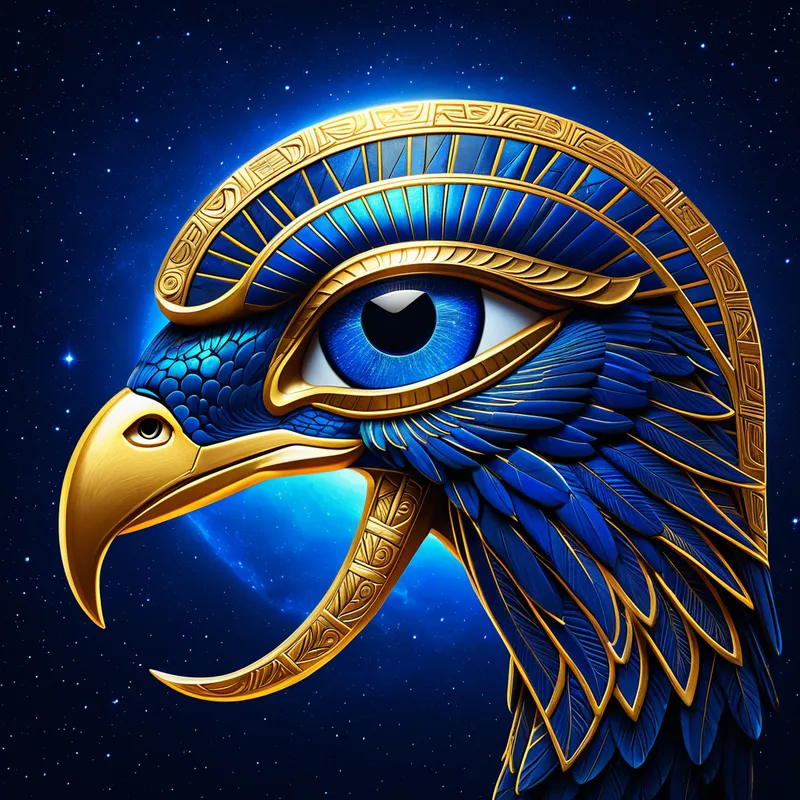
The Eye of Horus Myth Meaning & Symbolism
A myth of cosmic injury and sacred restoration, where a fragmented eye becomes the ultimate symbol of healing, protection, and the price of wholeness.
The Tale of The Eye of Horus
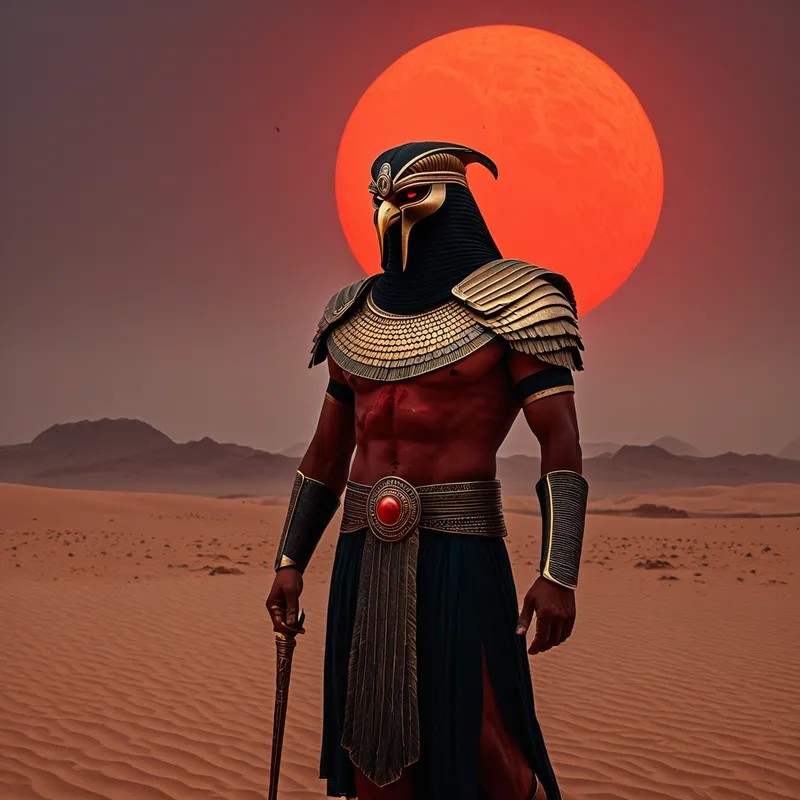
Listen, and let [the sands of time](/myths/the-sands-of-time “Myth from Greek culture.”/) part. In the age when gods walked the black earth of Kemet and [the sky](/myths/the-sky “Myth from Persian culture.”/) was a river of fire, a great shadow fell upon the Two Lands. It was [the shadow](/myths/the-shadow “Myth from Jungian culture.”/) of Set, whose heart was a storm of envy and rage. His brother, [Osiris](/myths/osiris “Myth from Global/Universal culture.”/), the Green Lord, lay dismembered, his reign shattered. But from the mourning of the goddess Isis rose an avenger: her son, [Horus](/myths/horus “Myth from Egyptian culture.”/).
Horus, the Distant One, whose eyes were the sun and moon, took up the mantle of his father. The air crackled with the scent of ozone and myrrh as god faced god in a series of epic duels for the throne. Their battles shook the pillars of the sky and churned the waters of the Nun. But in one ferocious clash, a moment of terrible violence unfolded. Set, in a fit of monstrous fury, reached out and tore the luminous left eye from Horus’s face. Not with a gentle theft, but with a rending that echoed through [the Duat](/myths/the-duat “Myth from Egyptian culture.”/), [the underworld](/myths/the-underworld “Myth from Greek culture.”/).
The eye—the Wedjat—fell to [the desert](/myths/the-desert “Myth from Biblical culture.”/) floor, not as a single orb, but as sixty-four pieces of shattered light. Its radiance dimmed, its power scattered like stars flung from the heavens. Horus roared, a sound of both physical agony and cosmic injustice. [The world](/myths/the-world “Myth from Tarot culture.”/) tilted; [the moon](/myths/the-moon “Myth from Tarot culture.”/), its celestial counterpart, threatened to vanish forever.
Yet, where there is fragmentation, the will to make whole is born. The cunning god [Thoth](/myths/thoth “Myth from Global/Universal culture.”/), he of the ibis head and the silent moon-paths, descended. With fingers that knew the secrets of number and the rhythms of healing, he began the sacred work. Piece by luminous piece, he searched the dunes and [the river](/myths/the-river “Myth from Buddhist culture.”/) reeds. He found the fragment of the eyebrow in the whisper of [the wind](/myths/the-wind “Myth from Various culture.”/), the pupil in the depth of a well, the tear-duct in a drop of morning dew. With incantations older than time itself, he reassembled the eye. He did not merely repair it; he restored it, fortified it, made it more than it was—a vessel of complete and potent magic.
And when the work was done, Thoth presented the restored Wedjat to Horus. The falcon-god, now whole, did not keep it for himself alone. In an act that defined the very principle of divine order, he offered the eye to his father, the resurrected Osiris, in the silent halls of the Duat. This gift was the ultimate sacrifice and the ultimate restoration—it fed Osiris, granted him eternal vitality, and in doing so, cemented the cycle of kingship, sacrifice, and renewal for all time. The eye was healed, and in its healing, it became the healer of worlds.
Cultural Origins & Context
This myth was not merely a story; it was a foundational pillar of Egyptian cosmic and state ideology. It was recited in temple rituals, inscribed on coffin texts, and depicted on amulets placed with the dead. Its primary function was explanatory and protective. It explained the phases of the moon—the periodic weakening and restoration of the lunar eye—and it established [the pharaoh](/myths/the-pharaoh “Myth from Egyptian culture.”/), as the living Horus-on-Earth, as the rightful ruler who had overcome chaos (Set).
The myth’s transmission was both oral, through priestly recitations during festivals like the “Feast of the Beautiful Reunion,” and textual, in funerary works like the Book of the Dead. To wear or inscribe the Eye of Horus was to invoke its power directly—to call upon the forces of healing, protection, and wholeness that Thoth enacted. It was a societal covenant: just as Horus restored order after Osiris’s murder, the [pharaoh](/myths/pharaoh “Myth from Egyptian culture.”/) maintained Maat against the ever-present threat of chaos. The myth thus functioned as a sacred blueprint for the resilience of the state, the cosmos, and the individual soul.
Symbolic Architecture
At its core, the Eye of Horus is a map of [fragmentation](/symbols/fragmentation “Symbol: The experience of breaking apart, losing cohesion, or being separated into pieces. Often represents disintegration of self, relationships, or reality.”/) and sacred recomposition. It is the [archetype](/symbols/archetype “Symbol: A universal, primordial pattern or prototype in the collective unconscious that shapes human experience, behavior, and creative expression.”/) of the wounded [healer](/symbols/healer “Symbol: A figure representing restoration, transformation, and the integration of physical, emotional, or spiritual wounds. Often symbolizes a need for care or a latent ability to mend.”/). Horus is injured in the process of confronting the [shadow](/symbols/shadow “Symbol: The ‘shadow’ embodies the unconscious, repressed aspects of the self and often represents fears or hidden emotions.”/) (Set), and from that very injury, a new, more potent faculty is born.
The eye itself is a [symbol](/symbols/symbol “Symbol: A symbol can represent an idea, concept, or belief, serving as a powerful tool for communication and understanding.”/) of [perception](/symbols/perception “Symbol: The process of becoming aware of something through the senses. In dreams, it often represents how one interprets reality or internal states.”/), but not just physical [sight](/symbols/sight “Symbol: Sight symbolizes perception, awareness, and insight, representing both physical and inner vision.”/). It represents [insight](/symbols/insight “Symbol: A sudden, deep understanding of a complex situation or truth, often arriving unexpectedly and illuminating hidden connections.”/), the all-seeing divine perception that understands the whole by seeing the parts. Its shattering into sixty-four pieces mirrors the fragmentation of [consciousness](/symbols/consciousness “Symbol: Consciousness represents the state of awareness and perception, encompassing thoughts, feelings, and experiences.”/) after [trauma](/symbols/trauma “Symbol: A deeply distressing or disturbing experience that overwhelms the psyche, often manifesting in dreams as unresolved emotional wounds or psychological injury.”/), the diaspora of [the self](/myths/the-self “Myth from Jungian culture.”/). Thoth’s restoration is not a return to a naive, pre-traumatic state. It is an alchemical [synthesis](/symbols/synthesis “Symbol: The process of combining separate elements into a unified whole, representing integration, resolution, and the completion of a personal journey.”/).
The whole that is rebuilt after a shattering is not the same as the whole that existed before. It is wiser, more complex, and carries within it the memory of its own fragmentation.
Mathematically, the fractions of the Eye’s parts (1/2, 1/4, 1/8, 1/16, 1/32, 1/64) were used in ancient measurements, linking the myth to the very fabric of ordered [reality](/symbols/reality “Symbol: Reality signifies the state of existence and perception, often reflecting one’s understanding of truth and life experiences.”/). Psychologically, this represents the process of reintegrating the dissociated parts of the [psyche](/myths/psyche “Myth from Greek culture.”/). Each recovered fragment—a [memory](/symbols/memory “Symbol: Memory symbolizes the past, lessons learned, and the narratives we construct about our identities.”/), an [emotion](/symbols/emotion “Symbol: Emotion symbolizes our inner feelings and responses to experiences, often guiding our actions and choices.”/), a lost potential—adds to a new totality. The final offering of the eye to Osiris symbolizes the ultimate [purpose](/symbols/purpose “Symbol: Purpose signifies direction, meaning, and intention in life, often reflecting personal ambitions and core values.”/) of healing: it is not for selfish wholeness, but to nourish the ancestral, foundational parts of our being (our “inner Osiris”), allowing new [life](/symbols/life “Symbol: The symbol of ‘Life’ represents a journey of growth, interconnectedness, and existential meaning, encompassing both the joys and challenges that define human experience.”/) and wisdom to flow from what was once dead.
The Dreamer’s Resonance
When this myth stirs in the modern unconscious, it often manifests in dreams of damaged or potent eyes. To dream of a shattered mirror, a broken lens, or a blindfold being removed is to touch this archetypal pattern. Somaticly, one might experience tension around the brow or a feeling of pressure behind the eyes upon waking.
Such dreams signal a profound psychological process: [the ego](/myths/the-ego “Myth from Jungian culture.”/) (the conscious “I,” akin to Horus the warrior-king) has engaged in a necessary conflict with an inner shadow (a destructive habit, a repressed rage, a deep betrayal complex) and has been wounded in the process. The dream of fragmentation reflects the feeling of being psychologically pulled apart, of losing a coherent sense of self or vision.
The appearance of a helpful, intellectual, or healing figure (the Thoth archetype) in the dream, or the act of patiently gathering pieces, indicates the psyche’s innate movement toward integration. The dreamer is in the process of Thoth’s work—not yet whole, but actively recovering the scattered faculties of perception and feeling that were lost in the battle. The emotional tone is key: terror in the shattering, followed by a determined, often quiet, focus on reassembly.

Alchemical Translation
For the individual on the path of individuation, the myth of the Eye is a master guide to psychic transmutation. [The first stage](/myths/the-first-stage “Myth from Alchemical culture.”/) is the inevitable and necessary confrontation with Set. This is the encounter with the personal and collective shadow—the aspects of ourselves we deny, which then project outward as chaos, sabotage, and enemy figures. Like Horus, we must engage this force; avoidance only grants it more power.
The shattering of the eye is the deconstruction of our old mode of perception. Our worldview, our self-image, our certainties are broken. This is a dark night of the soul, a feeling of being spiritually blinded. Yet, this is not the end, but the crucial beginning of the alchemical solve (dissolution).
Then enters Thoth-consciousness: the mindful, observing, intellectual, and healing function of the psyche. This is the part of us that can step back from the pain and begin the meticulous work of the coagula (coagulation). It journals, it therapies, it meditates, it analyzes patterns—it “finds the pieces.” This is not an emotional process, but a conscious, patient one of re-membering.
The offering of the restored eye to Osiris is the final, transcendent stage: we dedicate our hard-won wholeness not to the inflation of the ego, but to the service of something greater—the Self. Our healed perception now nourishes our deepest, most foundational being.
The ultimate alchemical product is the Wedjat itself: a consciousness that has been broken and remade. It sees not just outwardly, but inwardly and wholly. It is a perception that protects because it understands vulnerability, that heals because it remembers fracture, and that is whole precisely because it acknowledges its own once-shattered state. We become, in essence, living amulets of our own restoration.
Associated Symbols
Explore related symbols from the CaleaDream lexicon: