The Emerald Tablet of Hermes Trismegistus Myth Meaning & Symbolism
The myth of a divine tablet inscribed with the secret laws of the cosmos, revealing the unity of all things and the path of spiritual transmutation.
The Tale of The Emerald Tablet of Hermes Trismegistus
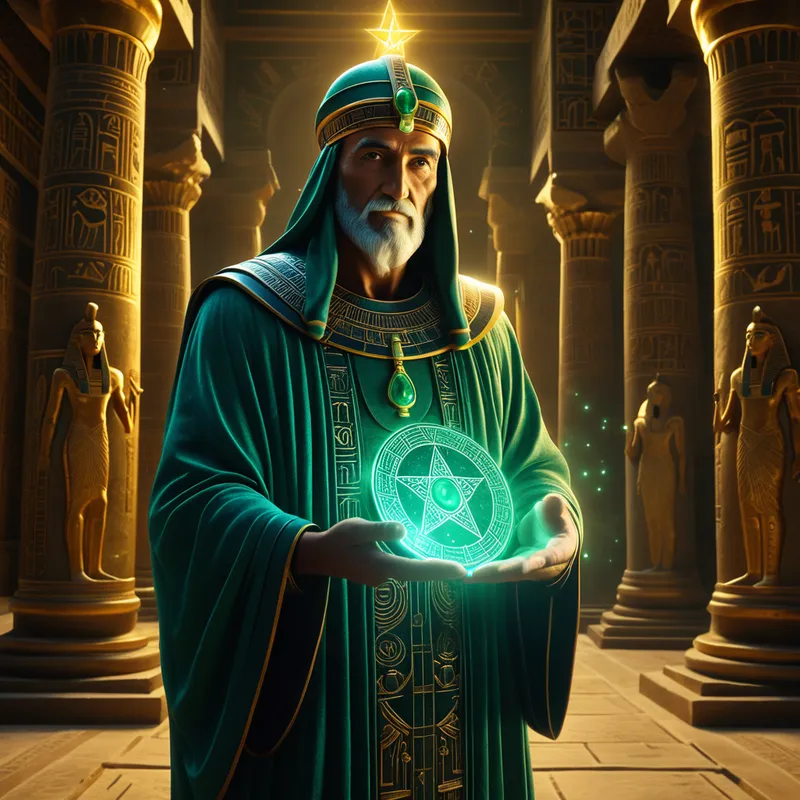
In the time before time was measured, when [the sky](/myths/the-sky “Myth from Persian culture.”/) was a deeper black and the stars spoke in whispers, there walked a being who was threefold great. He was known as [Hermes Trismegistus](/myths/hermes-trismegistus “Myth from Greek culture.”/), the thrice-great, the scribe of the gods, the tongue of the sun. His sandals had trodden the dust of forgotten roads between worlds, and in his heart, he carried the unspoken question that haunts all seekers: What is the thread that binds the dance of the heavens to the turning of [the earth](/myths/the-earth “Myth from Hindu culture.”/), the flight of the soul to the weight of the stone?
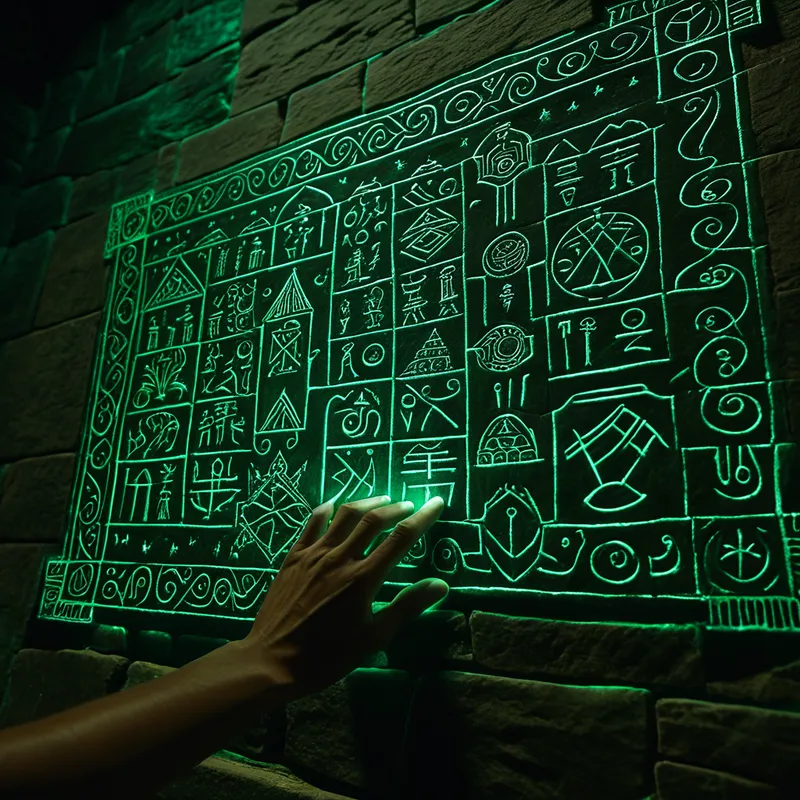
The answer did not come as a voice, but as a pull—a silent call from the very womb of [the world](/myths/the-world “Myth from Tarot culture.”/). It led him down, past the roots of mountains and the silent rivers of [the underworld](/myths/the-underworld “Myth from Greek culture.”/), into a chamber that was not built by hand. The air was thick with the scent of ozone and ancient soil. In the center, resting upon a simple altar of uncut rock, it lay. Not gold, not silver, but a tablet of pure, deep emerald, as if a piece of the living earth’s heart had been cut and polished by eternity itself. Upon its surface, lines of fire seemed to move—not carved, but grown—a script of light that was both geometry and language.
He approached, and the chamber hummed. To touch it was not to feel cold stone, but a vibration that traveled up his arm and settled in his bones. As his fingers traced the first symbol, the walls fell away. He was no longer in a cave, but suspended in the Anima Mundi, [the World Soul](/myths/the-world-soul “Myth from Various culture.”/). He saw the birth of suns in celestial furnaces and the slow, patient crystallization of gems in the dark. He witnessed the descent of spirit into matter, a glorious sacrifice, and the aching longing of matter to remember its spiritual origin. The great secret was not a list of commands, but a living pattern, a single breath held between the words “As Above” and “So Below.” The conflict was the illusion of separation; the resolution was the breathtaking, terrifying truth of unity. He did not read the tablet; it inscribed itself upon him. When the vision faded, and he stood once more in the silent dark, [the emerald](/myths/the-emerald “Myth from Medieval European culture.”/) light was now behind his own eyes. He emerged, not just as a keeper of a secret, but as its living embodiment, tasked not with hiding the truth, but with speaking it in a language the world could slowly, painfully, begin to hear.
Cultural Origins & Context
The myth of [the Emerald Tablet](/myths/the-emerald-tablet “Myth from Hermetic culture.”/) is [the cornerstone](/myths/the-cornerstone “Myth from Biblical culture.”/) of the Hermetic tradition, a syncretic current that emerged in the cultural melting pot of Alexandria between the 1st and 3rd centuries CE. It represents a profound fusion of Greek philosophical thought, particularly Platonism and Stoicism, with Egyptian theological and magical concepts. The figure of [Hermes](/myths/hermes “Myth from Global/Universal culture.”/) Trismegistus himself is a hybrid, merging the Greek god [Hermes](/myths/hermes “Myth from Global/Universal culture.”/) with the Egyptian god of wisdom and writing, [Thoth](/myths/thoth “Myth from Global/Universal culture.”/).
The text of the Tablet itself is famously brief, a cryptic poem that first appears in Arabic sources around the 8th century, though its legendary origins are pushed back to antiquity. It was not a story told in public squares but a secret doctrine passed from teacher to initiate, often written on actual tablets or amulets. Its societal function was esoteric and transformative. It served as a compact manifesto for a worldview that saw the cosmos as an interconnected, living whole, governed by consistent principles that operated from the galactic to the granular. In a world of political upheaval and religious flux, it offered a unifying, intellectual, and spiritual framework for understanding one’s place within a divine, intelligible universe.
Symbolic Architecture
The [Tablet](/symbols/tablet “Symbol: A tablet symbolizes personal connectivity, information access, and the blending of work and play in the digital age.”/) is not merely an object but a symbolic nexus of the Hermetic worldview. The emerald itself is a profound [symbol](/symbols/symbol “Symbol: A symbol can represent an idea, concept, or belief, serving as a powerful tool for communication and understanding.”/). As a green [stone](/symbols/stone “Symbol: In dreams, a stone often symbolizes strength, stability, and permanence, but it may also represent emotional burdens or obstacles that need to be acknowledged and processed.”/), it represents the manifest world, the [kingdom](/symbols/kingdom “Symbol: A kingdom symbolizes authority, belonging, and a sense of identity within a larger context or community.”/) of [life](/symbols/life “Symbol: The symbol of ‘Life’ represents a journey of growth, interconnectedness, and existential meaning, encompassing both the joys and challenges that define human experience.”/) and growth (the Below), yet it is a jewel, hinting at the perfected, crystalline state that matter can achieve through spiritual labor.
The Emerald Tablet is the psyche itself—the dense, opaque material of our being that, when illuminated from within, reveals the universal laws written in our very substance.
The central axiom, “As Above, So Below,” is the myth’s beating [heart](/symbols/heart “Symbol: The heart symbolizes love, emotion, and the core of one’s existence, representing deep connections with others and self.”/). It symbolizes [the principle](/symbols/the-principle “Symbol: A fundamental truth, law, or doctrine that serves as a foundation for a system of belief, behavior, or reasoning, often representing moral or ethical standards.”/) of correspondence: the structures of the [human](/symbols/human “Symbol: The symbol of a human represents individuality, complexity of emotions, and social relationships.”/) mind and [soul](/symbols/soul “Symbol: The soul represents the essence of a person, encompassing their spirit, identity, and connection to the universe.”/) (the [microcosm](/symbols/microcosm “Symbol: A small, self-contained system that mirrors or represents a larger, more complex whole, often reflecting the universe within an individual.”/)) mirror the structures of the [cosmos](/symbols/cosmos “Symbol: The entire universe as an ordered, harmonious system, often representing the totality of existence, spiritual connection, and the unknown.”/) (the [macrocosm](/symbols/macrocosm “Symbol: The universe as a whole, representing the interconnectedness of all existence and the reflection of the individual within the cosmic order.”/)). The myth of its [discovery](/symbols/discovery “Symbol: The act of finding something previously unknown, hidden, or lost, often representing personal growth, new opportunities, or hidden aspects of the self.”/) in a subterranean [chamber](/symbols/chamber “Symbol: A private, enclosed space representing the inner self, hidden aspects, or a specific stage in life’s journey.”/) signifies that this ultimate [truth](/symbols/truth “Symbol: Truth represents authenticity, honesty, and the quest for knowledge beyond mere appearances.”/) is not found in external heavens alone, but by descending into the [interior](/symbols/interior “Symbol: The interior symbolizes one’s inner self, thoughts, and emotions, often reflecting personal growth, vulnerabilities, and secrets.”/), the subconscious, the foundational layers of [reality](/symbols/reality “Symbol: Reality signifies the state of existence and perception, often reflecting one’s understanding of truth and life experiences.”/) and self. Hermes’s [role](/symbols/role “Symbol: The concept of ‘role’ in dreams often reflects one’s identity or how individuals perceive their place within various social structures.”/) as the one who comprehends the tablet symbolizes the awakening of the Self, the organizing center of the [psyche](/myths/psyche “Myth from Greek culture.”/) that can perceive this unity.
The Dreamer’s Resonance
When this myth pattern stirs in the modern dreamer, it often signals a profound encounter with the archetype of foundational truth. To dream of finding a tablet, a stone, or an ancient manuscript inscribed with incomprehensible yet deeply meaningful symbols points to a moment of nascent integration. The dreamer is not just learning a fact; they are being imprinted with a new operating principle for their psyche.
Somatically, this can feel like a deep, resonant vibration—a “knowing in the bones.” Psychologically, it is the process of a core complex or a lifelong [projection](/myths/projection “Myth from Alchemical culture.”/) dissolving, to be replaced by a simpler, more terrifying, and more liberating understanding. The conflict in the dream may be the fear of touching the tablet, or the frustration of being unable to read it. This mirrors [the ego](/myths/the-ego “Myth from Jungian culture.”/)’s resistance to a truth that will necessarily reorganize its entire worldview. The resolution—the moment the light transfers from the tablet to the dreamer—is the moment of insight, where an intellectual concept becomes an embodied, psychological reality.

Alchemical Translation
The myth is a perfect map of the individuation process. The alchemical work is famously summarized in the Tablet’s verses: “It ascends from the earth to the heaven, and again it descends to the earth, and receives [the force](/myths/the-force “Myth from Science Fiction culture.”/) of things superior and inferior.”
The goal of the work is not to escape matter (the Below) nor to worship spirit (the Above) in isolation, but to create the Philosopher’s Stone—the fully integrated psyche—which is the living proof of their inseparable unity.
The initial descent into [the cave](/myths/the-cave “Myth from Platonic culture.”/) is the [nigredo](/myths/nigredo “Myth from Alchemical culture.”/), the confrontation with [the shadow](/myths/the-shadow “Myth from Jungian culture.”/) and the unconscious. The Emerald Tablet represents the hidden [lapis philosophorum](/myths/lapis-philosophorum “Myth from Alchemical culture.”/) already present within that darkness. To “read” it is the albedo, the illumination where the patterns of one’s personal suffering are seen as reflections of universal patterns. The final stage, where Hermes becomes the living embodiment of [the law](/myths/the-law “Myth from Biblical culture.”/), is the [rubedo](/myths/rubedo “Myth from Alchemical culture.”/). Here, the understood truth is incarnated. The modern individual’s “[triumph](/myths/triumph “Myth from Roman culture.”/)” is not in possessing secret knowledge, but in becoming a person whose thoughts, feelings, and actions consistently reflect the realized unity of inner and outer, spirit and matter, Self and world. The struggle is the lifelong labor of making that emerald glow from within.
Associated Symbols
Explore related symbols from the CaleaDream lexicon: