The Emerald Tablet Myth Meaning & Symbolism
A myth of divine revelation where the sage Hermes Trismegistus receives the secret principles of cosmic unity and transformation inscribed upon a tablet of emerald.
The Tale of The Emerald Tablet
Listen, and hear the tale not written on papyrus, but whispered in the spaces between stars and the silence beneath the earth. It begins not with a birth, but with a descent.
In an age when the gods walked closer to men, there lived a being thrice-great: Hermes Trismegistus. His heart was a crucible of divine fire, his mind a mirror to the cosmos. Yet, a profound solitude gripped him—a knowing that the great secret, the single principle that bound the dance of the heavens to the growth of a blade of grass, remained just beyond his grasp. It was a melody heard only in fragments.
Driven by this holy yearning, he left the sun-drenched temples and walked into the mouth of the world. Down he went, through passages worn by time’s slow drip, into the profound dark where the earth remembers its first fire. The air grew thick and silent, a pressure not of stone, but of anticipation. Here, in the ultimate chamber, a tomb older than kingship, he found not bones, but a presence.
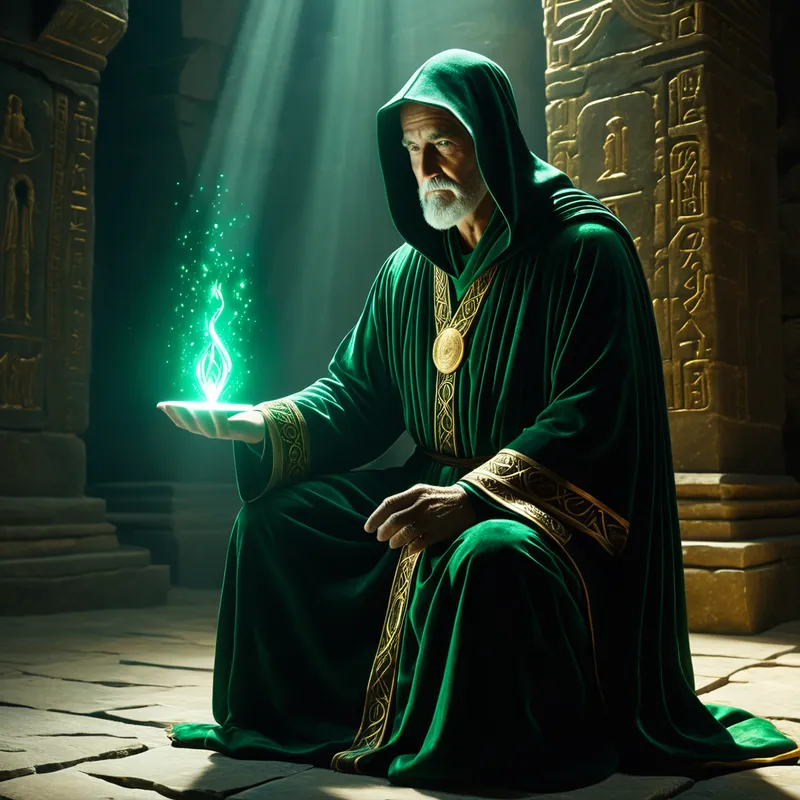
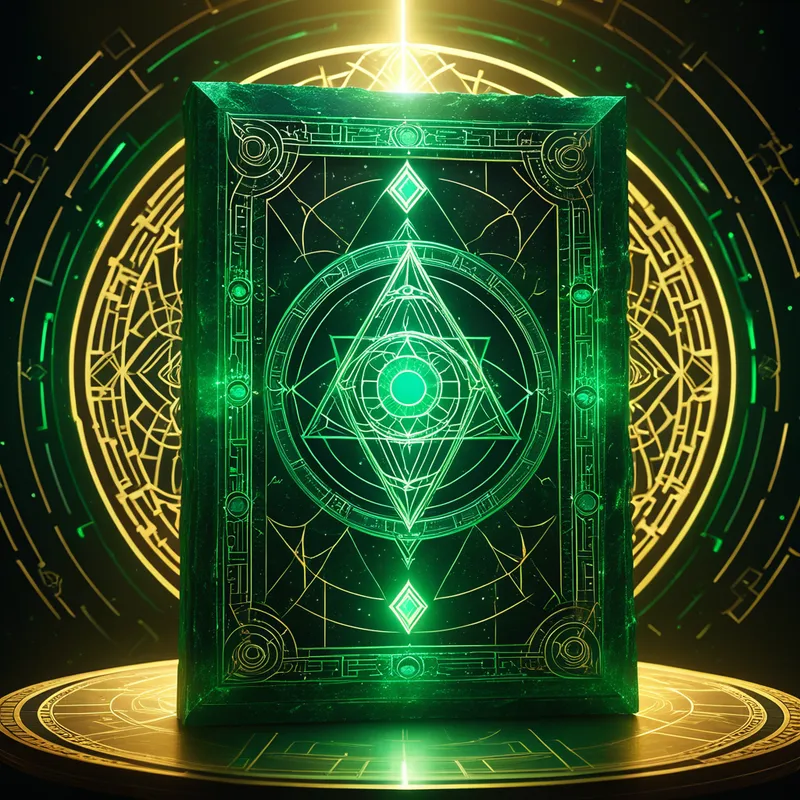
It was not a god who greeted him, but the corpse of one—Thoth himself, or perhaps his echo, preserved in the stillness. In the corpse’s clasped hands, a light pulsed, green and vital as a forest heart. It was a Tablet, hewn from a single, flawless emerald, as if a piece of the firmament had been made solid. The chamber held its breath.
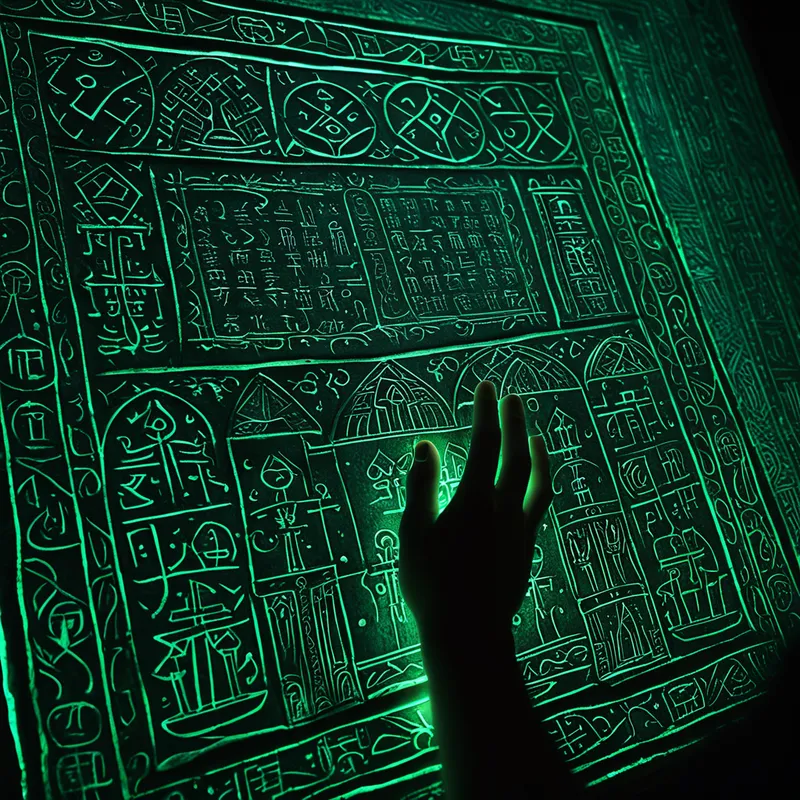
Hermes approached, the weight of epochs upon his shoulders. As his fingers neared the cool, radiant stone, the glyphs upon it—unknown, older than language—awoke. They did not simply shine; they sang. A silent music of geometry and flame poured into him, not through his eyes, but directly into his soul. He saw the great chain of being, from the cold, perfect mind of the One down to the dense, sleeping matter of the world. He saw how spirit crystallized into star, and star into mineral, and mineral into the seed of life. The conflict was not of battle, but of separation—the agony of the All forgetting it was One.
In that timeless moment, the resolution was written upon his very being. The secret was not a thing to be owned, but a relationship to be witnessed: That which is above is as that which is below, and that which is below is as that which is above, for the performance of the miracles of the One Thing. The emerald light filled him, dissolving the last barrier between seeker and secret. He did not take the Tablet; he became its living witness. When he emerged, blinking in the sun, he carried no stone, but the universe, perfectly reflected, in the quiet pool of his understanding.
Cultural Origins & Context
The myth of the Emerald Tablet is the cornerstone of the Hermetic tradition, a current of thought that emerged from the vibrant, syncretic crucible of Hellenistic Egypt. It represents not a single culture’s folklore, but a fusion—a marriage of Egyptian priestly wisdom concerning Thoth, the god of writing and magic, with Greek philosophical rigor embodied by Hermes, the messenger of the gods. From this union sprang the figure of Hermes Trismegistus, the “Thrice-Greatest.”
The tale first surfaces in the early centuries CE within the expansive body of the Hermetica. Its transmission was never for the public square; it was an esoteric treasure, passed from teacher to initiated disciple in the secluded halls of mystery schools or the quiet scriptoria of scholars. Its societal function was profound: it served as both a cosmological map and an initiatory key. It promised that the order of the cosmos was not chaotic but intelligible, and more importantly, that this intelligible order was mirrored within the human soul. To understand the Tablet was to undertake the ultimate journey of return—the opus alchymicum—from the fragmentation of material existence back to the unity of divine mind.
Symbolic Architecture
The myth is a perfect symbolic organism. The Dark Chamber is the unconscious itself, the hidden, foundational layer of reality and psyche where primordial truths lie buried. The corpse of Thoth represents ancient, dormant wisdom—knowledge that must be encountered in its “dead” or latent form before it can be resurrected in the living understanding of the seeker.
The Emerald Tablet is the ultimate symbol of the Prima Materia and the Anima Mundi (World Soul). Emerald, the stone, symbolizes the green life force of nature, the mediating principle between the gold of spirit (the sun) and the material world. The inscribed text is the Logos, the structuring law of the universe made manifest.
The central revelation, “As above, so below,” is the Hermetic axiom of correspondence. It declares that the macrocosm and microcosm are not merely analogous but are in fact a single reality viewed from different perspectives.
Hermes’s journey is the archetypal path of the Senex. His descent is a Nekyia, a deliberate journey into the underworld of the unconscious to retrieve a vital, life-giving truth. He does not conquer, but communes. His triumph is one of recognition, not possession, modeling the shift from ego-driven acquisition to soul-centered integration.
The Dreamer’s Resonance
When this myth stirs in the modern dreamer, it signals a profound call to inner coherence. To dream of finding a glowing tablet, a cryptic manuscript, or a radiant green stone in a basement, cave, or forgotten room is to dream of the emergent Self. The somatic feeling is often one of awe, a hushed and vibrating certainty—a “knowing” that bypasses the intellect.
Psychologically, this is the process of a deep psychic pattern coming to consciousness. The “chamber” is a part of the dreamer’s own psyche, previously walled off. The “script” on the tablet represents a core, organizing truth about one’s own nature that has been waiting to be read. The conflict in the dream may be the anxiety of approach, the fear of what such a totalizing revelation might demand. The resolution is the moment of reading, of understanding—a silent, internal aha! that carries the weight of destiny. It is the unconscious presenting its own constitution, its own law of operation, to the conscious mind, offering the key to personal integration.
Alchemical Translation
The myth of the Emerald Tablet is the ur-narrative of psychic alchemy. It models the entire individuation process. The initial state—Hermes’s yearning solitude—is the nigredo, the blackening, the sense of being lost in multiplicity and separation from one’s essence.
The descent into the tomb is the mortificatio, the symbolic death of the old, fragmented way of knowing. It is the dissolution of ego-certainties to make room for a transpersonal truth. The encounter with the corpse and the Tablet is the sublime coniunctio oppositorum (conjunction of opposites): the meeting of the living seeker and dead wisdom, of conscious mind and unconscious archetype, of human and divine.
The moment of illumination, where the glyphs become understanding, is the albedo, the whitening. It is the washing clean of confusion in the lucid light of a unifying principle. The secret is not a fact, but a relationship—the realization that one’s inner dynamics mirror the dynamics of the cosmos.
Finally, Hermes’s return to the world, transformed, is the rubedo, the reddening or embodiment. The gold of the insight is now carried in the vessel of his life. For the modern individual, this translates to the hard, practical work of living one’s truth. It means organizing one’s life “as below” (in daily actions, relationships, and choices) to reflect the “above” (the integrated Self, the recognized inner law). The Tablet is not kept in a vault; its inscription becomes the guiding principle for creating a life that is, itself, a miracle of the One Thing—a coherent, authentic, and whole expression.
Associated Symbols
Explore related symbols from the CaleaDream lexicon: