The Elder Tree Myth Meaning & Symbolism
A myth of the sacred Elder Mother, whose sacrifice births a tree of healing and wisdom, guarding the threshold between life and death.
The Tale of The Elder Tree
Listen. [The wind](/myths/the-wind “Myth from Various culture.”/) carries a story from a time when [the world](/myths/the-world “Myth from Tarot culture.”/) was younger, and [the veil](/myths/the-veil “Myth from Various culture.”/) between the folk of [the Sidhe](/myths/the-sidhe “Myth from Celtic culture.”/) and the folk of the soil was thin as a [spider](/myths/spider “Myth from Native American culture.”/)’s thread. In the heart of the greenwood, where sunlight fell in dappled pools, there lived not a tree, but a being. She was the Elder Mother. Her form was of [the earth](/myths/the-earth “Myth from Hindu culture.”/) and the air, both woman and woodland, her breath the scent of summer blossoms, her voice the rustle of leaves.
She was the guardian of the in-between places: the hedgerow between field and forest, the dusk between day and night, the quiet moment between breath in and breath out. All who dwelled in the greenwood knew her kindness. The wounded badger would limp to her roots and find solace. The fevered child, brought by a desperate mother, would sleep beneath her boughs and wake cool-browed. Her power was not of dominion, but of nurture; a deep, abiding care for the fragile web of life.
But a shadow grew. A blight, silent and grey, began to creep from the northern marshes. It was not a beast to be fought, but a withering, a forgetting. It stole the green from the grass, the song from the birds, the warmth from the sun. It was the chill of indifference, the rot of separation. The people grew fearful, and the land grew silent. The [Otherworld](/myths/otherworld “Myth from Celtic culture.”/) itself seemed to retreat, its music fading.
[The Elder Mother](/myths/the-elder-mother “Myth from Celtic culture.”/) felt the land’s pain as her own. She saw the connections fraying, the sacred web tearing. Counsel with the spirits of oak and [hawthorn](/myths/hawthorn “Myth from Celtic culture.”/) brought no answer; their strength was for endurance, not for this subtle unmaking. The solution, she knew in her heartwood, would not come from battle, but from a deeper sacrifice. It would require a gift that was also a becoming.
On the night of the dark moon, when the world held its breath, she walked to the most barren, blighted patch of earth at the forest’s edge. There, she did not chant a spell or call upon greater powers. Instead, she knelt. With a touch as gentle as a falling petal, she pressed her own essence—a seed formed of her life-force, her memory, her very identity as the guardian spirit—into the cold, unyielding ground.
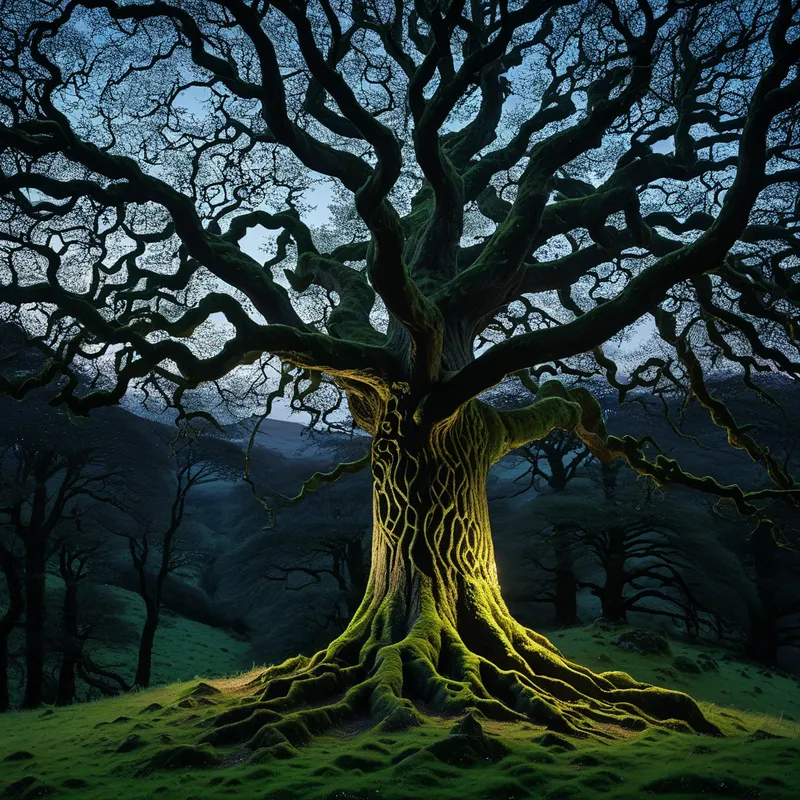
As she did so, her form began to change. Her limbs stretched and hardened, her skin became bark, her flowing hair became clusters of tiny, star-like flowers. She was not dying, but translating. Her conscious care, her mobile guardianship, was being rooted. She became the tree. From that seed, a swift and mighty growth surged: a gnarled, generous elder tree, its trunk thick with wisdom, its branches offering creamy blossoms and clusters of dark, blood-rich berries. Where its roots touched, the blight receded, not by force, but by a resonant, healing presence. The tree now stood as a permanent threshold, its roots in [the underworld](/myths/the-underworld “Myth from Greek culture.”/), its branches in the heavens, its trunk in our world—a living bridge of compassion. To ask for its aid, one must now whisper a request and give a promise in return, for the sacred is in the exchange.
Cultural Origins & Context
The figure of the Elder Mother or the sacred elder is a persistent strand in the folklore of Ireland, Scotland, Wales, and other Celtic regions. This myth, as recounted here, is a synthesis of core folk beliefs, not a single canonical text. It was passed down through the oral tradition, told by bards and grandmothers alike by the hearthside. Its societal function was multifaceted: it was a etiological tale for the elder tree’s medicinal properties, a behavioral guide instilling respect for nature, and a theological narrative about the immanence of the divine in the landscape.
The elder was considered one of the most sacred trees, a direct embodiment of a protective goddess. To cut one down without permission or proper offering was to invite the wrath of the spirit within. This belief enforced conservation and a relational ethics with the natural world. The myth served as a reminder that the land was not inert matter, but a living, sentient entity with which humanity was in a constant, reciprocal relationship. The story encoded a deep ecological and psychological principle: true healing and stability come not from extraction, but from rooted, sacrificial belonging.
Symbolic Architecture
At its [heart](/symbols/heart “Symbol: The heart symbolizes love, emotion, and the core of one’s existence, representing deep connections with others and self.”/), this is a myth of the Sacred Feminine in its most grounded, transformative [aspect](/symbols/aspect “Symbol: A distinct feature, quality, or perspective of something, often representing a partial view of a larger whole.”/). The Elder [Mother](/symbols/mother “Symbol: The symbol of ‘Mother’ represents nurturing, protection, and the foundational aspect of one’s emotional being, often associated with comfort and unconditional love.”/) is not a [warrior](/symbols/warrior “Symbol: A spiritual archetype representing inner strength, discipline, and the struggle for higher purpose or self-mastery.”/) [goddess](/symbols/goddess “Symbol: The goddess symbolizes feminine power, divinity, and the nurturing aspects of life, embodying creation and wisdom.”/) or a distant [queen](/symbols/queen “Symbol: A queen represents authority, power, nurturing, and femininity, often embodying leadership and responsibility.”/), but a localized, accessible deity of care. Her sacrifice represents the ultimate act of nurturing: the giving of one’s own form to become the [source](/symbols/source “Symbol: The origin point of something, often representing beginnings, nourishment, or the fundamental cause behind phenomena.”/) of sustenance and protection for others.
The most profound healing often requires the healer to become the medicine, to surrender their form to serve the function.
The [tree](/symbols/tree “Symbol: In dreams, the tree often symbolizes growth, stability, and the interconnectedness of life.”/) itself is a perfect [symbol](/symbols/symbol “Symbol: A symbol can represent an idea, concept, or belief, serving as a powerful tool for communication and understanding.”/) of the [axis](/symbols/axis “Symbol: A central line or principle around which things revolve, representing stability, orientation, and the fundamental structure of reality or consciousness.”/) mundi. Its three parts—roots ([underworld](/symbols/underworld “Symbol: A symbolic journey into the unconscious, representing exploration of hidden aspects of self, transformation, or confronting repressed material.”/)/past/unconscious), [trunk](/symbols/trunk “Symbol: The trunk in dreams typically denotes the core structure or foundation of one’s identity, values, or beliefs.”/) (middle world/present/ego), and branches/berries (upper world/future/[spirit](/symbols/spirit “Symbol: Spirit symbolizes the essence of life, vitality, and the spiritual journey of the individual.”/))—model an integrated [psyche](/myths/psyche “Myth from Greek culture.”/). The [blight](/symbols/blight “Symbol: A pervasive, destructive force that withers life, hope, or potential. Often represents decay, corruption, or systemic failure.”/) symbolizes psychic stagnation, depression, or the “coldness” that comes from disconnection—from [community](/symbols/community “Symbol: Community in dreams symbolizes connection, support, and the need for belonging.”/), [nature](/symbols/nature “Symbol: Nature symbolizes growth, connectivity, and the primal forces of existence.”/), and the unconscious. The Elder Mother’s transformation is the archetypal [pattern](/symbols/pattern “Symbol: A ‘Pattern’ in dreams often signifies the underlying structure of experiences and thoughts, representing both order and the repetitiveness of life’s situations.”/) of turning passive suffering into active, rooted wisdom.
The berries and flowers hold the core [alchemy](/symbols/alchemy “Symbol: A transformative process of purification and creation, often symbolizing personal or spiritual evolution through difficult stages.”/): white blossoms (purity, spirit, potential) and dark berries ([blood](/symbols/blood “Symbol: Blood often symbolizes life force, vitality, and deep emotional connections, but it can also evoke themes of sacrifice, trauma, and mortality.”/), [earth](/symbols/earth “Symbol: The symbol of Earth often represents grounding, stability, and the physical realm, embodying a connection to nature and the innate support it provides.”/), manifestation). The tree holds the [tension](/symbols/tension “Symbol: A state of mental or emotional strain, often manifesting physically as tightness, pressure, or unease, signaling unresolved conflict or anticipation.”/) of these opposites, producing a [medicine](/symbols/medicine “Symbol: Medicine symbolizes healing, transformation, and the pursuit of knowledge, addressing both physical and spiritual health.”/) that is both prophylactic and curative. This symbolizes the psyche’s [ability](/symbols/ability “Symbol: In dreams, ‘ability’ often denotes a recognition of skills or potential that one possesses, whether acknowledged or suppressed.”/) to hold contradiction and generate wholeness from it.

The Dreamer’s Resonance
When the motif of the Elder Tree appears in modern dreams, it often signals a profound process of psychic grounding and the integration of the caregiver archetype. The dreamer may be experiencing a period of burnout, feeling like an endless resource for others while their own roots feel shallow. The dream presents the tree as an image of sustainable nurture.
To dream of cutting down an elder tree suggests a fear of or resistance to this deep grounding process, perhaps an avoidance of necessary, albeit painful, responsibility or connection. To dream of hiding or taking shelter within its hollow trunk points to a need for sanctuary and a return to a primal, nourishing source—a retreat to heal before re-engagement.
Somatically, this dream pattern can coincide with feelings of heaviness in the legs and feet (the rooting process) or a tightness in the chest and shoulders (the burden of care seeking a new, structural form). The psyche is modeling a shift from a pattern of mobile, perhaps scattered, caregiving to one of centered, resilient, and cyclical giving-and-receiving. It asks the dreamer: What in your life requires you to become the structure of your own healing, rather than just seeking a cure?

Alchemical Translation
The alchemical journey mirrored in this myth is the opus of [nigredo](/myths/nigredo “Myth from Alchemical culture.”/) leading to a generative albedo. The blight is [the nigredo](/myths/the-nigredo “Myth from Alchemical culture.”/)—the depression, the coldness, the sense of life losing its meaning and vitality. The Elder Mother does not flee this darkness; she turns and faces it, kneeling in the barren soil. This is the crucial first step in individuation: confronting the desolate place within.
Her sacrifice is the alchemical solve (dissolution). She dissolves her previous, mobile identity. This is not annihilation, but the breaking down of an old form so a new, more enduring one can coalesce. The act of planting her essence is the coagula (coagulation). The new form—the tree—is the result. It represents the birth of a psychic structure born of compassion.
Individuation is not about becoming a isolated self, but about becoming a more complex, rooted, and interconnected node in the web of life.
For the modern individual, this translates to the process of transforming personal suffering or a caregiver’s fatigue into a lasting, structured part of one’s identity. It is the difference between feeling empathetic and building a life or practice that embodies that empathy in a sustainable way. The myth teaches that our greatest wounds, when consciously and sacrificially engaged, can become the very roots of our wisdom and our capacity to hold space for others. We are asked to move from being a passing helper to becoming a living sanctuary—firmly rooted, openly giving, and cyclically renewed by the deep earth of our own being.
Associated Symbols
Explore related symbols from the CaleaDream lexicon: