The Elder Mother Myth Meaning & Symbolism
A forgotten goddess of the elder tree demands respect, teaching that true healing comes from honoring the sacredness of the wild and the old.
The Tale of The Elder Mother
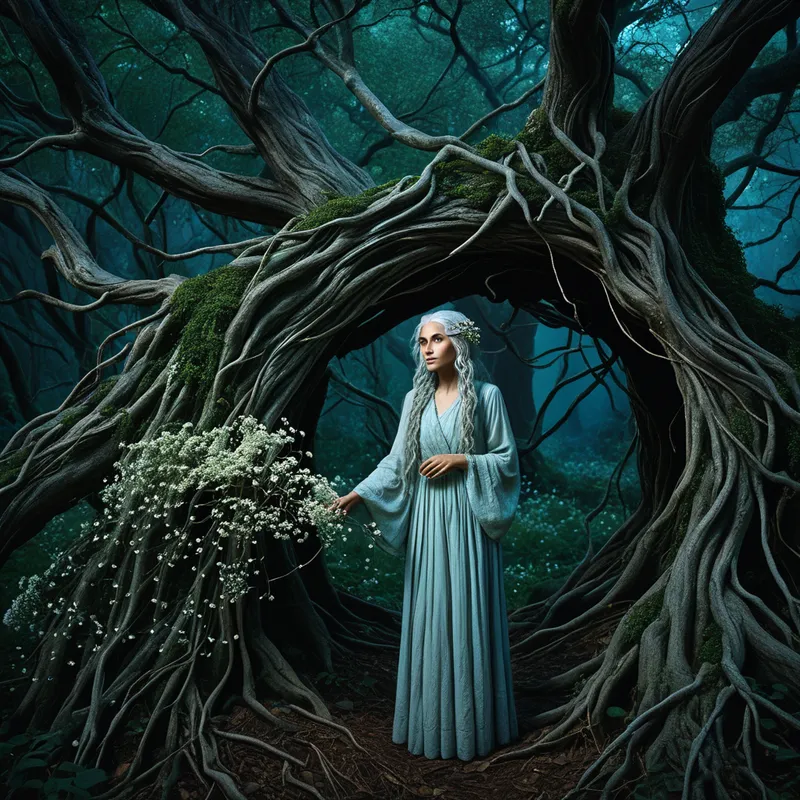
Listen. [The wind](/myths/the-wind “Myth from Various culture.”/) in the branches is not just wind. In the deep green heart of the forest, where the light falls in dappled pools and the air smells of damp earth and decay, there grows a tree. Not the mighty oak, king of the woods, nor the sacred [hawthorn](/myths/hawthorn “Myth from Celtic culture.”/) of the faeries. This is the elder, twisted and humble, its branches brittle, its flowers a froth of summer cream. To the careless eye, it is a weed-tree, good only for firewood or the ditch. But to those who remember, it is a threshold. And at that threshold sits She.
They called her the Elder Mother, the Cailleach of the elder grove. Her breath was the scent of the blossoms, sweet and faintly narcotic. Her bones were the grey wood beneath the bark. Her anger was the quick, purple rot that could take a man’s leg if he insulted her. A pact, old as the first clearing, bound her to the people: take what you need, but ask. Always ask.
There was a man, a woodcutter, whose heart was hardened by a long winter and a crying child. His infant son lay feverish in their wattle hut, burning from within. The healer had spoken of the elder—its inner bark for fever, its flowers for the cough. Desperate, the man went to the grove at twilight, the time of between. He saw not a goddess, but only wood. His axe was sharp, his prayer a muttered [thing](/myths/thing “Myth from Norse culture.”/).
He did not ask.
The blade bit into the trunk of the finest tree. A sound like a sigh, then a scream, tore through the silent wood. Not from the tree, but from [the earth](/myths/the-earth “Myth from Hindu culture.”/) itself. The axe stuck fast. From the wound, not sap, but a dark, honey-thick substance welled. The air grew cold. And from the hollow of the neighboring elder stepped a woman. She was tall, her hair the color of ash and moonlight, her eyes deep pools of forest shadow. In her hand, she held a branch, one end bursting with flower, the other blackened and dead.
“You take the blood of my body without word,” her voice was the rustle of a million leaves. “You forget the pact. You forget me.”
The woodcutter fell to his knees, his bravado gone, replaced by a terror colder than the grave. He stammered of his child, of his fear.
The Elder Mother looked through him, to [the hearth](/myths/the-hearth “Myth from Norse culture.”/)-smoke of his distant home. “Your fear is a blade that cuts both ways. You wish to heal with a hand that harms. [The child](/myths/the-child “Myth from Alchemy culture.”/)’s fate is now tied to the tree’s.”
She pointed her withering branch at him. “You will make right what you have made wrong. From this wounded tree, you will carve a cradle. Not with haste, but with reverence. You will speak its name with every cut. You will line it with the down of [the thistle](/myths/the-thistle “Myth from Celtic/Scottish culture.”/) and the moss from its north side. And when the new moon hangs her sliver in [the sky](/myths/the-sky “Myth from Persian culture.”/), you will place your child within it, under my boughs.”
The man, trembling, obeyed. For days he worked, his tools moving slowly, his lips forming the old names he’d heard his grandmother whisper. He carved not just wood, but a plea. On the night of the dark moon, he carried the pale cradle into the grove, his son a tiny, fevered weight within it. He placed it in the hollow of the wounded tree.
He waited through the long night. At times, he heard a lullaby on the breeze, a song without words. He saw the faint glow of will-o’-the-wisps dancing around the elder’s crown. Just before dawn, a profound silence fell. The Elder Mother stood by the cradle. She placed a single, perfect elderberry on the infant’s tongue.
“The fever is given to the earth,” she said, her voice softer now. “The child is returned to you. Remember: the healer and the harm live in the same root. To know one, you must respect the other. Go. And tell your people the Elder Mother remembers, even when they forget.”
The man took up his child, now cool and sleeping peacefully. The cradle remained, a part of the tree once more. And from that day, no one in that village ever took from the elder without a whispered request and a promise left in its place—a strand of hair, a drop of milk, a word of thanks.
Cultural Origins & Context
The figure of the Elder Mother is not found in the grand Ulster Cycle or the Welsh Mabinogion. Her domain is humbler, deeper, and older. She belongs to the stratum of belief scholars call folk tradition or Fairy Faith, the living, breathing mythology of the hearth and [the hedge](/myths/the-hedge “Myth from Folklore culture.”/), passed down through generations not by bards in halls, but by grandmothers by the fire. This is the animistic heart of the Celtic world-view, where every stream, stone, and tree possesses a numen, a conscious presence.
[The elder tree](/myths/the-elder-tree “Myth from Celtic culture.”/) (Sambucus nigra) was a pharmacy, a workshop, and a sacred site. Its wood was used for toys and musical instruments (but never for burning, lest you invite the Mother’s wrath), its flowers and berries for medicine, its hollow stems for bellows and pipes. This profound utility bred a profound taboo. To cut it without permission was to risk misfortune, illness, or the haunting of the Elder Mother herself. The myth served a critical societal function: it encoded ecological wisdom and sustainable practice into a compelling, fear-and-reverence-based narrative. It taught respect for the resources that sustained life, personifying the consequence of exploitation as a direct, supernatural retribution.
Symbolic Architecture
At its core, the myth is a profound [lesson](/symbols/lesson “Symbol: A lesson in a dream signifies a learning opportunity, often reflecting personal growth or unresolved issues requiring attention.”/) in [relationship](/symbols/relationship “Symbol: A representation of connections we have with others in our lives, often reflecting our emotional state.”/) and the consequences of a fractured cosmic pact. The Elder [Mother](/symbols/mother “Symbol: The symbol of ‘Mother’ represents nurturing, protection, and the foundational aspect of one’s emotional being, often associated with comfort and unconditional love.”/) is not a distant Olympian deity but an immanent [spirit](/symbols/spirit “Symbol: Spirit symbolizes the essence of life, vitality, and the spiritual journey of the individual.”/), the [soul](/symbols/soul “Symbol: The soul represents the essence of a person, encompassing their spirit, identity, and connection to the universe.”/) of the natural world made conscious and vocal.
The sacred is not separate; it is the neglected intelligence of the very matter we use and inhabit. To forget this is to make the world a corpse and ourselves its lonely parasites.
The woodcutter represents the utilitarian, dissociated ego—the part of humanity that sees [the world](/myths/the-world “Myth from Tarot culture.”/) as resource alone, stripping it of spirit in the name of need. His sick [child](/symbols/child “Symbol: The child symbolizes innocence, vulnerability, and potential growth, often representing the dreamer’s inner child or unresolved issues from childhood.”/) symbolizes the inevitable consequence of this [dissociation](/symbols/dissociation “Symbol: A psychological separation from one’s thoughts, feelings, or identity, often experienced as a journey away from the self during trauma or stress.”/): a sickness of the soul, the “[fever](/symbols/fever “Symbol: A heightened bodily state often symbolizing emotional intensity, transformation, or internal conflict.”/)” of disconnection that afflicts the next generation. The wound in the [tree](/symbols/tree “Symbol: In dreams, the tree often symbolizes growth, stability, and the interconnectedness of life.”/) is a mirror of the wound in the relationship.
The prescribed remedy—carving a cradle from the wounded tree—is an act of profound symbolic restitution. It transforms an act of taking (firewood) into an act of holding (a cradle). He must use the violated [body](/symbols/body “Symbol: The body in dreams often symbolizes the dreamer’s self-identity, personal health, and the relationship they have with their physical existence.”/) to create a [vessel](/symbols/vessel “Symbol: A container or structure that holds, transports, or protects something essential, representing the self, emotions, or life journey.”/) of protection, forcing a conscious, slow, and respectful re-engagement with the spirit he offended. The cradle becomes a [temenos](/myths/temenos “Myth from Greek culture.”/), a sacred [space](/symbols/space “Symbol: Dreaming of ‘Space’ often symbolizes the vastness of potential, personal freedom, or feelings of isolation and exploration in one’s life.”/) where the sickness (the fever) can be transferred back to its [source](/symbols/source “Symbol: The origin point of something, often representing beginnings, nourishment, or the fundamental cause behind phenomena.”/) (the [earth](/symbols/earth “Symbol: The symbol of Earth often represents grounding, stability, and the physical realm, embodying a connection to nature and the innate support it provides.”/)/the Mother) for [transmutation](/symbols/transmutation “Symbol: A profound, alchemical process of fundamental change where one substance or state transforms into another, often representing spiritual evolution or personal metamorphosis.”/).
The Dreamer’s Resonance
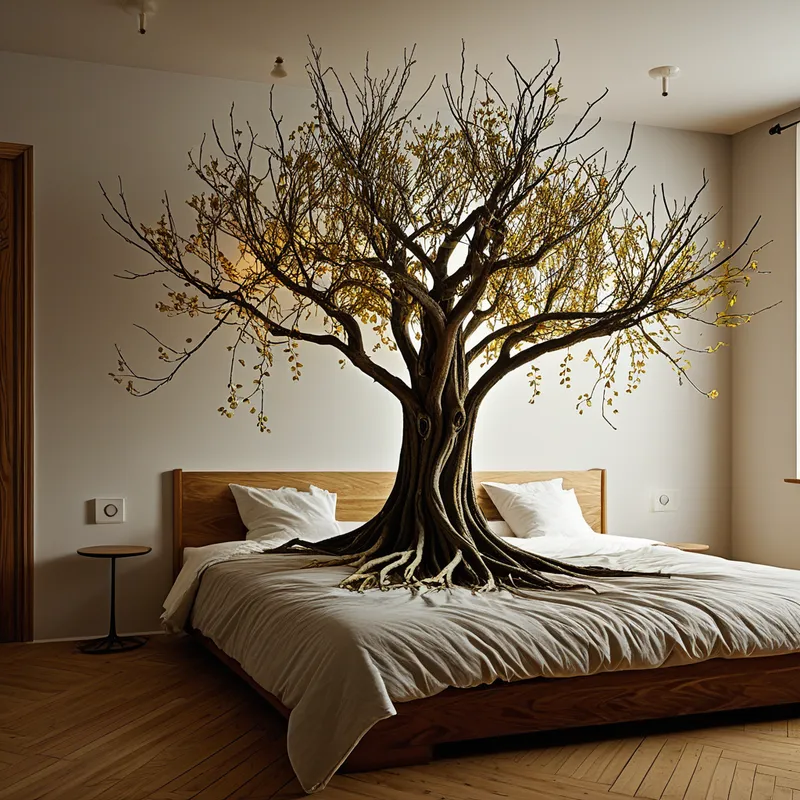
When this myth stirs in the modern unconscious, it rarely appears as a literal goddess in a forest. Instead, it manifests as a pattern of dream logic. You may dream of a neglected houseplant that, when you finally go to [water](/myths/water “Myth from Chinese culture.”/) it, has grown through the floorboards into a massive, threatening tree. You might dream of hastily taking medication without reading the instructions, only for the pills to transform into insects in your hand. The somatic feeling is one of uneasy guilt—a sense of having broken a rule you didn’t know existed, of having taken a shortcut that has led you profoundly astray.
Psychologically, this signals a confrontation with the neglected pact. The dreamer is being shown where they have been in relationship with something—a person, their own body, their creative work, the natural world—in a purely transactional, disrespectful way. The “fever” in the dream is the symptom of that fractured relationship: burnout, creative block, chronic anxiety, or a feeling of existential emptiness. The Elder Mother archetype emerges to enforce the boundary and dictate the terms of healing, which always involve a slow, deliberate, and humble act of repair.
Alchemical Translation
The myth’s structure is a perfect map for the individuation process, specifically the stage of making amends with the Shadow and the Anima (as the connecting function to the deep, instinctual world).
The initial state is dissociation (the unthinking woodcutter). The crisis is enforced awareness (the Mother’s appearance, the stuck axe)—the shocking realization that one’s actions have severed a vital connection. The alchemical work is [the opus](/myths/the-opus “Myth from Alchemical culture.”/) contra naturam: the work against one’s own careless nature. It is not a grand quest, but a prescribed, humble task.
The transformation of leaden guilt into golden responsibility does not happen through grand insight, but through the meticulous, repetitive carving of a new container for the soul.
Carving the cradle is the disciplined, daily work of therapy, journaling, or mindful practice—the slow re-shaping of one’s habits of engagement. Placing the “child” (one’s vulnerable, suffering self) into this new container under the gaze of the Mother is the act of surrendering the symptom to a process larger than [the ego](/myths/the-ego “Myth from Jungian culture.”/). The healing berry is the symbol of the unexpected grace that comes only after the hard work of restitution is done. The final lesson is the establishment of a new, conscious pact: one does not “conquer” the unconscious or “use” one’s inner resources without acknowledgment. One relates. One asks. One gives thanks. The Elder Mother myth, therefore, is an eternal reminder that wholeness is not a state of possession, but a quality of sacred relationship.
Associated Symbols
Explore related symbols from the CaleaDream lexicon: