The Einherjar Myth Meaning & Symbolism
The chosen slain warriors who feast and fight daily in Odin's hall, preparing for the final battle at the world's end.
The Tale of The Einherjar
Listen. The wind does not just blow across the frozen fjords; it carries a whisper of iron and ash. The raven’s cry is not mere noise, but a summons. For in the hall of the slain, a feast is being prepared, and the guests are forever arriving.
Picture the battlefield at day’s end. The sun, a bloody eye, sinks behind the hills. The air is thick with the salt-tang of blood and the cold scent of wet earth. Among the tangled dead, one warrior breathes his last. His shield is splintered, his ørlog spent. But as the light fades from his eyes, he does not hear the weeping of carrion birds. He hears the thunder of hooves that do not touch the earth.
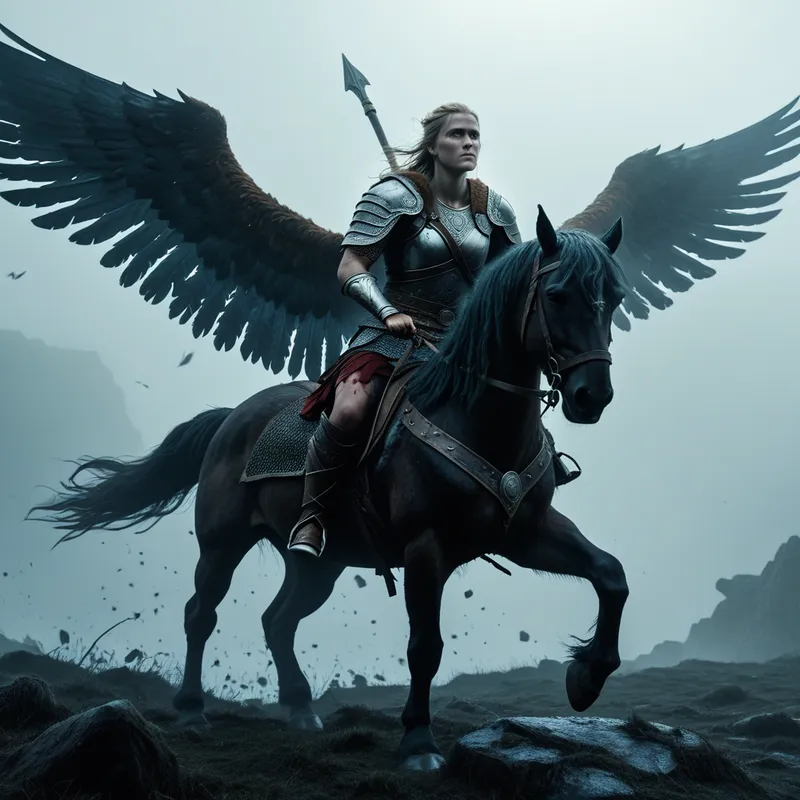
She descends like a storm made flesh—a Valkyrie. Her armor gleams with the cold light of stars not yet born. Her face is the stillness between heartbeats. Without a word, she lifts him from the mire. The world dissolves into a roar of wind and the dizzying rush of the Oskorei across the storm-racked sky. They ride the Bifröst, not as a gentle arch, but as a spear of shattered light hurled towards the home of the gods.
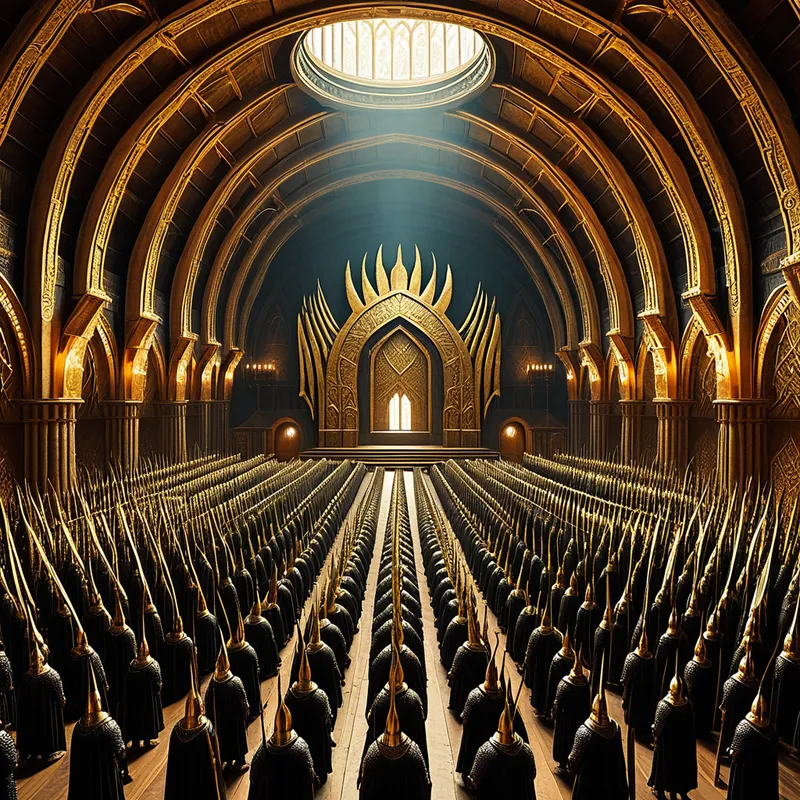
And then, a hall. Not a hall as men know it, but the Hall. Valhalla. Its gates tower, wide enough for eight hundred warriors to march abreast. Its rafters are spears, its roof thatched with shining shields. Within, the sound is a living thing—the roar of a thousand fires, the clash of friendly blades, the deep-throated laughter of men who have stared into the gullet of the wolf and laughed back.
At the high seat sits the One-Eyed God, Odin. His single eye holds the wisdom of the well and the hunger of the hunter. He nods, and the newly arrived warrior—now an Einherjar—is welcomed. His wounds vanish. He is given arms and armor that fit his spirit as much as his body.
Here, the day has one rhythm: glorious strife and glorious rest. Each dawn, the Einherjar don their war-gear and stride onto the vast field before the hall. They fight, they clash, they fall. But with each “death,” their wounds heal, and they rise whole again. It is a battle without end, without rancor, a whetting of the soul’s edge. And when the sun sinks, they return to Valhalla. The great boar Sæhrímnir is slaughtered and reborn in the cauldron Eldhrímnir. Mead flows from the udder of the goat Heiðrún. They feast, they boast, they listen to the tales of skalds and the wisdom of the god.
They wait. They train. They feast. They wait. For they all know the final verse of the song. They are being made ready, honed to a single, perfect purpose. When the watchman Gullinkambi crows, when the great wolf Fenrir breaks his bonds, and the world-tree Yggdrasil trembles to its roots, the doors of Valhalla will swing open one last time. Then, the Einherjar will march out, not to practice, but to fulfill their destiny. They will fight at the side of the gods in the twilight of all things, in the battle where even victory is a kind of ending. This is their story—a tale not of rest, but of relentless, sacred preparation.
Cultural Origins & Context
The myth of the Einherjar is preserved primarily in the Poetic Edda, particularly in the Grímnismál and Vafþrúðnismál, and in the later prose Prose Edda of Snorri Sturluson. It was not a mere bedtime story, but a central pillar of the Norse warrior ethos, transmitted by skalds in the halls of chieftains and kings. Its societal function was profound and multifaceted.
For the warrior class, it provided a theological framework for a life—and more importantly, a death—lived by the sword. It transformed the chaotic terror of the battlefield into a sacred selection process. To die bravely was not a final defeat, but a potential promotion to the divine retinue of the All-Father. This belief directly influenced concepts of honor, courage, and the disdain for a “straw death” (dying in bed of old age). The myth served as both comfort and incentive, framing the ultimate sacrifice as the beginning of a greater, more glorious duty.
Furthermore, it reinforced the social contract of the symbel. The endless feasting and drinking in Valhalla mirrored the ideal hall culture on earth, where loyalty was forged over shared meat and mead. The Einherjar were the ultimate warband, bound not by petty tribal loyalties but by a cosmic purpose, modeling the ideal of comradery for mortal warriors. The myth thus wove together personal fate, social structure, and cosmic destiny into a single, compelling narrative.
Symbolic Architecture
Beneath the epic imagery lies a profound symbolic architecture. The Einherjar represent the human capacity for conscious preparation for an inevitable, transformative crisis. They are not merely soldiers; they are souls in a state of perpetual, purposeful becoming.
The Einherjar embody the paradox of the warrior who must die to his old self to be reborn into a state of eternal readiness. Their daily battle is the alchemy of experience, where each “defeat” forges greater resilience.
Valhalla itself is a symbol of the temenos, a sacred, bounded space of initiation and transformation. It is not a paradise of rest, but a rigorous training ground for the psyche. The daily cycle of combat and feasting symbolizes the essential rhythm of exertion and integration. We fight (engage with challenge), we “die” to our current limitations, we are restored (integrate the lesson), and we feast (receive nourishment and community). This is a blueprint for profound psychological development.
Odin’s role is crucial. He is not a distant king but an active participant, the “Chooser of the Slain.” He represents the discerning, often ruthless, aspect of the Self that selects which parts of our personality—which battles, which sacrifices—are worthy of being integrated into our higher purpose. The Valkyrie is his agent, symbolizing the sudden, fateful moment of insight or crisis that “selects” us, wrenching us from the familiar battlefield of our daily struggles into a higher order of meaning.
The Dreamer’s Resonance
When this myth stirs in the modern unconscious, it rarely appears as Vikings and mead halls. Its pattern manifests in dreams of intense preparation for an undefined, looming event. You may dream of being in a vast, impersonal training facility, studying for an exam whose subject you don’t know, or endlessly rehearsing a performance for an audience that never arrives.
The somatic feeling is one of charged waiting—a mix of anxiety, purpose, and restless energy. This dream pattern signals that the psyche is in a state of gathering and honing. You are, perhaps unconsciously, assimilating experiences, skills, and hard-won lessons from past “battles” (failed projects, ended relationships, personal losses). The dream asks: What are you preparing for? What is the “Ragnarok” of your own life—the inevitable confrontation with age, a deep-seated fear, or a calling that demands your all?
Dreams of this cycle can also highlight an imbalance. Are you only fighting, never feasting—all work, no integration? Or are you only feasting, avoiding the necessary daily “battle” of growth? The Einherjar myth in dreams calls for a conscious recognition of this sacred rhythm of effort and renewal.
Alchemical Translation
For the modern individual, the path of the Einherjar is a powerful model for the Jungian process of individuation—the psychic transmutation of the base metal of the ego into the gold of the Self. It is the archetype of the Hero engaged in the ultimate inner work: not a single quest, but a lifelong discipline of readiness.
The first alchemical stage is the selection by the Valkyrie: the often-painful crisis that forces a “death” of an old identity, attitude, or life structure. This could be a burnout, a profound loss, or a sudden awakening. It feels like being chosen by a merciless grace.
The hall of Valhalla is the vessel of the individuating psyche. Within it, the conflicts of our inner opposites—aggression and compassion, courage and fear—are engaged daily, not to destroy one another, but to strengthen the whole being.
The daily battle is the practice of shadow integration. We consciously engage with our inner conflicts, our repressed weaknesses and strengths, allowing them to “fight” within the safe container of self-awareness. Each time we confront a fear, acknowledge a flaw, or own a hidden power, we “die” to a narrower self and are restored more whole. The feast that follows is self-acceptance and nourishment—the joy and vitality that come from this ongoing work.
The final march at Ragnarok translates as the conscious confrontation with one’s ultimate destiny or mortality. The individuated person does not avoid this existential battle. Having trained a lifetime in inner honesty and courage, they meet it with a readiness forged in the daily fires of self-knowledge. The triumph is not in “winning” in a conventional sense, but in facing the end—of a phase, a relationship, or life itself—with the full integrity of a spirit that has been diligently, sacredly prepared.
Associated Symbols
Explore related symbols from the CaleaDream lexicon: