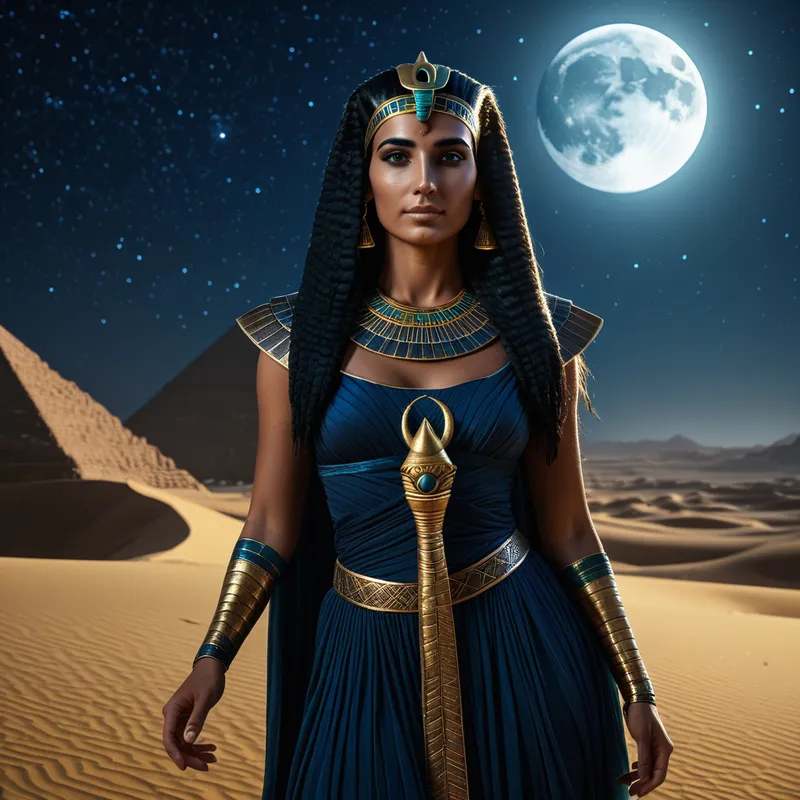
The Egyptian concept of the 'R Myth Meaning & Symbolism
The myth of the secret name, where divine power resides in a word, and identity itself is a sacred, guarded truth.
The Tale of The Egyptian concept of the ‘R
In the time when the world was young and the gods walked with the weight of eternity upon their shoulders, there was a silence deeper than the tomb. It was the silence of a name. Not the name men knew, not the titles sung by priests, but the True Name—the Ren—that which held the very ka and ba of a thing, its soul and its power, bound in a single, sacred utterance.
The sun, Ra, had grown old. His daily journey across the sky was a labor, his bones ached with the cycles of creation, and a creeping lassitude, a shadow of the primordial Nun, threatened his radiant mind. Yet his power was absolute, for his True Name, the source of his sovereignty over life and light, was known to him alone. He guarded it in the secret chamber of his heart, a word of fire that even the other gods dared not seek.
But Isis, the great magician, she whose cunning was as deep as the Nile and whose will was as sharp as a serpent’s tooth, watched. She saw the fissures in Ra’s glory. She desired not his throne, but his power—the power to heal, to protect, to make whole. To do this, she needed the unmakeable thing: the Ren of the All-Lord himself.
Her chance came as Ra walked the dusty paths of earth, his divine saliva dripping onto the ground. With the patience of a star, Isis gathered the earth mingled with the god’s spittle. She kneaded it with her knowledge, whispered spells of form and function, and fashioned a creature unlike any other: a serpent of glorious, terrible potency. Its scales held the dark of the abyss, its fangs the chill of forgotten depths. She placed it upon the path where Ra’s golden barque would pass.
The strike was swift. The divine serpent, a piece of Ra’s own substance turned against him, sank its fangs into the god’s flesh. Not a cry of pain, but a shudder that rocked the pillars of heaven escaped Ra’s lips. A fire that was not light—a cold, draining venom—flooded his veins. His radiant heat dimmed; a mortal weakness seized the immortal. The gods gathered in panic, their light flickering with his. They chanted, they pleaded, but the poison of his own essence would not yield.
Then Isis approached, her voice a balm and a blade. “O great father, a mighty power has felled you. Tell me your name, your True Name, that my magic may flow through its channel and command the poison to retreat. For a spell spoken with the authority of the Ren cannot be denied.”
Ra, trembling, offered his titles. “I am Khepri at dawn, Ra at noon, Atum at dusk. I am the maker of heavens…”
But with each title, Isis only shook her head, the venom deepening its hold. “Those are not the name that lives in your heart. The secret one. Speak it, and live. Hold it, and return to Nun.”
The struggle was not of body, but of being. To surrender the Ren was to hold nothing back, to be utterly known and thus potentially undone. The cosmos held its breath. Finally, broken by the pain that was erasing him, the sun god whispered his True Name into the ear of Isis. The word passed from his essence to hers.
And in that moment, the transfer was complete. Isis spoke the command, and the poison flowed back like a tide. Ra was healed, his light restored. But the sovereignty of the world had subtly shifted. The power of the foundational Word was now shared. Isis walked away, the secret humming in her blood, not to usurp, but to wield—a goddess now armed with the very sound of creation.
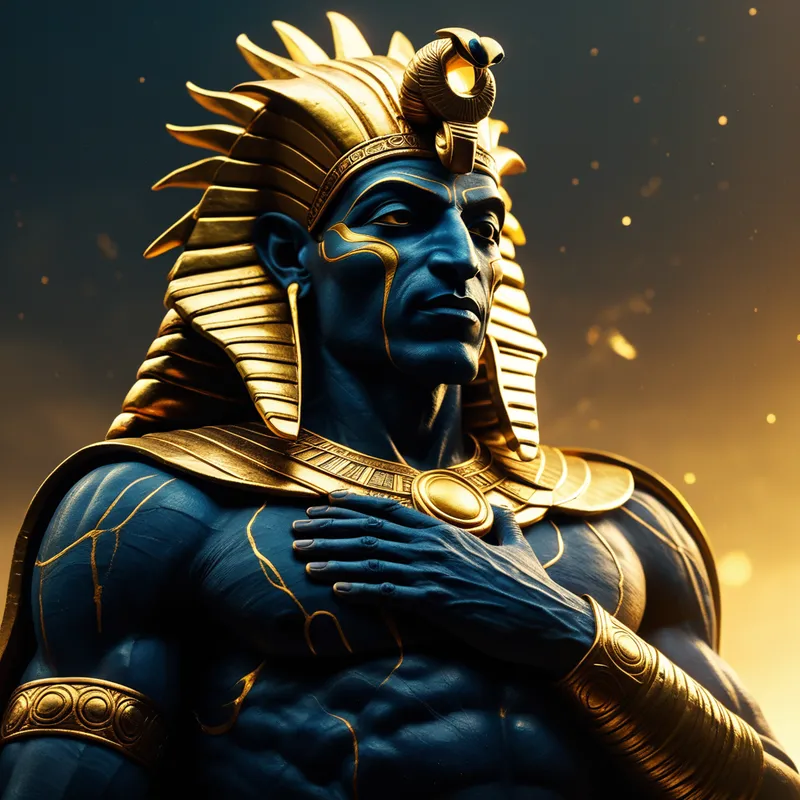
Cultural Origins & Context
This myth, primarily preserved in later funerary texts like the Book of the Dead and magical papyri, stems from the core of Egyptian metaphysical thought. It was not a popular folktale but a profound theological and magical narrative known to priests and practitioners of Maat. Its function was multifaceted: it explained the source of Isis’s preeminent magical authority, it illustrated a fundamental principle of their universe—that knowledge of a thing’s true essence grants power over it—and it served as a potent template for ritual. In spells, knowing the true name of a demon, a disease, or even a part of one’s own soul was the key to protection, healing, and afterlife triumph. The myth was a sacred instruction on the architecture of reality itself, where identity was not a label but a latent force.
Symbolic Architecture
At its heart, the myth of the Ren is about the paradox of identity and power. The True Name is not a nickname or a title; it is the psychic and spiritual DNA, the irreducible core of self that precedes and defines all action.
To know the true name is to hold the map to the soul’s fortress; to speak it is to stand at the gate with the master key.
Ra represents the established, conscious ego—the ruling principle of the psyche, brilliant but isolated, growing rigid with age. His hidden name is his untapped, unconscious wholeness, the source of his vitality which he hoards until it stagnates. The venom is the inevitable crisis: depression, ennui, a psychic illness that arises when the conscious mind is cut off from its deep, renewing roots.
Isis symbolizes the transformative function of the psyche—the anima or the guiding archetype of deep knowing. She is not a destroyer but a synthesizer. Her method is cunning, patient, and involves using a piece of the god’s own substance (his spittle) to create the serpent. This represents how our deepest crises are often forged from our own repressed material. The serpent, a creature of the earth and the unconscious, is the necessary, painful catalyst that forces the confrontation with the hidden self.
The ultimate transfer is not a theft, but an integration. The conscious ego (Ra) must surrender its absolute, isolated autonomy and admit its dependence on the deeper, more complete Self. The healing that follows is the healing of individuation—the psyche functioning as a unified whole, with conscious awareness now in dialogue with, and informed by, the profound power of the unconscious.
The Dreamer’s Resonance
When this myth stirs in the modern dreamer, it often manifests as dreams of forgotten passwords, unpronounceable words hovering on the tongue, or encounters with a mysterious, authoritative figure who demands a secret you feel you should know. You may dream of being poisoned by something you yourself created, or of healing a powerful but fading entity through a whispered confession.
Somatically, this can feel like a tightness in the chest or throat—the place of speech and hidden emotion. Psychologically, you are in the process of a profound identity negotiation. The “venom” is the symptom—anxiety, a creative block, a feeling of inauthenticity—pointing to a disconnect between who you present to the world (your titles) and who you truly are (your Ren). The dream is the psyche’s Isis, cunningly orchestrating a crisis to force you to seek, acknowledge, and ultimately speak your own deeper truth into your life, to reclaim the power you have locked away.
Alchemical Translation
The alchemical journey modeled here is the solve et coagula—dissolve and coagulate—applied to the self. First, the rigid, solar consciousness (Ra) must be dissolved by the venom of its own hidden aspects. This is the dark night, the nigredo, where the old, ruling identity becomes sick and untenable.
The crucible of transformation is sealed not by fire alone, but by the unbearable tension between holding on to a dying name and speaking a new, terrifying truth.
Isis represents the guiding intelligence of the process, the anima mundi or soul of the work. Her acquisition of the Ren is the moment of illumination, the albedo. The secret is brought to light, not to be used for domination, but for reconstitution. The final stage, the rubedo or reddening, is the healed, integrated state. Ra is restored, but he is no longer the solitary, unknowable monarch. He is a god in relationship, his light now infused with the wisdom of the deep. For the individual, this is the achievement of a more authentic identity. You regain your vitality and purpose, not by returning to who you were, but by integrating the previously hidden, powerful parts of your nature. You rule your inner kingdom not through rigid control, but through wise dialogue with your entire being. Your power is no longer a guarded secret, but a spoken, living reality.
Associated Symbols
Explore related symbols from the CaleaDream lexicon: