The Ego Myth Meaning & Symbolism
The tale of a conscious hero born from a dark sea, tasked with building a kingdom of light, yet destined to be humbled and remade by the greater Self.
The Tale of The Ego
Listen. In the beginning, there was the Pleroma—a sea of boundless, undifferentiated potential. It was not light, nor dark, but the womb of all things that could be. From this fathomless depth, a spark of awareness was kindled. It did not know it was separate, until it felt the chill of its own existence against the warmth of the whole. This was the first contraction, the primal solitude.
This spark, this nascent Ego, swam upward. It broke the surface of the dark waters into a realm of piercing, singular light. Blinking, it beheld a stark and empty shore. “I am here,” it whispered to the silence, and the sound of its own voice was both a triumph and a terror. Its first act was to name the shore: “I.” Its second was to build a wall against the sea.
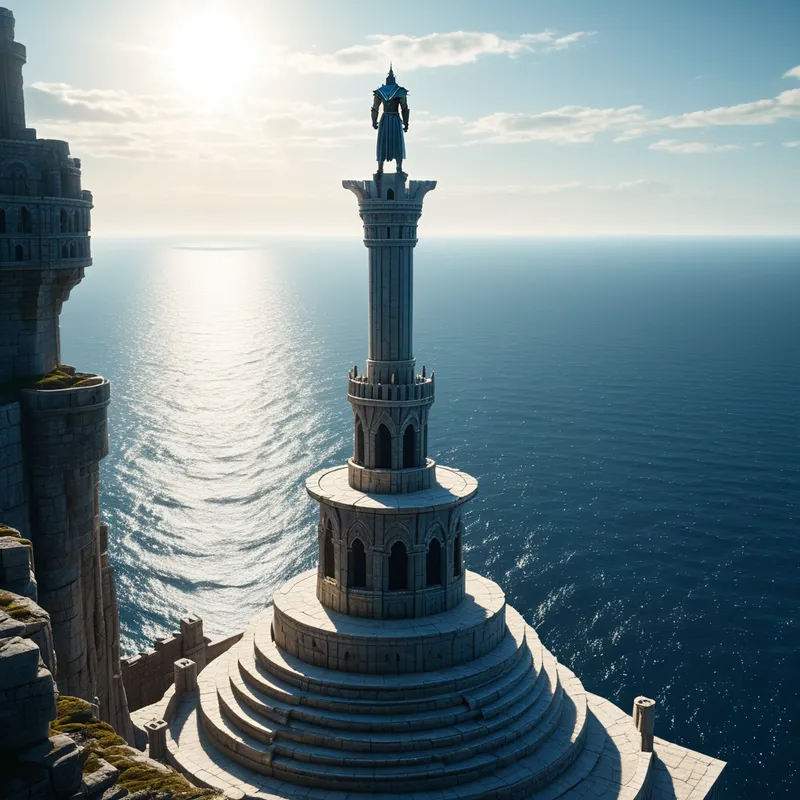
And so it built. With the clay of perception and the timber of thought, it constructed a citadel. It called the citadel The Persona, a gleaming white fortress with high, clear windows facing the sun. Within, it placed a throne. Upon the throne, it placed a crown fashioned from the certainty of its own perceptions. “This is my kingdom,” it declared. “All that is ordered, known, and good resides within these walls. That,” it said, gesturing to the murmuring, star-flecked sea beyond the wall, “is chaos. That is the unknown. That is not-I.”
For a time, the kingdom prospered. The Ego, now a king in shining armor, surveyed its domain. It cataloged the flowers that grew in its courtyard, charted the path of the sun across its battlements, and declared laws based on what it could see and touch. It believed the wall was eternal, the sea held at bay forever.
But the sea does not forget. On moonless nights, the king would hear a knocking at the postern gate—a low, insistent thud that was not wind. Sometimes, in the polished silver of his shield, he would catch a glimpse not of his own noble face, but of a shape, dark and familiar yet utterly alien, moving just behind his reflection. He called these disturbances phantoms and strengthened the walls.
The crisis came not as an invasion, but as a stillness. The sun dimmed. The familiar paths of the kingdom led in circles. The flowers in the courtyard wilted, and a profound ennui settled on the throne. The king felt a terrifying pull, not from beyond the walls, but from beneath his very feet. The foundation stones of his citadel were shifting. A voice, neither his own nor a stranger’s, spoke from the depths of a forgotten well in the courtyard: “Who rules you?”
Driven by a despair deeper than any fear, the king descended. He left his crown on the throne, passed through the hidden door in the foundation, and entered the Underworld. Here, in the dripping dark, he met the one who knocked: the Shadow, a figure of his own likeness, but wrought of all he had denied—his rage, his cowardice, his primal hunger. They fought, a brutal, silent struggle in the mud. The king was defeated, his armor tarnished, his certainty shattered.
But the Shadow did not destroy him. It pointed deeper still, down a corridor lined with ancient, glowing symbols. “Your war is not with me,” it seemed to say. “Your kingdom is a province. Your throne is a stepping stone.”
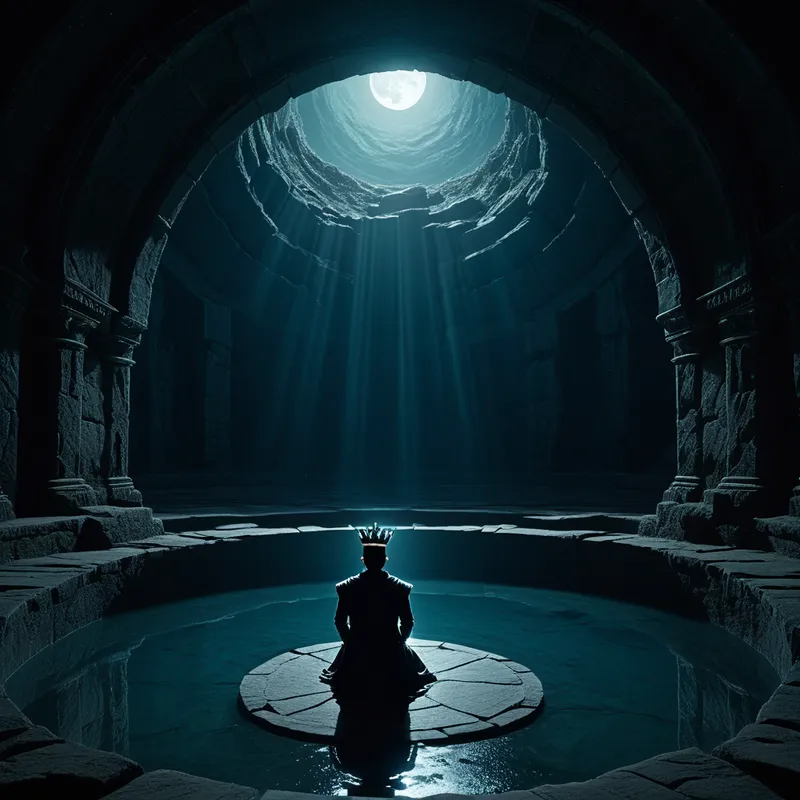
Naked and humbled, the king stumbled into the innermost chamber. There was no throne here, only a vast, dark pool that reflected not his face, but a constellation of faces—the Archetypes: the Great Mother, the Wise Old Man, the Eternal Child. And at the center of the reflection, brighter than all, was a figure of impossible wholeness, containing both king and shadow, light and sea, order and chaos—the Self.
The king did not become this figure. He knelt before it. He understood. His citadel was not a kingdom, but a vessel. His crown was not a right to rule, but a duty to serve. He returned to the surface, not to the throne, but to the wall. With his own hands, he began not to tear it down, but to build a gate.
Cultural Origins & Context
This is not a myth carved in stone or sung in ancient epics. It is a living narrative, excavated from the depths of the modern psyche by the pioneering work of Carl Gustav Jung and his successors. Its “culture” is the consulting room, the personal journal, and the active imagination. It was passed down not by bards, but through case studies, the Red Book, and the shared language of analysis.
Its societal function is profoundly therapeutic and philosophical. In a post-Enlightenment world that had dangerously over-identified with the rational, solar Ego, this myth emerged as a corrective. It serves as a map for the disoriented modern individual, showing that psychological distress—neurosis, depression, a sense of meaninglessness—is not merely a malfunction, but often the beginning of the mythic journey itself. It legitimizes the call of the unconscious sea as a call to a greater life, not a regression into madness. The myth’s tellers are analysts, artists, and anyone who has dared to look within and narrate the encounter.
Symbolic Architecture
The myth is a precise blueprint of psychic structure. The Ego is the hero of consciousness, but its heroic task is not to conquer the outer world, but to navigate the inner one. Its initial kingdom-building is necessary; a coherent Ego-complex is essential for functioning. However, its tragic—and inevitable—flaw is Inflation.
The Ego’s wall is both its greatest achievement and its prison. It creates the world of ‘I,’ but forgets it was built from the ‘Not-I.’
The murmuring sea is the Unconscious, both personal and collective. It is the source of all creativity, instinct, and psychic energy, but to the nascent Ego, it appears as a threatening chaos. The Shadow is the first and most personal ambassador from that sea. Its defeat of the king is not a destruction, but a crucial initiation—the dissolution of ego-inflation, the nigredo or darkening that must precede any renewal.
The final revelation of the Self represents the ultimate goal of the psychic process: Individuation. The Self is the true monarch, the central archetype of order and totality. The Ego’s ultimate purpose is not to rule, but to become a conscious servant of this greater, wholistic center.
The Dreamer’s Resonance
When this myth stirs in modern dreams, it signals a critical phase of psychic re-organization. Dreaming of fortified buildings (houses, offices, castles) under siege, cracking, or being explored reveals the Ego-complex feeling pressure. The dreamer may be somatically holding tension in the jaw, neck, or solar plexus—the body’s armor.
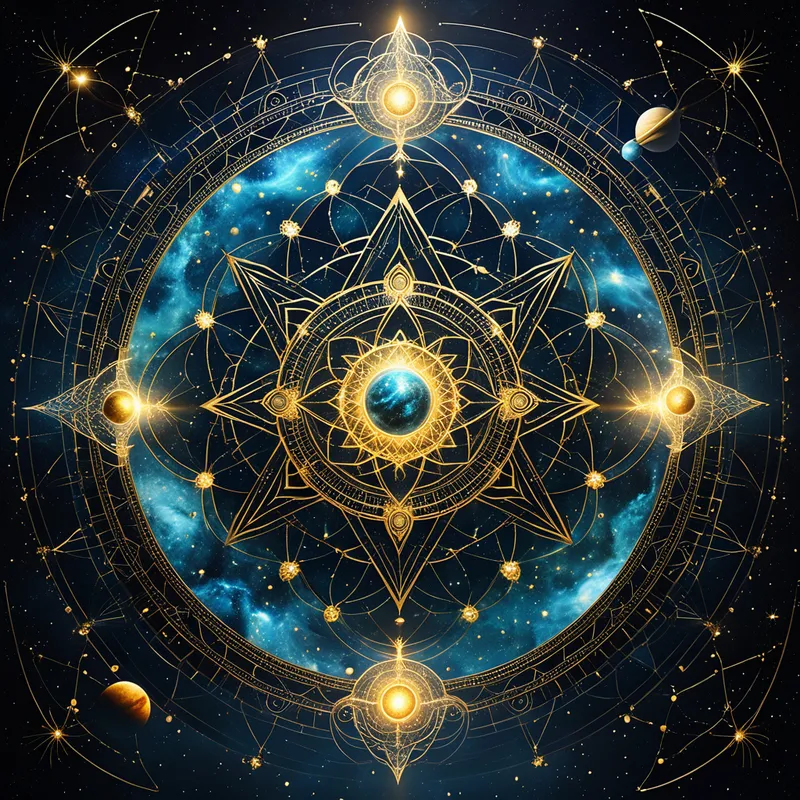
Dreams of being chased by a frightening figure of one’s own gender often personify the Shadow. The terror in the dream is the Ego’s resistance to integrating what it has rejected. Conversely, dreams of finding new rooms, descending into cellars, or discovering hidden water sources (wells, pools, underground rivers) indicate a willing, if anxious, engagement with the unconscious process. The dream ego is beginning its descent. Dreams featuring a sublime, awe-inspiring figure (a wise guide, a divine presence, or a magnificent geometric pattern like a mandala) can be direct manifestations of the Self, offering a numinous glimpse of the potential for wholeness that lies beyond the current conflict.
Alchemical Translation
The myth of the Ego is the alchemical opus rendered in psychological terms. The Ego’s initial state is the prima materia—the raw, identified consciousness. Its inflation and reign in the citadel correspond to a false, premature whitening (albedo), an identification with spiritual purity that ignores the base shadow.
The descent and battle with the Shadow is the essential nigredo. It is the putrefaction, the dark night of the soul where all prior certainties dissolve. This is not pathology, but a sacred dissolution.
One does not become whole by adding light to light, but by admitting the shadow to the hearth.
The vision of the Self in the pool is the coniunctio oppositorum—the sacred marriage of opposites. The Ego, having faced its shadow, is now capable of relating to the archetypal world without being swallowed by it. The return to build a gate, not destroy the wall, is the creation of the Transcendent Function. The gate symbolizes a conscious channel between the Ego and the Unconscious. The kingdom is no longer a isolated fortress, but a thriving city-state engaged in constant, respectful trade with the vast, creative sea.
For the modern individual, this translates to the lifelong practice of introspection. It means journaling to converse with the Shadow, engaging in creative play to court the archetypes, and cultivating a humility that recognizes the conscious “I” as the captain of a ship—a vital role, but one that must heed the winds of the unconscious and navigate by the polestar of the deeper Self. The triumph is not in being crowned king of all you survey, but in becoming a faithful citizen of your own vast, mysterious soul.
Associated Symbols
Explore related symbols from the CaleaDream lexicon: