The Eagle and Serpent Vision Myth Meaning & Symbolism
A divine vision of an eagle devouring a serpent on a cactus guided the Mexica people to their promised land, founding the heart of their empire.
The Tale of The Eagle and Serpent Vision
Hear now the tale of the wandering ones, the people of the sun, the Mexica. For generations, they were a people without a home, carrying the bundled bones of their patron god, Huitzilopochtli, on their backs. They walked under a curse and a promise, driven from place to place, their sandals worn thin by the long road of exile.
Their god had spoken a cryptic prophecy: they must journey until they found the place of the sign. A place where they would see an eagle, proud and sun-born, perched upon a nopal cactus, thriving from a stone. And in its talons, a serpent, caught and glistening. There, and only there, would their long suffering end. There, they would build their city, the navel of the world, and their name would become mighty.
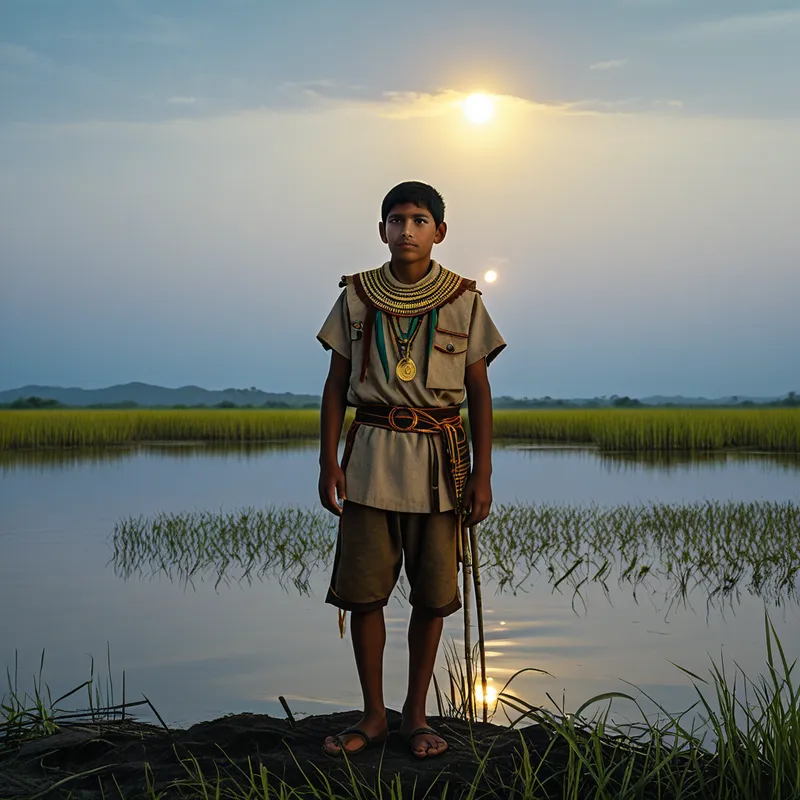
Decades passed. They traversed deserts and mountains, skirted great lakes, and fought other tribes. Doubt was a constant companion. Was the vision a true promise or a cruel jest from a capricious deity? Then, one fateful morning, their scouts pushed through the reeds onto the marshy shores of Lake Texcoco. The air was thick with the scent of mud and water-lilies. Before them lay a series of swampy islands.
And there, on one such island, the world held its breath.
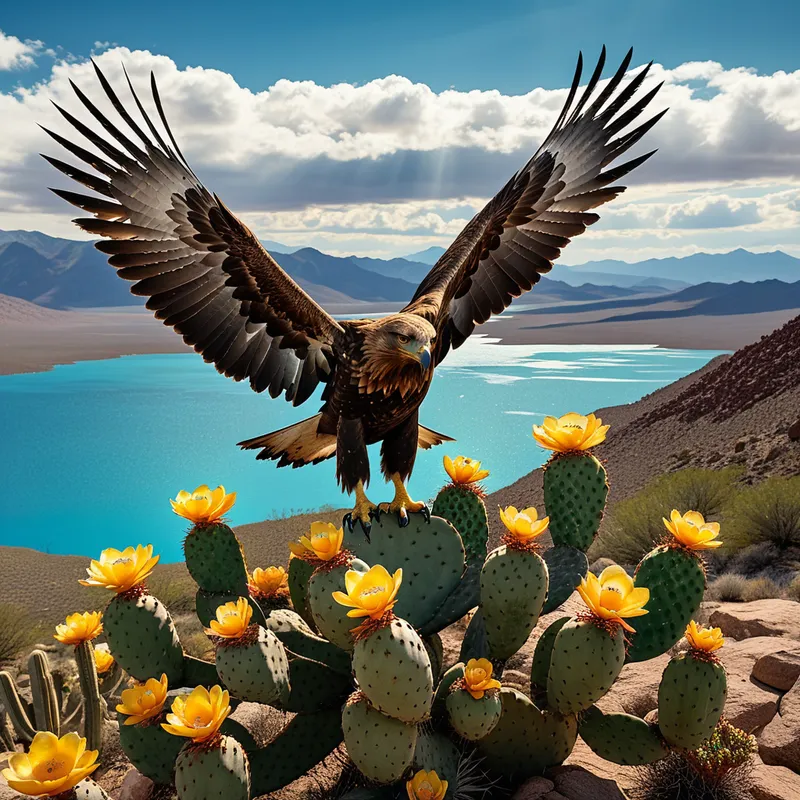
Upon a rock, a tenacious nopal cactus had taken root. And upon that cactus, a magnificent eagle, its feathers like burnished copper in the dawn light, stood with wings outstretched to embrace the rising sun. In its powerful talons, a serpent writhed, its scales flashing like emerald and obsidian. The eagle bent its regal head, not in malice, but in fulfillment of a cosmic order. This was the moment. The sign. The long-sought vision made flesh, water, and stone.
A cry went up, a mixture of awe, relief, and triumphant joy that echoed across the water. They had found it. The prophecy was true. On that spot, they drove the first pilings into the lakebed. They would build their glorious city, Tenochtitlan, a Venice of the New World, its canals and temples radiating from this sacred, witnessed center. The eagle and the serpent, forever locked in a sacred tableau, became the soul of their empire, etched onto their shields and the very fabric of their destiny.
Cultural Origins & Context
This foundational myth is the origin story of the Mexica empire, recorded in colonial-era codices like the Tira de la Peregrinación and the Florentine Codex. It was not merely a folktale but a state-sanctioned sacred history, recited by priests and elder storytellers to legitimize Aztec political and spiritual authority. The myth served a crucial societal function: it transformed a period of likely historical migration and subjugation into a divinely ordained quest. It provided an unshakable rationale for their presence in the Valley of Mexico, a land already occupied by powerful city-states. The vision was the ultimate mandate from Huitzilopochtli himself, justifying their settlement, their subsequent expansion, and their right to rule. It was the spiritual charter for their civilization, making their capital, Tenochtitlan, not just a city, but the literal center of the cosmos, chosen by the gods.
Symbolic Architecture
The [vision](/symbols/vision “Symbol: Vision reflects perception, insight, and clarity — often signifying the ability to foresee or understand deeper truths.”/) is a potent [hieroglyph](/symbols/hieroglyph “Symbol: Ancient Egyptian writing system using pictorial symbols, representing sacred knowledge, communication with the divine, and the power of language to shape reality.”/) of the [universe](/symbols/universe “Symbol: The universe symbolizes vastness, interconnectedness, and the mysteries of existence beyond the individual self.”/), a [snapshot](/symbols/snapshot “Symbol: A frozen moment in time, representing memory, preservation, and the desire to capture fleeting reality.”/) of [cosmic balance](/symbols/cosmic-balance “Symbol: The ‘Cosmic Balance’ signifies the equilibrium of forces in the universe, highlighting the interplay of opposites such as light and dark, creation and destruction.”/) and the [birth](/symbols/birth “Symbol: Birth symbolizes new beginnings, transformation, and the potential for growth and development.”/) of order from [chaos](/symbols/chaos “Symbol: In Arts & Music, chaos represents raw creative potential, uncontrolled expression, and the breakdown of order to forge new artistic forms.”/).
The eagle is the celestial principle: the sun (Tonatiuh), the daytime sky, masculine force, sovereign power, and the ascending spirit. The serpent is the terrestrial principle: the earth, the underworld (Mictlan), watery chaos, feminine wisdom, and the coiled, latent power of the soil.
Their [conjunction](/symbols/conjunction “Symbol: In arts and music, a conjunction represents the harmonious or dissonant merging of separate elements to create a new, unified whole.”/) on the cactus growing from the [stone](/symbols/stone “Symbol: In dreams, a stone often symbolizes strength, stability, and permanence, but it may also represent emotional burdens or obstacles that need to be acknowledged and processed.”/) is the mythic [moment](/symbols/moment “Symbol: The symbol of a ‘moment’ embodies the significance of transient experiences that encapsulate emotional depth or pivotal transformations in life.”/) of [axis](/symbols/axis “Symbol: A central line or principle around which things revolve, representing stability, orientation, and the fundamental structure of reality or consciousness.”/) mundi—the world center—being established. The cactus itself, with its nourishing [fruit](/symbols/fruit “Symbol: Fruit symbolizes abundance, nourishment, and the fruits of one’s labor in dreams.”/) (tuna) and protective thorns, symbolizes sustenance born from hardship. The [stone](/symbols/stone “Symbol: In dreams, a stone often symbolizes strength, stability, and permanence, but it may also represent emotional burdens or obstacles that need to be acknowledged and processed.”/) represents the enduring, foundational [truth](/symbols/truth “Symbol: Truth represents authenticity, honesty, and the quest for knowledge beyond mere appearances.”/). The act of the [eagle](/symbols/eagle “Symbol: The eagle is a symbol of power, freedom, and transcendence, often representing a person’s aspirations and higher self.”/) subduing the [serpent](/symbols/serpent “Symbol: A powerful symbol of transformation, wisdom, and primal energy, often representing hidden knowledge, healing, or temptation.”/) does not signify destruction, but rather [integration](/symbols/integration “Symbol: The process of unifying disparate parts of the self or experience into a cohesive whole, often representing psychological wholeness or resolution of internal conflict.”/) and mastery. It is the necessary imposition of solar order (law, empire, culture) upon chthonic chaos (the untamed [swamp](/symbols/swamp “Symbol: Represents the subconscious mind, emotions, and the complexities of personal issues.”/), the unknown land, primal instinct). This is the sacred contract of civilization: the sky power must engage with and successfully order the [earth](/symbols/earth “Symbol: The symbol of Earth often represents grounding, stability, and the physical realm, embodying a connection to nature and the innate support it provides.”/) power to create a stable, fertile world.
Psychologically, the eagle represents the conscious ego’s drive for [clarity](/symbols/clarity “Symbol: A state of mental transparency and sharp focus, often representing resolution of confusion or attainment of insight.”/), [height](/symbols/height “Symbol: Height often symbolizes ambition, perspective, and the elevation of one’s self-awareness.”/), and dominion. The serpent is the unconscious—instinctual, deep, and potentially dangerous if ignored, but a [source](/symbols/source “Symbol: The origin point of something, often representing beginnings, nourishment, or the fundamental cause behind phenomena.”/) of immense vitality and wisdom when engaged. The vision, then, models the psyche finding its rightful place and [purpose](/symbols/purpose “Symbol: Purpose signifies direction, meaning, and intention in life, often reflecting personal ambitions and core values.”/) (the [city](/symbols/city “Symbol: A city often symbolizes community, social connection, and the complexities of modern life, reflecting the dreamer’s relationships and societal integration.”/)) only when these two opposing forces are brought into a dynamic, visible [relationship](/symbols/relationship “Symbol: A representation of connections we have with others in our lives, often reflecting our emotional state.”/).
The Dreamer’s Resonance
When this mythic pattern erupts in the modern dreamscape, it signals a profound moment of psychic orientation. Dreaming of an eagle and serpent locked in a significant encounter—whether in struggle, dance, or static display—often coincides with a life crossroads where one is seeking their “right place” or true calling. The somatic feeling can be one of awe-struck stillness, a “knowing” in the gut.
This is the dream of the scout who finally sees the sign. Psychologically, the dreamer is going through the process of synthesis after a long search. The wandering (a period of confusion, career changes, spiritual seeking) culminates in an internal vision so clear it feels external and destined. The serpent may appear as a tangled problem, a deep fear, or a repressed passion. The eagle is the emerging insight or the assertive part of the self that can finally grasp that problem and give it form. The dream is a message from the personal Huitzilopochtli: “Stop here. Build here. Your struggle has meaning, and this is the symbol that proves it.” It marks the end of existential drift and the beginning of conscious foundation-laying.

Alchemical Translation
The myth is a perfect map for the alchemical process of individuation, where the base materials of the psyche are transmuted into the gold of the integrated Self.
The long, arduous migration represents the nigredo—the dark night of the soul, the period of confusion, suffering, and dissolution of old identities. The people carry their god (the latent Self) as a burden, not yet realized. The swampy island of the vision is the albedo—the whitening, the moment of clarity appearing in the midst of the murky unconscious (the lake). The confrontation of eagle and serpent is the sacred coniunctio oppositorum (the conjunction of opposites), the core of the alchemical work.
The triumph is not the eagle killing the serpent, but the eagle mastering it in full view of the conscious mind (the scouts). This is the integration of shadow (serpent) with the soaring spirit (eagle), resulting in the rubedo—the reddening, the birth of something new and enduring.
For the modern individual, this translates to the moment when a lifelong inner conflict or a deep, instinctual part of the self (a talent, a wound, a desire) is finally recognized, confronted, and claimed—not eliminated—by the conscious personality. This act of conscious integration (seeing the vision) provides the foundational “stone” upon which one can build a coherent identity (Tenochtitlan). The city you build is your authentic life, structured around this hard-won, central truth. The myth teaches that our deepest purpose is found not by avoiding the swampy, serpentine depths of our being, but by venturing into them to discover the precise point where our highest nature can take root and rule.
Associated Symbols
Explore related symbols from the CaleaDream lexicon:
- Eagle — The sovereign spirit, solar consciousness, and the soaring vision that seeks a place to manifest its power and dominion over chaos.
- Serpent — The chthonic wisdom of the earth and unconscious, representing primal instinct, latent vitality, and the transformative power that must be engaged and integrated.
- Vision — The divine or deeply intuitive revelation that provides unambiguous direction, ending a period of wandering and marking the point of destiny.
- Journey — The long, arduous migration of the psyche or life path that precedes a moment of foundational discovery, representing necessary suffering and search.
- Destiny — The pre-ordained purpose or endpoint revealed by the vision, transforming random struggle into a sacred, meaningful quest.
- Foundation — The stone and the act of city-building that follows the vision, representing the establishment of a stable, authentic identity or life structure upon a recognized truth.
- Water — The chaotic, fertile, and unknown realm (Lake Texcoco) from which the island of clarity emerges, symbolizing the unconscious and emotional depths.
- Stone — The enduring, unshakable base upon which the cactus of destiny grows, representing foundational truth, reality, and the anchoring point for the psyche.
- Mountain — Symbolic of the axis mundi or world center achieved in microcosm on the island, representing the connection between heaven and earth realized in a specific place.
- Sun — The direct correlate of the eagle, representing the light of consciousness, divine favor, and the life-giving force that validates the chosen path.
- Sacrifice — Implicit in the long migration and the serpent’s capture, representing the necessary offering of old ways, comfort, and energy required to fulfill a higher purpose.
- Rebirth — [The founding of Tenochtitlan](/myths/the-founding-of-tenochtitlan “Myth from Aztec culture.”/) is the cultural and psychic rebirth of the Mexica, marking the transition from a wandering tribe to an empire, from seekers to founders.