The Dybbuk Possessing Spirit Myth Meaning & Symbolism
A tale of a soul, denied rest, that clings to the living—a myth of unresolved oaths, shattered vessels, and the desperate need for a voice.
The Tale of The Dybbuk Possessing Spirit
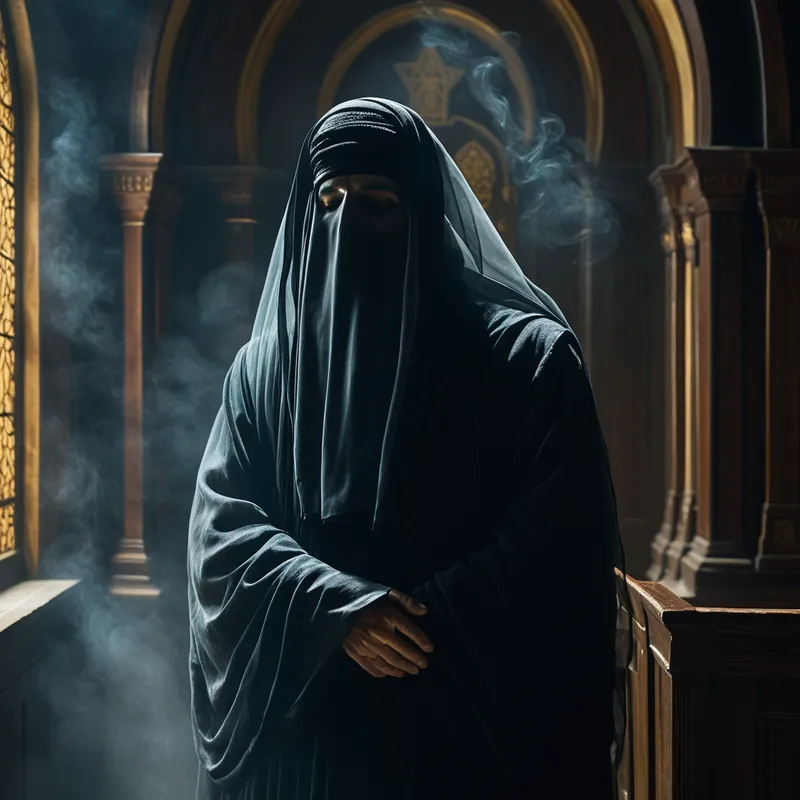
Listen, and hear a tale not of demons from without, but of ghosts from within. It begins not in fire, but in a silence so profound it becomes a scream. In a shtetl nestled like a sigh in the hollow of the hills, the air grew heavy. It was the weight of a word unspoken, an oath unfulfilled, a life cut short with its business unfinished.
Her name was Leah, though when it began, she did not know that name. She knew only a sudden chill in her bones on a warm afternoon, a taste of salt and bitterness on her tongue that was not her own. Then came the voice—a rasping, desperate thing that coiled in her throat. Her hands, once gentle, wrote frantic, archaic script she could not read. Her eyes, once bright, saw through a film of another’s grief. She was no longer alone in her skin. A stranger dwelled there, a Dybbuk, a soul denied the peace of the Olam Ha-Ba, clinging to the living world with the tenacity of a drowning man to a raft.
The community whispered. They saw the change. They heard the dual-toned voice that issued from her lips—one hers, young and terrified; the other, old, male, and thick with a sorrow that had curdled into rage. The Baal Shem was summoned. An old man with eyes that saw the weave of worlds, he entered the house where Leah lay bound, not by ropes, but by the invisible chains of the possessing spirit. The air smelled of wax, fear, and myrrh.
The confrontation was not a battle of spells, but a court of souls. The Baal Shem, wrapped in his tallit, faced the one who spoke through Leah. “Who are you, and why do you torment this daughter of Israel?”
And the story poured forth—a torrent of anguish. The Dybbuk was Chaim, a merchant betrayed by his partner, an oath sworn on a mezuzah broken, a life lost in disgrace before he could clear his name. His soul, barred from its rest, had wandered the Kelipot, the shells of existence, until it found a crack in Leah’s light—a moment of profound grief or vulnerability—and slipped in.
The Baal Shem did not condemn. He listened. For three days and nights, the ritual unfolded. The blasts of the shofar shattered the spiritual stagnation. Psalms were chanted, not as weapons, but as solvents for pain. The community formed a minyan, a circle of witness and containment. Finally, the Baal Shem issued the decree: “By the sacred names, you are commanded to depart. You shall not rest here, in this living vessel.”
A great struggle shook Leah’s frame. Then, with a sound like tearing parchment, the presence separated. The air in the corner of the room grew dense and dark, forming the faint, sorrowful outline of a man. The Baal Shem pointed to the threshold. “Go. Your case is heard. Your name is cleared in the eyes of Heaven. Now, go to your rest.” The shadow seemed to sigh, a sound of immense relief, and then it was gone, like smoke in a sudden wind. Leah awoke, herself again, but forever marked by the memory of a soul that was not her own.

Cultural Origins & Context
The myth of the Dybbuk is not ancient biblical lore, but a profound flowering of later Jewish mystical thought, primarily within the Kabbalistic and Hasidic traditions of Eastern Europe from the 16th century onward. It is a folk theology born from the intersection of profound metaphysical concepts and the gritty realities of shtetl life. The stories were passed down orally, often told by rebbes and mystics, and later immortalized in plays like S. Ansky’s seminal “The Dybbuk.”
Its societal function was multifaceted. On one level, it was a framework for explaining mental and physical illnesses that defied contemporary understanding—hysteria, epilepsy, psychosis—placing them within a spiritual cosmology. More deeply, it served as a narrative container for communal anxieties about justice, especially for the powerless. In a world where earthly justice was often absent or corrupt, the idea that a wronged soul could return to demand restitution was a powerful, if terrifying, comfort. It reinforced the sacredness of oaths and the belief that moral accounts are ultimately settled, if not in this world, then in the movement between them.
Symbolic Architecture
At its core, the Dybbuk myth is not about external evil, but about the [psychology](/symbols/psychology “Symbol: Psychology in dreams often represents the exploration of the self, the subconscious mind, and emotional conflicts.”/) of the unresolved. The Dybbuk is the ultimate [Shadow](/symbols/shadow “Symbol: The ‘shadow’ embodies the unconscious, repressed aspects of the self and often represents fears or hidden emotions.”/)—not one’s personal [shadow](/symbols/shadow “Symbol: The ‘shadow’ embodies the unconscious, repressed aspects of the self and often represents fears or hidden emotions.”/), but a transpersonal one: a fragment of unresolved historical, familial, or collective [trauma](/symbols/trauma “Symbol: A deeply distressing or disturbing experience that overwhelms the psyche, often manifesting in dreams as unresolved emotional wounds or psychological injury.”/) that seeks a [host](/symbols/host “Symbol: The symbol of a ‘host’ often represents nurturing, hospitality, or the willingness to offer support and guidance to others.”/).
The unintegrated past does not die; it seeks a body to haunt.
The possession represents a psychic takeover, where an autonomous complex—a bundle of thoughts, emotions, and memories—usurps the ego. The “crack” through which it enters symbolizes a [vulnerability](/symbols/vulnerability “Symbol: A state of emotional or physical exposure, often involving risk of harm, that reveals authentic self beneath protective layers.”/) in the psyche’s boundaries, often born of [grief](/symbols/grief “Symbol: A profound emotional response to loss, often manifesting as deep sorrow, yearning, and a sense of emptiness.”/), [shame](/symbols/shame “Symbol: A painful emotion arising from perceived failure or violation of social norms, often involving exposure of vulnerability or wrongdoing.”/), or unprocessed fear. The Baal Shem represents the mediating [consciousness](/symbols/consciousness “Symbol: Consciousness represents the state of awareness and perception, encompassing thoughts, feelings, and experiences.”/), the Self, who does not destroy the intruder but listens to its [story](/symbols/story “Symbol: The symbol of ‘Story’ represents the narrative woven through our lives, embodying experiences, lessons, and emotions that shape our identities.”/). The exorcism is not an annihilation, but a forceful [differentiation](/symbols/differentiation “Symbol: The process of distinguishing or separating parts of the self, emotions, or identity from a whole, often marking a developmental or psychological milestone.”/) and relocation. The [spirit](/symbols/spirit “Symbol: Spirit symbolizes the essence of life, vitality, and the spiritual journey of the individual.”/) is not sent to hell, but to its proper place—the [afterlife](/symbols/afterlife “Symbol: A symbolic journey beyond death, representing transition, the unknown, and ultimate questions about existence, purpose, and what follows life.”/). This is a myth of radical justice and re-ordering.

The Dreamer’s Resonance
When this myth pattern stirs in the modern dreaming, it rarely manifests as a literal ghost story. Instead, the dreamer may experience sensations of being controlled by a foreign will, of speaking with a voice not their own, or of a persistent, nagging presence in their personal space. They may dream of a room in their house they didn’t know existed, filled with another’s belongings.
Somatically, this can correlate with feelings of chronic fatigue, a “heaviness” on the chest, or unexplained pains—the body bearing the weight of an unlived life that is not one’s own. Psychologically, it signals a process of psychic intrusion. This could be the unrecognized burden of a family secret, the unexpressed grief of an ancestor, or the adoption of a life script (career, identity, relationship) that belongs to someone else’s unmet expectations. The dream-Dybbuk is that which lives through you, but is not you.
Alchemical Translation
The alchemical process modeled here is the separation (separatio) and reintegration (coniunctio) of spirit and matter, past and present. The initial state is one of dangerous fusion—the living and the dead entangled. The goal is not to simply eject the “bad” spirit, but to transmute the relationship to it.
Individuation requires hearing the ghost’s testimony before granting it peace.
First, one must recognize the possession—the uncomfortable truth that parts of one’s life are being lived by a ghost of trauma, expectation, or old identity. This is the “calling of the Baal Shem.” Then comes the ritual of listening: creating a sacred, bounded space (therapy, journaling, art) to allow the autonomous complex to speak its full, often painful, story. This is the exorcism’s trial. The final, crucial stage is the directional release: consciously assigning that energy to its proper place. The grief goes to the past where it occurred; the shame is returned to its source; the unlived life is mourned and laid to rest. What remains for the host is not emptiness, but a cleansed vessel, now capable of holding their own, authentic spirit. The possessed one becomes the one who witnessed, integrated, and, in the deepest sense, granted a form of healing justice to the fragmented soul of the past.
Associated Symbols
Explore related symbols from the CaleaDream lexicon:
- Spirit — The core entity of the myth, representing a disembodied consciousness that has lost its way, embodying the pure state of unresolved psychic energy seeking resolution.
- Door — The threshold, both physical and spiritual, through which the Dybbuk enters and is finally expelled; it symbolizes the permeable boundary of the self and the moment of transition.
- Oath — The broken promise or vow that anchors the Dybbuk to the world, representing the binding power of words and the psychic weight of unfulfilled commitments.
- Shadow — The Dybbuk is the archetypal Shadow made manifest, a literalized version of the disowned, painful, and unconscious aspects that demand recognition.
- Wound — The “crack” in the soul’s vessel that allows possession; it signifies unhealed trauma, vulnerability, and the point of entry for unresolved history.
- Voice — The dual-toned speech of the possessed, representing the struggle between the authentic self and the intruding complex, and the ultimate need for the hidden story to be spoken.
- Ritual — The structured, communal ceremony of exorcism, which provides the sacred container necessary to safely confront and transmute overwhelming psychic material.
- Justice — The driving force behind the Dybbuk’s return and the ultimate goal of the exorcism; it signifies the soul’s deep, non-negotiable need for moral equilibrium and truth.
- Soul — The primary subject of the drama, in both its fragmented (Dybbuk) and integrated states, highlighting the Jewish concept of the soul’s journey and its need for proper rest.
- Key — The sacred names and wisdom of the Baal Shem that “unlock” the possession, symbolizing the specialized knowledge or inner resource needed to resolve a deep psychic bind.
- Grief — The fundamental emotional substance of the Dybbuk, the unprocessed sorrow that fuels its restless wandering and desperate attachment to the living.
- Dream — The myth itself operates like a collective dream, providing a symbolic language for experiences of psychic invasion and the process of differentiation that occurs in the depths of the unconscious.