The Dwarves of Svartalfheim Myth Meaning & Symbolism
In the roots of the world, the master smiths of Svartalfheim forge destiny from darkness, crafting the gods' greatest treasures and their deepest flaws.
The Tale of The Dwarves of Svartalfheim
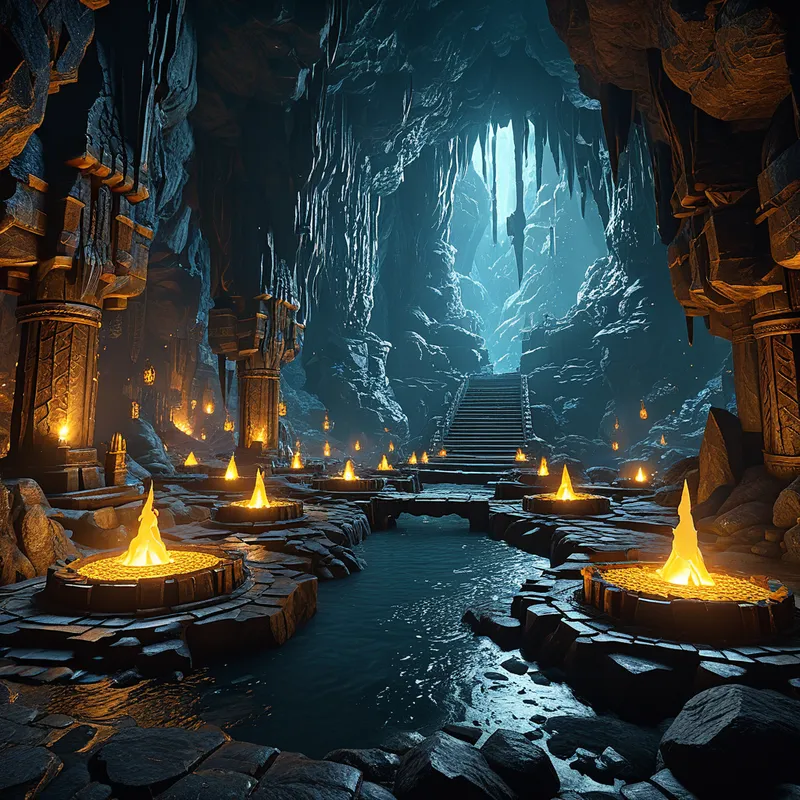
Beneath the groaning roots of the Yggdrasil, where the light of the sun is but a forgotten rumour, lies the realm of stone and shadow. This is Svartalfheim, a labyrinth of echoing caverns lit by the hellish glow of a thousand forges. Here, in the deep earth’s womb, dwell the master smiths, the dvergar. Their breath is the smell of hot metal and damp stone; their music is the relentless, rhythmic clang-clang-clang of hammer on anvil.
Listen now to the tale of a creation that shook the very halls of Asgard. It began not with a god’s command, but with a god’s folly. Loki, silver-tongued and restless, had sheared the golden hair from the goddess Sif. To avert the thunderous wrath of her husband, Thor, Loki was given one chance: replace what was lost with something greater.
He descended into the crushing dark, to the very forges of the sons of Ivaldi. There, in that fire-lit gloom, he found his salvation. The dwarven smiths, their eyes gleaming like chips of obsidian, took up the challenge. They did not merely spin gold; they wrought life into metal. From their hammers sprang Sif’s Hair, more radiant than the sun. But they did not stop. Their genius, once unleashed, became a torrent. They forged Skidbladnir, a vessel that could sail any sea yet fold into a cloth. And finally, they created Gungnir, a spear of such terrible perfection that its oath was unbreakable.
Loki, swollen with pride, boasted that no smiths in all the Nine Worlds could surpass these works. His boast reached the ears of another pair of brothers, the dwarves Brokkr and Sindri. Their pride, a cold and patient thing, was stirred. A wager was struck, with Loki’s own head as the prize.
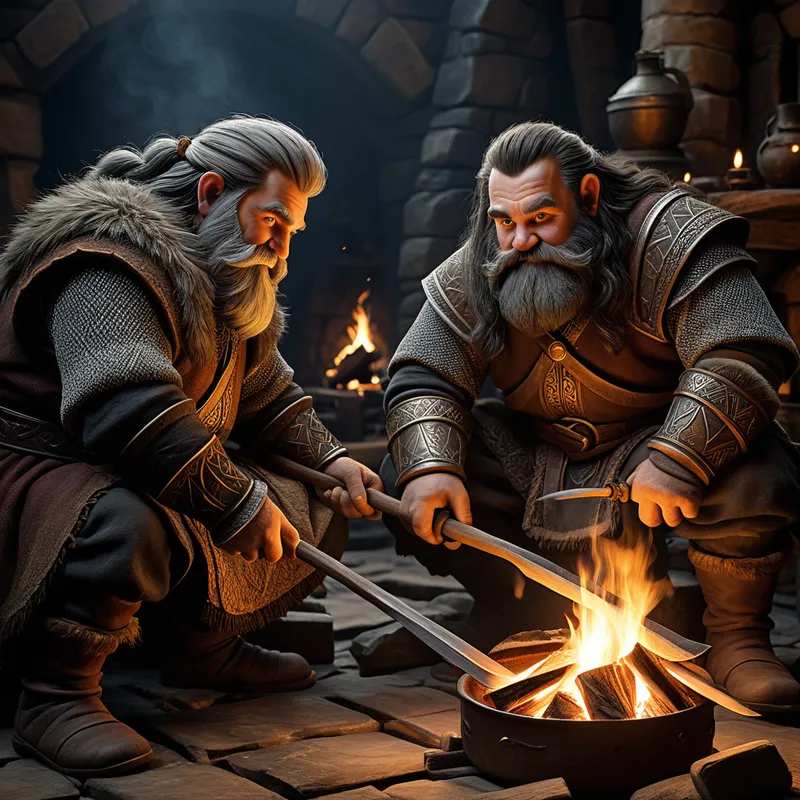
In their secluded forge, the ritual began. Sindri placed a pig’s skin in the furnace. “Brother,” he commanded, his voice a gravelly whisper, “work the bellows without cease. The fate of our craft rests on a single, unbroken rhythm.” As Sindri chanted secrets older than the gods, Brokkr pumped the great bellows, his muscles corded with strain. From the fire, they drew Gullinbursti, a living boar of gold that shone in the dark and ran across sky and sea.
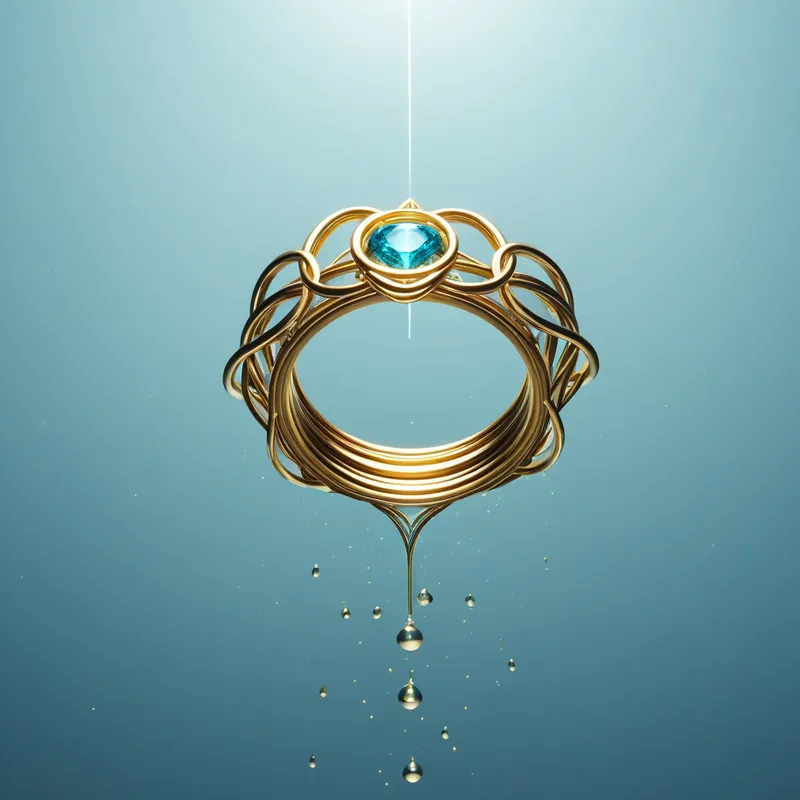
Next, a bar of gold. The heat was infernal, the air thick with magic. As they worked, a fly—Loki in disguise—bit Brokkr’s hand fiercely, but the dwarf did not falter. From the anvil rose Draupnir, a ring of multiplying gold, a symbol of endless wealth and endless obligation.
Finally, a block of iron. This was the masterwork. The fly returned, landing on Brokkr’s eyelid, drawing blood that blinded him. For one heartbeat, just one, the rhythm broke. Sindri’s chant hitched. Yet, they pulled from the flames the great hammer Mjolnir. It was flawless in power and purpose, but its handle was cruelly short—the only mar on a perfect weapon, born from that single moment of interrupted focus.
When the treasures were presented to the gods, the verdict was clear. Odin took Gungnir and Draupnir. Freyr took Skidbladnir and Gullinbursti. Thor took Mjolnir, the greatest defense of Asgard. The dwarves had won. Loki, bound by his word, faced the consequence of his wagered head. His escape through trickery is another tale, but the legacy of that forging echoes forever: from the deepest dark came the brightest light, and from a moment’s flaw came a weapon that would define an age.
Cultural Origins & Context
The tales of the dwarves of Svartalfheim are not the stories of a people about themselves, but the stories a culture tells about the mysterious, amoral, and potent forces of creation that operate just beyond the periphery of the known world. These myths were preserved primarily in the Poetic Edda and the later Prose Edda of Snorri Sturluson. They were not scripture, but living lore, told by skalds around hearth-fires in the long, dark winters of Scandinavia.
The function of these stories was multifaceted. On one level, they are etiological myths, explaining the origins of the gods’ most iconic possessions. On a deeper level, they served as a cultural acknowledgment of the master craftsman—the smith, the carver, the artisan—whose skill bordered on the supernatural and was essential to the community’s survival and prestige. The dwarves represent the ultimate externalization of this craft: beings whose entire nature is to transform raw, earthly material (stone, metal) into objects of transcendent power and beauty. They are not gods, but their work is divine. They exist in a tense, transactional relationship with the Aesir, providing the tools of cosmic order while remaining apart from it, bound to their subterranean forges.
Symbolic Architecture
The dwarves of the deep represent the archetypal force of the Shadow as Creator. They dwell not in a moral underworld of punishment, but in a psychic underworld of potential. They are the personification of the unconscious, instinctual intelligence that works in the dark, applying immense pressure and transformative heat to raw experience to produce something of value for the conscious self (the gods).
The greatest treasures are not found in the light, but forged in the acknowledged dark. The unworked ore of the soul lies waiting in Svartalfheim.
The artifacts they create are perfect symbols of psychic functions: Gungnir is the focused, unwavering will (Odin’s spear). Draupnir is the self-replenishing source of creative energy and the cycles of the unconscious. Mjolnir is the power of consciousness to defend its own structure and impose order (Thor’s hammer), yet its short handle signifies that this power, born from the unconscious, is never fully within our conscious control. The flaw is inherent. Loki’s role is crucial; he is the trickster who mediates between the gods’ conscious world and the dwarves’ unconscious realm. His provocations are the necessary crises that force the hidden depths to produce their masterworks.
The Dreamer’s Resonance
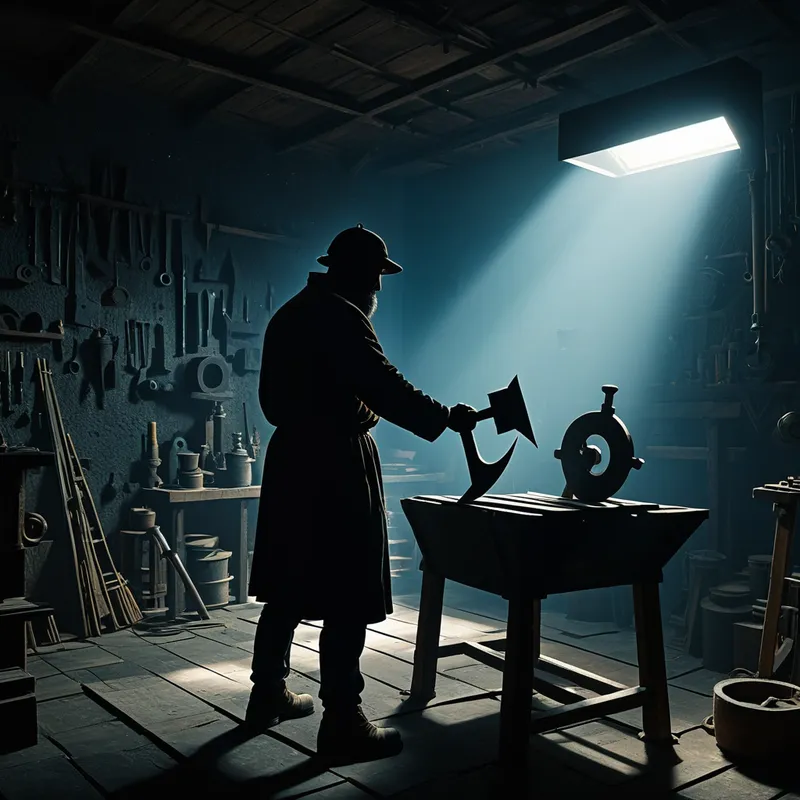
When the motif of the dwarven forge appears in modern dreams, it signals a profound somatic and psychological process underway. The dreamer may find themselves in a basement, a cave, or a cluttered workshop. The feeling is often one of pressurized isolation, of intense, focused work happening out of sight.
This is the psyche’s workshop where the “shadow material”—repressed emotions, neglected talents, unresolved traumas—is being subjected to the alchemy of integration. The relentless hammering is the often-uncomfortable process of confronting and shaping this raw material. Dreaming of dwarves crafting an object suggests the nascent formation of a new psychic capability, a new “tool” for navigating the world. It is a dream of incubation. The somatic resonance can be felt as a deep, rhythmic tension in the body, a sense of being “in the grip” of a creative or transformative process that feels both arduous and destined. One is not watching a myth; one is in the myth, playing the role of both the dwarf at the anvil and the god awaiting the treasure.
Alchemical Translation
The myth models the complete cycle of psychic transmutation, or individuation. It begins with a nigredo, a blackening: Loki’s destructive act (cutting Sif’s hair) plunges the psychic system into crisis and debt. This forces a descent into the solutio—the watery, chaotic depths of the unconscious (Svartalfheim).
There, in the calcinatio of the forge, the base materials of the personality are subjected to the fire of intense focus and emotional heat. The dwarf-smiths represent the autonomous, structuring intelligence of the unconscious that performs this work. The crafting of the treasures is the coagulatio—the precipitation of new, solid, and durable structures within the psyche.
The goal is not to become the dwarf, but to honor the forge within. To provide the raw material of honest self-examination and withstand the heat of transformation, trusting the hidden smith to shape what you cannot.
Finally, the return of the artifacts to Asgard is the rubedo, the reddening or integration, where the new psychic functions are raised to consciousness and put to use in the governance of the self. The entire process is sealed by a wager—a commitment that stakes something precious (Loki’s head, our old identity) on the outcome. For the modern individual, the myth instructs: your greatest powers are forged in darkness, through a pact with the deep, creative, and amoral parts of your own nature. You must dare the descent, endure the heat, and accept the gift, flaw and all, for it is the flaw in Mjolnir’s handle that makes it uniquely, powerfully yours.
Associated Symbols
Explore related symbols from the CaleaDream lexicon: