The Dwarves Myth Meaning & Symbolism
Craftsmen born from the corpse of a giant, the dwarves forge the gods' greatest treasures from the raw, dark substance of the underworld.
The Tale of The Dwarves
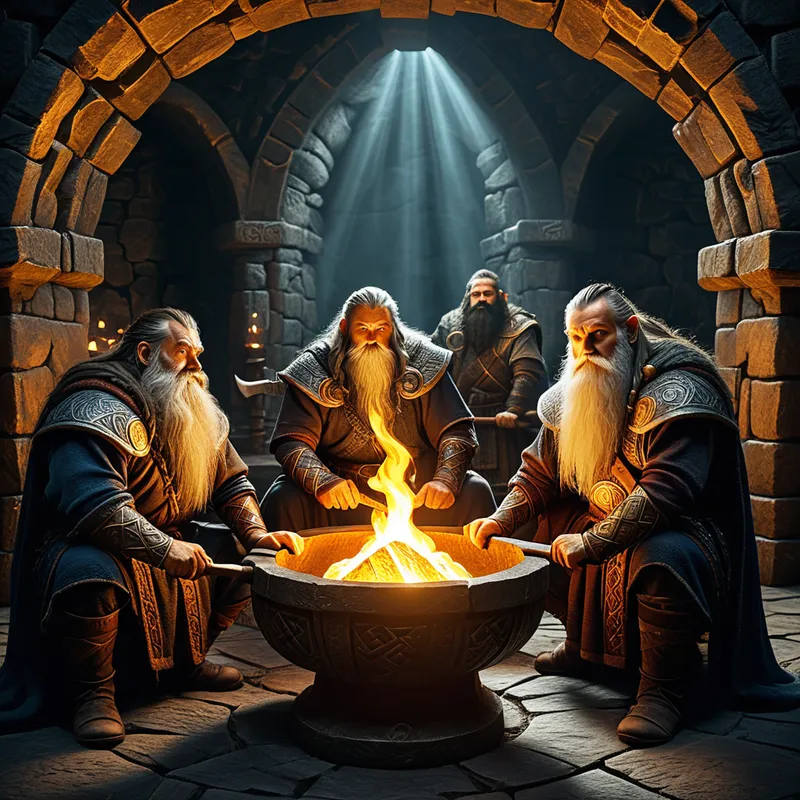
Listen, and hear the song of the deep-delvers, the whisper from under the roots of [the world](/myths/the-world “Myth from Tarot culture.”/). In the time before time, when the great Ymir was slain, his flesh became [the earth](/myths/the-earth “Myth from Hindu culture.”/), his blood the seas, and his bones the mountains. But from the writhing maggots that feasted upon that colossal corpse, the All-Father Odin and his brothers shaped beings of cunning and craft. They were given wits and wisdom, and were sent deep into the dark places, into the stone-veins and mineral hearts of [the earth](/myths/the-earth “Myth from Hindu culture.”/). These were the Dvergar, the dwarves.
They are not of the sun’s realm, nor [the wind](/myths/the-wind “Myth from Various culture.”/)’s. Their world is [Svartalfheim](/myths/svartalfheim “Myth from Norse culture.”/), a [labyrinth](/myths/labyrinth “Myth from Various culture.”/) of glittering caverns and echoing forges, lit only by the glow of molten rivers and the cold shine of embedded gems. Here, in the absolute dark, their hammers ring a constant, rhythmic heartbeat against the anvil of the world. They speak to stone, know the secrets of metal, and understand the language of fire.
The gods in their golden hall of Asgard needed tools of power to shape destiny and hold back the encroaching chaos. And so they turned to the dark below. It was the dwarves who forged [Gungnir](/myths/gungnir “Myth from Norse culture.”/), the spear that seals oaths. It was they who spun the hair of purest gold for the goddess Sif, after [the trickster](/myths/the-trickster “Myth from Various culture.”/) Loki sheared her own. And in their most famous trial, spurred by Loki’s wager, the brothers Brokkr and Eitri labored.
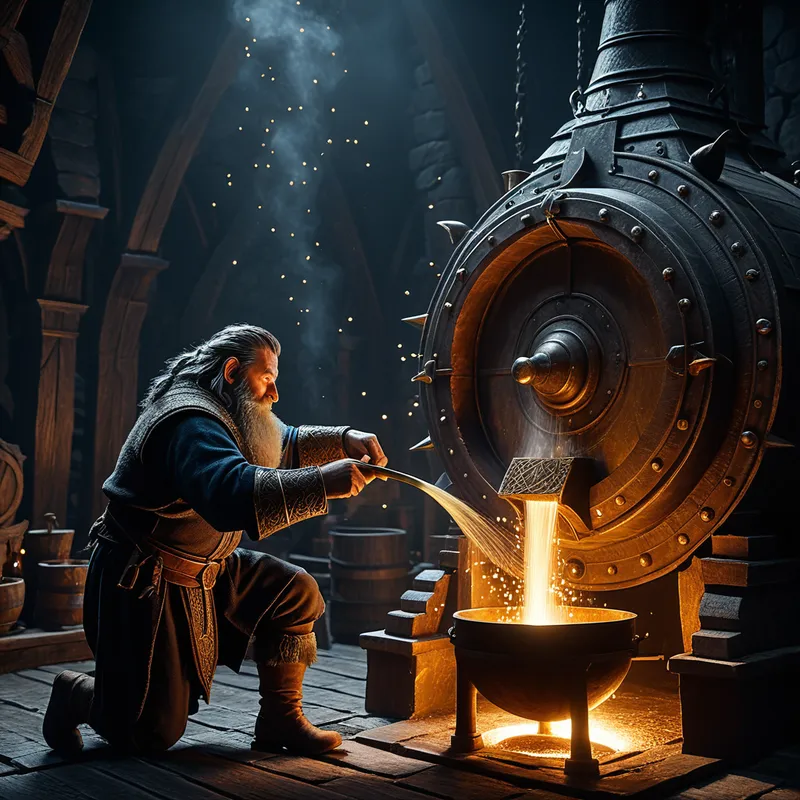
In their hidden forge, with Brokkr working the bellows against a swarm of Loki-disguised-as-a-fly, Eitri wrought miracles. From the fire came [Gullinbursti](/myths/gullinbursti “Myth from Norse culture.”/). From [the crucible](/myths/the-crucible “Myth from Alchemical culture.”/) came Draupnir. And finally, from the anvil, he brought forth Mjolnir, the terror of giants, the protector of gods and humans alike—though its handle was left a touch short by Loki’s final, desperate bite. The treasures were borne to Asgard, and the dwarves’ craft was deemed supreme, their names etched into the bones of the world-tree itself. They are the unthanked makers, the architects of fate, forever shaping the tools of others from the raw darkness they call home.
Cultural Origins & Context
The myths of the dwarves, like all Norse lore, were not scripture but living story, passed down orally by skalds and poets across the Viking Age. They are preserved primarily in the Prose Edda and the older, poetic fragments of the Poetic Edda. These stories functioned as more than entertainment; they were a cosmological map and a cultural mirror.
In a society where mastery of material craft—shipbuilding, metalwork, woodcarving—was essential for survival and status, the dwarves embodied the ultimate ideal of the artisan. Their existence explained the origin of prized objects and natural wonders: a particularly fine sword, a vein of ore, a strangely shaped stone. They represented the mysterious, almost magical process of transforming raw, base material (stone, ore) into objects of immense cultural power and value. Furthermore, as beings of [the underworld](/myths/the-underworld “Myth from Greek culture.”/), they occupied a crucial liminal space in the Norse cosmos, mediating between the chaotic raw material of the primordial past (Ymir’s corpse) and the ordered, yet fragile, reality of the present world of gods and humans.
Symbolic Architecture
Psychologically, the dwarves are not merely fantasy laborers; they are the personification of the unconscious creative process. They dwell in the [shadow](/symbols/shadow “Symbol: The ‘shadow’ embodies the unconscious, repressed aspects of the self and often represents fears or hidden emotions.”/), not as a place of pure evil, but as the repository of raw potential, instinct, and unformed genius. Their [realm](/symbols/realm “Symbol: The symbol of ‘Realm’ often signifies the boundaries of one’s consciousness, experiences, or emotional states, suggesting aspects of reality that are either explored or ignored.”/) is the somatic, chthonic [underworld](/symbols/underworld “Symbol: A symbolic journey into the unconscious, representing exploration of hidden aspects of self, transformation, or confronting repressed material.”/) of the [body](/symbols/body “Symbol: The body in dreams often symbolizes the dreamer’s self-identity, personal health, and the relationship they have with their physical existence.”/) and the instinctual [psyche](/myths/psyche “Myth from Greek culture.”/).
The dwarf’s forge is the crucible of the unconscious, where the base metals of instinct, trauma, and forgotten memory are subjected to the transformative fire of attention.
The treasures they create—Draupnir (generativity), Mjolnir (focused will and [defense](/symbols/defense “Symbol: A protective mechanism or barrier against perceived threats, representing boundaries, security, and resistance to external or internal challenges.”/)), Gungnir (purposeful [direction](/symbols/direction “Symbol: Direction in dreams often relates to life choices, guidance, and the path one is following, emphasizing the importance of navigation in personal journeys.”/))—are symbolic of the potent psychological faculties that can only be forged by engaging with our own [depths](/symbols/depths “Symbol: Represents the subconscious, hidden emotions, or foundational aspects of the self, often linked to primal fears or profound truths.”/). The dwarves work for the gods, meaning these profound capacities are ultimately in service to the ruling principles of [consciousness](/symbols/consciousness “Symbol: Consciousness represents the state of awareness and perception, encompassing thoughts, feelings, and experiences.”/) ([the ego](/myths/the-ego “Myth from Jungian culture.”/) and the Self), but they cannot be commanded directly. They must be approached with respect, and their work often requires a pact, a wager, or a price—symbolizing the psychic [energy](/symbols/energy “Symbol: Energy symbolizes vitality, motivation, and the drive that fuels actions and ambitions.”/) and risk required for true creation.
The Dreamer’s Resonance
When the motif of the dwarf appears in modern dreams, it rarely manifests as a literal, folkloric figure. Instead, one may dream of being in a vast basement, a network of tunnels, or a hidden workshop. There is a sense of pressure, of being underground, coupled with a focused, urgent activity. You might be trying to fix a complex, broken machine, or you are observing small, intense figures meticulously assembling something of great importance.
Somatically, this dream pattern often correlates with a process of deep, almost physical integration. It speaks to a period where the psyche is working on a foundational level, below the radar of conscious thought, to forge a new capability or reconcile a core conflict. The feeling upon waking can be one of subterranean exhaustion, as if real labor has occurred in the night. It is the psyche’s workshop phase, where the raw materials of lived experience—our pains, our passions, our neglected skills—are being hammered into a new form. The dream is an invitation to acknowledge this hidden labor, to respect the time and darkness required for crafting something durable within oneself.
Alchemical Translation
The myth of the dwarves provides a precise model for the alchemical stage of [nigredo](/myths/nigredo “Myth from Alchemical culture.”/)—the blackening, the descent into [the prima materia](/myths/the-prima-materia “Myth from Alchemical culture.”/)—and its subsequent transmutation. The process begins with the massa confusa, represented by the corpse of Ymir: the chaotic, undifferentiated stuff of our unexamined life and inherited patterns. The dwarves are born from this; they are the latent, organizing intelligence within the chaos itself.
The individuation journey requires us to send our consciousness (the “godly” aspect) down into this personal Svartalfheim. We must engage with our own “dwarves”—the often-stubborn, literal, instinctual, and craft-oriented complexes that dwell in our psychological shadow. These are the parts of us that hold skill, patience, and gritty perseverance, but also perhaps greed, resentment, or a refusal to see the bigger picture.
To own one’s hammer is to claim the power of conscious formation; to own one’ anvil is to accept the resistant reality upon which the self is shaped.
The alchemical work is to provide the “bellows” of sustained attention and the “fire” of emotional energy to these inner smiths. The wager with Loki represents the trickster nature of the psyche that both instigates and interferes with creation, testing the resolve of the process. The outcome is not merely a product, but a faculty: a Mjolnir of focused will to act in the world, a Draupnir of inner fertility that generates new possibilities. We do not become the dwarf; we learn to honor its craft, integrating its forged gifts into the sovereignty of a more complete Self, capable of both weathering storms and creating enduring value from the dark ore of experience.
Associated Symbols
Explore related symbols from the CaleaDream lexicon: