
The Duppy Spirit Jamaica Myth Meaning & Symbolism
A tale of restless spirits from the crossroads of African memory and Caribbean soil, teaching the necessity of confronting what we have buried.
The Tale of The Duppy Spirit Jamaica
Hush now, and listen close. This story does not begin in the light, but in the deep, velvet dark of a Jamaican night, when the moon is a sliver and the wind carries the salt of the sea and the sigh of the past. It is a story of the yard, the red earth packed hard by generations, and of the things that walk when proper folk are meant to be asleep.
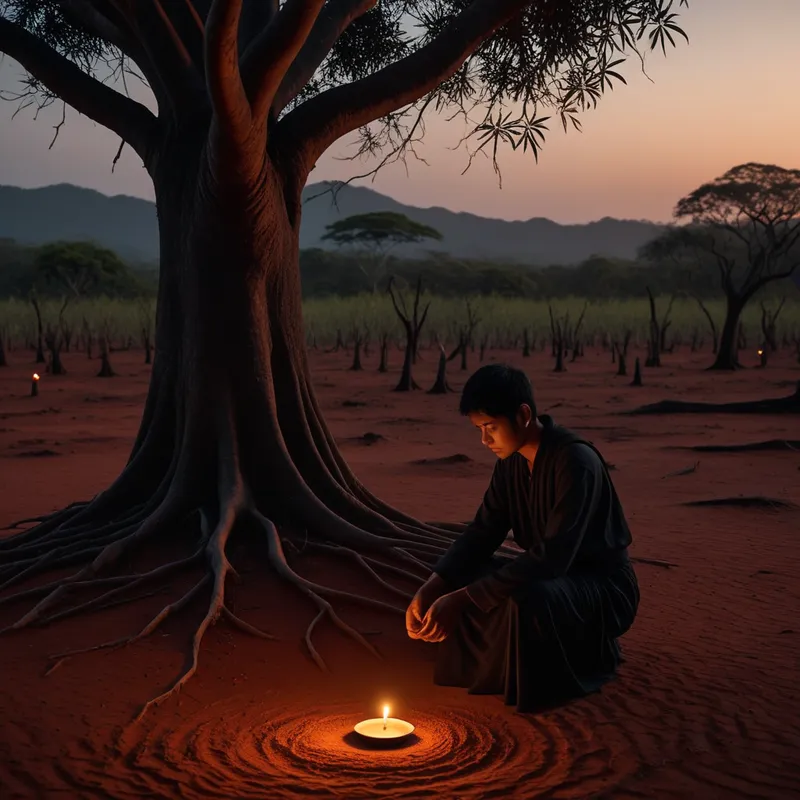
In the time when memory was a chain and the future a door yet unopened, there lived a spirit of the in-between. They called it a Duppy. This was no simple ghost of mist and moan. This was a weight, a presence born from a story cut short. Perhaps it was a man who met a violent end at the crossroads, his justice denied. Perhaps it was a mother who passed in sorrow, her children lost to the waves of history, her lullaby unfinished. Their life-song ended on a discordant note, and so their shadow remained, tethered to the places of their pain—the old silk cotton tree with roots deep as time, the bottom of a dry well, the corner of a forgotten plantation wall.
The Duppy does not announce itself with thunder. It arrives in the creeping cold that makes the skin prickle on a warm night. It is the sudden sickness that befalls a healthy child, the milk that sours in the churn for no reason, the tool that vanishes and reappears in a foolish place. It is the shape you see from the corner of your eye, just at the edge of the lamplight, that is gone when you turn your head. It is a hunger for recognition, a debt of memory that demands payment.
To confront a Duppy, one must be brave and wise. You cannot fight it with fists or fire, for it is made of older stuff. You must meet it at its own threshold. The wise ones, the Obeah man or woman, would listen to the whispers in the community—whose name was spoken in fear, what tragedy was left un-mourned. They would prepare: grains of salt, pure and sharp to the spirit’s tongue, a candle flame to hold back the pressing dark, words of power that were old when the ships first sailed.
The ritual was a conversation with the abyss. At the crossroads, or beneath the haunted tree, the offerings were made. Not gold or finery, but things of essence: rum, food, tobacco smoke. And then, the calling. Speaking the Duppy’s true name, acknowledging its story, its pain, its unfinished business. In that moment of fearless recognition, the haunting would transform. The oppressive cold might lift. The shadow might take a clearer, sadder form, nod once, and then—like smoke caught by the morning wind—dissipate. The chain was broken. The discordant note could finally resolve, not into silence, but into the vast, quiet song of the ancestral world. The yard was peaceful once more, but forever changed, for a truth had been faced and a memory laid to its rightful rest.
Cultural Origins & Context
The Duppy is a profound artifact of the African Diaspora, specifically born in the crucible of Jamaica. Its roots are tangled deep in the spiritual soil of West and Central Africa, where the dead are not gone but transitioned to another plane of existence, remaining active participants in the community’s life. Concepts of the restless dead, those who died badly or without proper ritual, exist among the Akan (the sasa), the Kongo (the mvumbi), and others.
Transported across the Atlantic in the minds and hearts of the enslaved, these beliefs did not die; they mutated. They encountered the brutal reality of the Middle Passage, plantation life, and premature, often violent death. The Duppy is the spectral embodiment of this historical trauma—the spirit of those who were denied proper burial, who died with their stories untold, their desires unfulfilled, their justice unachieved. It is a folklore born from a need to explain unexplained misfortunes, but more importantly, to maintain a relationship with the past, however painful.
Passed down orally in yards and kitchens, in stories told to warn children (“Come in before dark, or duppy will catch you!”) and in the serious consultations with elders and Obeah practitioners, the Duppy myth served multiple societal functions. It was a moral compass, warning against wrongdoing that could lead to a restless afterlife. It was a social glue, as dealing with a Duppy often required community knowledge and collective memory to identify the spirit. Ultimately, it was a mechanism of psychological and spiritual resilience—a way to name, confront, and ritually manage the pervasive presence of historical and personal grief that could not otherwise be expressed.
Symbolic Architecture
The Duppy is the ultimate [symbol](/symbols/symbol “Symbol: A symbol can represent an idea, concept, or belief, serving as a powerful tool for communication and understanding.”/) of the Unfinished. It represents every unresolved [emotion](/symbols/emotion “Symbol: Emotion symbolizes our inner feelings and responses to experiences, often guiding our actions and choices.”/), every unhealed [trauma](/symbols/trauma “Symbol: A deeply distressing or disturbing experience that overwhelms the psyche, often manifesting in dreams as unresolved emotional wounds or psychological injury.”/), every secret [shame](/symbols/shame “Symbol: A painful emotion arising from perceived failure or violation of social norms, often involving exposure of vulnerability or wrongdoing.”/), and every promise broken that we, or our ancestors, have left in our wake. It is the psychic [residue](/symbols/residue “Symbol: What remains after a process or event; traces left behind that persist beyond the original occurrence.”/) that haunts the “[yard](/symbols/yard “Symbol: A yard symbolizes a space of personal growth, boundaries, and external representation of the self.”/)” of our personal and collective psyche.
The Duppy is not the past itself, but the past’s active, hungry shadow. It is memory that has not been metabolized into wisdom, but remains as a poison in the soil of the present.
The [silk](/symbols/silk “Symbol: A luxurious natural fiber representing refinement, sensuality, and transformation from humble origins to exquisite beauty.”/) [cotton](/symbols/cotton “Symbol: A natural fiber representing purity, comfort, and vulnerability, often linked to childhood, healing, and economic systems.”/) [tree](/symbols/tree “Symbol: In dreams, the tree often symbolizes growth, stability, and the interconnectedness of life.”/) under which it often dwells is a powerful symbol of its [nature](/symbols/nature “Symbol: Nature symbolizes growth, connectivity, and the primal forces of existence.”/). With its vast, above-ground roots, it is a literal and figurative embodiment of the visible and hidden support structures of [history](/symbols/history “Symbol: History in dreams often represents the dreamer’s past experiences, lessons learned, or unresolved issues that continue to influence their present.”/). The Duppy lives in these roots—in the foundational, often ugly, truths we build upon. The rituals to dispel it—[salt](/symbols/salt “Symbol: Salt represents purification, preservation, and the essence of life. It is often tied to the balance of emotions and spiritual cleansing.”/), light, calling its name—are not magic tricks but profound symbolic acts. Salt represents preservation and [truth](/symbols/truth “Symbol: Truth represents authenticity, honesty, and the quest for knowledge beyond mere appearances.”/)-telling (it stings the [spirit](/symbols/spirit “Symbol: Spirit symbolizes the essence of life, vitality, and the spiritual journey of the individual.”/) of false [peace](/symbols/peace “Symbol: Peace represents a state of tranquility and harmony, both internally and externally, often reflecting a desire for resolution and serenity in one’s life.”/)). Light is [consciousness](/symbols/consciousness “Symbol: Consciousness represents the state of awareness and perception, encompassing thoughts, feelings, and experiences.”/), the act of looking directly at what frightens us. Calling its name is the act of [integration](/symbols/integration “Symbol: The process of unifying disparate parts of the self or experience into a cohesive whole, often representing psychological wholeness or resolution of internal conflict.”/), of saying, “I see you. I acknowledge your pain as part of my [story](/symbols/story “Symbol: The symbol of ‘Story’ represents the narrative woven through our lives, embodying experiences, lessons, and emotions that shape our identities.”/).”

The Dreamer’s Resonance
When the pattern of the Duppy myth arises in modern dreams, it signals a profound somatic and psychological process: the emergence of the unintegrated shadow. The dreamer is not being haunted by an external ghost, but by an internalized fragment of their own history or psyche that is demanding attention.
This might manifest as a recurring dream of a presence in the house (the psyche), often a forgotten room or basement (the unconscious). The presence may cause malfunctions—lights flickering (clarity failing), locks not working (defenses breached), a pervasive sense of dread. The dreamer might be fleeing a shapeless pursuer or trying to placate a sorrowful, silent figure. Somatically, upon waking, one might feel an unexplained heaviness, a chill, or a sense of contamination.
This is the psyche’s way of stating that something has been buried alive. It could be a childhood trauma, a repressed grief over a lost relationship, a denied aspect of one’s identity, or even an ancestral memory held in the body. The Duppy-dream is a crisis and an invitation: the unconscious material has gained enough energy to disrupt the status quo, forcing a confrontation. The process underway is the initial, often terrifying, recognition of this “haunting.”

Alchemical Translation
The myth of the Duppy provides a precise alchemical map for the modern individuation process, specifically the nigredo or blackening phase—the confrontation with the shadow. The goal is not to destroy the Duppy, but to transmute it from a haunting, autonomous complex into an integrated part of the self.
First, we must locate the haunting (identify the symptom: chronic anxiety, a repeating relationship pattern, a inexplicable rage). This is noticing the “cold spot” in our emotional life. Then, we must go to the crossroads—the liminal space of therapy, meditation, journaling, or creative expression where conscious and unconscious can meet.
The core alchemical act is calling its name. This is the fearless, compassionate investigation: What is this pain? When did it enter my story? Whose face does it wear? This requires the salt of brutal honesty and the candle-flame of sustained attention. We offer the “rum and food” of our conscious feeling—allowing ourselves to truly feel the grief, anger, or shame we’ve avoided.
The ritual is complete not when the spirit vanishes, but when its energy is reclaimed. The Duppy’s hunger was for acknowledgment. Once fed with truth, its chaotic power transforms into ancestral wisdom, a deeper rooting in one’s own complete story.
The resolution is integration. The oppressive “haunting” energy dissolves, and in its place comes a more complex, grounded, and authentic sense of self. The yard of the psyche is now fertilized by this once-toxic material, allowing for new, conscious growth. We achieve not a peace that is mere absence of conflict, but a wholeness that includes the reconciled shadow. We learn that to be fully alive, we must learn how to properly bury our dead.
Associated Symbols
Explore related symbols from the CaleaDream lexicon:
- Spirit — The Duppy is the quintessential unsettled spirit, representing psychic energy that has not found its proper place in the order of the conscious self or the ancestral world.
- Ancestral Spirits — The Duppy exists as a dysfunctional subset of the ancestral realm; it is an ancestor who cannot rest, highlighting the importance of proper remembrance and ritual in maintaining healthy lineage.
- Shadow — The Duppy is a perfect embodiment of the Jungian shadow: the disowned, often frightening parts of the personal and collective psyche that autonomously influence our lives until confronted.
- Root — Symbolizing the deep, often hidden historical and psychological causes of the haunting, connecting the present disturbance to traumas buried in the foundational layers of personal or cultural history.
- Door — Represents the threshold between the world of the living and the spirit world, and the conscious choice to open that door to confront what lies beyond, which is the first step in resolving the haunting.
- Ritual — The prescribed, symbolic actions (salt, light, naming) required to engage with and transform the Duppy, mirroring the therapeutic or introspective practices needed to integrate shadow material.
- Grief — The primary emotional substance of many Duppies; it is unmourned loss that gives the spirit its weight and its sorrowful, persistent presence in the world.
- Tree — Specifically the silk cotton tree, representing the living, growing structure of history and family, within whose ancient roots and shadows the unresolved past makes its home.
- Mirror — In confronting a Duppy, one is forced to see a reflection of one’s own fragmented or denied history; the spirit acts as a dark mirror to what has been suppressed.
- Journey — The process of identifying, confronting, and laying a Duppy to rest is an inner journey into the underworld of the psyche, requiring courage and guidance to navigate.
- Death — Not as an end, but as a failed transition; the Duppy myth is about the pathology of death where the process is incomplete, teaching that psychological “deaths” (endings, losses) also require proper completion.