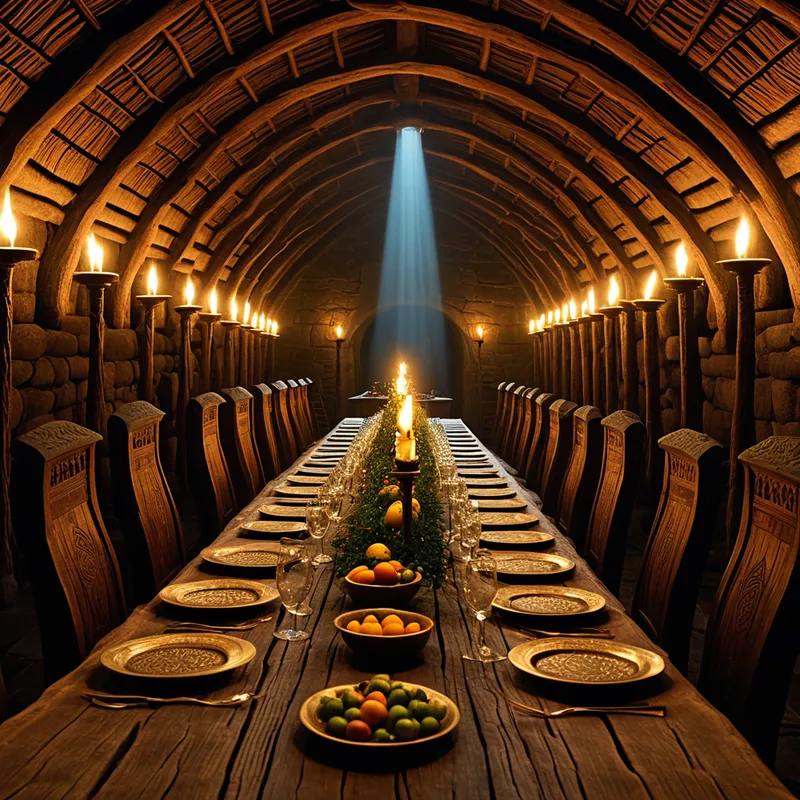
The Dumb Supper Myth Meaning & Symbolism
A ritual of silent communion where the living host the dead, navigating grief to reclaim lost wisdom and restore the fractured soul.
The Tale of The Dumb Supper
Listen, and let the fire’s crackle become [the hearth](/myths/the-hearth “Myth from Norse culture.”/) of memory. In a time when [the veil](/myths/the-veil “Myth from Various culture.”/) between the worlds was as thin as the last autumn leaf, there lived a chieftain named Cumha. His hall, once roaring with the boasts of warriors and the songs of bards, had fallen into a silence deeper than winter snow. A great sickness had swept through the land, taking not only his beloved wife and firstborn son, but with them, the very soul of his people. The stories had fled. The tunes for the harvest were forgotten. The land itself seemed to hold its breath, grieving for the voices that had named it.
Cumha wandered the empty fields, a king without a kingdom, a man whose heart was a sealed tomb. One evening, as [Samhain](/myths/samhain “Myth from Celtic culture.”/)’s dusk bled into night, an old fili, her eyes like wells into forgotten hills, barred his path. “You mourn the flesh,” she whispered, her voice the sound of dry reeds, “but you have buried the spirit alive. You host a feast of absence. You must host a feast of presence.”
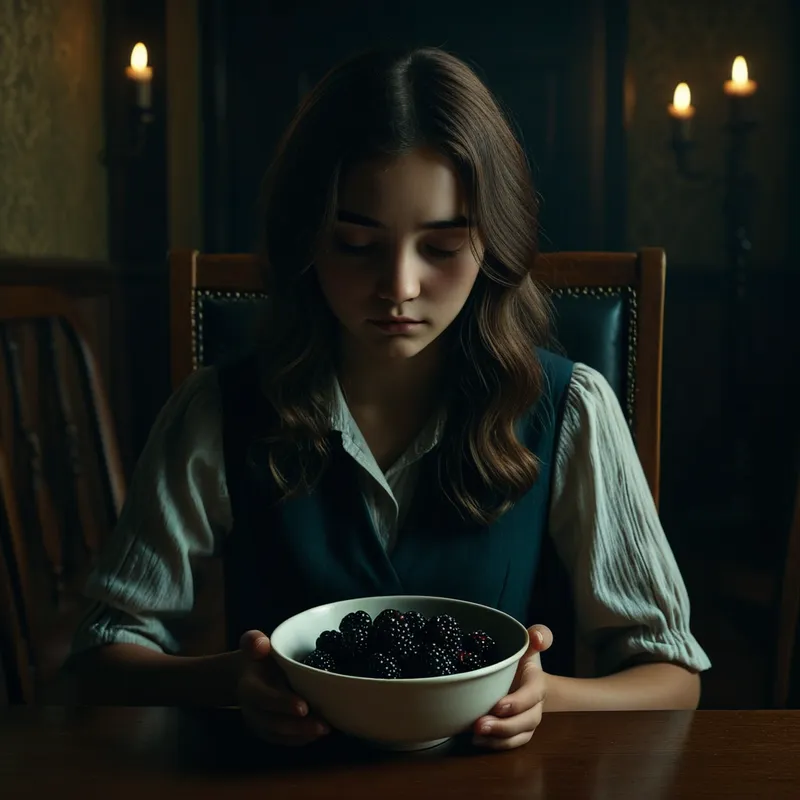
She instructed him in the old, perilous rite: The Dumb Supper. On the third night of the new moon, he was to prepare a table with the finest of the late harvest—blackberries, nuts, apples, dark bread, and a cup of the strongest ale. He must set a place for each of his lost kin, and one extra for any unnamed soul who might wander. The rules were absolute: not a word, not a sigh, not a clatter of dish upon dish. The work was to be done in reverent silence, the food served backwards, from the last course to the first. Then, he was to sit at the foot of the table and wait.
Terror colder than the grave river gripped Cumha, but a spark deeper than despair ignited. He prepared the hall. As night fell, he moved like a ghost in his own home, laying the places, pouring the ale. The silence was a living [thing](/myths/thing “Myth from Norse culture.”/), pressing on his ears. He took his seat, his eyes fixed on the empty chairs. Time unraveled. The torch flames seemed to still. Then, a scent not of earth, but of ozone and damp moss. A faint chill, not unpleasant, like the air from a deep forest well.
One by one, the chairs were no longer empty. Forms gathered, shimmering like heat haze over summer stone. He saw his wife, not as in life, but as the essence of her laughter. He saw his son, a presence of unspent courage. Other, older figures from the lineage he barely remembered took shape. They did not eat the food, but a subtle warmth left the bowls, a faint steam rose from the cups, as if the essence of the offering was consumed. The silence was no longer empty; it was full. It was a conversation of shared memory, flowing without sound.
In that wordless communion, a weight lifted from Cumha’s chest, not the weight of grief, but the weight of isolation. He was not alone in his remembering. As the first grey light touched the eastern window, the figures began to fade. But his wife’s presence lingered a moment longest. Her shimmering hand passed over the extra, unnamed place at the table’s head. Upon the plate, where there had been nothing, now lay a single, perfect hazelnut.
With the dawn, the spell broke. Sound returned—the call of a waking crow, the sigh of [the wind](/myths/the-wind “Myth from Various culture.”/). Cumha, his face wet with tears not of bitterness but of release, picked up the hazelnut. When he cracked it open, it did not contain meat, but a tiny, coiled leaf from a tree that had not grown in that land for a hundred generations. It was a story, returned. That day, he spoke for the first time in seasons, and his voice, though rough, began to sing the old tunes back into [the world](/myths/the-world “Myth from Tarot culture.”/).
Cultural Origins & Context
The motif of the Dumb Supper finds its roots not in a single, codified myth, but in the rich substratum of Celtic folk practice and belief, particularly associated with Samhain. The “Celtic” culture referenced here is a tapestry of Iron Age tribes whose worldview was profoundly animistic and cyclical. The dead were not gone; they resided in the [Sídhe](/myths/sdhe “Myth from Celtic / Irish culture.”/) or [Tír na nÓg](/myths/tr-na-ng “Myth from Celtic culture.”/), accessible at certain liminal times—dusk, dawn, and the turning points of the year like Samhain.
This was not a priestly ritual from high mythology, but a folk custom, passed down through generations of women, often as a form of divination or remembrance. Historical and folkloric records, particularly from Scotland, Ireland, and Wales, describe variations where young women would perform the silent supper to catch a glimpse of their future husbands among the visiting dead. The strict adherence to silence, the backwards serving, and the extra “stranger’s” place were crucial ritual technologies to navigate the sacred danger of this communion. Its societal function was dual: it was a technology for managing grief and memory, ensuring the ancestors remained integrated into the community’s fabric, and it was a pragmatic, if terrifying, method of divination, seeking wisdom from the one realm that knows all futures—the past.
Symbolic Architecture
At its core, the Dumb Supper is a myth of the broken container and its sacred repair. The hall of Cumha represents the [psyche](/myths/psyche “Myth from Greek culture.”/) in a state of traumatic [rupture](/symbols/rupture “Symbol: A sudden break or tear in continuity, often representing abrupt change, separation, or the shattering of established patterns.”/). The forgotten [stories](/symbols/stories “Symbol: Stories symbolize the narratives of our lives, reflecting personal experiences and collective culture.”/) and songs symbolize a [loss](/symbols/loss “Symbol: Loss often symbolizes change, grief, and transformation in dreams, representing the emotional or psychological detachment from something or someone significant.”/) of meaning, a disconnection from the animating libido or [life](/symbols/life “Symbol: The symbol of ‘Life’ represents a journey of growth, interconnectedness, and existential meaning, encompassing both the joys and challenges that define human experience.”/)-force. The [ritual](/symbols/ritual “Symbol: Rituals signify structured, meaningful actions carried out regularly, reflecting cultural beliefs and emotional needs.”/) is the deliberate, courageous act of re-creating the container—the [table](/symbols/table “Symbol: Tables in dreams often symbolize stability, social interactions, and a platform for discussions, negotiations, or decisions in our waking life.”/)—and inviting the disavowed contents back in.
The unspoken guest is always the most important. The empty chair is an altar to the unknown self.
The silence is not merely procedural; it is the essence of the [operation](/symbols/operation “Symbol: An operation signifies a process of change or transformation that often requires deliberate effort and planning.”/). In a world saturated with [noise](/symbols/noise “Symbol: Noise in dreams signifies distraction, confusion, and the need for clarity amidst chaos.”/) and personal narrative, silence creates a [vessel](/symbols/vessel “Symbol: A container or structure that holds, transports, or protects something essential, representing the self, emotions, or life journey.”/) deep enough to hold the transpersonal. It is [the ego](/myths/the-ego “Myth from Jungian culture.”/) relinquishing its compulsive commentary, making [space](/symbols/space “Symbol: Dreaming of ‘Space’ often symbolizes the vastness of potential, personal freedom, or feelings of isolation and exploration in one’s life.”/) for the voices of the [shadow](/symbols/shadow “Symbol: The ‘shadow’ embodies the unconscious, repressed aspects of the self and often represents fears or hidden emotions.”/) and the archetypes. The backwards serving symbolizes a reversal of ordinary [consciousness](/symbols/consciousness “Symbol: Consciousness represents the state of awareness and perception, encompassing thoughts, feelings, and experiences.”/), a [journey](/symbols/journey “Symbol: A journey in dreams typically signifies adventure, growth, or a significant life transition.”/) back in time and into the unconscious to the root of the nourishment (the [trauma](/symbols/trauma “Symbol: A deeply distressing or disturbing experience that overwhelms the psyche, often manifesting in dreams as unresolved emotional wounds or psychological injury.”/), the loss, the forgotten wisdom).
The ancestors represent the contents of the personal and [collective unconscious](/symbols/collective-unconscious “Symbol: The Collective Unconscious refers to the part of the unconscious mind shared among beings of the same species, embodying universal experiences and archetypes.”/)—our inherited traumas, talents, and patterns. They are not literal ghosts, but psychic data, complex emotional memories that demand [integration](/symbols/integration “Symbol: The process of unifying disparate parts of the self or experience into a cohesive whole, often representing psychological wholeness or resolution of internal conflict.”/). The hazelnut, in Celtic lore the [symbol](/symbols/symbol “Symbol: A symbol can represent an idea, concept, or belief, serving as a powerful tool for communication and understanding.”/) of concentrated wisdom (from the Salmon of [Knowledge](/symbols/knowledge “Symbol: Knowledge symbolizes learning, understanding, and wisdom, embodying the acquisition of information and enlightenment.”/) myth), represents the [kernel](/symbols/kernel “Symbol: Represents potential, hidden essence, or the core of something waiting to develop. Often symbolizes beginnings, nourishment, or unexpressed emotions.”/) of new consciousness born from this encounter. It is not a return to the old life, but the [germination](/symbols/germination “Symbol: A symbol of new beginnings, potential, and the emergence of life from dormancy, often representing personal growth, ideas, or emotional states.”/) of a new understanding from the core of the old pain.

The Dreamer’s Resonance
When this myth stirs in the modern dreamer, it often manifests as dreams of preparing for unseen guests in a state of anxious solemnity, or of sitting at a table with familiar-yet-strange figures where communication happens through feeling, not word. One may dream of trying to speak at such a feast and finding their voice gone, or of watching as food turns to dust or ectoplasm.
These dreams signal a critical somatic and psychological process: the psyche is attempting to host what has been excluded. The “dumb” or mute aspect points to a feeling or memory that has been rendered wordless—a pre-verbal trauma, a grief too deep for language, an intuition that defies logic. The body may feel heavy, the throat constricted. The process is one of receptive mourning. It is not an active working-through, but a sacred passivity, a allowing. The ego is being asked to stand down, to cease its managing and fixing, and to simply witness the arrival of the disinherited parts of [the self](/myths/the-self “Myth from Jungian culture.”/). The terror in the dream is the fear of being overwhelmed by this unconscious material; the resolution, when it comes, is the profound relief of no longer carrying the burden of exile alone.
Alchemical Translation
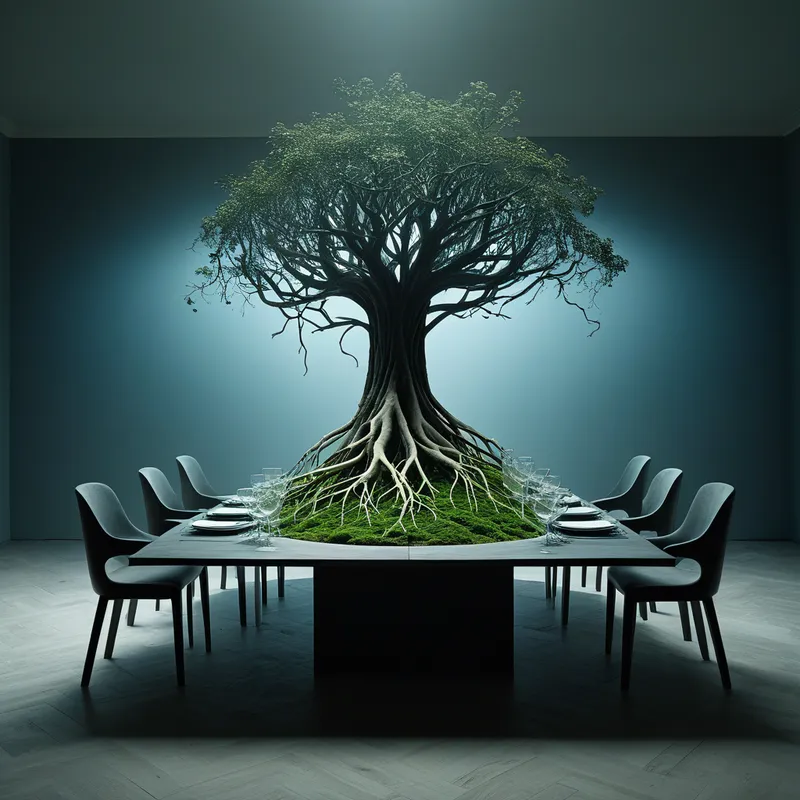
The alchemical journey mirrored in the Dumb Supper is the [nigredo](/myths/nigredo “Myth from Alchemical culture.”/), the descent into the blackness of despair and dissolution (Cumha’s empty hall), followed by the ablutio and albedo of the silent, cleansing ritual. The myth provides a model for psychic transmutation in the modern individuation process.
Individuation begins not with adding a new skill, but with hosting the oldest, most silent parts of yourself.
First, one must acknowledge the Famine of Meaning—the Samhain of the soul, where old identities have died and nothing new grows. Then, one must consciously Set the Table in Silence. This is the disciplined creation of inner space through meditation, journaling, or therapy, where the ego’s chatter is intentionally stilled. The Backwards Serving is the courageous act of tracing current suffering back to its roots in personal and family history, without judgment.
The Communion with the Ancestors is the heart of shadow-work: facing the inherited wounds, the parental complexes, the cultural traumas that sit as ghosts at our inner table. We do not “eat” them (identify with them) nor banish them; we acknowledge their presence and offer them the warmth of our attention. Finally, the Gift of the Hazelnut is the emergent symbol, the new insight or direction that arises not from the ego, but from the depths of this integrative process. It is the small, hard seed of a new narrative, a new piece of one’s own myth, returned from the land of the dead, ready to be planted in the world of the living. The ritual transforms isolation into community, grief into wisdom, and a sealed tomb into a hall once again fit for life.
Associated Symbols
Explore related symbols from the CaleaDream lexicon: