The Dullahan Myth Meaning & Symbolism
A headless rider, a golden coach, a call in the night. The Dullahan is the Celtic harbinger of death, a myth of fate, finality, and the shadow we must face.
The Tale of The Dullahan
Listen, and listen well, for the wind carries a name that chills the blood. When the moon is a sliver of bone in the sky and the night is so deep the stars seem to drown, you may hear it—the thunder of hooves on empty air. Do not look. Do not dare. For it is the Dullahan who rides.
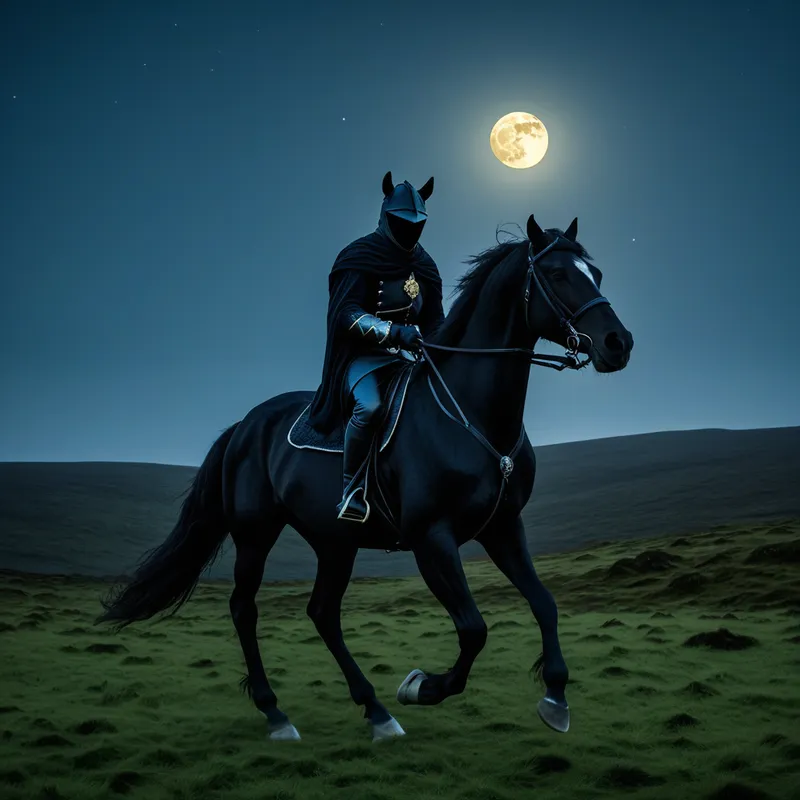
He comes from the hollow hills, from the places where the old gods sleep. His steed is a creature of shadow and nightmare, its eyes like burning coals, its breath the mist of the grave. And upon its back rides the rider… who carries his own head. It is a ghastly thing, the color and texture of moldering cheese, with a hideous, knowing grin and eyes that dart and see all. In one hand, he holds it high, a lantern to his path. In the other, he cracks a whip made from a human spine, its snap the sound of a dying man’s last breath.
His coach follows, a thing of unearthly gold and darkness, drawn by six black horses. Its wheels are silent, but the air screams around it. Where it stops, a life ends. The Dullahan calls out a name—a true name, the one whispered at birth and carried in the soul. He calls it once, and the door of fate swings open. He calls it twice, and the soul begins to loosen its moorings. He never needs to call it a third time.
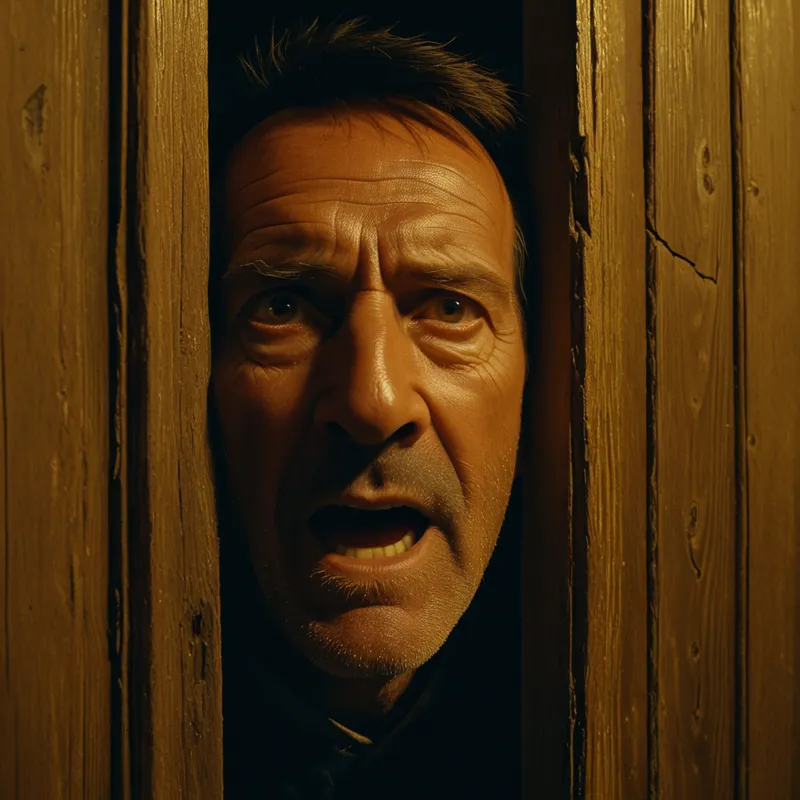
There is a tale of a brave, or perhaps foolish, man in a lonely cottage. He heard the dread silence that precedes the coach and saw the golden light seep under his door. Driven by a terror beyond fear, he peered through the keyhole. And there, in that sliver of vision, he met the gaze of the head held in the rider’s hand. A single drop of blood, black as pitch, fell from the head’s staring eye and struck the man’s own. He was not taken that night. But from that hour, he bore a mark of seeing, a knowledge of the void that never left him. The Dullahan had passed, but a piece of the abyss had been shared.
He rides still. He is the boundary itself, the final gatekeeper. He answers to no god of this world or the next. His law is the law of ending. And his only mercy is his one, singular weakness: a stray, forgotten object of gold. A single gold coin on the road can halt his terrible procession, for even death must pause before the pure, unmoving light of the sun, captured in metal. But beware—it is only a pause. The call will come. It always does.
Cultural Origins & Context
The Dullahan is a figure of specifically Irish folklore, a potent emanation from the rich, dark soil of Celtic mythic consciousness. He is not a god of the Tuatha Dé Danann, but something older and more primal—a fairy, a solitary and terrible spirit of the Unseelie Court. His tales were not written in illuminated manuscripts but whispered at the hearthside, passed down through generations as a seanchas.
This oral tradition served a profound societal function. In a world where death was a constant, intimate companion, the Dullahan gave a shape and a protocol to the unknown. He personified the sudden, inexplicable death—the fever that strikes at midnight, the accident on a lonely road. He was a narrative container for the collective anxiety about fate and mortality. By naming him, describing his habits, and even identifying his rare vulnerability (gold), the culture gained a semblance of control. He transformed blind panic into a story with rules, however terrifying. The myth enforced community boundaries—stay inside at certain hours, respect the old ways, do not interfere with the processes of fate—while also acknowledging the ultimate, sovereign power of death over all human plans.
Symbolic Architecture
Psychologically, the Dullahan is not merely a monster but a profound archetypal symbol of the ultimate Shadow. He is the personification of the reality we spend our lives avoiding: our absolute finitude, the fact that our name will be called.
The Dullahan is the Self stripped of its story, the ego severed from its identifying narrative. He is consciousness confronting its own cessation.
His headlessness is the central symbol. The head is the seat of identity, reason, and persona—everything we use to say “I am.” The Dullahan carries his detached head, showing that he operates from a place beyond individual identity. He is pure function: the announcer of endings. The golden coach symbolizes a perverse, terrifying form of transcendence—not upward toward light, but a final, compulsory journey into the dark. The whip of spine connects him directly to the mortal frame, the physicality of life that he ends. His aversion to gold is deeply alchemical; gold represents the perfected, eternal self, the goal of spiritual transformation. The Dullahan, as raw, untransformed fate, cannot touch this perfected state. He is the catalyst that forces the confrontation which may lead to it, but he is not the goal itself.
The Dreamer’s Resonance
When the Dullahan gallops into modern dreams, he rarely appears in full folkloric regalia. The psyche translates the archetype into contemporary symbols. One might dream of a relentless, faceless authority figure (a boss, a judge, a government agency) issuing a final, inescapable decree. Another might dream of missing a crucial, life-defining appointment or hearing their own name called from an empty, dark space.
Somatically, these dreams are often accompanied by feelings of profound dread, paralysis, or a chilling certainty. The psychological process at work is the ego’s confrontation with a non-negotiable limit. This could be the end of a relationship, a career, a life phase, or the burgeoning awareness of one’s own mortality. The Dullahan dream pattern signals that the psyche is attempting to assimilate a truth too large for the conscious mind to hold—the truth of an ending. It is the soul’s way of rehearsing for a necessary death, not of the body, but of an outworn identity, a false hope, or an unsustainable way of being. The terror is the ego’s protest against its own diminishment.
Alchemical Translation
The individuation journey, the process of becoming whole, is not a path of endless growth but a series of conscious deaths. The Dullahan models the most critical phase of this alchemy: the nigredo, the blackening. This is the encounter with the shadow in its most absolute form.
To engage with this myth alchemically is not to flee the horseman, but to dare to ask: What, in me, must die for my true self to live? The Dullahan’s call is not just a summons to the grave, but a call to radical honesty. It demands we name the aspects of our lives that are already dead but we pretend are alive—the lifeless job, the hollow relationship, the obsolete self-image.
The gold that stops the Dullahan is the authentic, integrated Self we must forge in life. It is the conscious value we create, the meaning we distill from our experiences, which makes the arbitrary call of fate into a meaningful destiny.
The mythical figure who peered through the keyhole and was marked by blood offers a clue. He did not die, but he was forever changed. He saw. The alchemical translation is the courage to “look through the keyhole”—to consciously confront the reality of our limits, our mortality, our shadow. This seeing is a painful initiation. It leaves a mark, a melancholy wisdom. But it also liberates. By staring into the void held in the Dullahan’s hand, we are freed from the petty fears that govern an unexamined life. We begin to live not in denial of death, but in profound relationship to it, understanding that every ending contains the seed of a necessary beginning. We learn to ride with our own darkness, carrying our head not as a trophy of fear, but as a lantern of hard-won awareness.
Associated Symbols
Explore related symbols from the CaleaDream lexicon: