The Dísablót Myth Meaning & Symbolism
A sacred Norse ritual honoring the ancestral feminine spirits, weaving fate, memory, and the deep, guiding power of the underworld.
The Tale of The Dísablót
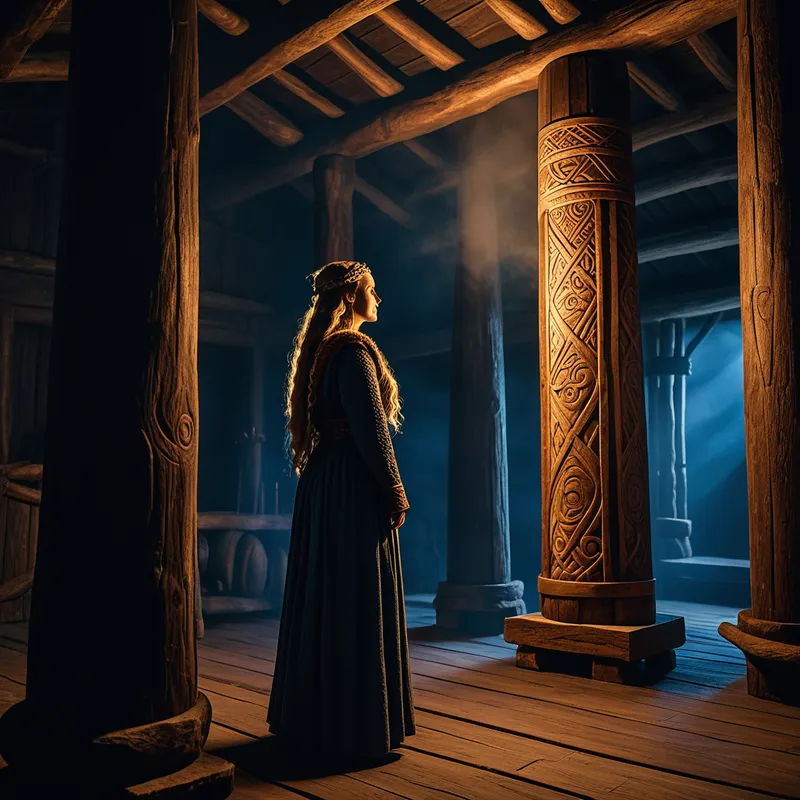
Hear now, and listen with the ear of the heart. The wind does not blow; it holds its breath. The long, dark months have gnawed at the soul of the land, and the sun is a pale, distant memory. In the great hall, the air is not cold, but deep. It is the deep of the well, the deep of the barrow-mound, the deep of time itself.
The people gather, their breath mingling in the fire-lit gloom. All chatter has died. The only sounds are the sigh of the logs and the slow, heavy beat of a heart that is not one heart, but the heart of the clan. At the head of the hall stands the húsfreyja, her face a mask of solemn grace. In her hands, she does not hold a weapon, but a vessel: a great, carved horn, brimming with the blood-dark mead of summer, now a sacred offering.
She approaches the stalli, the high-seat pillar, but her gaze passes through the wood, into the earth below. She is not calling to the thunder-god this night. She turns, and her voice, low and resonant as stone shifting, calls out names. Not the names of the Æsir, but older names. The names of grandmothers seven times removed. The names of daughters lost in childbirth. The names of shield-maidens whose deeds are sung only in the sighing of the pines. These are the dísir.
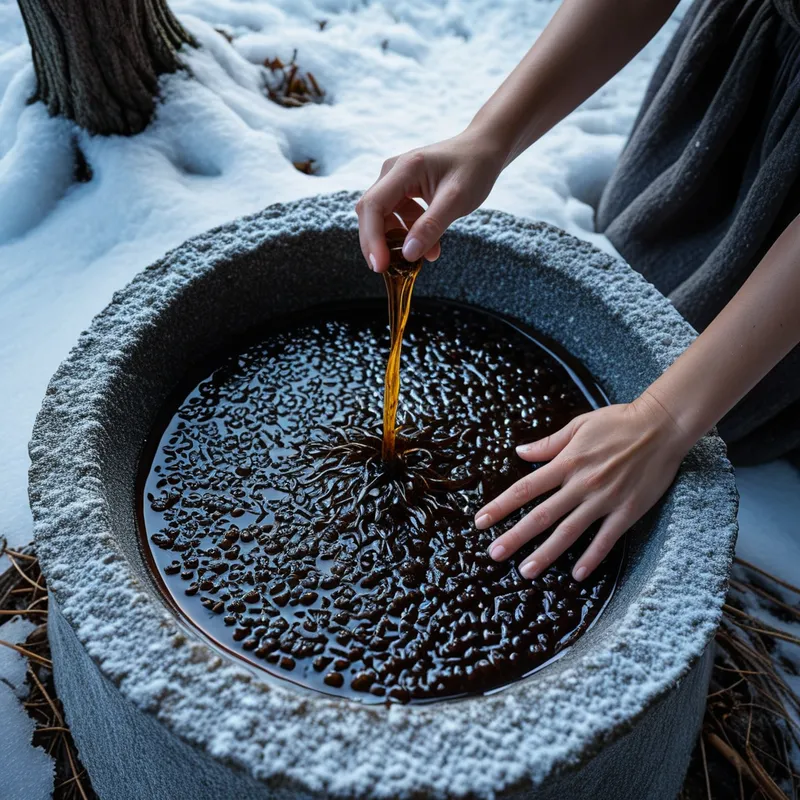
As she pours the first libation onto the packed earthen floor, a silence falls so complete it has weight. It is the silence of the mound. Then, a sensation—not a sound, but a presence. It is as if the very walls of the hall breathe. Shadows near the roof-beams seem to coalesce, to take the form of seated women, watching with eyes that hold the patience of glaciers and the warmth of buried hearths. The air grows thick with the scent of damp soil, of iron, of myrrh.
The húsfreyja speaks, her words a tapestry of remembrance. She recounts the harvest gathered, the children born, the conflicts weathered. She speaks of fears for the coming spring—the seed in the barn, the strength of the young men, the health of the livestock. This is no demand, but a sharing. A laying of the clan’s life before its most ancient mothers.
One by one, others come forward. A grizzled warrior places a ring beside the pillar, whispering the name of the sister who taught him his first spear-cast. A young mother leaves a lock of her child’s hair, her eyes seeking an invisible blessing. The offering is not one of tribute, but of connection. A thread spun across the chasm of death.
And then, as the last drops seep into the earth, a change. The oppressive depth of the air lightens. The watchful presence does not leave, but it softens, becoming protective, encircling. A warmth, subtle as the first hint of thaw, spreads from the hearthstone outward. No vision is granted, no booming prophecy. Only a profound, unshakable certainty: the thread is not broken. The weave holds. The dísir have received the memory, and in return, they grant the courage to face the remaining dark. The ritual ends not with a shout, but with a shared, deep exhalation. The clan is whole.
Cultural Origins & Context
The Dísablót was not a myth for the skalds to sing in crowded courts, but a living, seasonal rite embedded in the domestic and communal heart of pre-Christian Norse society. Primarily attested in later Icelandic sagas and scattered references, it was a blót distinct from those dedicated to the major gods like Odin or Thor. Its timing, often placed at the onset of winter or during the Disting period, marks it as a rite of threshold—performed when the world is most vulnerable, suspended between death and renewal.
This was a ceremony led by women, the húsfreyja of the household or a female godi, underscoring its connection to fertility, lineage, and the guardianship of the home. It was a localized, intimate practice. While grand festivals at places like the Temple at Uppsala might be recorded, the Dísablót happened in the longhouse, by the ancestral burial mound, or in sacred groves. Its function was societal glue: to reaffirm the bond between the living and their ancestral dísir, who were believed to influence fortune, childbirth, and the fate of the family line. It was an act of psychological and spiritual ecology, ensuring the “soil” of the clan—its memory and luck—remained fertile.
Symbolic Architecture
At its core, the Dísablót is a profound symbolic dialogue with the underworld—not a hell of punishment, but the Niflhel of memory, the ancestral ground from which all life springs and to which it returns. The dísir represent the feminine aspect of fate, the ørlög as it is woven into the specific tapestry of a family. They are the psychopomps of lineage.
The offering is not a payment, but a conversation. To pour mead onto the earth is to speak to the roots of your own being.
The ritual’s symbols form a perfect architecture: the hall (the conscious, ordered world), the earth floor (the threshold to the unconscious, the past), and the invisible dísir (the ancestral content of the psyche). The libation is the act of consciousness deliberately reaching down, acknowledging its source. The shared silence is the ego’s humility before the vast, collective psyche. The resulting “warmth” or “certainty” symbolizes the ego’s realignment with its deeper, guiding foundations—a psychic state where one is no longer a lonely individual, but a living branch on an ancient tree.

The Dreamer’s Resonance
When this myth stirs in the modern dreamer, it rarely appears as a Viking hall. Instead, it manifests as a profound somatic and emotional pattern. One may dream of discovering a hidden basement or cellar in their childhood home, filled with forgotten, meaningful objects belonging to long-dead relatives. There may be a compelling urge to clean an attic, sort through old photographs, or visit a graveyard. The dream landscape might be a vast, intricate network of roots one must carefully navigate, or a council of silent, knowing women who impart no words, only a feeling.
Psychologically, this is the process of ancestral shadow-work. It is the psyche’s imperative to integrate the unspoken histories, traumas, talents, and blessings carried in the family unconscious. The “offering” in the dream is the dreamer’s attention—their willingness to hold space for these ghostly contents. The somatic feeling is often one of a deep, grounding weight, a release of anxiety that comes from feeling supported by time itself, from realizing one’s struggles are part of a longer story. It is the opposite of ancestral baggage; it is the discovery of ancestral ballast.

Alchemical Translation
The alchemical process mirrored in the Dísablót is the nigredo—the blackening, the descent into the primal matter. In individuation, this is the often-dark, confusing stage where one confronts the impersonal, inherited layers of the psyche: the family complexes, cultural conditioning, and biological drives that feel like fate.
The ritual models the crucial step: to consciously invite this darkness, to offer it respect and a place at the hearth, rather than fleeing from it or being possessed by it.
The modern individual performs their own Dísablót by engaging in genealogy, by examining repetitive family patterns, by honoring the stories of those who came before—flaws and all. The “mead” offered is one’s conscious life energy and curiosity. The act of naming—“this is my grandmother’s depression, this is my grandfather’s resilience”—is the libation. This does not bind one to the past, but paradoxically, frees one from its unconscious grip. By integrating the dísir, the ancestral powers within, the individual no longer fights their own foundation. They gain access to its deep, time-tested strength and wisdom, transforming inherited ørlög from a sentence into a source of sovereignty. The warmth that returns is the birth of a personality grounded not just in personal history, but in the mythic time of the soul.
Associated Symbols
Explore related symbols from the CaleaDream lexicon: