The Dragon King Zahhak Myth Meaning & Symbolism
A myth of a king corrupted by evil, whose shoulders sprout serpents demanding human brains, until a blacksmith's hero-son rises to forge a new dawn.
The Tale of The Dragon King Zahhak
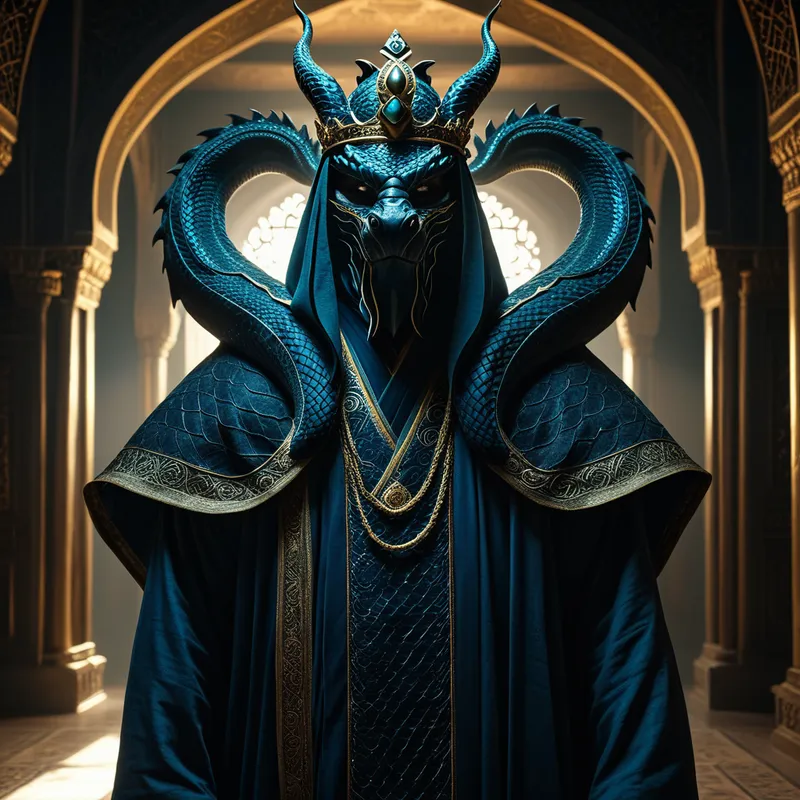
Hear now the tale of the shadow that fell upon the land of Aryana, a tale whispered by the wind through the cypress trees and roared by the fires of the forge. In the dawn of time, there was a king, a youth of noble bearing named Zahhak. But a hole had been bored in the wall of the world, and through it slithered Ahriman, the Lie. Disguised as a wise physician, the Dark One approached the king and praised him, speaking honeyed words of power eternal. “O glorious king,” he whispered, “allow me but to kiss your shoulders, that all strength may flow into you.”
And Zahhak, his heart a field ripe for the seed of pride, consented. Where the Lie’s lips touched, two serpents, black as a starless night, erupted from the king’s flesh. No physician, no sage could cut them away, for they were part of him now, the manifested price of his pact. Then Ahriman returned, now as a cunning cook. “Great King,” he said, “your magnificent new companions hunger. Only one food will sate them: the brains of the youth of Aryana.” And so began the long night. Each day, two young men were chosen, slain, and their brains given to the serpents. The land wept. The sun seemed to dim. Zahhak, once a man, became a prison for the Dragon, a tyrant ruling from a throne of terror for a thousand years.
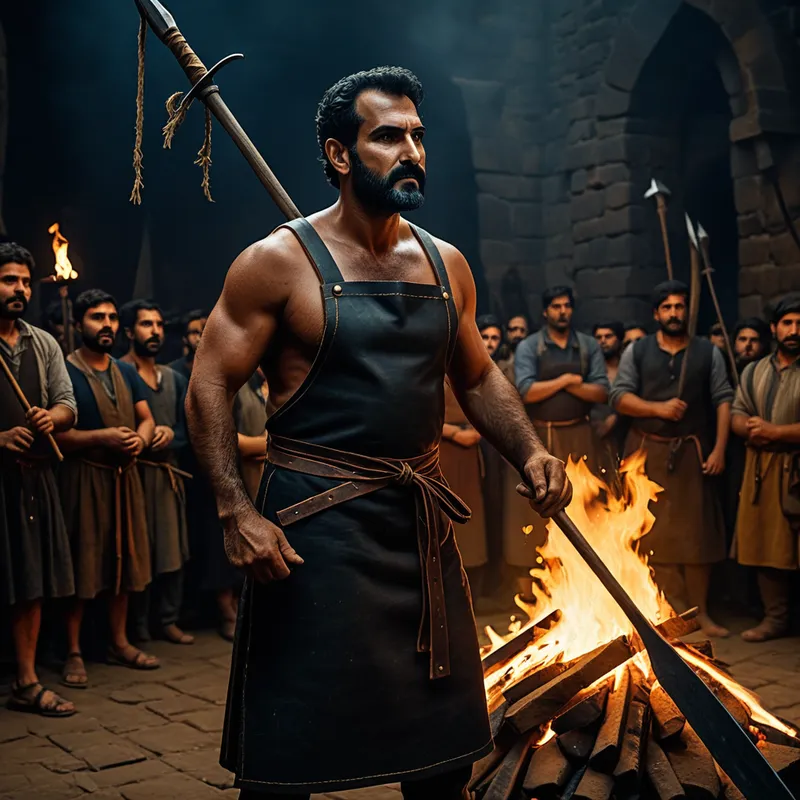
But the soul of a people cannot be extinguished. In a humble forge, the fire of rebellion was kindled. The blacksmith Kaveh had lost seventeen sons to the serpent-king’s hunger. When the guards came for his eighteenth and last, grief turned to white-hot wrath. He tore the leather apron from his body—the apron stained with the soot of his labor and the tears of his loss—and raised it upon a spear. This was no royal standard of silk and gold, but the Banner of the People, a flag of raw, defiant truth.
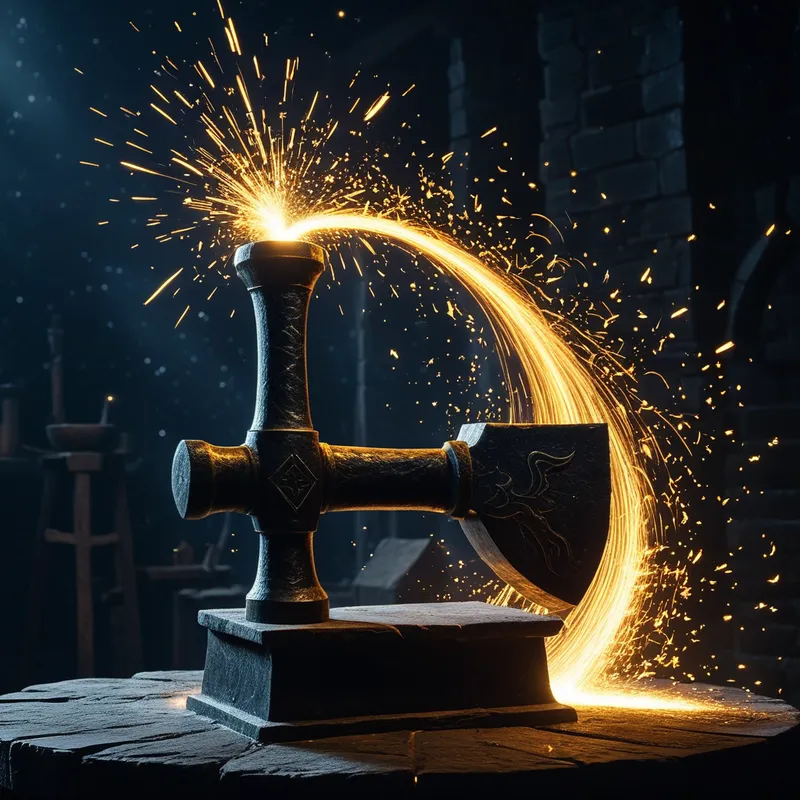
With this banner aloft, Kaveh marched to the mountains, and the people, their hearts a smoldering coal of hope, followed. There they found Fereydun, a youth of royal Farr, raised in secret, whose spirit was as a tempered blade. Forged in the collective will of the oppressed, Fereydun took up the banner. He fashioned a mighty mace, its head like a bull’s, and led the rising tide of humanity to Zahhak’s fortress-palace. The final battle was not of vast armies, but of essence against corruption. Guided by the wisdom of the angel Soroush, Fereydun did not slay the Dragon King. Instead, he bound him with sacred straps and cast him into a deep, dark prison beneath the mighty Mount Damavand, where he remains, chained, until the end of days. The long night broke. The serpents withered. And with the dawn, the cry went up: “Justice has awakened!”
Cultural Origins & Context
This foundational myth is preserved in the Shahnameh (The Book of Kings), composed by the poet Ferdowsi over a thousand years ago. However, its roots dig far deeper into the Zoroastrian soil of pre-Islamic Iran. Zahhak, or Aži Dahāka, appears in the sacred texts of the Avesta as a monstrous, three-headed dragon, a creation of the evil spirit Angra Mainyu. Ferdowsi’s genius was to humanize this cosmic demon, transforming him into a king corrupted—a figure that bridged the cosmic and the political.
The Shahnameh was not merely literature; it was the vessel of Persian language, identity, and ethical philosophy through centuries of upheaval. Recited in coffeehouses and royal courts, the tale of Zahhak served a crucial societal function: it was a mirror held up to power. It defined the nature of illegitimate rule—rule based on deceit, violence against the innocent, and a pact with the inner and outer darkness. Conversely, it modeled legitimate sovereignty as emerging from popular will (Kaveh’s banner), justice, and heroic virtue (Fereydun’s guided strength). It was a mythic charter for resistance against tyranny, reminding both ruler and ruled of the consequences of moral collapse.
Symbolic Architecture
Zahhak is not a monster who invades from without, but one who is cultivated from within. The serpents are not imposed; they sprout from the site of a seductive kiss, a willing acceptance of poisonous flattery and the promise of unchecked power.
The ultimate tyranny is not the serpent on the throne, but the throne we build within ourselves for the serpent.
The serpents represent the insatiable, parasitic aspect of the ego when it aligns with the shadow. Their food—the brains of the youth—is a devastating symbol: the tyranny consumes the future, the intellect, the hope, and the vitality of the people. Each day’ sacrifice is the systematic murder of potential. Kaveh’s leather apron-banner is one of the most powerful symbols of grassroots revolution in world mythology. It represents the dignity of labor transforming grief into a unifying standard. It is not a top-down mandate, but a bottom-up declaration of humanity.
Fereydun’s victory is instructive. He does not exterminate Zahhak; he binds and imprisons him deep within the mountain. Evil, in this cosmology, is not destroyed but contained. The shadow is chained in the dungeon of the collective unconscious, where it remains a perpetual, bound potential. Mount Damavand thus becomes the symbolic axis of the world, the pillar that pins down chaos.
The Dreamer’s Resonance
When this myth stirs in the modern soul, it often manifests in dreams of insidious possession and desperate revolt. You may dream of a growing, uncomfortable burden on your shoulders that you cannot see but can feel moving. You may dream of being forced to feed something horrible, or of being part of a system that demands a cruel, daily sacrifice of your energy, creativity, or relationships (the “brains” of your psychic youth).
The somatic experience is one of a deep, shameful corruption—a sense that something alien has become intrinsic to you. This is the psychological process of confronting the shadow not as a vague notion, but as a structured, feeding entity you have accommodated. The dream of Kaveh rising up is the eruption of the Self’s integrity, the moment when accumulated grief and violation finally crystallize into a clear “no.” It is the forging of an identity (the banner) from the very scars of your history. The dream may feel violent, not because it seeks destruction, but because it is the psychic equivalent of prying a parasitic growth from the host body.
Alchemical Translation
The individuation journey modeled here is the transmutation of a passive, infected state into an active, binding authority. The initial stage is the kiss of Ahriman: our own vulnerabilities—our pride, our hunger for validation, our fear—invite a parasitic complex to attach itself to our psyche. It promises power but feeds on our essence. The serpents grow, and we become the tyrannical king of our own inner kingdom, sacrificing our potential (our creative “youth”) to maintain the sickly status quo.
The alchemical fire is first felt as the searing heat of unbearable loss—the loss of the last son, the last hope. Only in that crucible is the base metal of suffering forged into the weapon of liberation.
Kaveh represents the function of feeling pushed to its extreme. His is not an intellectual analysis of tyranny, but a visceral, gut-wrenching grief that erupts into action. His apron-banner is the symbolic function—the creation of a new, authentic image from the raw materials of one’s life experience. This is the birth of a personal ethos from personal pain.
Fereydun is the emerging Self, guided by the transcendent function (Soroush). His action is not vengeful slaughter, but precise, sacred binding. The alchemical goal is not to pretend the shadow (Zahhak) does not exist, but to depose it from the throne of consciousness and chain it in its proper place—the deep, contained layers of the psyche (Mount Damavand). Victory is integration through conscious imprisonment, not through naive denial or chaotic expulsion. We become the hero not by killing our demons, but by stripping them of their authority and learning to rule our own inner kingdom with justice.
Associated Symbols
Explore related symbols from the CaleaDream lexicon:
- Dragon — The archetypal force of chaos, primordial power, and instinctual energy, here corrupted into a parasitic tyranny that must be bound and contained.
- Serpent — The specific manifestation of the corrupting pact, representing knowledge turned poisonous, insatiable appetite, and a growth that is both part of the self and alien to it.
- Blood — The vital life force of the people, systematically spilled to feed the tyranny, symbolizing the cost of maintaining a corrupted system or psyche.
- Hero — Embodied by Fereydun, representing the destined aspect of the Self that integrates collective will and divine guidance to restore order and justice.
- Mountain — As Mount Damavand, it is the world axis, the place of imprisonment and containment, symbolizing the foundational, stable structure needed to hold chaos at bay.
- Fire — The transformative element of the blacksmith’s forge, representing both the destructive heat of grief and the creative power of rebellion and re-forging.
- Shadow — The entire myth is a narrative of the collective and personal shadow, the repressed evil that, when invited into power, consumes the light of consciousness.
- Crown — The symbol of legitimate and illegitimate sovereignty, representing the authority that is either earned through justice or stolen through a pact with darkness.
- Sacrifice — The daily, horrific sacrifice of youth, representing the ultimate cost of tyranny: the forfeiture of the future and the soul’s potential.
- Banner — Kaveh’s leather apron, a symbol of authentic, grassroots revolution born from personal loss and the dignity of labor, becoming a unifying standard for liberation.
- Journey — The collective journey from oppression to liberation, and Fereydun’s destined path to confront the tyrant, modeling the necessary pilgrimage toward wholeness.
- Rebirth — The dawn that follows Zahhak’s binding, symbolizing the renewal of the world and the psyche after the long night of shadow-rule.