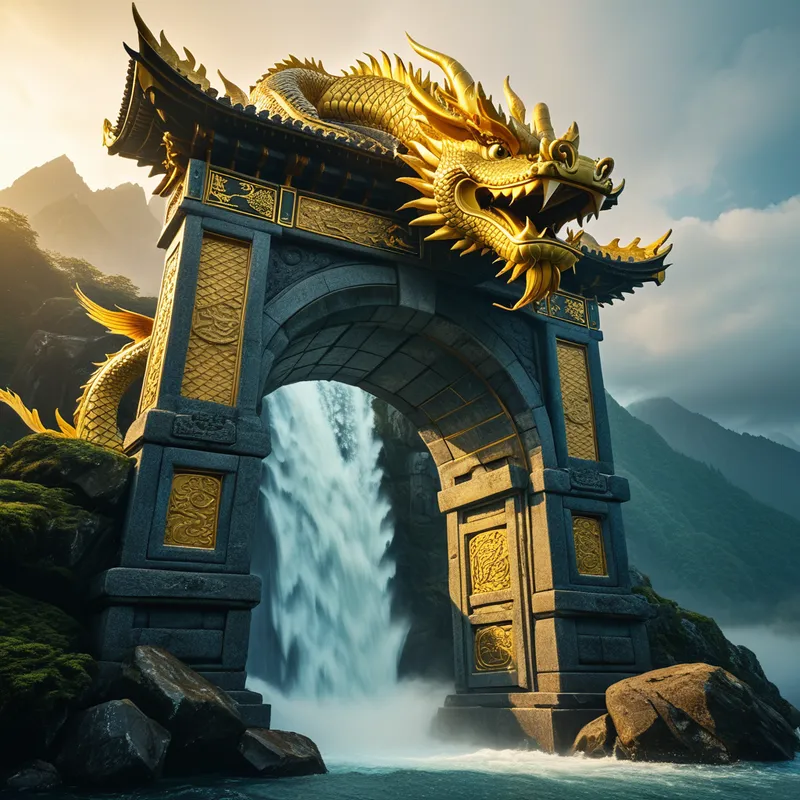
The Dragon Gate Myth Meaning & Symbolism
A carp's epic struggle to leap a mythical waterfall and transcend its nature, becoming a celestial dragon through sheer perseverance and destiny.
The Tale of The Dragon Gate
Listen, and hear the tale whispered by the rushing waters. In the ancient, mist-wrapped mountains where earth brushes the heavens, there roared a cataract of such terrible and glorious power that it was known to all as the [Longmen](/myths/longmen “Myth from Chinese culture.”/), [the Dragon](/myths/the-dragon “Myth from Chinese culture.”/) Gate. Its waters thundered down from a realm of clouds, a silver veil separating the mundane world from the celestial. And at its very apex, where the spray birthed perpetual rainbows, stood the Gate itself—an arch of living stone, carved by no mortal hand, humming with the promise of destiny.
For the countless carp that swam in [the river](/myths/the-river “Myth from Buddhist culture.”/) below, this waterfall was a song, a siren call written into their very bones. They were but fish, silver and gold flashes in the deep, yet in their hearts burned a memory not their own: a memory of scales becoming armor, of fins becoming claws, of [water](/myths/water “Myth from Chinese culture.”/) becoming cloud. Each spring, as the Third Month rains swelled [the river](/myths/the-river “Myth from Buddhist culture.”/), the great gathering would begin. A thousand-thousand carp would abandon the placid pools and journey against the current, their bodies a living river of determination flowing toward the thunder.
The ascent was a symphony of struggle. The current was a mighty hand pressing them down. The rocks were teeth waiting to shatter their resolve. Many grew weary, their strength spent, and were swept back into the anonymous flow. But a few—the most resilient, the most stubbornly hopeful—would press on. They would find the hidden channels, the fleeting eddies, and leap. Not once, but again and again, hurling their bodies against the wall of water. They would leap until their scales were bruised and their spirits were pared down to a single, shining point of will.
And then, for one carp in ten thousand, the miracle. At the zenith of a final, all-or-nothing leap, as it passed through [the veil](/myths/the-veil “Myth from Various culture.”/) of spray and the light of the Gate fell upon it, transformation would seize it. A bolt of celestial fire would arc from the clouds. Its golden scales would harden into jade-like plates. Whiskers would lengthen into flowing tendrils of power. Fins would stretch and reshape into the limbs of a sovereign. From a creature of the stream emerged a Long, a dragon—coiling, powerful, and free. With a roar that echoed the waterfall’s own voice, it would ascend into the clouds, master of the rains, a myth made flesh, a promise fulfilled.
Cultural Origins & Context
The myth of the Dragon Gate is a deeply embedded strand in the cultural DNA of China, later flowing into Japanese lore as Ryūmon. Its earliest literary appearances are in texts like the San Qin Ji (Records of the Three Qins) from the 3rd century CE, solidifying it as an ancient and enduring metaphor. It was never merely a children’s fable; it was a societal narrative engine.
Its primary function was as an allegory for the imperial examination system, the Keju. For over a millennium, this system offered (theoretically) any scholar, regardless of birth, a path to prestige and power. The years of grueling study in humble circumstances were the arduous swim against the current. The examination hall in the capital was the Dragon Gate itself—a daunting, make-or-break barrier. Success meant a meteoric transformation: from an obscure scholar to a “Son of the Dragon,” a mandarin in the emperor’s service, bringing honor to one’s entire family and village. The myth provided a sacred framework for this brutal, life-defining struggle, sanctifying the effort and the elusive reward.
Beyond the examinations, the story was told to inspire perseverance in any endeavor. It validated struggle as a necessary prelude to glory. It was a tale told by teachers to students, by parents to children, and by communities to themselves, reinforcing values of diligence, destiny, and the transformative power of overcoming an immense challenge.
Symbolic Architecture
At its [heart](/symbols/heart “Symbol: The heart symbolizes love, emotion, and the core of one’s existence, representing deep connections with others and self.”/), the [Dragon Gate](/symbols/dragon-gate “Symbol: A powerful threshold symbol representing transformation, ascension, and overcoming impossible challenges through perseverance and destiny.”/) myth is a masterclass in the [symbolism](/symbols/symbolism “Symbol: The use of symbols to represent ideas or qualities, often conveying deeper meanings beyond literal interpretation. In dreams, it’s the language of the unconscious.”/) of alchemical change. The carp represents the latent potential within the mundane, the “base [metal](/symbols/metal “Symbol: Metal in dreams often signifies strength, transformation, and the qualities of resilience or coldness.”/)” of the [soul](/symbols/soul “Symbol: The soul represents the essence of a person, encompassing their spirit, identity, and connection to the universe.”/). It is humble, earthly, and confined to its element. The [waterfall](/symbols/waterfall “Symbol: Waterfalls in dreams often signify a release of emotions or a transformation, symbolizing the flow of life and the transition of feelings.”/) is the ordeal, the necessary [friction](/symbols/friction “Symbol: Friction represents resistance, conflict, or the necessary tension required for movement and transformation in dreams.”/) that tests and refines. It is not a malicious force, but a natural, impersonal threshold that demands everything.
The Gate is not a door to be opened, but a mirror to be passed through. It only reflects and reveals the truth of what has already been forged in the climb.
The transformation into a [dragon](/symbols/dragon “Symbol: Dragons are potent symbols of power, wisdom, and transformation, often embodying the duality of creation and destruction.”/) is not a reward given, but a [nature](/symbols/nature “Symbol: Nature symbolizes growth, connectivity, and the primal forces of existence.”/) unveiled. The dragon is the fully realized Self—autonomous, powerful, creative (as a bringer of rain), and in [harmony](/symbols/harmony “Symbol: A state of balance, agreement, and pleasing combination of elements, often associated with musical consonance and visual or social unity.”/) with cosmic forces. It signifies a shift in one’s state of being, from being subject to the currents of [life](/symbols/life “Symbol: The symbol of ‘Life’ represents a journey of growth, interconnectedness, and existential meaning, encompassing both the joys and challenges that define human experience.”/) to becoming a shaper of them. The specific imagery is potent: the fish, a [creature](/symbols/creature “Symbol: Creatures in dreams often symbolize instincts, primal urges, and the unknown aspects of the psyche.”/) bound to a single medium ([water](/symbols/water “Symbol: Water symbolizes the subconscious mind, emotions, and the flow of life, representing both cleansing and creation.”/)), becomes the [dragon](/symbols/dragon “Symbol: Dragons are potent symbols of power, wisdom, and transformation, often embodying the duality of creation and destruction.”/), a being that moves through [water](/symbols/water “Symbol: Water symbolizes the subconscious mind, emotions, and the flow of life, representing both cleansing and creation.”/), [earth](/symbols/earth “Symbol: The symbol of Earth often represents grounding, stability, and the physical realm, embodying a connection to nature and the innate support it provides.”/) (as it coils), and sky. This symbolizes the [expansion](/symbols/expansion “Symbol: A symbol of growth, increase, or extension beyond current boundaries, often representing personal development, opportunity, or overwhelming change.”/) of [consciousness](/symbols/consciousness “Symbol: Consciousness represents the state of awareness and perception, encompassing thoughts, feelings, and experiences.”/) and capability, the [achievement](/symbols/achievement “Symbol: Symbolizes success, mastery, or reaching a goal, often reflecting personal validation, social recognition, or overcoming challenges.”/) of a multidimensional existence.
Psychologically, the countless carp that fail represent the myriad potentialities, efforts, and former selves that must be sacrificed or outgrown. The solitary success speaks to the intensely personal, non-transferable nature of profound transformation. No one can leap the Gate for you.
The Dreamer’s Resonance
When this myth stirs in the modern unconscious, it often surfaces in dreams of immense verticality and striving. The dreamer may find themselves at the bottom of a sheer cliff, a towering staircase, or an endless escalator, feeling a compulsive need to ascend. The “waterfall” may be symbolized by a crushing workload, a relentless inbox, or a social media feed that feels like a torrent of comparison.
The somatic experience is key: dreams of swimming fiercely against a current, or of leaping only to fall back, are direct somatic metaphors. The body in the dream is rehearsing the feeling of total expenditure against resistance. This often coincides with waking life periods of intense effort toward a goal—career advancement, artistic completion, or a personal breakthrough—where the outcome is uncertain and the effort feels Herculean.
The dream may also feature the moment of transformation in distorted, anxious forms: the dreamer’s skin peeling to reveal scales, or a feeling of terrifying expansion. This reflects the [psyche](/myths/psyche “Myth from Greek culture.”/)’s ambivalence toward its own growth. To become the dragon is to leave the familiar school of carp behind; it is a glorious but lonely birth. The dreamwork is the psyche’s way of metabolizing the stress of the climb and the fear of the impending change, should the leap succeed.

Alchemical Translation
For the individual on the path of individuation, the Dragon Gate models the final, critical phase of psychic transmutation. The long preparation—the therapy, the introspection, the confronting of shadows—is the swim upstream. It is the gathering of all one’s resources and the honing of will.
The leap itself is the act of conscious integration. It is the moment when the insights gained must be enacted in a definitive, irreversible choice or realization. It is the decision to speak one’s truth, to leave a toxic pattern behind, to fully own a creative power, or to accept a painful but liberating self-knowledge. This leap always feels like a risk of annihilation—the fear of falling, of being dashed on the rocks of failure or ridicule.
The alchemical fire that strikes the carp is the lightning flash of consciousness, the sudden, irreversible realization that one is not what one was. The old identity cannot survive this voltage.
Passing through the Gate is the dissolution of [the ego](/myths/the-ego “Myth from Jungian culture.”/)‘s old form (the carp) and the revelation of the greater Self (the dragon). The individual no longer identifies solely with their struggles, their history, or their limitations. They recognize themselves as part of a larger, dynamic order. They gain agency, not as control, but as the ability to consciously participate in the flow of their own destiny. The rain the dragon brings is the creative, life-giving output that becomes possible from this new state—the work, wisdom, or influence that nourishes [the world](/myths/the-world “Myth from Tarot culture.”/) around them. The myth assures us that the ordeal has a purpose: not to punish, but to transmute. The Gate awaits not the lucky, but the forged.
Associated Symbols
Explore related symbols from the CaleaDream lexicon: