The Double-Hulled Canoe Navigation Myth Myth Meaning & Symbolism
A myth of celestial navigation where the double-hulled canoe, guided by ancestral wisdom, voyages across the primal sea to find new land and life.
The Tale of The Double-Hulled Canoe Navigation Myth
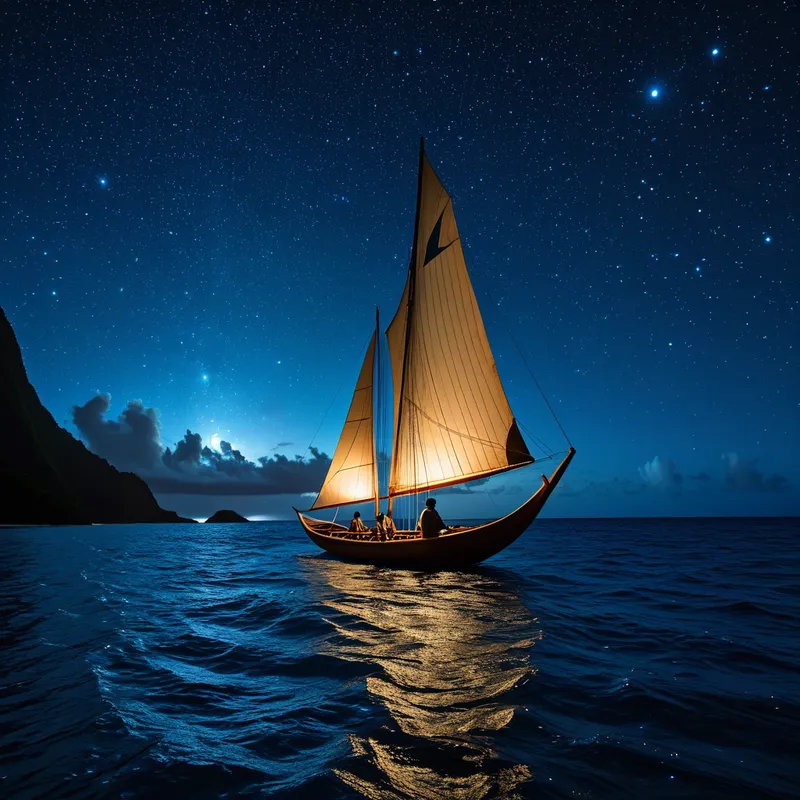
Listen. The world is not still. It is a great, breathing Ocean, and we are born upon its back. In the time before time, when the islands were young and the gods walked closer, the people knew a longing. They felt the press of the horizon, heard the whisper of lands unseen in the sigh of the wind. But the sea was a trackless desert, a Chaos of water and sky, and to venture upon it was to invite Death.
Then came the dreamers, the Navigator. Not a single hero, but a lineage of them, their minds sharpened by generations of watching. They did not see an empty void. They saw a Path. They saw the Sun birth itself from the same notch in the sea-mountains each dawn. They saw the Moon swell and wane, pulling the very breath of the ocean. And at night, they saw the Stars—not scattered dust, but a great, turning shell of named ancestors: Hōkūpaʻa, the steadfast star; Hikianalia, the star path to the south. They were a living compass, a starry Temple in the dome of night.
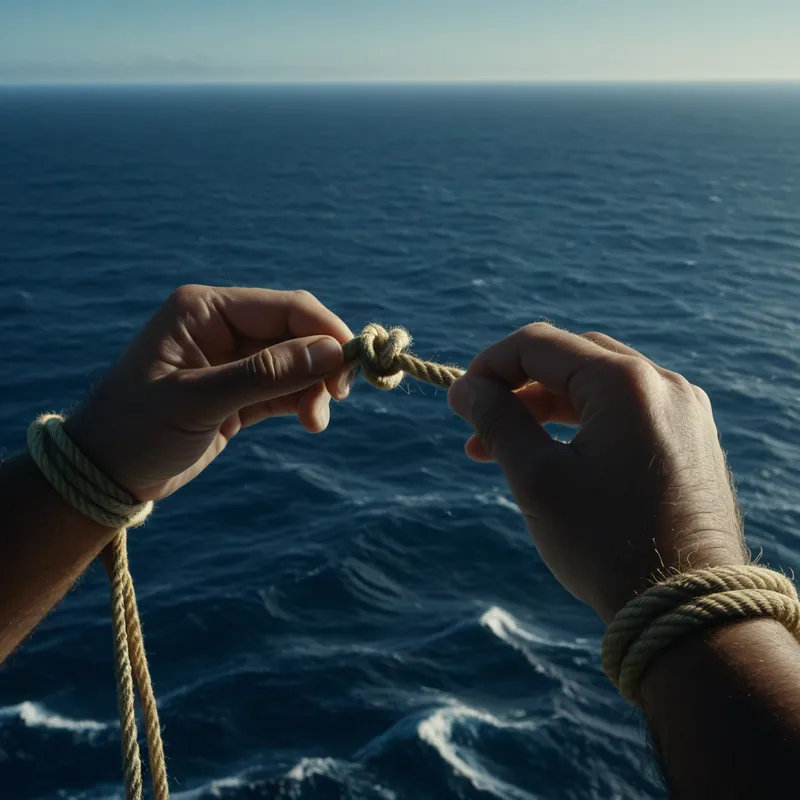
But knowledge was not enough. The vessel had to be worthy. From the great Forest came the koa wood, strong and resilient. The craftsmen, guided by Spirit, shaped not one hull, but two. They bound them together with sennit cord, strong as destiny. This was the waʻa kaulua—the Double-hulled canoe. It was not merely a boat; it was a pact. One hull for the people, their food, their Mother earth in the form of seed and soil. The other hull for balance, for stability against the capricious will of the sea. Together, they formed a single vessel of survival.
The moment of departure was a Ritual. The Navigator stood at the stern, his body a living sextant. He felt the swell roll beneath the hulls, tasted the wind for its story, watched the dance of birds that spoke of distant land. He looked not at the water, but up, into the memory of the stars, even by day. He steered by the feel of the ocean’s pulse, by the color of the clouds, by the song of the waves against the hull. For weeks, they lived in the Ocean’s womb, a tiny world of wood and fiber on the infinite blue. Fear was a constant companion, and doubt a chilling mist. The navigator fought not monsters, but silence, exhaustion, and the creeping question: had he misremembered a star’s rise?
Then, a change. The flight pattern of a tern. A log borne on a different current. A certain heaviness to the clouds on the horizon. And finally, a faint, dark smudge that did not fade with the dawn—the smell of earth and green carried on the wind. The Land. A new island, born from their courage and their memory. They had not simply traveled across the sea; they had conversed with it, listened to the sky, and followed a Destiny written in light and water. The canoe had carried them, but the Navigation had carried their soul.
Cultural Origins & Context
This is not a myth of a single event, but the sacred Mythos of a people—the Polynesians, with the Hawaiian tradition as a brilliant branch. It is the foundational epic of migration and identity. Passed down not in written texts, but in chants (oli), dance (hula), and the meticulous oral teachings of the kahuna kilo hōkū (star-gazing priests), this knowledge was the most prized possession of the culture.
Its societal function was paramount: it was a living library of survival, astronomy, ecology, and genealogy. To know the stars was to know your ancestors, who were immortalized in the night sky. To build and sail the canoe was an act of communal spirituality, requiring the woodcarver, the cord-maker, the farmer, and the priest. The myth justified and sanctified the incredible feat of settling the most isolated archipelago on Earth. It declared that humans are not passive creatures of land, but active partners with the cosmos, capable of using profound observation and memory to traverse the greatest unknowns.
Symbolic Architecture
At its [heart](/symbols/heart “Symbol: The heart symbolizes love, emotion, and the core of one’s existence, representing deep connections with others and self.”/), the myth is a supreme [metaphor](/symbols/metaphor “Symbol: A figure of speech where one thing represents another, often revealing hidden connections and deeper truths through symbolic comparison.”/) for [consciousness](/symbols/consciousness “Symbol: Consciousness represents the state of awareness and perception, encompassing thoughts, feelings, and experiences.”/) navigating the unconscious.
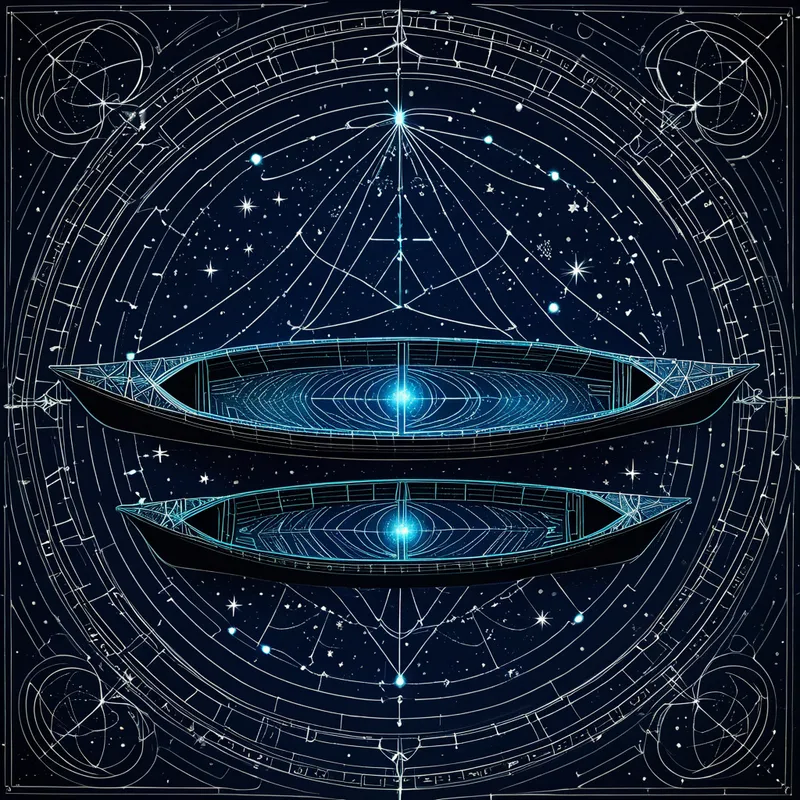
The double-hulled canoe is the embodied psyche: two distinct yet inseparable aspects bound together for a single, vital purpose.
One [hull](/symbols/hull “Symbol: The outer shell of a vessel, representing protection, boundaries, and the separation between inner self and external world.”/) represents the conscious mind—the ego, [identity](/symbols/identity “Symbol: Identity represents the sense of self, encompassing personal beliefs, cultural background, and social roles.”/), and the tangible cargo of daily [life](/symbols/life “Symbol: The symbol of ‘Life’ represents a journey of growth, interconnectedness, and existential meaning, encompassing both the joys and challenges that define human experience.”/). The other [hull](/symbols/hull “Symbol: The outer shell of a vessel, representing protection, boundaries, and the separation between inner self and external world.”/) is the unconscious—the deep, often [unseen forces](/symbols/unseen-forces “Symbol: Unseen Forces symbolize the invisible influences in one’s life, representing external and internal factors that direct thoughts, behaviors, and fate.”/) of instinct, [memory](/symbols/memory “Symbol: Memory symbolizes the past, lessons learned, and the narratives we construct about our identities.”/), and the ancestral past. Alone, each is unstable, prone to capsizing in the face of [life](/symbols/life “Symbol: The symbol of ‘Life’ represents a journey of growth, interconnectedness, and existential meaning, encompassing both the joys and challenges that define human experience.”/)’s storms (the chaotic sea). Lashed together, they create [stability](/symbols/stability “Symbol: A state of firmness, balance, and resistance to change, often represented by solid objects, foundations, or steady tools.”/), [resilience](/symbols/resilience “Symbol: The capacity to recover quickly from difficulties, adapt to change, and maintain strength through adversity.”/), and the [capacity](/symbols/capacity “Symbol: A measure of one’s potential, limits, or ability to contain, process, or achieve something, often reflecting self-assessment or external demands.”/) for an extraordinary [Journey](/symbols/journey “Symbol: A journey in dreams typically signifies adventure, growth, or a significant life transition.”/).
The Navigator symbolizes the emerging Self, the coordinating center of the [personality](/symbols/personality “Symbol: Personality in dreams often symbolizes the traits and characteristics of the dreamer, reflecting how they perceive themselves and how they believe they are perceived by others.”/) that can integrate both conscious [knowledge](/symbols/knowledge “Symbol: Knowledge symbolizes learning, understanding, and wisdom, embodying the acquisition of information and enlightenment.”/) and unconscious [intuition](/symbols/intuition “Symbol: The immediate, non-rational understanding of truth or insight, often described as a ‘gut feeling’ or inner knowing that bypasses conscious reasoning.”/). He does not fight the [ocean](/symbols/ocean “Symbol: The ocean symbolizes the vastness of the unconscious mind, representing deeper emotions, intuition, and the mysteries of life.”/); he learns its [language](/symbols/language “Symbol: Language symbolizes communication, understanding, and the complexities of expressing thoughts and emotions.”/). He uses the fixed stars (enduring values, core truths) to navigate through the shifting waves of [emotion](/symbols/emotion “Symbol: Emotion symbolizes our inner feelings and responses to experiences, often guiding our actions and choices.”/) and circumstance.
The vast Ocean is the [realm](/symbols/realm “Symbol: The symbol of ‘Realm’ often signifies the boundaries of one’s consciousness, experiences, or emotional states, suggesting aspects of reality that are either explored or ignored.”/) of the unknown, the [collective unconscious](/symbols/collective-unconscious “Symbol: The Collective Unconscious refers to the part of the unconscious mind shared among beings of the same species, embodying universal experiences and archetypes.”/) itself—teeming with life and [danger](/symbols/danger “Symbol: The symbol of ‘Danger’ often indicates a sense of threat or instability, calling for caution and awareness.”/), the [source](/symbols/source “Symbol: The origin point of something, often representing beginnings, nourishment, or the fundamental cause behind phenomena.”/) of all potential and all [terror](/symbols/terror “Symbol: An overwhelming, primal fear that paralyzes and signals extreme threat, often linked to survival instincts or deep psychological trauma.”/). The [destination](/symbols/destination “Symbol: Signifies goals, aspirations, and the journey one is on in life.”/), the new Land, is the achieved state of individuation: a new, stable psychic territory won through courageous exploration.
The Dreamer’s Resonance
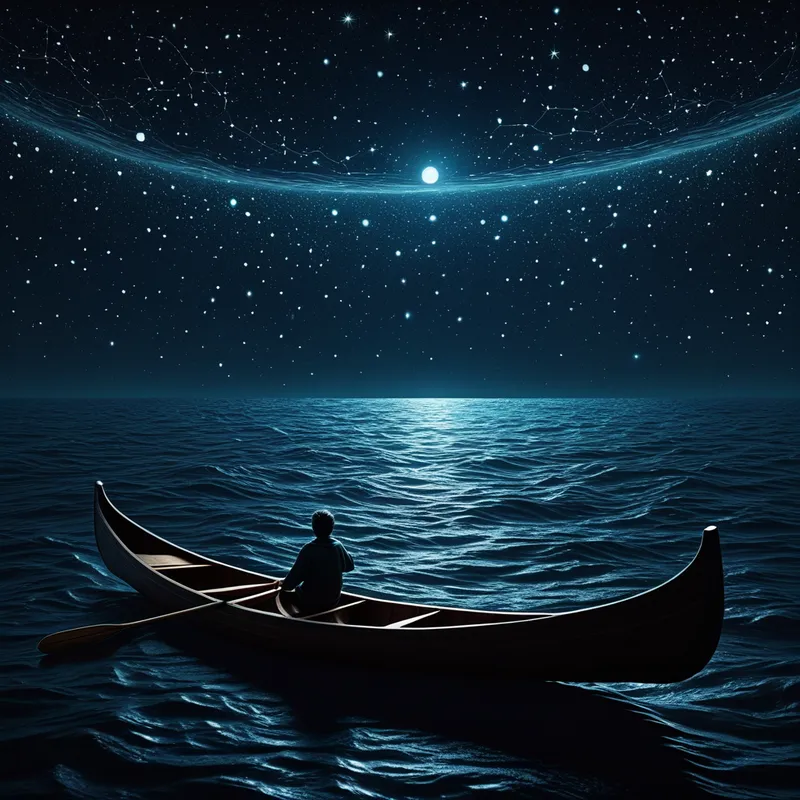
When this myth stirs in the modern Dream, it often manifests as dreams of being on a boat in open water, of searching for a shore, or of trying to read a map under strange stars. The somatic feeling is one of profound vulnerability mixed with purposeful motion—the feel of swell beneath you, the salt air on your skin.
Psychologically, this signals a major transitional phase. The dreamer is “at sea,” having left the safe harbor of an old identity, belief, or life structure (the known island). The two hulls may appear as a conflicted choice, a partnership, or a sense of being pulled in two directions. The navigator figure, if present, is the dreamer’s own nascent guiding intelligence, often felt as a quiet, observant presence within the anxiety. The dream is an expression of the psyche’s innate drive to find a new synthesis, to use inner resources (star-knowledge/memory) to cross a disorienting emotional or life passage. The absence of a visible landfall in the dream is not failure; it is the accurate portrayal of being in the process of navigation, where trust in the method must replace certainty of the destination.
Alchemical Translation
The myth models the complete alchemical cycle of psychic transmutation. The old, crowded “island” of the persona is voluntarily left behind (the nigredo, or descent into chaos). The individual enters the solutio—dissolved in the waters of the unconscious, feeling lost and unmoored.
The building of the double-hulled canoe is the coagulatio: the conscious effort to construct a vessel of integrity that can hold the tension of opposites.
The long voyage is the arduous work of separatio and coniunctio. The navigator must separate true star from deceiving cloud (discernment), while simultaneously conjoining wave direction with bird sign (synthesis). He holds the tension between doubt and faith, memory and present sensation. This is the ego’s service to the larger Self, steering by a law beyond itself.
The sighting of land is the albedo, the dawning of a new clarity. It is not the end, but the confirmation that the path was true. The final arrival and establishment of life is the rubedo, the full embodiment of the new consciousness. The individual has not found a pre-existing land, but has dreamed it into being through the act of the journey itself. The once-trackless ocean of the psyche now has a known pathway, and the individual is no longer a passive resident of an island, but a navigator of their own soul’s vast sea.
Associated Symbols
Explore related symbols from the CaleaDream lexicon:
- Ocean — The boundless, primal realm of the collective unconscious, representing both the source of all life and the great unknown that must be traversed for growth.
- Stars — The fixed points of ancestral wisdom, core values, and guiding principles that provide orientation in the darkness of the unknown.
- Journey — The fundamental process of psychic transformation, moving from a known state, through a chaotic passage, toward a new integration.
- Double — The essential duality of the psyche—conscious and unconscious, ego and shadow, self and other—bound together to create a stable vessel for life.
- Canoe — The vessel of the Self, the constructed identity and life structure that carries one through the journey of existence.
- Navigation — The active, discerning intelligence of the emerging Self, which integrates observation, memory, and intuition to find direction.
- Land — The achieved state of wholeness, a new psychic territory or level of consciousness that is the destination of the transformative journey.
- Spirit — The ancestral wisdom and invisible guiding force that informs the navigator’s art, connecting the individual to a lineage greater than themselves.
- Dream — The symbolic language in which the voyage of the psyche is revealed, offering maps and portents of the inner journey.
- Destiny — The pull toward individuation, the innate psychic blueprint that calls the Self to undertake the necessary voyage across the unconscious.
- Mythos — The overarching narrative framework that gives sacred meaning to the act of navigation, transforming a physical feat into a spiritual paradigm.
- Chaos — The formless, terrifying, yet generative state of the un-navigated unconscious, which precedes and necessitates the creation of order and direction.