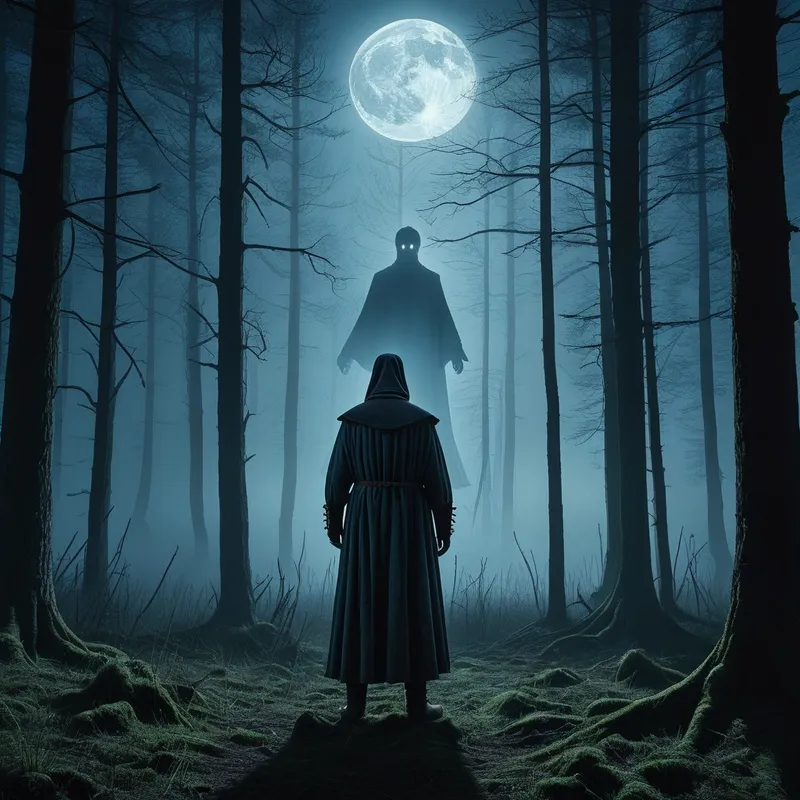
The Doppelgänger in Germanic f Myth Meaning & Symbolism
A tale of a man who meets his ghostly double, a harbinger of doom that forces a confrontation with the self he has refused to become.
The Tale of The Doppelgänger in Germanic f
Listen, and let the firelight grow dim. In the deep, black forests of the old lands, where the pines whisper secrets older than memory, there walked a man named Albrecht. He was a man of substance, a burgher of good standing, whose life was a ledger of prudent gains and measured steps. His soul, he believed, was as orderly as his household.
One evening, as a cold, silver mist crept from the river and wrapped the world in a shroud, Albrecht took his customary walk along the linden-lined avenue outside the town walls. The world was silent, save for the crunch of his own boots on the gravel. Then, a second crunch fell into step with his own.
He turned. There, perhaps twenty paces behind, stood a figure. The fading twilight and the mist obscured its face, but its posture, its coat, the very tilt of its hat—it was his own. A cold sharper than winter’s breath seized his heart. He quickened his pace. The crunching behind him quickened. He stopped. It stopped.
Summoning the courage of a rational man, Albrecht turned fully and called out, his voice thin in the vast quiet. “Who goes there? Show yourself!”
The figure stepped forward. The mist parted like a curtain. Albrecht’s own eyes stared back at him from his own face. But this face was pale as a corpse, its expression one of infinite, weary sorrow—a sorrow Albrecht had spent a lifetime burying beneath duty and reputation. It was him, and yet it was not. It was the shape of his solitude, the portrait of his suppressed grief.
Terror, pure and animal, took him. He fled, his breath ragged, the gravel flying beneath his heels. He did not hear pursuit, but he felt it—a cold presence keeping perfect pace, a shadow not cast by any light. He burst through his own door, slammed it shut, and barred it with trembling hands. For days, he did not leave. He saw the face in every windowpane’s reflection, heard its step in the creak of his floorboards.
Weeks passed. The memory began to soften, to feel like a fever dream. Emboldened by sunlight and the mundane rhythms of trade, Albrecht ventured to a nearby city on business. In a crowded guildhall, amid the clatter of tankards and the rumble of conversation, he felt a gaze upon him. He looked across the smoky room.
There, seated alone at a corner table, was the double. It looked directly at him, and in its eyes was not malice, but a profound and knowing pity. Then, it slowly raised its hand and pointed—not at Albrecht, but at the empty space directly beside him.
At that moment, a great timber in the hall’s ceiling, rotten and unseen, gave way. It crashed down precisely where Albrecht had been standing an instant before. In the chaos of screams and dust, Albrecht searched the corner. The chair was empty. Only then did he understand the pointing finger. It had not marked a target, but a salvation. The double had not come to cause his end, but to show him the shape of the fate he had narrowly avoided—a fate written by the life he had been living. The harbinger was also a savior. Albrecht returned home a different man, forever seeing two paths: the one he walked, and the one walked by the ghost in his own skin.
Cultural Origins & Context
The Doppelgänger is not a myth with a single, canonical text, but a pervasive folk belief that seeped through the cracks of Germanic and broader European consciousness. It belongs to the realm of Volkssage (folk legend) rather than national epic. These stories were passed down in hushed tones by the hearth, in tavern tales, and in the warnings of elders. They functioned as a profound, pre-psychological law of the soul: to encounter one’s double was to encounter one’s own destiny, typically a foreshadowing of severe illness, radical transformation, or death.
The tellers were not bards of heroes, but ordinary people—farmers, housewives, soldiers—who sensed the uncanny fragility of identity. In a world deeply influenced by Romanticism’s exploration of the self, the Doppelgänger became a potent literary device for writers like E.T.A. Hoffmann, Jean Paul (who coined the term), and later Dostoevsky. It served a societal function as a narrative container for anxieties about self-loss, authenticity, and the invisible forces that govern a life. It was the folk expression of a terrifying truth: the self is not a single, solid thing, but a territory that may have another claimant.
Symbolic Architecture
At its core, the Doppelgänger is the mythic embodiment of the Shadow. It is not merely an evil twin, but the totality of the personality that the conscious ego has refused to acknowledge—the unlived life, the repressed grief, the abandoned potential, the hidden weakness. It appears as an external entity because the psyche cannot yet tolerate owning these qualities as its own.
The Doppelgänger is the self that was exiled so the ego could build its city; it returns not to destroy the walls, but to remind the ruler of the land beyond them.
The encounter is a brutal confrontation with fate, or wyrd—not as a predetermined script, but as the natural culmination of one’s chosen and unchosen paths. The double’s traditional role as a death omen is symbolic: it heralds the end of a particular psychic configuration, a way of being that has become too narrow, too false, or too brittle to sustain. The pointing finger in the tale of Albrecht is the key. It indicates the collision point between the path of the conscious ego and the path of the fuller, if more sorrowful, self. The Doppelgänger thus becomes a paradoxical guide, forcing a crisis that is also the only chance for redemption or change.

The Dreamer’s Resonance
When the Doppelgänger pattern emerges in modern dreams, it signals a critical phase of shadow-work. The dreamer is not simply having a scary dream; they are undergoing a somatic and psychological process of differentiation.
You may dream of being chased by a faceless figure that you know is you. You may see yourself across a room, turning away. You may look in a mirror and see a stranger wearing your face, often expressing an emotion you have disavowed—like profound grief or cold rage. Somatically, these dreams are often accompanied by feelings of dread, paralysis, or a chilling recognition. The psyche is making the unconscious conscious through stark, terrifying imagery. It is presenting the dreamer with the parts of themselves they have “ghosted.” The process is one of involuntary self-confrontation. The ego is being shown its own limits, and the larger Self is demanding recognition. The terror in the dream is the resistance to this integration; the figure itself is the call.

Alchemical Translation
The myth of the Doppelgänger models the alchemical stage of Nigredo—the initial blackening, the descent into the dark night of the soul where all certainties dissolve. The modern individual’s journey of individuation often begins with such a “double” experience: a crushing depression that feels like an alien presence, a sudden failure in a life that seemed perfect, a haunting sense of being a fraud in one’s own skin.
To meet the double is to have the solitude of the ego shattered. The path to wholeness begins when we stop running from the ghost and ask it what it wants.
The alchemical translation is the move from persecution to dialogue. The figure that first appears as a harbinger of doom must, through immense courage, be engaged. This is the transmutation. One must turn and speak to the double, as Albrecht did, however fearfully. What sorrow does it carry? What life did it wish to live? What warning does it truly bring? In answering these questions, the individual begins to integrate the shadow. The psychic energy locked in maintaining the split—the energy of repression, fear, and projection—is liberated. The Doppelgänger ceases to be a spectral stalker and becomes, instead, a remembered part of the soul’s history. The individual is no longer a singular burgher on a safe path, but a complex citizen of a much larger, richer, and more authentic internal kingdom. The death it foretold was the death of an illusion; the life it offers is the difficult, real, and complete one.
Associated Symbols
Explore related symbols from the CaleaDream lexicon: