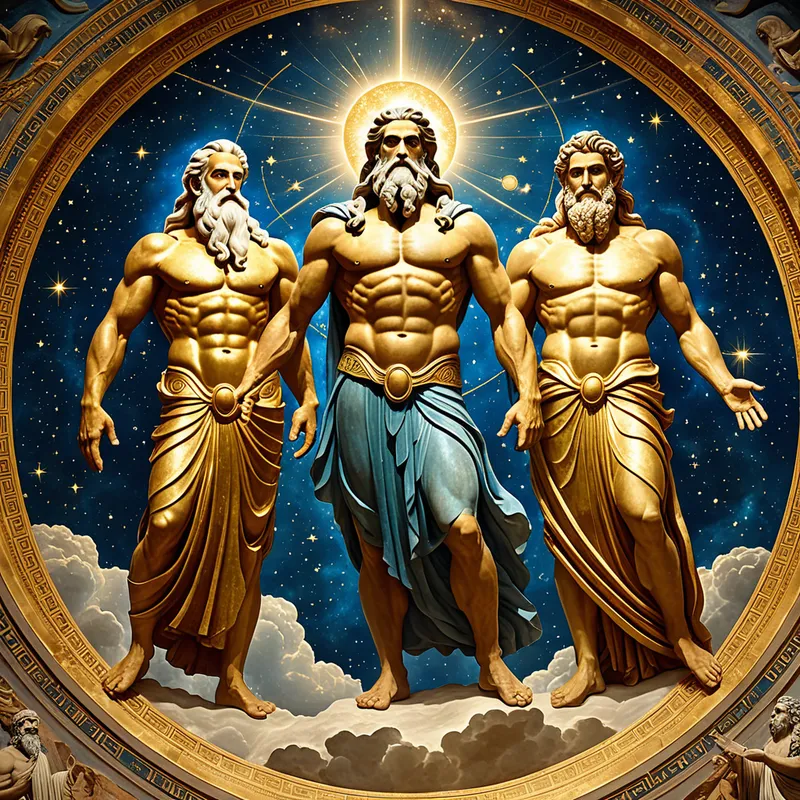
The Dice Game of Zeus, Poseidon, and Hades Myth Meaning & Symbolism
After defeating the Titans, three brother gods cast lots to divide the cosmos, a sacred gamble determining the dominion of sky, sea, and underworld.
The Tale of The Dice Game of Zeus, Poseidon, and Hades
Before there were kings, there were brothers. Before there were laws, there was the lot.
The air still tasted of ozone and divine blood, the last echoes of the Titanomachy fading into the groans of [the earth](/myths/the-earth “Myth from Hindu culture.”/). [The world](/myths/the-world “Myth from Tarot culture.”/) was a prize, newly won, yet terrifyingly unclaimed. Who would hold [the sky](/myths/the-sky “Myth from Persian culture.”/)? Who would command the abyssal deep? Who would… preside over the silent, gathering dark?
In a place beyond mortal mountains, where the fabric of reality was still soft from creation’s forge, three sons of [Kronos](/myths/kronos “Myth from Greek culture.”/) stood. Zeus, whose brow still flickered with the fury of the thunderbolt. [Poseidon](/myths/poseidon “Myth from Greek culture.”/), whose trident dripped with the memory of shattered leviathans. [Hades](/myths/hades “Myth from Greek culture.”/), whose silence was deeper than any chasm, his gaze already turned inward.
No war would be fought between them. The universe could not withstand another fraternal cataclysm. Instead, they chose the ancient way, [the way](/myths/the-way “Myth from Taoist culture.”/) of [the Moirai](/myths/the-moirai “Myth from Greek culture.”/), [the way](/myths/the-way “Myth from Taoist culture.”/) of pure, unadulterated chance. They would cast the lots.
A simple vessel was brought forth, not of clay or gold, but carved from the heart of a fallen star. Within it rested three tokens, smooth and cold. They were not dice as mortals know them, but clēroi, pieces of destiny itself. To touch one was to feel the weight of eternity.
Zeus, the youngest yet boldest, reached first. His hand, which had hurled lightning, trembled only for a heartbeat. The lot he drew did not roll; it ascended. It glowed with a fierce, white-hot light, and the very ether around it crackled. A domain of boundless blue, of towering cloud-citadels and the pure, terrifying freedom of the heights was his. The sky bowed to him.
Poseidon’s turn was a tempest in miniature. He grasped his lot, and a roar like a thousand waves crashing filled [the void](/myths/the-void “Myth from Buddhist culture.”/). His token swirled with blues and greens, and the scent of salt and the cry of gulls became manifest. He felt the pull of every tide, the secret currents of the world-ocean, and the restless power of the earthquake sleeping in the deep. The seas were his to command.
Then, all fell silent. Hades, who had watched without word, extended his hand. His lot did not glow or roar. It grew heavy, impossibly so, and a profound chill emanated from it. The light seemed to drain from the space around it, not into darkness, but into a profound, rich gloom. He felt the pull not outward, but downward—to the roots of mountains, to the silent fields where whispers cease, to the solemn dignity of final rest. The world below, Erebos, awaited its king.
No celebration followed. Only a solemn acknowledgment. The cosmic die was cast. The brothers parted, not as rivals, but as sovereigns of their own vast, lonely kingdoms. The gamble was complete. The order of the world was set.
Cultural Origins & Context
This foundational myth is not the story of a single hero, but the story of the world’s architecture. It originates from the deepest layers of Greek cosmogonic thought, most famously recounted in Hesiod’s Theogony. Hesiod, a poet of the 8th century BCE, served as a conduit for these sacred narratives, weaving together older, disparate oral traditions into a coherent divine history.
The myth’s primary function was etiological—it explained why things are the way they are. Why does Zeus rule from Olympus? Why is [the sea](/myths/the-sea “Myth from Greek culture.”/) unpredictable and mighty? Why is the land of the dead separate and ruled by a different, unseen god? The answer was not mere conquest, but a sacred, randomized procedure that carried the weight of legitimacy. It transformed potential chaos into a recognized, tripartite order.
The act of casting lots (lanchanō) was a deeply ingrained practice in ancient Greek society, used for everything from distributing land and political offices to selecting sacrificial victims. It was seen as a way to remove human bias and allow the divine will, or pure chance ([Tyche](/myths/tyche “Myth from Greek culture.”/)), to manifest. By framing the division of the cosmos as a lottery, the myth sacralized this practice, elevating it to a cosmic principle. It presented a world where ultimate authority is not solely won by force, but is also subject to the inscrutable, impartial mechanics of fate.
Symbolic Architecture
Beneath the narrative of divine real estate lies a profound symbolic [architecture](/symbols/architecture “Symbol: Architecture in dreams often signifies structure, stability, and the framing of personal identity or life’s journey.”/) concerning the [nature](/symbols/nature “Symbol: Nature symbolizes growth, connectivity, and the primal forces of existence.”/) of power, [destiny](/symbols/destiny “Symbol: A predetermined course of events or ultimate purpose, often linked to spiritual forces or cosmic order, representing life’s inherent direction.”/), and [the self](/myths/the-self “Myth from Jungian culture.”/).
The three brothers represent a fundamental trichotomy of existence. Zeus is the [realm](/symbols/realm “Symbol: The symbol of ‘Realm’ often signifies the boundaries of one’s consciousness, experiences, or emotional states, suggesting aspects of reality that are either explored or ignored.”/) of the conscious, the aspirational, the sovereign “I” that seeks to command and illuminate. Poseidon is the realm of the emotional and instinctual, the vast, turbulent, and creative unconscious that surrounds and supports the conscious mind. [Hades](/symbols/hades “Symbol: Greek god of the underworld, representing death, the unconscious, and hidden aspects of existence.”/) is the realm of the repressed, the forgotten, the foundational—the psychic substratum where all that is rejected or ended resides, awaiting [integration](/symbols/integration “Symbol: The process of unifying disparate parts of the self or experience into a cohesive whole, often representing psychological wholeness or resolution of internal conflict.”/).
The dice are not thrown by the gods; they are the gods. The gamble is existence itself.
The [lottery](/symbols/lottery “Symbol: Winning or participating in a lottery in a dream often reflects the desire for luck, chances, or sudden changes in life circumstances.”/) is the central, terrifying [symbol](/symbols/symbol “Symbol: A symbol can represent an idea, concept, or belief, serving as a powerful tool for communication and understanding.”/). It represents the arbitrariness of circumstance, the “givenness” of our [condition](/symbols/condition “Symbol: Condition reflects the state of being, often focusing on physical, emotional, or situational aspects of life.”/). We do not choose our [native](/symbols/native “Symbol: The term ‘native’ represents an intrinsic connection to one’s heritage or origin, often symbolizing identity and belonging.”/) realm (be it physical, psychological, or social); we draw it. Our fundamental nature, our core challenges, and our domain of influence feel fated. This is not a passive fatalism, but an acknowledgment of the initial conditions of one’s [life](/symbols/life “Symbol: The symbol of ‘Life’ represents a journey of growth, interconnectedness, and existential meaning, encompassing both the joys and challenges that define human experience.”/)—the sky, sea, or [underworld](/symbols/underworld “Symbol: A symbolic journey into the unconscious, representing exploration of hidden aspects of self, transformation, or confronting repressed material.”/) one is born to rule.
The [resolution](/symbols/resolution “Symbol: In arts and music, resolution refers to the movement from dissonance to consonance, creating a sense of completion, release, or finality in a composition.”/)—peaceful [acceptance](/symbols/acceptance “Symbol: The experience of being welcomed, approved, or integrated into a group or situation, often involving validation of one’s identity or actions.”/) of the draw—symbolizes the necessity of internal order. The [psyche](/myths/psyche “Myth from Greek culture.”/) cannot be at war with its own foundational structures. [The ego](/myths/the-ego “Myth from Jungian culture.”/) (Zeus) must accept it cannot control the [depths](/symbols/depths “Symbol: Represents the subconscious, hidden emotions, or foundational aspects of the self, often linked to primal fears or profound truths.”/) of [emotion](/symbols/emotion “Symbol: Emotion symbolizes our inner feelings and responses to experiences, often guiding our actions and choices.”/) (Poseidon) or fully avoid the contents of the [shadow](/symbols/shadow “Symbol: The ‘shadow’ embodies the unconscious, repressed aspects of the self and often represents fears or hidden emotions.”/) (Hades). Each must be granted its proper dominion for the whole self to function.
The Dreamer’s Resonance
When this myth stirs in the modern unconscious, it often manifests in dreams of profound choice or assignment where the dreamer feels like a passive participant. One might dream of being handed a sealed envelope determining their career, drawing a unique but burdensome tool from a chest, or arriving at a crossroads where the paths are already labeled with immutable destinies.
Somatically, this can feel like a heavy weight settling in the chest or gut—the “lot of Hades.” Or it might feel like a surging, uncontrollable rush—the “lot of Poseidon.” Psychologically, this dream pattern signals a critical moment of acknowledging one’s portion. It is the psyche working to reconcile “what I want” with “what I have been given”—be it a talent, a limitation, a family legacy, or a deep-seated personality trait.
The dream is not about changing the draw, but about coming to terms with the sovereignty it implies. The anxiety in such dreams stems from the resistance to fully inhabiting the domain one has received. The dream asks: Will you rule your sky, your sea, your [underworld](/myths/underworld “Myth from Greek culture.”/), or will you live in perpetual envy of your brother’s realm?
Alchemical Translation
The alchemical process modeled here is not the hero’s journey outward, but the ruler’s journey inward—the work of individuation through the acceptance and mastery of one’s allotted sphere.
[The first stage](/myths/the-first-stage “Myth from Alchemical culture.”/) is Separation (The Casting). The unified, undifferentiated self (the victorious brothers post-Titans) must differentiate. This is the often-painful realization that one cannot be everything. One must identify one’s primary “element”—one’s core driving force or inherent nature.
The second stage is [Nigredo](/myths/nigredo “Myth from Alchemical culture.”/) (The Descent). This is the confrontation with the “lot of Hades,” the acceptance of one’s shadow, one’s limits, and one’s mortality. To be a true ruler of the self, one must first acknowledge and descend into [the underworld](/myths/the-underworld “Myth from Greek culture.”/) of one’s own psyche, making peace with what is hidden and foundational.
The gold is not in winning the best lot, but in forging a scepter from the one you drew.
The final stage is Coagulatio (The Establishment of Dominion). This is the slow, lifelong work of building order within one’s domain. For Zeus, it is building laws and consciousness. For Poseidon, it is channeling creative and emotional power. For Hades, it is cultivating depth, integrity, and the wisdom of endings. The goal is not to usurp another’s realm, but to become the wise, authentic sovereign of your own, thereby taking your rightful place in the ecology of the whole.
The myth teaches that our deepest power lies not in what we wished for, but in how we rule what we received. The universe was ordered not by a battle, but by a game of chance accepted with solemn grace. Our personal cosmos awaits the same ratification.
Associated Symbols
Explore related symbols from the CaleaDream lexicon: