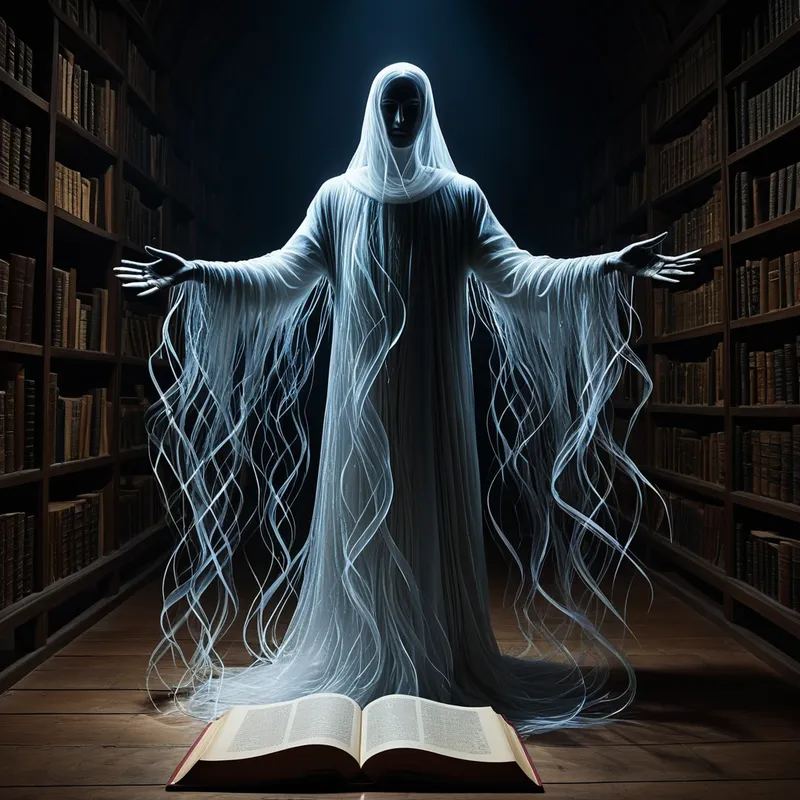
The Dibuk Spirit Myth Meaning & Symbolism
A tale of a soul denied rest, clinging to a living host, demanding exorcism to heal the rupture between the worlds of the living and the dead.
The Tale of The Dibuk Spirit
Listen, and hear a tale not of flesh, but of spirit adrift. In the pale, whispering hours between midnight and dawn, when the veil between worlds grows thin as a moth’s wing, there walks a soul that cannot find its rest. It is a Dibuk—a cleaving one, a fragment of a life shattered before its time.
Its story begins not in death, but in a life cut by a blade of injustice, a promise broken, a sin so profound it barred the gates of peace. Perhaps a scholar who desecrated sacred vows, or a lover betrayed unto death. This soul, denied entry to the cycle, becomes a wanderer in the hollow places of the world, a sigh in the wind, a chill in a sunlit room. It is an exile, and exile hungers for home.
Then, it finds a vessel: a living person, often one whose own soul bears a hidden crack—a grief unspoken, a loneliness deep as a well. The Dibuk does not announce itself with thunder. It slips in on a breath of despair, through a moment of profound weakness or forgotten prayer. It settles in the hidden chambers of the heart, a silent tenant at first.
But a soul cannot be housed quietly for long. The host begins to change. Their voice may speak in tongues unknown to them, words of ancient liturgy or bitter accusation spilling from their lips. Their body contorts, not their own. They know things they should not know, weep for sorrows they never lived. They are a person, and yet they are not. A second shadow moves within them, crying out its unfinished story, its rage, its guilt. The family watches in horror as their beloved becomes a haunted house, the windows of their eyes showing a different, tormented occupant.
In desperation, they turn to the one who can navigate these shadowed waters: the Tzaddik. The sage, steeped in the mysteries of the Kabbalah, gathers a court of ten, a minyan, in a room stripped of vanity. The air is thick with the scent of fear and faith. The host is brought, their body a battleground. The Tzaddik begins not with shouts, but with questions—gentle, relentless, profound. He speaks not to the person, but to the other.
“Who are you? Why do you cling here?”
And from the host’s mouth, in a voice cracked and ancient, the Dibuk answers. It tells its tale of woe, its sin, its injustice. The exorcism is not a battle of force, but a trial of truth. The Tzaddik listens, bearing witness to the pain of the exile. He offers no easy pardon, but a path: confession, acknowledgment, the speaking of the unspeakable. He commands in the name of the sacred, invoking the holy names and the authority of the celestial court.
The climax is not an explosion, but a release. The Dibuk, its story finally heard and its existence acknowledged, is compelled to depart. The sign is often small: a guttering candle flame, the snapping of a thread, a faint sigh. The host collapses, themselves again, exhausted and hollowed out, but clean. The Dibuk, its attachment severed, continues its journey—not to oblivion, but perhaps, now, toward the rest it was denied. The room is left in a silence that rings, a testament to the fragile boundary between the living and the dead, and the power of a word to heal a soul.
Cultural Origins & Context
The myth of the Dibuk is not an ancient biblical tale, but a profound flowering of Jewish mystical and folk imagination from the 16th century onward, rooted in the soil of the Kabbalah and the historical trauma of exile. It emerged most powerfully within the Ashkenazi world, a culture intimately acquainted with displacement, persecution, and the haunting question of unresolved justice.
The concept is deeply tied to Kabbalistic cosmology, particularly the idea of Gilgul—the cycling of souls through lifetimes to achieve rectification. A Dibuk represents a soul stuck in this process, a spiritual malfunction. It became a central narrative in Jewish folklore, passed down not by formal decree, but in the hushed stories told by firelight, in the warnings of grandmothers, and in the seminal 20th-century Yiddish play The Dybbuk by S. Ansky, which crystallized the myth for modern audiences.
Societally, the myth functioned as a powerful container for communal anxiety. It gave form to the fear of unresolved sin, the terror of madness, and the grief for those lost to violence or despair whose stories ended abruptly. The exorcism ritual, conducted by a Tzaddik, reinforced communal authority and the redemptive power of religious law and community (minyan) in the face of chaotic, individual suffering. It was a myth that acknowledged the dead could cling to the living, and that the living had a sacred duty to help them—and themselves—find release.
Symbolic Architecture
At its core, the Dibuk is the ultimate [symbol](/symbols/symbol “Symbol: A symbol can represent an idea, concept, or belief, serving as a powerful tool for communication and understanding.”/) of unintegrated [trauma](/symbols/trauma “Symbol: A deeply distressing or disturbing experience that overwhelms the psyche, often manifesting in dreams as unresolved emotional wounds or psychological injury.”/). It is the psychic shard that will not be buried, the [memory](/symbols/memory “Symbol: Memory symbolizes the past, lessons learned, and the narratives we construct about our identities.”/) that possesses the present, the secret that speaks through the [body](/symbols/body “Symbol: The body in dreams often symbolizes the dreamer’s self-identity, personal health, and the relationship they have with their physical existence.”/) when the mind is silent.
The Dibuk is not an invader from without, but an exile from within—a part of the self so wounded it has become a ghost in its own house.
The living [host](/symbols/host “Symbol: The symbol of a ‘host’ often represents nurturing, hospitality, or the willingness to offer support and guidance to others.”/) represents the conscious ego, going about its [life](/symbols/life “Symbol: The symbol of ‘Life’ represents a journey of growth, interconnectedness, and existential meaning, encompassing both the joys and challenges that define human experience.”/), while the Dibuk is the autonomous [Shadow](/symbols/shadow “Symbol: The ‘shadow’ embodies the unconscious, repressed aspects of the self and often represents fears or hidden emotions.”/) complex, laden with [guilt](/symbols/guilt “Symbol: A painful emotional state arising from a perceived violation of moral or social standards, often tied to actions or inactions.”/), rage, or unfinished [grief](/symbols/grief “Symbol: A profound emotional response to loss, often manifesting as deep sorrow, yearning, and a sense of emptiness.”/). The “possession” is the [moment](/symbols/moment “Symbol: The symbol of a ‘moment’ embodies the significance of transient experiences that encapsulate emotional depth or pivotal transformations in life.”/) this complex erupts into [consciousness](/symbols/consciousness “Symbol: Consciousness represents the state of awareness and perception, encompassing thoughts, feelings, and experiences.”/), shattering the illusion of a unified self. The Tzaddik symbolizes the transcendent function—the mediating, compassionate [awareness](/symbols/awareness “Symbol: Conscious perception of self, surroundings, or internal states. Often signifies awakening, insight, or heightened sensitivity.”/) that can listen to the [shadow](/symbols/shadow “Symbol: The ‘shadow’ embodies the unconscious, repressed aspects of the self and often represents fears or hidden emotions.”/) without being destroyed by it. The exorcism is not annihilation, but a sacred [dialogue](/symbols/dialogue “Symbol: Conversation or exchange between characters, representing communication, relationships, and narrative flow in games and leisure activities.”/) leading to [differentiation](/symbols/differentiation “Symbol: The process of distinguishing or separating parts of the self, emotions, or identity from a whole, often marking a developmental or psychological milestone.”/) and release.
The myth maps the geography of a [soul](/symbols/soul “Symbol: The soul represents the essence of a person, encompassing their spirit, identity, and connection to the universe.”/) in [exile](/symbols/exile “Symbol: Forced separation from one’s homeland or community, representing loss of belonging, punishment, or profound isolation.”/), both from the divine and from its own wholeness. It speaks to the Jewish historical experience of diaspora, internalized as a psychological state. The Dibuk’s need to tell its [story](/symbols/story “Symbol: The symbol of ‘Story’ represents the narrative woven through our lives, embodying experiences, lessons, and emotions that shape our identities.”/) is universal: trauma demands witness. Without it, it possesses.
The Dreamer’s Resonance
When this myth stirs in the modern dreamer, it rarely appears as a full-blown exorcism drama. Instead, it manifests in somatic and symbolic echoes of possession and fragmentation.
The dreamer may find themselves in a familiar house (the psyche) where one room is permanently locked, from behind which comes the sound of weeping or Hebrew chant. They may look in a mirror and see a stranger’s face superimposed on their own, or feel their dream-body moving against their will. Common motifs include being unable to speak while another voice uses their mouth, or being pursued by a figure that looks exactly like them but with eyes of sorrow or anger.
Psychologically, this signals a powerful confrontation with a dissociated complex. The dreamer is undergoing a process where a buried part of the self—often rooted in ancestral trauma, childhood shame, or a repressed life decision—is demanding recognition. It is a crisis of identity, where the old “I” feels hijacked by a force of unresolved history. The somatic resonance is often a feeling of being “haunted,” of carrying a weight that is not one’s own, or of sudden, inexplicable emotions that feel alien.
Alchemical Translation
The myth of the Dibuk provides a stark, potent model for the alchemical process of psychic transmutation, or Individuation. The base material here is not lead, but a soul fused with a foreign element—a state of painful, chaotic possession.
The goal is not to destroy the spirit, but to liberate it from its wrongful attachment, thereby freeing both the host and the ghost.
The first stage (Nigredo) is the darkening: the eruption of the complex, the “possession.” Life falls apart; the conscious personality is overwhelmed by contents it cannot control. This is the necessary descent into chaos.
The second stage (Albedo) is the work of the Tzaddik—the rising of conscious awareness. This is the modern practice of deep introspection, therapy, or active imagination. One must “gather the minyan”—call upon all facets of one’s integrity and resources—to sit in the sacred court of the self and listen. One must confront the Dibuk not with violence, but with relentless, compassionate inquiry: “Who are you? What pain do you carry? What contract binds you to me?”
The third stage (Rubedo) is the exorcism, the red dawn of integration. This is the moment of truth-telling, where the hidden story is finally voiced and witnessed. The “holy names” invoked are the core, authentic values of the Self. The release occurs when the complex is seen, named, and its energy transmuted from a possessing demon into a remembered story. The host is not the same; they are hollowed out, but clean. The Dibuk—the traumatic complex—loses its autonomous, haunting power and is assimilated into the broader tapestry of the personality. The individual achieves a higher order of wholeness, having made peace with their own most exiled parts.
The myth teaches that healing comes not from silencing the ghost, but from giving it a voice and a directed path home. In doing so, we perform the exorcism that liberates both the living and the dead within us.
Associated Symbols
Explore related symbols from the CaleaDream lexicon:
- Spirit — The Dibuk is the quintessential troubled spirit, representing a soul fragment that has lost its way, embodying the psychological truth that unresolved psychic energy becomes an autonomous entity.
- Door — The moment of possession, where a crack in the soul’s defenses allows the exiled spirit entry; symbolizing thresholds between consciousness and the unconscious, and between life and death.
- Wound — The foundational trauma or sin that creates the Dibuk, the unhealed injury that festers and eventually seeks expression through another.
- Shadow — The Dibuk perfectly personifies the Jungian Shadow—the repressed, guilt-laden, and unknown aspects of the self that can possess the ego if not acknowledged.
- Ritual — The formal exorcism conducted by the Tzaddik represents the structured, sacred container necessary to safely process and transmute chaotic psychic material.
- Key — The specific truth, confession, or holy name that unlocks the binding attachment and allows the Dibuk to depart, symbolizing the insight that liberates a complex.
- Exile — The core state of the Dibuk’s existence; a soul cast out from rest, mirroring the Jewish historical experience and the psychological state of feeling disconnected from one’s own wholeness.
- Voice — The instrument of the Dibuk’s manifestation and liberation; the repressed story that must speak to be healed, representing the power of testimony.
- Soul — The central battleground of the myth, representing the totality of the individual, which can be fractured, possessed, and ultimately reintegrated.
- Grief — A primary energy of many Dibuk tales, the unresolved sorrow that binds a spirit to the world, demanding witness and release.