The Desert Wanderings Myth Meaning & Symbolism
A people, freed from bondage, wander a vast desert for forty years, tested by scarcity and doubt, forging a covenant and an identity in the emptiness.
The Tale of The Desert Wanderings
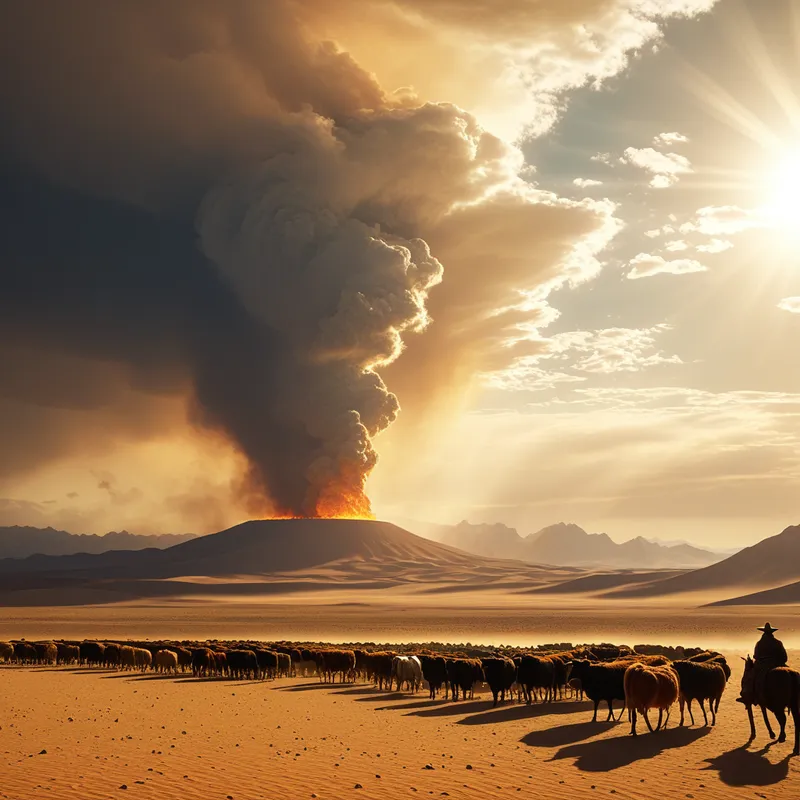
Hear now a tale written not on papyrus, but on the skin of a people. It begins not with a birth, but with a breath of freedom so sharp it cuts the throat. From the brick-kilns of Mitzrayim, a multitude stumbled into the vast, open mouth of the wilderness. Behind them, the waters of the Yam Suf crashed upon the chariots of their past. Before them, nothing but a burning expanse of sand and stone, a horizon that shimmered with mirage and menace.
They were led by a man whose staff had split the sea, Moshe, his face still radiant from speaking with the Unnameable. And the Unnameable did not abandon them to the wastes. By day, a great Pillar of Cloud moved before them, a divine shadow against the glare. By night, it became a Pillar of Fire, a heart of warmth in the desert’s cold, beating breast. It was their only compass in a land without roads.
But freedom’s first flavor turned to ash. Thirst clawed at their throats at Marah. Hunger gnawed their bellies, and memory betrayed them, painting the slave-quarters of Egypt as “lands flowing with milk and honey.” They grumbled against Moshe, against Adonai. “Why have you brought us out here to die?” The heavens answered not with rebuke, but with bread—Manna—fine as frost, tasting of honey-wafers, gathered each dawn with the trust that more would come with the morning. Quail fell from the sky. Water gushed from rock struck by Moshe’s staff.
Yet the wilderness was a crucible, not a cradle. At the mountain called Sinai, amidst thunder and thick cloud, the covenant was forged. The people heard the voice and trembled. They received the tablets of stone, inscribed with fire. But in the terrifying absence of their leader, fear bred idolatry. They pooled their gold and fashioned a Calf of Molten Gold, a god they could see, a echo of the stable, visible gods of Egypt. The covenant shattered before it could cool. Moshe descended, his face alight with a terrible grief, and dashed the holy tablets against the mountain’s foot.
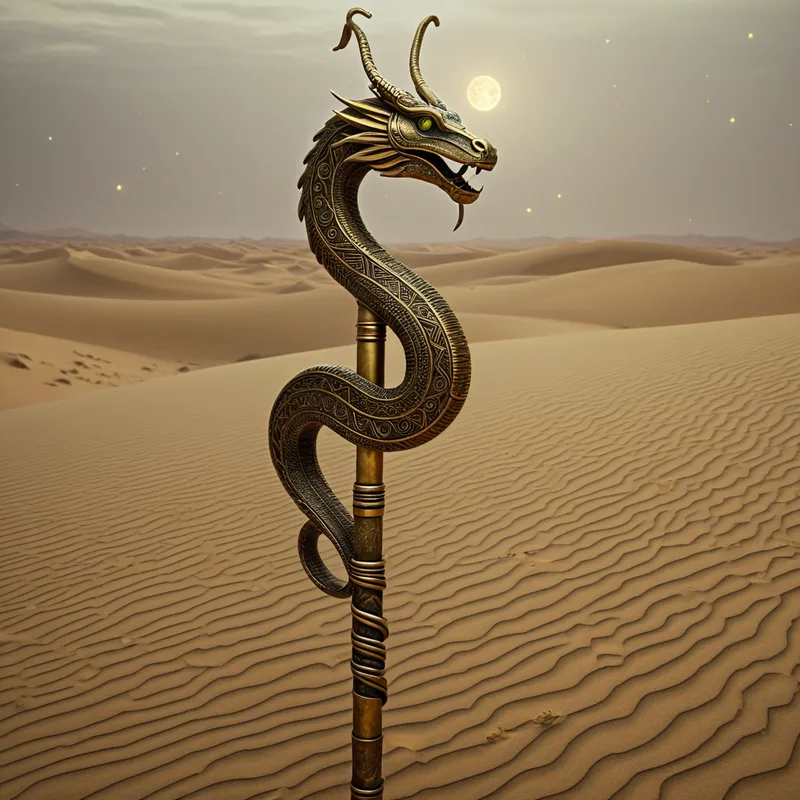
The journey resumed, now under a sentence. This generation, whose souls were still patterned by the bricks of Egypt, would not enter the Promised Land. They would turn their faces from it and wander. For forty years—a lifetime—they traced circles in the dust. Their sandals did not wear out. The manna never ceased. They were suspended, a nation in gestation, dying off one by one so a new people, born in the wilderness and knowing only its harsh lessons, could be raised up. They faced serpents of fire, and were healed by gazing upon a serpent of brass lifted high on a pole. They watched their clothes not age, their feet not swell, fed by a miracle, yet condemned to live within it until the last slave-hearted soul returned to the sand from which it came. The desert was their womb and their tomb, their school and their sentence, until at last, by the banks of the Jordan, a new generation stood ready, looking across the water to a land they had only heard in stories, forged in the great and terrible emptiness.

Cultural Origins & Context
This is the foundational national epic of ancient Israel, woven from oral traditions, tribal memories, and liturgical recitations. It functions as the “origin story” not of the world, but of a people’s soul. Scholars see layers: possible memories of smaller groups escaping Egyptian control, merged with nomadic wilderness sojourns and the profound theological innovations of the priesthood. It was told and retold at Passover (Pesach), not as distant history, but as a participatory drama: “You were strangers in the land of Egypt.” The story served to explain why Israel’s God was not a territorial deity tied to a mountain or city, but a God of journey and covenant. It justified their claim to Canaan, explained the forty-year gap between Exodus and conquest, and, most crucially, established the core identity: a people chosen and shaped through hardship, defined by law and liberation, not by the bricks of empire.
Symbolic Architecture
The desert is the central symbol—the Tohu wa-Bohu (formless void) of the soul after a great rupture. It is the necessary emptiness after the collapse of an old, oppressive order (Egypt). It represents the terrifying, fertile ground of potential where the old, internalized “slave” must die so the free “citizen of the covenant” can be born.
The promised land is not a place you find, but a state of being you become ready to enter. The desert is the price of that readiness.
The Manna symbolizes divine grace that must be gathered daily—a lesson in radical, moment-to-moment dependency and trust, the antithesis of Pharaoh’s storehouses. The Golden Calf is the psyche’s desperate retreat to a known, tangible symbol of power and security when faced with the unbearable ambiguity of the unseen Divine. The forty years is not merely a punishment, but the complete cycle of a psychological generation; the time required for a pathology (the slave mentality) to fully exhaust itself. The wandering itself is the process; the destination is almost secondary.
The Dreamer’s Resonance
To dream of desert wanderings is to be in a somatic state of psychic purgation. The dreamer is between structures. The known “Egypt” of a former identity, relationship, or career has been left behind, but the new “Canaan” is not yet visible. The body in the dream may feel parched, fatigued, or lost. This is the nervous system processing the anxiety of the transitional space. Dreaming of following a distant pillar of light or fire suggests an intuitive, if fragile, connection to a guiding Self. Dreaming of grumbling, of wanting to return to “Egypt,” signals a resistance to the process, a nostalgic longing for the familiar chains. Dreams of gathering strange, miraculous food point to finding sustenance in unexpected, perhaps spiritual, sources during a time of material or emotional scarcity.

Alchemical Translation
The alchemy of the desert is the transmutation of collective trauma into conscious covenant. The “lead” of the victim identity (“We were slaves”) is not simply discarded; it is carried through the fire of the wilderness until it becomes the “gold” of chosen responsibility (“We will do and we will hear”).
The tablets are shattered so that the law can be rewritten not on stone, but on the heart of a people who have tasted both miracle and consequence.
The modern individual undergoes this when they leave a toxic system (family, culture, job) but then must spend a necessary period in the “wilderness” of therapy, solitude, or disorientation. This is the nigredo, the blackening, where the old ego-structures break down. The manna is the small, daily insights that sustain. The repeated crises (thirst, hunger, rebellion) are the iterations of purification. The goal is not to avoid the forty years, but to consent to them—to understand that the wandering is the path to the promised land of an integrated Self. One does not cross the Jordan until the part of oneself that would rebuild Egypt in Canaan has died of its own irrelevance. The covenant forged at the end is not with an external god, but with one’s own deepest, most demanding, and most liberating truth.
Associated Symbols
Explore related symbols from the CaleaDream lexicon: