The Desert Fathers' Cells Myth Meaning & Symbolism
Early Christian ascetics retreat to the desert's silence, confronting their inner chaos to find God in the stark solitude of their cells.
The Tale of The Desert Fathers’ Cells
In the fourth century, when the world grew loud with doctrine and the cities thick with comfort, a great turning began. Men and women felt a pull in their blood, a call not to build, but to unbuild. They turned their backs on the green Nile and walked east, into the scorching breath of the Egyptian desert—the Scetes.
They sought a furnace, not of fire, but of silence.
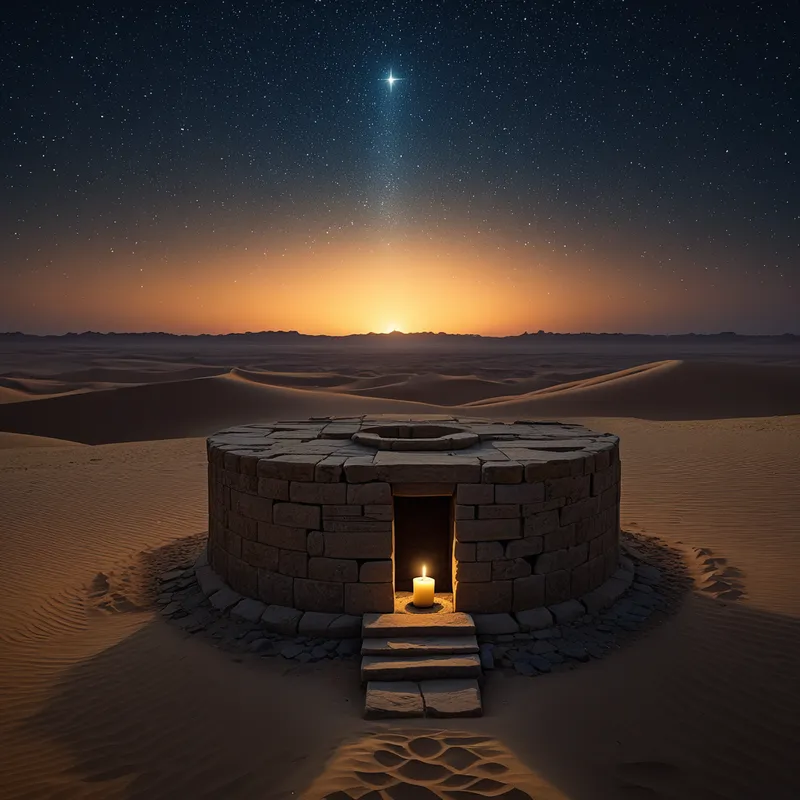
There, under a sky so vast it swallowed thought, they built their cells. Not houses, but tombs for the living. A circle of stones, a cave in the cliffside, a hut of woven reeds. A space just large enough for a man to sit, to sleep, to die to the world. The door was low, forcing a bow to enter. The window, if it existed, was a slit facing the blank wall of another cell, or the endless, tawny sea of sand.
The first enemy was the desert itself—the sun like a hammer, the night cold enough to crack stone, the scorpion and the snake. But this was only the beginning. For when the winds died and the world held its breath, the real battle commenced. It began in the cell.
In that absolute quiet, the soul began to speak. And it did not speak in prayers. Memories, long buried, rose like specters. The face of a wronged friend, the taste of a forgotten feast, the warmth of a lost embrace. Then came the logismoi—the thought-arrows. Whispered accusations of vanity: “You are here for show.” Taunts of despair: “God does not hear you in this waste.” Fantasies of power, of lust, of return. The cell, once a refuge, became a theater of madness, the four walls pressing in, mirroring the chaos within.
A young monk, Abba Moses the Black, would flee his cell, driven to distraction, only to be told by the elder Abba Isidore to “Go back to your cell. Your cell will teach you everything.” It sounded like a sentence. But it was the instruction.
So they returned. They sat. They wrestled. They wept. They repeated one simple prayer, a rope lowered into the well of the self: “Lord Jesus Christ, Son of God, have mercy on me.” The battle was not to conquer the thoughts, but to sit unmoved as they raged, to see them as clouds passing before the unchanging sun. Slowly, a terrible alchemy occurred. The demons of memory and desire, faced without flight, lost their substance. In the space they vacated, a different presence began to be felt—not an emotion, but a ground of being. A silence within the silence.
The resolution was not a victory cry, but a profound, unshakeable peace. The cell was no longer a prison of struggle, but a vessel of presence. The desert was no longer a wasteland, but a paradise. The hermit, having faced the totality of himself, found he was not alone. The cell had become the meeting place between the human and the divine.
Cultural Origins & Context
This is not a single myth with a plotted narrative, but a collective corpus of stories, sayings, and lives recorded in texts like the Apophthegmata Patrum (Sayings of the Fathers). It emerged in the 3rd and 4th centuries AD, following the end of Roman persecution. With Christianity becoming acceptable, many felt the faith was losing its radical, transformative edge. The desert offered a new martyrdom—a “white martyrdom” of the ascetic life, replacing the “red martyrdom” of blood.
These stories were passed down orally in the desert communities themselves, told by disciples at the feet of their elders. They served a dual function: practical wisdom for the spiritual combatant and a societal critique. They presented an alternative empire, a “city in the desert,” where the currency was humility and the law was love. The tales validated the extreme path of the few while inspiring and instructing the many in the churches, reminding all that the kingdom of God was an interior reality, won through confrontation, not comfort.
Symbolic Architecture
The cell is the central, multifaceted symbol. It is the alchemical vessel, the sealed container where the raw material of the psyche is subjected to the heat of attention until it transmutes. It represents the bounded space of the self, the conscious ego-structure we inhabit.
The cell is the physicalization of the psyche’s container. To stay within it is to consent to the process of self-confrontation, where the walls are the limits of your own being.
The desert is the prima materia—the void, the unknown, the unconscious. It is the necessary “away” from the collective norms (the city) where individuation can begin. The logismoi are not external demons but the personified contents of the personal and collective shadow: repressed desires, unlived lives, inherited fears, and the sheer psychic noise of a life unlived with awareness. The command to “stay in your cell” is the foundational rule of depth work: you must not flee from what arises within your own psychological space. You must meet it, bear it, and see through it.
The Dreamer’s Resonance
When this myth pattern activates in the modern psyche, it often manifests in dreams of stark, empty rooms, abandoned houses, or isolated cabins. The dreamer may feel compelled to stay in the room despite fear, or desperately want to flee. This is the somatic signal of the psyche initiating a “cell work.”
The psychological process is one of containment. The ego is being asked to hold space for uncomfortable material—anxiety, grief, old trauma, creative blocks—without its usual escape routes (distraction, addiction, projection onto others). The feeling of the walls closing in mirrors the pressure of this unprocessed content seeking consciousness. To dream of finally finding peace or even beauty in such a place indicates the successful integration of shadow material, where the isolated ego-space becomes a connected Self-space.
Alchemical Translation
The myth models the complete arc of individuation. The call to the desert is the call to a deeper life, often felt as a crisis or profound dissatisfaction with the status quo (nigredo, the blackening, descent into chaos). Building the cell is the conscious commitment to the process—creating a regular practice of introspection, therapy, or meditation.
The battle with the logismoi is the mortificatio, the dying to old identities and the painful confrontation with the shadow. The repetitive prayer is the rotatio, the focused, disciplined work that sustains the process through its darkest phases.
The triumph is not the annihilation of the demons, but the realization that they are made of one’s own substance, and in that recognition, they lose their autonomous, terrifying power.
The resulting peace and perception of the desert as paradise signify the albedo (whitening) and rubedo (reddening)—the illumination and integration. The cell, once a symbol of isolation, is revealed as the temenos where the ego-Self axis is established. For the modern individual, the myth translates to a non-religious but sacred imperative: to find your “cell” (a regular, bounded space and time for inner work), stay within it despite the inner turmoil it provokes, and allow the alchemy of attention to transform your relationship to your own interior chaos, ultimately discovering a foundational peace and authenticity that no external circumstance can grant or take away. The desert fathers did not find God by escaping the self, but by descending into its deepest, most solitary chamber.
Associated Symbols
Explore related symbols from the CaleaDream lexicon: