The Descent of the Gods into the Underworld Myth Meaning & Symbolism
The goddess Inanna's perilous journey to the underworld reveals the price of sovereignty, the nature of death and rebirth, and the necessity of facing the shadow.
The Tale of The Descent of the Gods into the Underworld
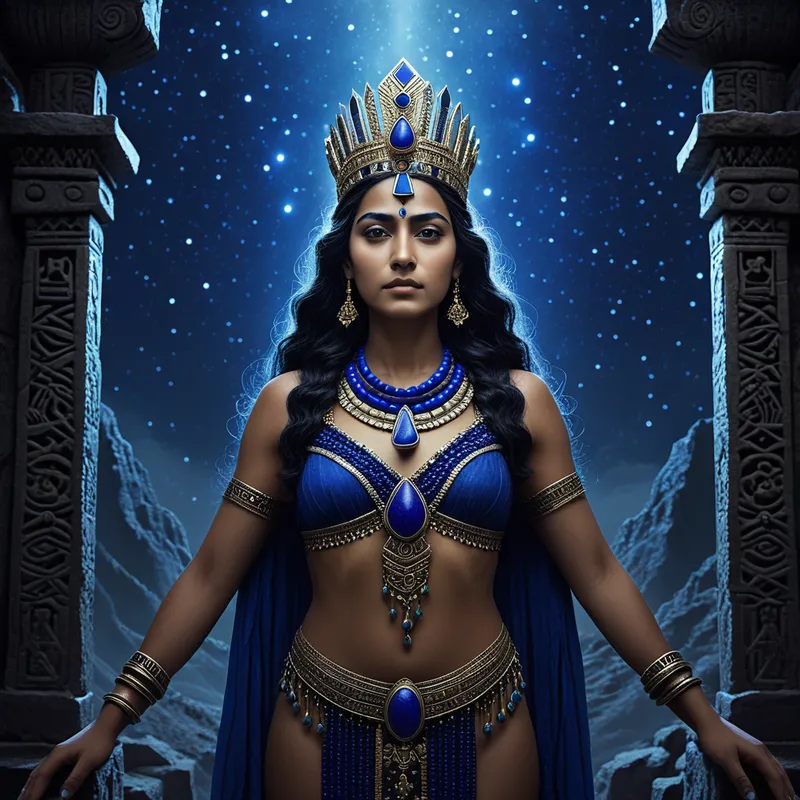
Hear now the tale that shakes the pillars of heaven and earth, the story not of a mortal’s folly, but of a goddess’s will. In the great above, where the Me are held, reigned Inanna, Queen of Heaven. Radiant in her lapis lazuli beads, crowned with the shining horns of divinity, she was the force of life, desire, and sovereignty. Yet, a deep knowing stirred within her—a pull toward the great below, the silent, dust-choked realm of her elder sister, Ereshkigal.
“From the Great Above I set my mind toward the Great Below,” she declared. Her trusted minister, Ninshubur, pleaded, but Inanna’s resolve was iron. She gathered the seven Me about her person: the crown of the steppe, the rod of lapis lazuli, the double strand of beads, the breastplate called ‘Come, man, come!’, the gold ring on her hand, the lapis lazuli measuring rod and line. Thus armored in her very identity, she descended.
The path led to the Kur, whose entrance was guarded by Neti at the first of seven gates. At each gate, a demand was made. “Remove your crown,” Neti intoned at the first. Inanna, Queen of Heaven, obeyed. At the second, “Remove your lapis lazuli beads.” So it went, gate by terrible gate. Her rod, her breastplate, her gold ring, her measuring rod—each piece of her divine adornment, each emblem of her power and role in the world above, was stripped from her. By the seventh gate, she stood naked and bowed, all sovereignty shed.
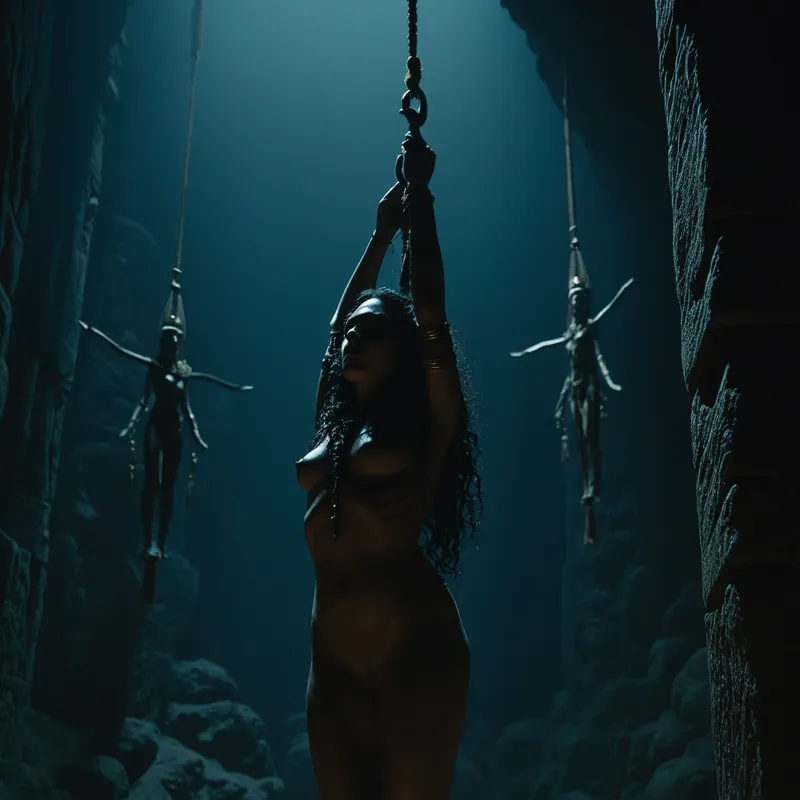
She entered the throne room of Ereshkigal, a cavernous hall lit by no friendly fire. The two goddesses, sisters of light and dust, locked eyes. Then the Annunaki, seated in the darkness, passed their judgment. The gaze of death fell upon Inanna. In that instant, she was struck down. Her body became a piece of rotting meat, hung upon a hook on the wall.
Above, time ceased. The bull no longer mounted the cow, the gardener no longer sang. Life itself held its breath. Ninshubur, following her queen’s desperate instructions, raised a lament. She went to the gods. Enlil refused help. Nanna refused. Only Enki, the cunning one, heard the plea. From the dirt under his fingernails, he fashioned two sexless creatures, the kurgarra and galatur. To them, he gave the food and water of life and whispered a strategy of empathy.
They slipped into the underworld, unseen as flies. They did not confront Ereshkigal but found her as she was: a woman in the agony of childbirth, moaning, “Oh, my insides!” They moaned with her. “Oh, your insides!” They shared her pain. Moved by this unheard-of compassion, Ereshkigal offered them a boon. They asked only for the corpse on the hook. Sprinkling the food and water of life sixty times upon Inanna’s lifeless form, they restored her.
But the laws of the Kur are absolute. No one leaves the underworld without providing a substitute. Inanna ascended, but behind her rose the dread galla, their eyes fixed, demanding a life for her life. They would not be swayed. And so, the returning goddess, reborn but forever marked by the below, was followed by shadows seeking their due.
Cultural Origins & Context
This myth, known as Inanna’s Descent to the Underworld, is one of the most powerful and complete narratives to survive from ancient Sumer, later adopted and adapted into Babylonian tradition as Ishtar’s Descent. It was recorded in cuneiform on clay tablets over 4,000 years ago. It was not mere entertainment; it was sacred literature, likely recited during ritual ceremonies, perhaps connected to the cycles of the seasons (Inanna’s disappearance linked to infertility) or to the initiation rites for priestesses and priests.
The story functioned as a profound theological and societal document. It articulated a core, terrifying truth: even divine power is subject to the laws of the unseen realms. It explored the balance of power between the great cosmic domains—Heaven, Earth, and the Underworld—and established that true sovereignty involves a confrontation with its opposite. The myth also served as an etiology for the seasonal cycle, explaining the barren period through the goddess’s absence, and reinforced the inescapable nature of divine decree and the necessity of sacrifice within the cosmic order.
Symbolic Architecture
The descent is the ultimate [metaphor](/symbols/metaphor “Symbol: A figure of speech where one thing represents another, often revealing hidden connections and deeper truths through symbolic comparison.”/) for the encounter with the [Shadow](/symbols/shadow “Symbol: The ‘shadow’ embodies the unconscious, repressed aspects of the self and often represents fears or hidden emotions.”/). Inanna does not go to conquer, but to witness. Her [journey](/symbols/journey “Symbol: A journey in dreams typically signifies adventure, growth, or a significant life transition.”/) is one of radical deconstruction.
The crown must be removed at the first gate. To enter the realm of the unseen, the persona—the glittering identity we present to the world—must be surrendered, piece by sacred piece.
Each of the seven gates represents a stripping away of a specific [aspect](/symbols/aspect “Symbol: A distinct feature, quality, or perspective of something, often representing a partial view of a larger whole.”/) of her conscious, worldly power. This is not [punishment](/symbols/punishment “Symbol: A dream symbol representing consequences for actions, often tied to guilt, societal rules, or internal moral conflicts.”/), but the necessary price of [passage](/symbols/passage “Symbol: A passage symbolizes transition, movement from one phase of life to another, or a journey towards personal growth.”/). The naked, [corpse](/symbols/corpse “Symbol: A corpse symbolizes death, the end of a cycle, and often implies the need for transformation and renewal.”/)-like state she achieves is the ego’s [death](/symbols/death “Symbol: Symbolizes transformation, endings, and new beginnings; often associated with fear of the unknown.”/), the total [vulnerability](/symbols/vulnerability “Symbol: A state of emotional or physical exposure, often involving risk of harm, that reveals authentic self beneath protective layers.”/) required for a genuine encounter with the contents of the personal and [collective unconscious](/symbols/collective-unconscious “Symbol: The Collective Unconscious refers to the part of the unconscious mind shared among beings of the same species, embodying universal experiences and archetypes.”/), symbolized by Ereshkigal.
Ereshkigal herself is not evil; she is the repressed, exiled [sister](/symbols/sister “Symbol: The symbol of a sister in a dream often represents connection, support, and the complexities of familial relationships.”/). She is the totality of experience that the bright, [life](/symbols/life “Symbol: The symbol of ‘Life’ represents a journey of growth, interconnectedness, and existential meaning, encompassing both the joys and challenges that define human experience.”/)-affirming [consciousness](/symbols/consciousness “Symbol: Consciousness represents the state of awareness and perception, encompassing thoughts, feelings, and experiences.”/) of Inanna has denied: [grief](/symbols/grief “Symbol: A profound emotional response to loss, often manifesting as deep sorrow, yearning, and a sense of emptiness.”/), rage, [isolation](/symbols/isolation “Symbol: A state of physical or emotional separation from others, often representing a need for introspection or signaling distress.”/), raw biological pain. Their meeting is a confrontation between the conscious [attitude](/symbols/attitude “Symbol: Attitude symbolizes one’s mental state, perception, and posture towards life, influencing emotions and actions significantly.”/) and its [counter](/symbols/counter “Symbol: A counter symbolizes boundaries, transitions, and the interplay between order and chaos, as well as a space for negotiation and interaction.”/)-balancing, unconscious opposite. Enki’s [rescue](/symbols/rescue “Symbol: The symbol of rescue embodies themes of salvation, support, and liberation from distressing circumstances.”/) plan is the key [insight](/symbols/insight “Symbol: A sudden, deep understanding of a complex situation or truth, often arriving unexpectedly and illuminating hidden connections.”/): salvation comes not through force, but through [empathy](/symbols/empathy “Symbol: The capacity to understand and share the feelings of others, often manifesting as emotional resonance or intuitive connection in dreams.”/). The kurgarra and galatur save Inanna by first acknowledging Ereshkigal’s suffering. The return, however, is not clean. The clinging galla demons signify that any genuine engagement with the [depths](/symbols/depths “Symbol: Represents the subconscious, hidden emotions, or foundational aspects of the self, often linked to primal fears or profound truths.”/) leaves a permanent [mark](/symbols/mark “Symbol: A ‘mark’ often symbolizes identity, achievement, or a defining characteristic in dreams.”/) and demands an ongoing sacrifice—a [piece](/symbols/piece “Symbol: A ‘piece’ in dreams often symbolizes a fragment of the self or a situation that requires integration, reflection, or understanding.”/) of one’s former, simpler self must be left behind.
The Dreamer’s Resonance
When this myth stirs in the modern psyche, it manifests in dreams of profound transition and ego-death. One may dream of descending endless staircases, riding elevators into subterranean car parks, or finding hidden basements in familiar homes. The feeling is one of compelled, solemn journeying. Dreams of being stripped of clothing, job titles, or social roles directly mirror Inanna at the gates. The appearance of a powerful, fearsome, or deeply sorrowful feminine figure (often silent or wrathful) represents the Ereshkigal aspect—the dreamer’s own unintegrated power, grief, or primal pain.
The somatic experience upon waking is often a heavy dread or a hollow vulnerability, as if the psychic skin has been removed. This is the feeling of the persona being dismantled. The dream is signaling a critical phase of psychological initiation, where the conscious self is being called to acknowledge and integrate what it has previously cast into its personal underworld: shame, forgotten trauma, rejected creativity, or unexpressed rage. The process feels like a death because it is.
Alchemical Translation
In the alchemy of individuation, Inanna’s descent models the nigredo, the blackening, the necessary dissolution of the ego’s prized structures. The modern individual is called to this descent not by curiosity, but by a sense of existential crisis, depression, or the collapse of a life structure (relationship, career, identity).
The underworld is not a place we visit, but a state of being we become. The hook that holds the corpse is also the crux where transformation hangs.
The sevenfold stripping is the conscious, often painful, work of therapy, shadow-work, or deep reflection: questioning one’s values, releasing outdated self-images, and confronting personal myths. Enki’s role is the emergent wisdom of the Self—the inner, guiding intelligence that crafts a strategy of compassion (galatur and kurgarra) where the ego’s willpower (Enlil, Nanna) fails.
The confrontation with Ereshkigal is the heart of the work: sitting with the pain, the depression, the anger without trying to fix it or spiritualize it away, but simply acknowledging its reality. This empathetic witnessing is what begins the transformation. The “food and water of life” is the nourishing insight that comes from this acceptance. The return is the albedo, a rebirth into a more complex, grounded consciousness. Yet, the galla are ever-present. The substitute sacrificed is the naïve innocence of the old personality. One can never fully “return”; one moves forward carrying the knowledge of the dark, which becomes a source of profound depth, resilience, and authentic power—the true, hard-won crown of the integrated Self.
Associated Symbols
Explore related symbols from the CaleaDream lexicon:
- Goddess — The central figure of divine will and sovereignty undertaking a perilous journey, representing the conscious psyche’s drive for wholeness and its confrontation with its own depths.
- Underworld — The realm of the forgotten, the repressed, and the ancestors; symbolizing the personal and collective unconscious where ego-identity is dissolved and reconstituted.
- Door — The seven gates of the underworld, each a threshold requiring surrender, representing the sequential stages of ego-dismantling necessary for profound psychological passage.
- Ritual — The structured, sacred process of the descent itself, mirroring initiatory rites where the initiate is symbolically stripped, “killed,” and reborn into a new state of being.
- Shadow — Ereshkigal and the Annunaki judges embody the repressed, feared, and unknown aspects of the self that must be faced and integrated for true wholeness.
- Death — The state of the corpse on the hook, representing the necessary ego-death, the end of a former identity, which is the prerequisite for any genuine rebirth or renewal.
- Rebirth — Inanna’s resuscitation by the food and water of life, symbolizing the emergence of a new, more complex consciousness from the ashes of the old self.
- Sacrifice — The stripping of the Me at each gate and the demand for a substitute upon return, representing the inescapable cost of transformation—something cherished must be given for something greater to be gained.
- Journey — The fundamental narrative arc from the Great Above to the Great Below and back, mapping the internal voyage of self-discovery, confrontation, and integration.
- Water — The “water of life” given by Enki, representing the animating, healing, and transformative power of unconscious wisdom that restores the psyche after its ordeal.
- Light — The divine radiance Inanna carries from the upper world, which is extinguished in the descent, only to be rekindled as a different, more grounded form of illumination upon her return.
- Key — Enki’s cunning strategy of empathy, which acts as the key to unlocking the frozen situation in the underworld, showing that compassion, not force, opens the way back to life.