The Descent of Ishtar
The Sumerian goddess Ishtar descends into the underworld, causing life on earth to wither until a deal is struck for her return.
The Tale of The Descent of Ishtar
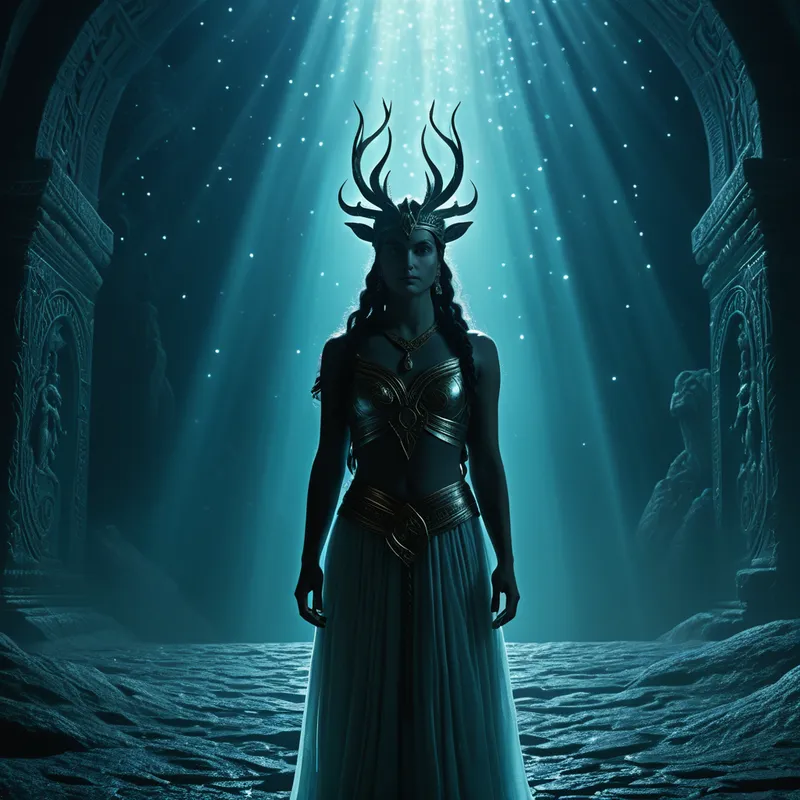
The tale begins not with a fall, but with a turning. [Ishtar](/myths/ishtar “Myth from Babylonian culture.”/), the radiant goddess of love, fertility, and war, whose domain was the pulsing heart of life itself, set her gaze downward. From the An, she looked to the Kur, the land of no return, ruled by her dark sister, Ereshkigal. What compulsion drove her? The epic whispers of a heart wounded by the [death](/myths/death “Myth from Tarot culture.”/) of her lover, the shepherd-god [Tammuz](/myths/tammuz “Myth from Mesopotamian culture.”/). Other fragments suggest a raw, imperial ambition, a desire to extend her sovereignty even over the realm of [death](/myths/death “Myth from Tarot culture.”/). Perhaps it was both—the lover’s grief and the queen’s pride intertwined into a single, fateful resolve.
Adorned with the seven divine me—her crown of the high plains, the pendants of her ears, the beads about her neck, the gems upon her breast, the golden girdle of birthstones, the bracelets of her hands and feet, and the robe of her body—she approached the great gate of [the underworld](/myths/the-underworld “Myth from Greek culture.”/). She demanded entrance from Neti, the guardian. “Open the gate, Neti, open the gate! If you do not open the gate, I will shatter the door, I will splinter the bolt, I will raise up the dead to devour the living!”
Faced with such raw divine power, Neti hurried to Ereshkigal. The Queen of the Great Below, seated on her dark throne, heard the news and her face grew pale with a cold rage. “What does her heart desire here? What does she seek in this land of dust? Very well. But follow the ancient decree. Open the seven gates to her. At each gate, remove a piece of her adornment.”
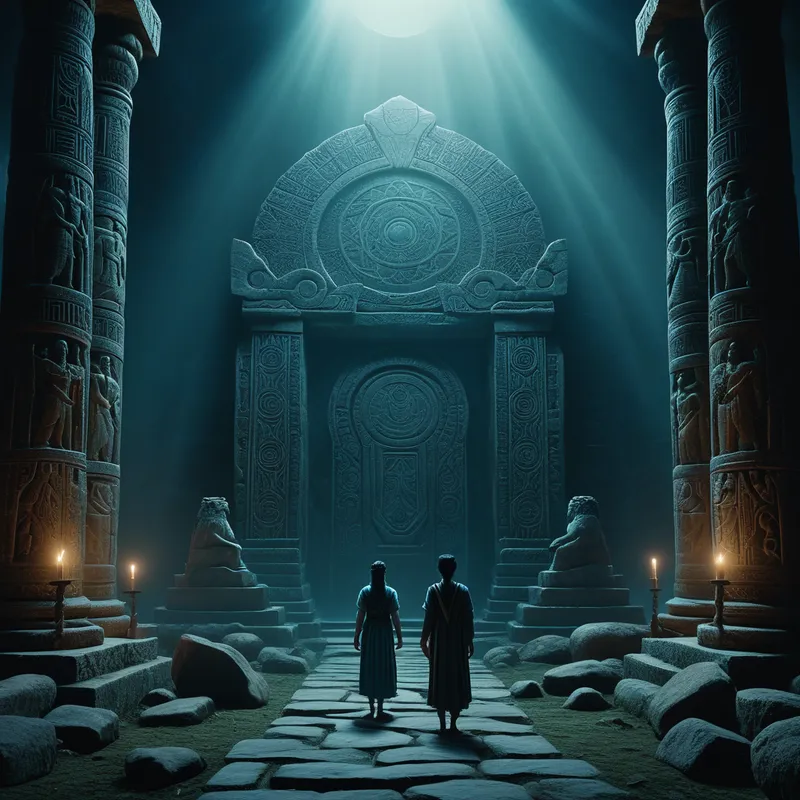
And so, the great descent began. At the first gate, her crown was taken. At the second, her ear pendants. Gate by gate, the symbols of her identity, her power, her connection to [the world](/myths/the-world “Myth from Tarot culture.”/) above, were stripped from her. The robe, the girdle, the beads, the gems—all were removed. By the time she stood naked and shivering before Ereshkigal’s throne, Ishtar was no longer the Queen of Heaven. She was merely a soul, stripped bare.
Ereshkigal’s wrath was immediate. She fixed Ishtar with the eye of death, and the goddess of life fell lifeless, hung upon a hook like a side of meat. With her descent and imprisonment, a terrible stillness fell upon [the earth](/myths/the-earth “Myth from Hindu culture.”/). Above, in the world of the living, all processes of love and generation ceased. The bull would not mount the cow, the ewe rejected the ram, and men and women turned away from each other’s beds. The green world withered. Life itself held its breath, poised on the edge of extinction.
In the heavens, the god Anu saw the barren silence. The wise god Ea crafted a plan, creating Asushunamir, a being of exquisite beauty and ambiguous nature, to charm Ereshkigal. Flattered and disarmed, Ereshkigal granted a boon. Asushunamir asked for the waters of life to revive Ishtar. Enraged by the trickery but bound by her oath, Ereshkigal commanded her servant Namtar to sprinkle Ishtar with the life-giving [water](/myths/water “Myth from Chinese culture.”/).
Ishtar was revived, but the laws of the Kur are absolute. No one may leave without providing a substitute. As Ishtar ascended back through the seven gates, each of her adornments was returned. She emerged once more in her full splendor. But behind her, a shadow followed. To secure her own release, she had to offer another to take her place. Her gaze fell upon Tammuz, her beloved, whose mourning for her had been insufficient. He was chosen. For half the year, he would dwell in the darkness, and the earth would mourn with Ishtar’s weeping. For the other half, he would return, and life would blossom anew. Thus, the cycle of descent and return, death and rebirth, was etched into the very fabric of the world.
Cultural Origins & Context
The myth, known as [Inanna](/myths/inanna “Myth from Sumerian culture.”/)’s Descent to the Netherworld in its older Sumerian form (Inanna being the direct precursor to the Akkadian Ishtar), is one of the most complete and psychologically complex narratives to survive from ancient Mesopotamia. It is preserved on clay tablets dating to the late third millennium BCE. This was not merely a story but a sacred text, intimately tied to the ritual life and cosmic understanding of the Sumerians and later Akkadians, Babylonians, and Assyrians.
The descent myth functioned as the divine precedent for the annual lamentation rituals for Tammuz (Dumuzi in Sumerian), a dying-and-rising god of vegetation. His six-month imprisonment in the [underworld](/myths/underworld “Myth from Greek culture.”/) explained the brutal summer drought of Mesopotamia, while his return heralded the autumn rains and renewed fertility. Ishtar’s journey thus provided a theological framework for the most urgent of human concerns: the cyclical death and rebirth of the natural world. Furthermore, it established the terrifying sovereignty of the underworld and its queen, Ereshkigal, a power even the most vibrant goddess must acknowledge. The myth underscores a fundamental Mesopotamian worldview: that the cosmos is governed by immutable decrees and that even divine will is subject to them, requiring negotiation, sacrifice, and the acceptance of cyclical loss.
Symbolic Architecture
The myth’s power lies in its stark, layered symbols. The seven gates represent the sevenfold [initiation](/symbols/initiation “Symbol: A symbolic beginning or transition into a new phase, status, or awareness, often involving tests, rituals, or profound personal change.”/) into the [mystery](/symbols/mystery “Symbol: An enigmatic, unresolved element that invites curiosity and exploration, often representing the unknown or hidden aspects of existence.”/) of [death](/symbols/death “Symbol: Symbolizes transformation, endings, and new beginnings; often associated with fear of the unknown.”/), a systematic deconstruction of [the ego](/myths/the-ego “Myth from Jungian culture.”/). Ishtar does not fight her way down; she is ritually unmade.
The stripping of the me is not a punishment but a necessary dissolution. To enter the realm of the absolute Other, one must surrender all attributes that define the self in the realm of the familiar. The lover, the warrior, the queen—these identities are garments that cannot be worn in the land of dust.
Her hanging on a hook is an [image](/symbols/image “Symbol: An image represents perception, memories, and the visual narratives we create in our minds.”/) of utter passivity and [suspension](/symbols/suspension “Symbol: A state of being held in limbo, neither progressing nor regressing, often representing unresolved tension or transitional phases in life.”/), the state between [life](/symbols/life “Symbol: The symbol of ‘Life’ represents a journey of growth, interconnectedness, and existential meaning, encompassing both the joys and challenges that define human experience.”/) and death, a seed in [winter](/symbols/winter “Symbol: Winter symbolizes a time of reflection, introspection, and dormancy, often representing challenges or a period of transformation.”/)’s ground. The creation of Asushunamir, the beautiful androgynous figure, represents the [emergence](/symbols/emergence “Symbol: A process of coming into being, rising from obscurity, or breaking through a barrier, often representing birth, transformation, or revelation.”/) of a new, reconciling [consciousness](/symbols/consciousness “Symbol: Consciousness represents the state of awareness and perception, encompassing thoughts, feelings, and experiences.”/) born from divine wisdom (Ea) to mediate between the irreconcilable opposites of [life](/symbols/life “Symbol: The symbol of ‘Life’ represents a journey of growth, interconnectedness, and existential meaning, encompassing both the joys and challenges that define human experience.”/) (Ishtar) and death (Ereshkigal).
Most profound is the substitution of Tammuz. It reveals a brutal cosmic economy: life is purchased with death; return requires a sacrifice. The myth refuses a simple, happy ending, instead instituting an eternal, bittersweet [rhythm](/symbols/rhythm “Symbol: A fundamental pattern of movement or sound in time, representing life’s cycles, emotional flow, and universal order.”/) of [presence](/symbols/presence “Symbol: Presence in dreams often signifies awareness or acknowledgment of something significant in one’s life.”/) and [absence](/symbols/absence “Symbol: The state of something missing, void, or not present. Often signifies loss, potential, or existential questioning.”/), joy and [grief](/symbols/grief “Symbol: A profound emotional response to loss, often manifesting as deep sorrow, yearning, and a sense of emptiness.”/).
The Dreamer’s Resonance
To encounter this myth is to dream of our own necessary descents. Psychologically, it maps the journey into [the personal unconscious](/myths/the-personal-unconscious “Myth from Jungian Psychology culture.”/)—the “underworld” of repressed grief, shame, trauma, or unacknowledged shadow. Ishtar’s prideful or grief-stricken impulse to confront the dark mirrors our own moments of crisis, when a part of us must go down into depression, despair, or profound loss to retrieve something vital.
The stripping at the gates resonates with any experience that dismantles our social [persona](/myths/persona “Myth from Greek culture.”/): illness, failure, heartbreak. We are forced to confront who we are when our crown, our job title, our relationships, our defining talents, are taken away. The naked soul before Ereshkigal is the core self, shorn of illusion. The period of suspension is [the dark night of the soul](/myths/the-dark-night-of-the-soul “Myth from Christian Mysticism culture.”/), where all action is impossible, and we are merely hung, waiting for a grace we cannot summon ourselves. The return, and the necessary sacrifice, speaks to the lasting change such an ordeal brings. We may re-enter life, but we are forever altered; an old way of being (a naive love, a brittle pride) must stay behind as a tribute to the depths we have witnessed.

Alchemical Translation
In the alchemical vessel of the soul, The Descent of Ishtar is the operation of [nigredo](/myths/nigredo “Myth from Alchemical culture.”/)—the blackening, the putrefaction, the essential first step of dissolution. The bright, conscious, solar principle (Ishtar) must willingly submit to the dark, lunar, chaotic waters of the unconscious (the Kur).
The goal is not to conquer the darkness, but to be transformed by it. Ishtar does not overthrow Ereshkigal; she is killed by her gaze and then revived by Ereshkigal’s own command. The Queen of Death becomes, paradoxically, the agent of a deeper, more resilient life. This is the alchemical coniunctio oppositorum—the conjunction of opposites—achieved not through force, but through ordeal and sacred law.
The cyclical fate of Tammuz represents the resulting [circulatio](/myths/circulatio “Myth from Alchemy culture.”/), the endless cycle of distillation and condensation, of spirit descending into matter and matter releasing spirit. The myth teaches that wholeness is not a static state of perfection, but a dynamic, eternal process of descent and ascent, loss and return. The power retrieved from the underworld is not more of the same solar glory, but a wisdom tempered by the knowledge of dust, a love deepened by the acceptance of loss.
Associated Symbols
Explore related symbols from the CaleaDream lexicon:
- Door — The seven gates of the underworld, each a threshold of surrender and transformation, marking the irreversible journey from one state of being to another.
- Mirror — Ereshkigal’s gaze, which reflects not an image but the absolute reality of mortality, stripping away all illusion and leaving only the bare essence.
- Descent — The fundamental movement of the myth, the willing or compelled journey into the depths of the unknown, the unconscious, or the realm of shadow.
- Sacrifice — The immutable law of the underworld; for something to live, something else must take its place, establishing the painful economy of all renewal.
- Cycle — The eternal rhythm instituted by the myth: life withers in descent and blooms in return, a cosmic pattern of death and rebirth.
- Shadow — The underworld itself and its queen, representing all that is repressed, feared, and denied by the bright, conscious world above.
- Power — Ishtar’s divine me, the external trappings of sovereignty that must be relinquished to access a more profound, internal form of authority.
- Grief — The primal emotion that may initiate the descent and the enduring state of the world during Tammuz’s absence, the necessary companion to love.
- Ritual — The myth’s structure reflects and informs sacred ceremonies, particularly lamentations, which re-enact the descent to safely navigate collective sorrow.
- Rebirth — Ishtar’s revival by the waters of life, representing the emergence of a new, more integrated consciousness from the ordeal of dissolution.