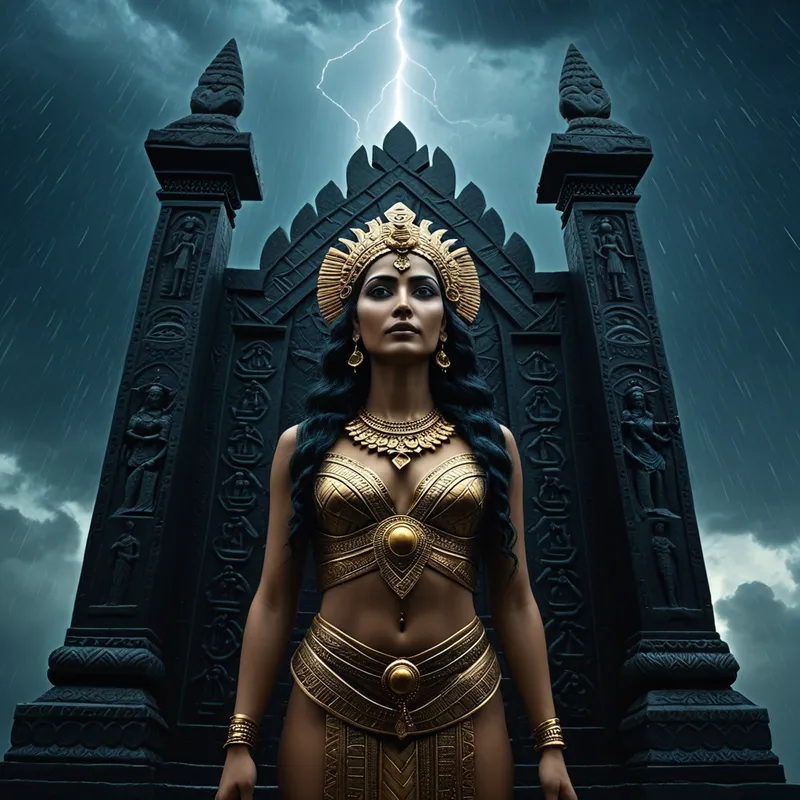
The descent of Inanna into the Myth Meaning & Symbolism
The Queen of Heaven descends to the land of no return, is stripped, killed, and resurrected, modeling the ultimate journey of ego death and renewal.
The Tale of The Descent of Inanna
The heavens held their breath. Inanna, Lady of the Great Above, fastened the final piece of her sovereignty about her person. The crown of the steppe, the rod and line of kingship, the lapis lazuli necklace, the twin egg-shaped beads, the golden breastplate, the pala dress, and the kohl for her eyes—all seven me were in place. Her heart was a drumbeat of pure will. She would go to the Great Below, to the Kur, a place from which no divine breath returns.
She instructed her faithful vizier, Ninshubur, to raise a lament if she did not return in three days, to seek aid from the great gods. Then, she turned her face from the sun and descended.
The way grew cold and silent. At the first lapis lazuli gate of Ereshkigal, the stern gatekeeper, Neti, barred her path. “Who are you?” he demanded. “I am Inanna, Queen of Heaven, on my way to the East,” she declared. But Neti’s voice was iron. “Stay here, Inanna. I must speak to my queen.” He returned with Ereshkigal’s decree: the visitor may enter, but at each of the seven gates, she must surrender a piece of her regalia.
At the first gate, the shining crown was taken from her brow. “What is this?” she cried. “Quiet, Inanna,” said Neti, “the ways of the underworld are perfect. They may not be questioned.” At the second gate, her lapis lazuli beads were stripped. At the third, the double strand. At the fourth, the breastplate of gold. At the fifth, the ring from her hand. At the sixth, the measuring rod and line. At the seventh and final gate, the very dress from her body. Naked and bowed, the Queen of Heaven entered the throne room of her sister.
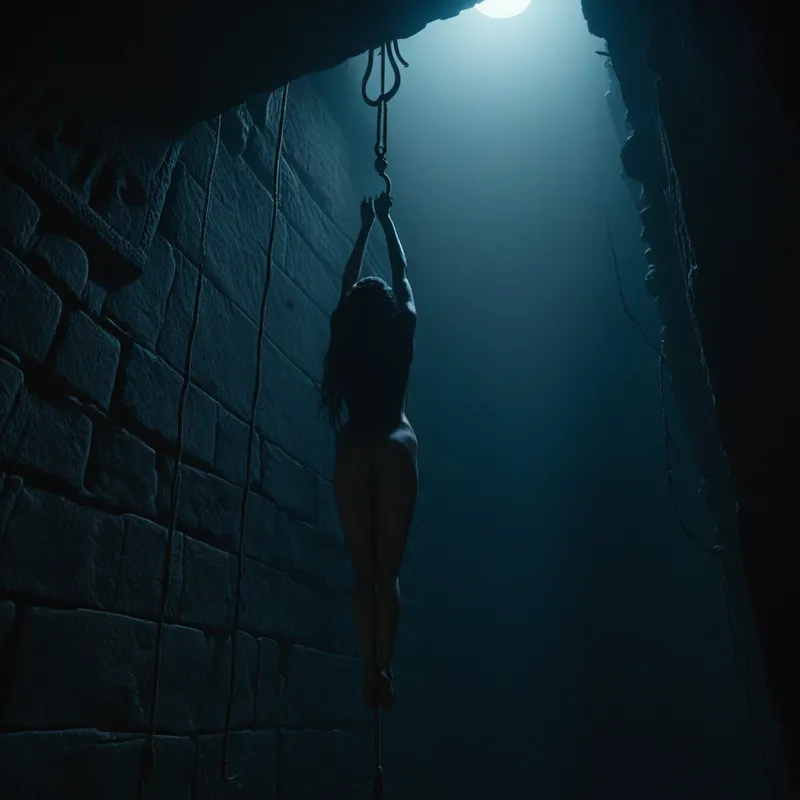
Ereshkigal sat upon her throne in the dark. The Anunnaki, the judges of the underworld, sat with her. They fastened their eyes upon Inanna, the eyes of death. A word was spoken. A judgment passed. Inanna was turned to a piece of rotting meat, a side of green, fly-blown flesh. They hung her corpse upon a hook.
Above, three days passed. Ninshubur raised the lament, beating the drum, circling the temples. She went first to Enki, the clever god. Moved by her tears, Enki fashioned two beings from the dirt beneath his fingernails: the Kurgarra and the Galatur. He gave them the food of life and the water of life, and whispered a strategy into their sexless ears.
They slipped into the underworld like mist, finding Ereshkigal moaning in the agony of childbirth, alone in her pain. They did not look upon her, but mirrored her cries. “Oh, my insides!” cried the queen. “Oh, your insides!” they sighed. “Oh, my outsides!” she wailed. “Oh, your outsides!” they echoed. Seen and heard in her raw suffering, Ereshkigal’s heart softened. “What do you wish of me?” she asked. They asked only for the corpse on the hook. She granted it.
They sprinkled the food and water of life upon Inanna’s lifeless flesh. Once, twice. She stirred. She rose. But the laws of the Kur are absolute: no one leaves without providing a substitute. The Anunnaki clung to her as she ascended, a host of hungry galla demanding their due. She would not give them Ninshubur, nor her sons. But when she returned to her city, she found her husband, Dumuzid, seated upon her throne, clad in fine robes, not mourning. A cold fire lit in her eyes. She looked upon him. The galla seized him. And so, the shepherd god descended to take her place, for half the year, in the dust.
Cultural Origins & Context
This myth is one of humanity’s oldest recorded narratives, inscribed on clay tablets in cuneiform over 4,000 years ago in ancient Sumer. It was not mere entertainment but a sacred text, likely recited during ritual ceremonies, possibly linked to the cycles of kingship, the seasons, and the mysteries of fertility and decay. The story of Inanna’s descent provided a cosmological framework for understanding the most profound transitions: the death of vegetation, the fall of a ruler, the experience of profound grief, and the hope for renewal. It was a story told to bind the community to the terrifying yet necessary rhythms of loss and return, affirming that even divine power must submit to the laws of the deeper realms.
Symbolic Architecture
The descent is the ultimate map of a conscious ego’s journey into the unconscious. Inanna is the radiant, identified self—the “Queen of Heaven”—who voluntarily turns away from the light of conscious control and achievement.
The first death is not of the body, but of the persona. One must be stripped to be rebuilt.
Her seven me represent the accumulated attributes of identity: status, power, relationships, and roles. To enter the realm of the shadow (Ereshkigal), these must be surrendered. The gates are the successive layers of defense and illusion we must pass through. Nakedness is not vulnerability as weakness, but as the only authentic state in which one can meet the core self, often experienced initially as a terrifying, destructive force (Ereshkigal in her rage). The hook is the absolute stasis of psychic death, where all motion and ambition cease.
The rescue by the Kurgarra and Galatur, born of Enki’s wisdom (the deep, creative unconscious), models the therapeutic intervention of empathy. They do not fight the darkness; they mirror it. By witnessing Ereshkigal’s pain without judgment, they facilitate a transformation. This is the alchemy of compassion, where attending to our own deepest, most rejected suffering (the “shadow queen”) releases the energy needed for rebirth.
The Dreamer’s Resonance
When this myth stirs in modern dreams, it announces a profound initiation. One may dream of losing a job title, a home, a relationship—the symbolic “garments.” Dreams of elevators plunging, of being stripped in public, or of wandering in a vast, dark basement all echo Inanna’s passage. The somatic experience is often one of crushing weight, paralysis, or chilling cold—the body registering the ego’s “death.” The figure of Ereshkigal may appear as a terrifying ex-partner, a wrathful parent, or a monstrous version of the dreamer themselves. This is not a nightmare to be merely escaped, but a process to be endured. The dream psyche is forcing a confrontation with what has been denied, demanding a surrender of an outdated self-image to make way for a more authentic existence. The hook is the depressive episode, the burnout, the “dark night of the soul”—a necessary, if agonizing, pause in the machinery of the persona.
Alchemical Translation
For the individual, Inanna’s journey is the blueprint for individuation. The conscious decision to “descend” is the courage to enter therapy, to face a deep-seated trauma, or to question the very foundations of one’s life path.
The throne of the underworld is also the seat of the Self. We must be dethroned to be truly crowned.
The stripping away is the painful but liberating work of shedding the “shoulds” and external validations that define us. The confrontation with Ereshkigal is the moment of hitting rock bottom, where we meet our own raw, unmediated pain, rage, or grief. The rescue comes not from “positive thinking,” but from the deep, instinctual wisdom (Enki) within us that knows how to offer unconditional presence to that pain. The rebirth is not a return to the old self, but the emergence of a new consciousness that has integrated the shadow. Finally, the provision of a substitute (Dumuzid) signifies that transformation requires a sacrifice. Some part of our old, unconscious, entitled, or naive way of being (the consort who lounges on the throne) must be given over to the cyclical depths. We achieve wholeness not by avoiding death, but by agreeing to let parts of us die, seasonally, so that new life can grow. The myth teaches that true power is born not from invulnerability, but from the sacred cycle of shedding, dying, and rising again.
Associated Symbols
Explore related symbols from the CaleaDream lexicon: