The Descent of Inanna Myth Meaning & Symbolism
The Queen of Heaven descends to the land of the dead, is stripped, killed, and resurrected, mapping the soul's journey through annihilation and renewal.
The Tale of The Descent of Inanna
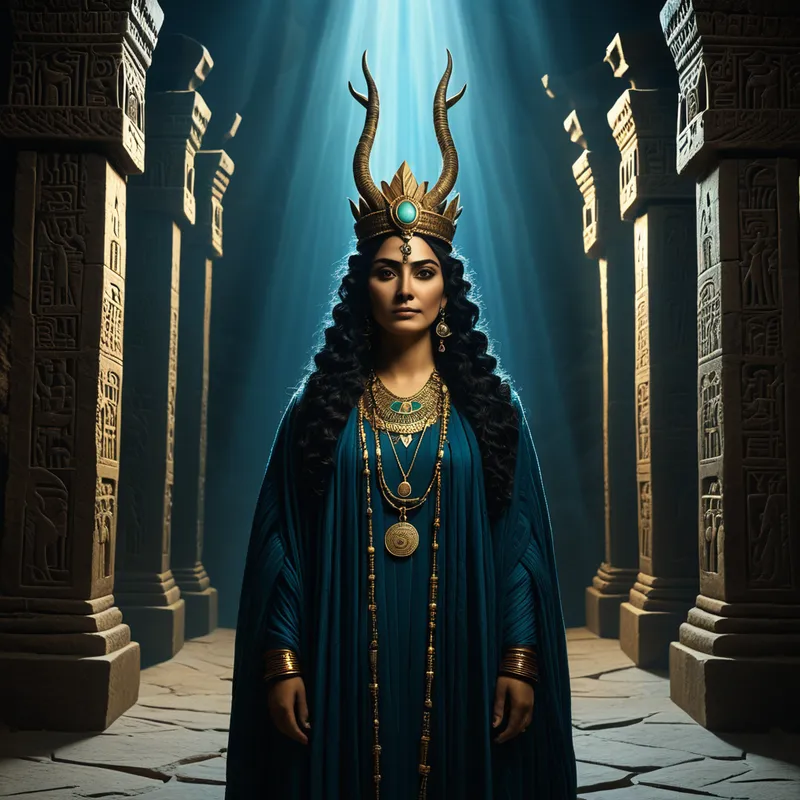
Hear now the tale that echoes from the clay tablets of Uruk, the story of the Queen of Heaven and the Great Below. Inanna, Lady of the Me, whose laughter could shake the date palms and whose gaze could command the morning star, turned her heart toward a realm where her power held no sway. She set her sight on the Kur, the silent, dusty land ruled by her dark sister, Ereshkigal.
With the regalia of her cosmic station—the shining Shugurra crown upon her brow, the lapis lazuli beads around her neck, the twin Rod and Ring of Justice in her hands, the breastplate called ‘Come, man, come!’ upon her chest, the gold ring on her wrist, and the royal robe draped about her—she descended. But the way was barred by seven gates, each manned by a silent netherworld guardian. At the first gate, the guardian’s hollow voice spoke: “Remove your crown, for such is the custom of the Kur.” Inanna, Queen of Heaven, bowed her head and complied.
Gate by gate, the unmaking continued. At each threshold, a piece of her divine identity was demanded and surrendered: her beads, her breastplate, her gold ring, her rod and ring, until finally, at the seventh gate, the royal robe was taken. Naked and bowed, she entered the throne room of Ereshkigal.
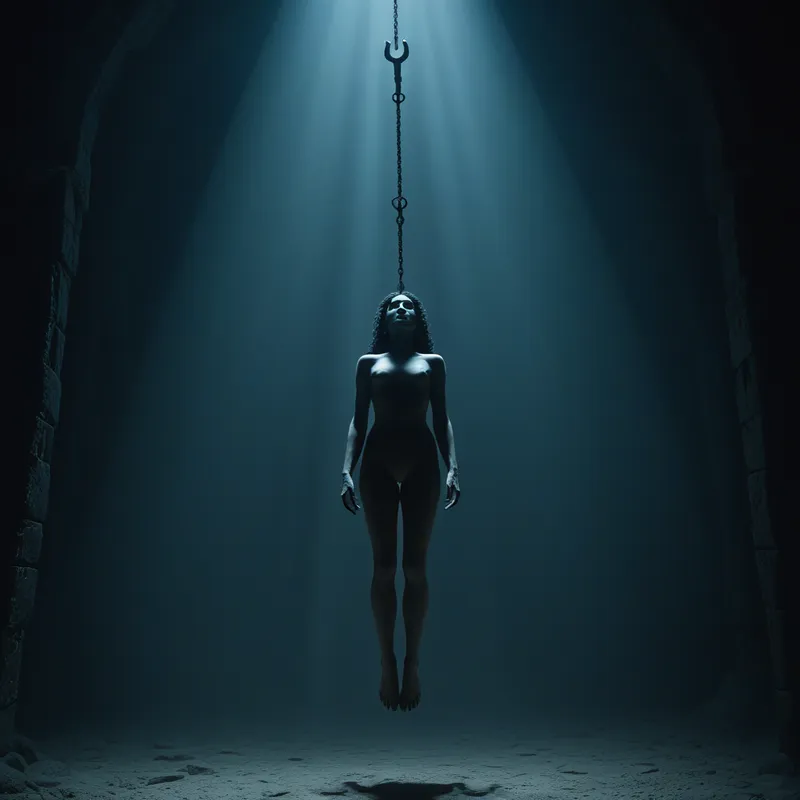
There was no welcome. The Anunnaki fixed upon her the eyes of death. Ereshkigal, seated on her throne of grief, whose own husband was stolen by the surface world, unleashed her fury. Inanna was turned to a corpse, a piece of rotting meat, and hung upon a hook.
Above, in the world of light, all life ceased. The bull no longer mounted the cow, the gardener no longer sang. For three days and three nights, the world hung in barren suspense. But Inanna was not without foresight. Before her descent, she had commanded her loyal vizier, Ninshubur, to raise a lament if she did not return. Ninshubur did so, beating the drum for her in the temples of the gods. She went first to Enki, the clever god of the sweet waters. Moved, Enki fashioned two beings from the dirt under his fingernails: the Kurgarra and the Galatur. To them, he gave the food and water of life.
These sexless emissaries slipped into the underworld like whispers. They found Ereshkigal in the throes of agony, crying out as if in childbirth. They did not flinch. They mirrored her cries, saying, “You! You!” in shared suffering. So seen, so companioned in her absolute isolation, Ereshkigal’s heart softened. As a gift, she offered them anything from her realm. They asked only for the corpse on the hook. Sprinkling the food and water of life sixty times upon Inanna’s lifeless form, they restored her.
But the laws of the Kur are absolute: none may leave without providing a substitute. As Inanna ascended back through the seven gates, each piece of her regalia was returned. Yet, behind her trailed the Gallu, the pitiless demons of the deep, insisting on their due. They would take anyone who did not show proper grief for her absence. They found her husband, Dumuzid, seated in fine clothes, unmourning. Inanna, her heart now holding the cold knowledge of the underworld, gave him to the demons. Thus was the balance kept, and the cycle of descent and return sealed.
Cultural Origins & Context
This myth, one of humanity’s oldest recorded narratives, originates in ancient Mesopotamia, circa 1900-1600 BCE. It was inscribed in cuneiform on clay tablets, part of a rich tradition of Sumerian literature. The story was not mere entertainment; it was a sacred text, likely recited during ritual ceremonies, perhaps linked to the cycles of vegetation, the planet Venus (Inanna’s celestial aspect), and the institution of kingship. The king’s legitimacy was tied to being the spouse of Inanna, and the fate of Dumuzid served as a potent mythic precedent for ritual mourning and the seasonal cycle of death and rebirth. It functioned as a societal map for understanding the most profound transitions: not just of seasons, but of power, fate, and the inevitable journey to the land from which none return.
Symbolic Architecture
The descent is the ultimate map of ego dissolution and encounter with the absolute Other. Inanna is the conscious personality, the “I,” adorned with all its accomplishments, titles, and social masks (the me). The seven gates represent the systematic deconstruction of this persona. It is not a battle but a surrender, a required stripping to the bare essence.
To meet the Queen of the Great Below, one must first become nothing.
Ereshkigal is the ultimate Shadow, not an evil twin but the repressed totality of experience—grief, rage, isolation, raw instinct. She is what the luminous, public Self must deny to function. Their meeting is a confrontation between the ego and the unconscious core. Inanna’s death on the hook is the psychic annihilation necessary for transformation; the old identity must die for a new consciousness to be born.
The rescue is equally symbolic. The Kurgarra and Galatur, born from the dirt of the wise god Enki, represent a transcendent, non-dual consciousness. They do not fight darkness with light but heal through radical empathy, mirroring Ereshkigal’s pain. This signifies that the healing force from the depths arises not from opposition, but from compassionate witnessing of our own most broken parts.

The Dreamer’s Resonance
When this myth stirs in the modern dreamer, it announces a profound somatic and psychological initiation. You may dream of losing your job, your home, your relationships—a symbolic stripping at various gates. You may dream of being paralyzed, hung up, or trapped in a basement, mirroring Inanna’s helpless suspension. These are not nightmares of mere anxiety, but of necessary ego death.
The somatic process is one of collapse: a deep fatigue, a feeling of being “undone,” a loss of vitality that mimics Inanna’s barren world above. Psychologically, it is the eruption of the Ereshkigal complex—long-buried grief, ancestral pain, or a foundational rage that shatters the dreamer’s self-concept. The dreamer is in the nigredo, the blackening, where all seems lost. The task here is not to immediately “fix” or ascend, but to fully inhabit the despair, to be the corpse on the hook, and await the mysterious, non-dual empathy (the Kurgarra and Galatur) that can only emerge from total surrender.
Alchemical Translation
For the individual on the path of individuation, Inanna’s descent is the quintessential model of psychic transmutation. The conscious ego (Inanna) must voluntarily undertake a journey into its own underworld (the unconscious). The alchemical operation is one of solve et coagula: to dissolve and re-coagulate.
The stripping at the gates is the solve, the dissolution of the persona. The death on the hook is the necessary putrefaction, where the old psychic structures break down into primal matter. The rescue via empathetic witnessing is the first stirring of the new, integrated consciousness—it is the albedo, the whitening, born from embracing the shadow.
The treasure hard to attain is not found in the light, but forged in the agreement between the corpse and the hook that holds it.
The return, however, completes the operation. One does not come back unchanged. Inanna returns with the Gallu, the demands of the deep. This translates to the modern individual’s responsibility: having touched the depths, you must now honor them. You must allow something of your previous, unconscious life (the Dumuzid within) to be sacrificed to the cyclical demands of depth. This might be an old habit, a naive ideal, or a one-sided way of being. The final transmutation is the establishment of a conscious relationship between the upper and lower worlds, a psyche that acknowledges both its radiant power and its necessary, periodic descent into the nourishing dark.
Associated Symbols
Explore related symbols from the CaleaDream lexicon: