The Decade of the Labors of Heracles Myth Meaning & Symbolism
A hero, driven mad by a goddess, must complete ten impossible labors to atone, battling monsters and his own nature to find redemption.
The Tale of The Decade of the Labors of Heracles
Hear now the tale of a strength that became a curse, and the long road that turned curse into legend. The air in the palace of Eurystheus was thick with fear and spite. Before him stood [Heracles](/myths/heracles “Myth from Greek culture.”/), a mountain of a man broken. The fire of madness, sent by the jealous goddess Hera, had only just cooled in his veins. In its wake, a horror: his own children, slain by his hands. The ash of his hearth was cold, his soul a wasteland.
The voice of the [Pythia](/myths/pythia “Myth from Greek culture.”/) still echoed in his ears: to be purified, he must bind himself in service. Not to a noble king, but to his own lesser cousin, the cowardly Eurystheus. For ten years, he would labor. Ten tasks, each whispered by Hera to be impossible, each designed not for glory, but for annihilation.
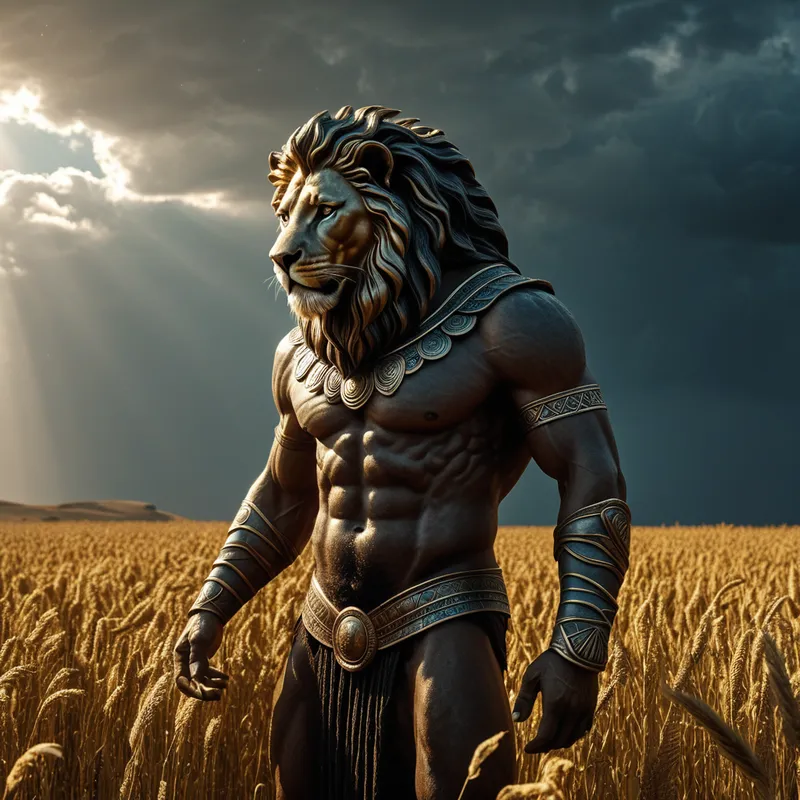
His journey began in the sun-scorched valley of Nemea, hunting a beast whose hide turned bronze and stone. Heracles found not just a lion, but a lesson in futility. His club shattered, his arrows fell useless. In the dark of its cave, strength met strength, and the hero learned a new language—that of suffocation, of raw, desperate force. He emerged wearing the beast’s own skin, a cloak of his first conquered impossibility.
From the swamp of Lerna came [the Hydra](/myths/the-hydra “Myth from Greek culture.”/), a nest of serpents with venomous breath and regenerating heads. Here, fire became his ally, the searing brand cauterizing each neck as his nephew Iolaus severed it. The stench of burning flesh and primal swamp filled his lungs. The labor was not clean; it was a messy, collaborative slaughter.
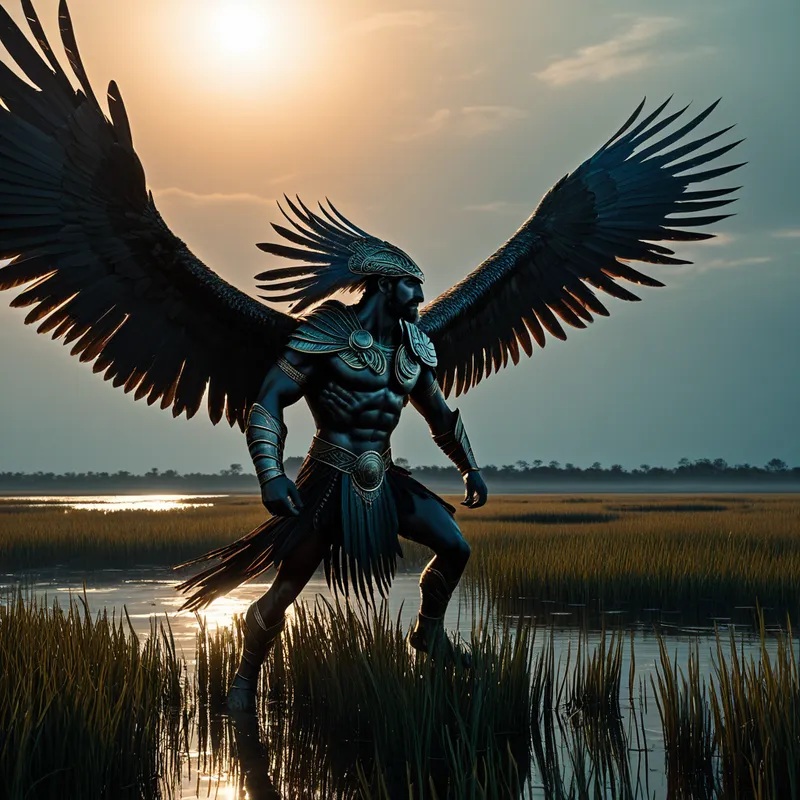
He chased the hind of Ceryneia, not to kill, but to capture, a test of patience as much as speed. He cleansed the filth of [the Augean stables](/myths/the-augean-stables “Myth from Greek culture.”/) not with a shovel, but by diverting rivers, turning the work of a lifetime into the work of a day—a labor of cunning that Eurystheus refused to count. He drove away the Stymphalian birds, their bronze feathers like deadly rain, with a thunderous clash of bronze castanets. He wrestled the Cretan Bull, its breath hot and angry, and bridled the man-eating mares of Diomedes, their muzzles stained red.
Each task was a world. The girdle of the Amazon queen Hippolyta, a negotiation in a land of warrior women. The cattle of the monster Geryon, stolen from the red sands of the sunset isle Erytheia. The golden apples from the garden of the [Hesperides](/myths/hesperides “Myth from Greek culture.”/), fetched by tricking the Titan Atlas himself. And finally, the descent. The journey to the house of [Hades](/myths/hades “Myth from Greek culture.”/) to leash Cerberus, the hound of hell. There, in the land of whispers, he completed the circle, facing not a monster of [the earth](/myths/the-earth “Myth from Hindu culture.”/), but the final guardian of the realm of death.
One by one, over a decade of dust, blood, and salt spray, the impossible was done. He returned each time to the bronze jar where Eurystheus hid in terror, depositing proof of a world remade by his hands. When the tenth year waned and the twelfth labor was complete, the hero stood, still cloaked in the lion’s skin, but the man beneath was no longer the shattered murderer of Thebes. He was something forged, task by terrible task.
Cultural Origins & Context
This epic cycle, far more than a simple adventure serial, was the bedrock of a hero cult that permeated the Hellenic world. The myths of Heracles were not confined to a single poet like [Homer](/myths/homer “Myth from Greek culture.”/) or Hesiod, but were a collective possession, told and retold in local variations across city-states. He was the Panhellenic hero, claimed by all. The labors, likely systematized into the canonical twelve later by poetic sources like Peisander of Rhodes, served a crucial societal function. They mapped the known and imagined world: from the local (Nemea, Lerna) to the exotic edges of the earth (the Hesperides, Erytheia) and even into [the Underworld](/myths/the-underworld “Myth from Greek culture.”/).
The telling of these tales occurred in symposia, at festivals, and at the many shrines and temples dedicated to Heracles. They were not mere entertainment; they were a form of cultural instruction. They explored the relationship between raw power (bia) and cunning intelligence ([metis](/myths/metis “Myth from Greek culture.”/)), between the burden of divine favor and the persecution of divine jealousy. Heracles, the ultimate demi-god, modeled the human struggle with monstrous forces—both external and internal—and the possibility of achieving kleos (glory) and honor even from a position of profound shame.
Symbolic Architecture
The [Decade](/symbols/decade “Symbol: A ten-year period representing a distinct era of personal or collective experience, often symbolizing cycles, progress, or nostalgia.”/) of the Labors is a masterclass in the [psychology](/symbols/psychology “Symbol: Psychology in dreams often represents the exploration of the self, the subconscious mind, and emotional conflicts.”/) of [atonement](/symbols/atonement “Symbol: A spiritual process of making amends for wrongdoing, seeking reconciliation with the divine, others, or oneself through sacrifice, repentance, or restitution.”/) and [integration](/symbols/integration “Symbol: The process of unifying disparate parts of the self or experience into a cohesive whole, often representing psychological wholeness or resolution of internal conflict.”/). Heracles begins in a state of [fragmentation](/symbols/fragmentation “Symbol: The experience of breaking apart, losing cohesion, or being separated into pieces. Often represents disintegration of self, relationships, or reality.”/)—his mighty [strength](/symbols/strength “Symbol: ‘Strength’ symbolizes resilience, courage, and the ability to overcome challenges.”/), a gift from his [father](/symbols/father “Symbol: The father figure in dreams often symbolizes authority, protection, guidance, and the quest for approval or validation.”/) Zeus, has been turned against his own house by the [fury](/symbols/fury “Symbol: An intense, overwhelming rage that consumes the dreamer, often representing suppressed anger or a primal emotional eruption.”/) of Hera. The madness is not random; it is the [eruption](/symbols/eruption “Symbol: A sudden, violent release of pent-up energy or emotion from beneath the surface, often representing transformation or crisis.”/) of an unlived [life](/symbols/life “Symbol: The symbol of ‘Life’ represents a journey of growth, interconnectedness, and existential meaning, encompassing both the joys and challenges that define human experience.”/), a potency perverted.
The labor is the container that transforms chaotic, destructive energy into disciplined, world-shaping action.
Each [monster](/symbols/monster “Symbol: Monsters in dreams often symbolize fears, anxieties, or challenges that feel overwhelming.”/) represents an autonomous complex, a “[piece](/symbols/piece “Symbol: A ‘piece’ in dreams often symbolizes a fragment of the self or a situation that requires integration, reflection, or understanding.”/)” of the unconscious that has grown monstrous and must be confronted. The Nemean [Lion](/symbols/lion “Symbol: The lion symbolizes strength, courage, and authority, often representing one’s inner power or identity.”/) is untamed aggression. The Lernean [Hydra](/symbols/hydra “Symbol: A multi-headed serpent from Greek mythology that regenerates two heads when one is cut off, symbolizing persistent, multiplying challenges.”/) is the [problem](/symbols/problem “Symbol: Dreams featuring a ‘problem’ often symbolize internal conflicts or challenging situations that require resolution and self-reflection.”/) that multiplies when attacked directly (regenerating heads), requiring the “fire” of [insight](/symbols/insight “Symbol: A sudden, deep understanding of a complex situation or truth, often arriving unexpectedly and illuminating hidden connections.”/) to cauterize it. The Augean Stables are the accumulated filth of a neglected life or [legacy](/symbols/legacy “Symbol: What one leaves behind for future generations, encompassing values, achievements, possessions, and memory.”/). The [journey](/symbols/journey “Symbol: A journey in dreams typically signifies adventure, growth, or a significant life transition.”/) to the [Underworld](/symbols/underworld “Symbol: A symbolic journey into the unconscious, representing exploration of hidden aspects of self, transformation, or confronting repressed material.”/) for [Cerberus](/symbols/cerberus “Symbol: The three-headed hound guarding the underworld’s entrance, symbolizing boundaries, protection, and the unconscious mind’s threshold.”/) is the ultimate confrontation with the [shadow](/symbols/shadow “Symbol: The ‘shadow’ embodies the unconscious, repressed aspects of the self and often represents fears or hidden emotions.”/) and the fear of [death](/symbols/death “Symbol: Symbolizes transformation, endings, and new beginnings; often associated with fear of the unknown.”/) itself.
Eurystheus, the pathetic [king](/symbols/king “Symbol: A symbol of ultimate authority, leadership, and societal order, often representing the dreamer’s inner power or external control figures.”/) hiding in a jar, is a brilliant [symbol](/symbols/symbol “Symbol: A symbol can represent an idea, concept, or belief, serving as a powerful tool for communication and understanding.”/) of the frail, fearful ego that sets the tasks of growth but cannot bear to witness the process. The labors are not for him; they are for the [soul](/symbols/soul “Symbol: The soul represents the essence of a person, encompassing their spirit, identity, and connection to the universe.”/) of the [hero](/symbols/hero “Symbol: A hero embodies strength, courage, and the ability to overcome significant challenges.”/). The divine artifacts—the lion’s [skin](/symbols/skin “Symbol: Skin symbolizes the boundary between the self and the world, representing identity, protection, and vulnerability.”/), the golden apples—are tokens of integration, proof that the conquered complex now serves as a [source](/symbols/source “Symbol: The origin point of something, often representing beginnings, nourishment, or the fundamental cause behind phenomena.”/) of strength and wisdom.
The Dreamer’s Resonance
When this myth stirs in the modern [psyche](/myths/psyche “Myth from Greek culture.”/), it rarely appears as a classical tableau. Instead, the dreamer finds themselves in an endless, oppressive loop of impossible tasks. They are cleaning a house that instantly refilths itself (the Augean Stables). They are preparing for an exam on a subject they’ve never studied, in a room that keeps changing (the capture of the Ceryneian Hind). They are fighting a boss or a figure that regenerates or transforms each time it is struck (the [Hydra](/myths/hydra “Myth from Greek culture.”/)).
Somatically, this can feel like a profound, wearying burden in the shoulders and back—the weight of [the world](/myths/the-world “Myth from Tarot culture.”/), or of Atlas’s sky. The psychological process is one of confronting a life structure, career, or internal state that feels like a divinely imposed sentence. The dreamer is in the “decade,” feeling the grind of an ordeal with no clear end, often following a personal catastrophe (the “madness”) that shattered their old identity. The dream is not about solving a single problem, but about enduring the transformative process of the sequence itself, where the real labor is the slow, grinding alchemy of [the self](/myths/the-self “Myth from Jungian culture.”/).
Alchemical Translation
The alchemical journey of Heracles is the opus contra naturam—the work against one’s own base nature. He begins as [nigredo](/myths/nigredo “Myth from Alchemical culture.”/), the blackening: the ashes of his children, the black mood of murderous guilt. The labors are the arduous, iterative stages of albedo (whitening) and citrinitas (yellowing), the purification and honing.
Each labor is a confrontation with a specific [prima materia](/myths/prima-materia “Myth from Alchemical culture.”/) of the soul: fear, rage, filth, chaos, temptation. The hero does not simply destroy these elements; he engages with them, learns their nature, and transmutes their energy. He wears the lion’s skin; he uses the Hydra’s venom for his arrows. The poison becomes a tool.
The ultimate goal is not freedom from service, but the transformation of servitude into sovereignty.
By submitting to the will of the oracle and the petty demands of Eurystheus (the flawed ego), Heracles ultimately transcends them. He does not become a king in a palace; he becomes a god. His apotheosis is the final stage of [rubedo](/myths/rubedo “Myth from Alchemical culture.”/), the reddening, the achievement of the philosopher’s stone—a self that has integrated all its monstrous, difficult parts. For the modern individual, the myth maps the path of individuation: the conscious, willing descent into one’s own labyrinths and swamps to retrieve the golden apples of wholeness, emerging not as who you were, but as what you have, through terrible effort, become.
Associated Symbols
Explore related symbols from the CaleaDream lexicon: