The Death of Sundiata Myth Meaning & Symbolism
The foundational myth of the Mali Empire's end, where the great king Sundiata Keita completes his destiny, transforming from a mortal ruler into an eternal ancestor.
The Tale of The Death of Sundiata
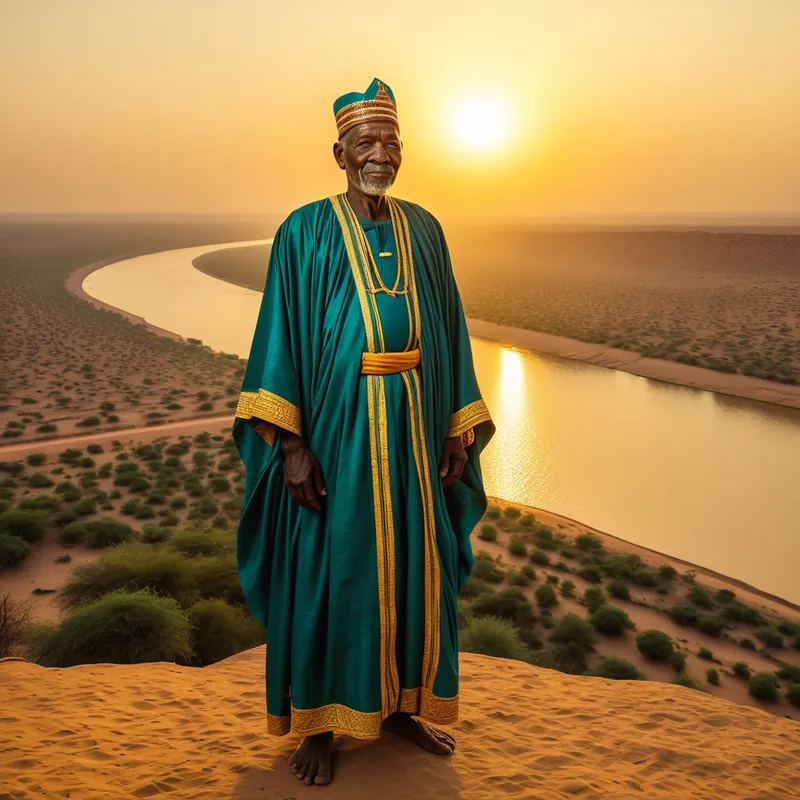
Listen. The air over the great river Joliba is heavy, not with rain, but with a knowing silence. The sun, a burning disc of copper, begins its slow descent behind the baobabs, casting long shadows that stretch like fingers across the land of Manden. At the river’s edge stands Sundiata Keita, the Lion King. His frame, once unbendable as ironwood, now carries the weight of years and empire. He feels the ache in his bones, a familiar song older than the drums of his court.
He had come to this place, a bend in the river sacred to the smiths and the nyama of the earth, drawn by a pull deeper than memory. The water flows, dark and patient, whispering secrets in a language only the soul understands. He remembers the prophecy from his youth, spoken by the djeliba: that his life would be a bow drawn taut, and its final release would not be in battle, but in a quiet consummation with the land itself.
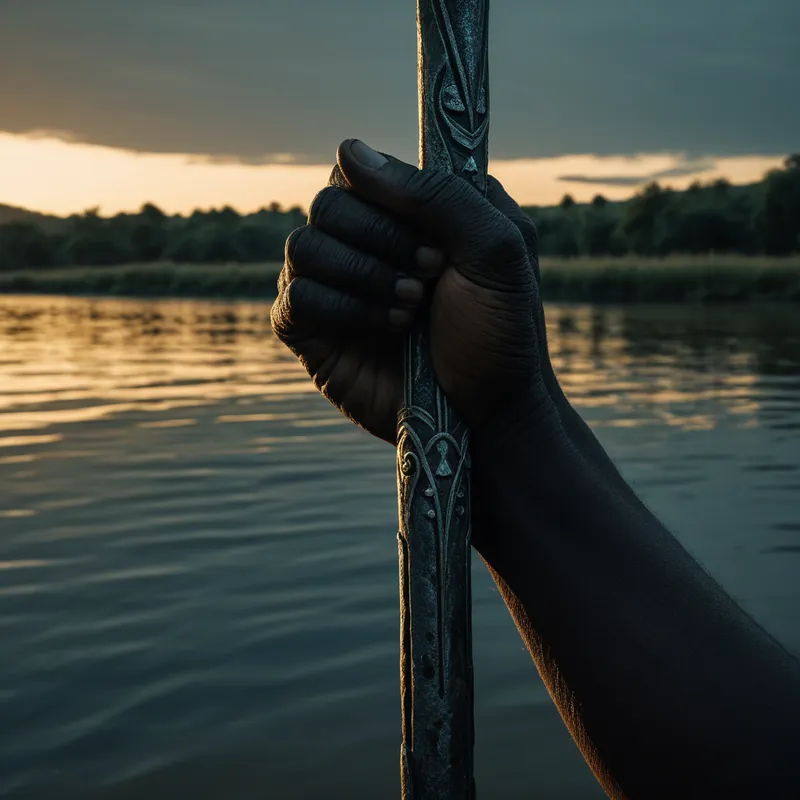
A great peace settles upon him, a stillness more profound than any victory. He plants his iron staff—the symbol of his authority and his link to the smith-ancestors—firmly into the soft earth. He does not call for his warriors or his sons. This is a journey for one soul alone. He looks not westward, toward his bustling capital of Niani, but eastward, to the source of the great river, to the ancestral home.
He begins to speak, his voice a low rumble that merges with the river’s flow. He speaks his true name, the names of his mothers and fathers, the names of the clans, weaving the story of Manden into the twilight. He gives thanks to the earth that bore him, to the river that nourished his kingdom, to the sky that witnessed his oath. He releases his da, his personal destiny, back to the source from which it came.
Then, without a sound of struggle, the great lion lets go. His body becomes still, a mountain coming to rest. But the story does not end with stillness. As the last light fades, a transformation begins. His form seems to soften, to merge with the riverbank. Some say his body turned to stone, a sentinel forever watching over the river. Others whisper that he dissolved into the waters of the Joliba, becoming one with its eternal flow. And others still, around fires for generations after, would swear that he did not die, but walked into the river, and from its depths was gathered by the ancestors, to sit in council among them for all time. The mortal king was gone. The eternal ancestor was born.
Cultural Origins & Context
This narrative of Sundiata’s passing is not a single, fixed text, but a living strand within the epic oral tradition of the Sunjata, performed for centuries by jeliw (griots). While the epic primarily celebrates his miraculous birth, exile, and triumphant return to found the Mali Empire in the 13th century, the traditions concerning his death are varied and profound. They serve a crucial societal function: to complete the archetypal cycle of the culture hero.
In Mande cosmology, a proper death is as vital as a proper life. It is the final act that seals one’s legacy and facilitates the transition from a living elder to a venerated ancestor who can intercede for the community. The myriad versions of Sundiata’s death—whether by transformation, peaceful passing, or mystical departure—all achieve this. They remove the hero from the mundane historical timeline and place him firmly in the mythological landscape, making him a permanent part of the land’s spiritual geography. This mythologized death ensures that Sundiata is not a figure of the past, but a perpetual, active presence in the cultural psyche of West Africa.
Symbolic Architecture
The death of Sundiata is not an annihilation, but a sublime metamorphosis. It represents the ultimate integration of the individual with the collective, the king with his kingdom, the man with the myth.
The hero’s final task is not to conquer another enemy, but to surrender his own separateness, returning his borrowed authority to the cosmos that lent it.
The Joliba is the central symbol of this process. It is the flowing, timeless essence of life, history, and spirit. Sundiata’s merging with it signifies that his personal story is now part of the eternal, collective story. His iron staff, planted in the earth, acts as a conduit—anchoring his legacy to the land while also serving as a lightning rod for his spirit’s ascent or dissolution. He does not fall; he is absorbed. This transforms the concept of death from an end into a change of state, from ruler to ancestor, from a body in time to a presence in the spiritual ecosystem of the people.
The Dreamer’s Resonance
When this mythic pattern stirs in the modern dreamer, it rarely appears as a literal king by a river. It manifests as a profound somatic and psychological process of completion and release. One might dream of a long-held project or identity—a career, a role, a creative endeavor—reaching a point of perfect, quiet fruition. There is no fanfare, only a deep, undeniable sense of “it is finished.”
The somatic signature is one of relief and weightlessness, often following a period of immense burden or responsibility. The dreamer may feel themselves dissolving, not into nothingness, but into a larger landscape—a forest, an ocean, a starfield. This is the psyche’s enactment of surrendering the ego’s central command post. The conflict is not against an outer foe, but against the inner clinging to a form that has outlived its purpose. The dream signals that a major cycle of the individual’s life is concluding, and the psychic energy invested in it is ready to be returned to the soul’s source, to be reconstituted into a new, less personal, more essential form of being.

Alchemical Translation
For the modern individual navigating the path of individuation, Sundiata’s death models the final alchemical stage: Rubedo, the reddening, followed by Projectio. Here, the “gold” is the fully realized Self. The struggle is to perform the ultimate act of sovereignty: to willingly relinquish the isolated, heroic identity that was so painstakingly built.
Individuation’s zenith is not a crown kept, but a crown given back. It is the realization that the true self was never the lone hero, but the very river into which the hero steps.
This is the transmutation of the ego from ruler to servant of the greater Self. The “empire” one has built—a career, a reputation, a complex personality—must eventually be surrendered to the flow of time and the larger community of one’s inner archetypes (the “ancestors”). The process feels like a death because it is. It is the death of the self-as-separate-project. The triumph is the birth of the self-as-integral-part. One moves from having a destiny to being a note in the destiny of the whole. The peace Sundiata finds is the peace of this homecoming, where the individual will is seamlessly aligned with the animating will of life itself.
Associated Symbols
Explore related symbols from the CaleaDream lexicon:
- Hero — The archetype that completes its cycle not in endless battle, but in the conscious, willing surrender of its own title and form, achieving true immortality through dissolution into the collective.
- River — The eternal flow of life, time, and spirit into which the individual consciousness returns, symbolizing that all personal stories are tributaries of a greater, endless narrative.
- Death — Not as an end, but as the essential transformative rite that changes the state of being from mortal actor to eternal, influencing presence within the psychic and cultural landscape.
- Destiny — The personal life-force or path that is fulfilled and consciously released back to its source, completing a sacred contract between the individual and the cosmos.
- Ancestor — The state of being achieved through a mythologized death, where one transitions from a historical figure to a timeless, guiding force within the community’s soul and memory.
- Sacrifice — The ultimate offering of the achieved self, the greatest gift a hero can give, which is the return of their power and story to the common well of meaning.
- Transformation — The core process of the myth, where the physical and personal is alchemized into the spiritual and eternal, changing form but not essence.
- Earth — The receptive element that anchors the legacy, as Sundiata’s staff is planted in it, symbolizing the rooting of myth into the tangible world and its cycles.
- Stone — The potential form of his transformed body, representing permanence, memory, and the petrification of a moment of transition into an eternal monument.
- Light — The golden sunset of completion and the inner illumination of acceptance that guides the final journey, representing conscious understanding at the moment of transition.
- Order — The societal and cosmic balance that is secured not by a king’s continued rule, but by his perfect, timely departure, ensuring the continuity of the kingdom’s spiritual law.
- Circle — The completed cycle of the hero’s journey, from prophesied birth to destined death, which closes perfectly, allowing the energy to renew itself in the cultural unconscious.