The Death Canoe Myth Meaning & Symbolism
A myth of a canoe that carries souls to the afterlife, representing the perilous journey of transformation and the dissolution of the ego.
The Tale of The Death Canoe
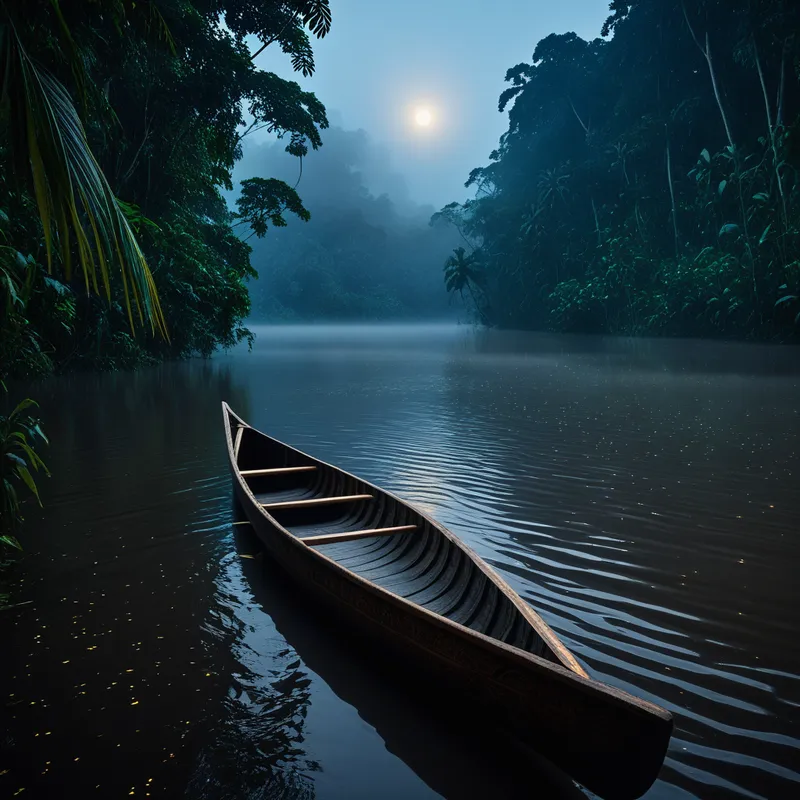
Listen. The jungle is not silent. It breathes, it hums, it watches. And on the black water of the great river, when the moon is a sliver and the stars are veiled, it sends forth its messenger. Not a spirit of claw and fang, but of wood and water. The Death Canoe.
It does not appear to the living who cling to the village fires, to the chatter and the smoke. It comes for the one who is already half-gone, whose soul has been tasted by grief, or sickness, or a longing so deep it has carved a hollow where the heart once beat. It glides from the upstream darkness, a shape of polished, waterlogged timber, older than the oldest tree. No paddle dips. No hand guides it. It moves with the patience of the river itself, knowing its destination.
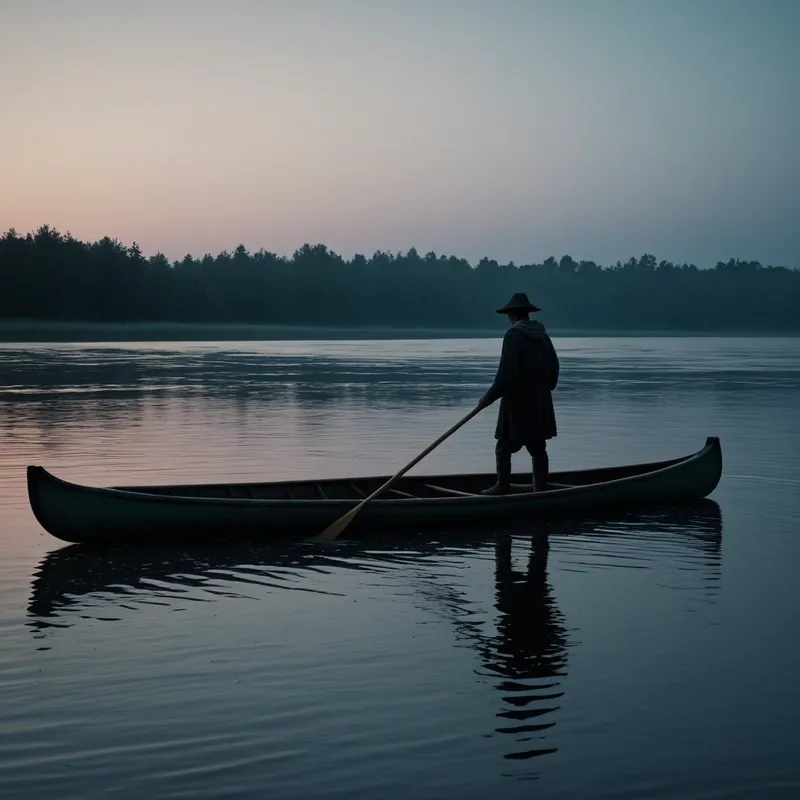
The chosen one—the traveler—feels a cold pull in their marrow. They rise from their hammock, or from the forest path, drawn to the bank. The air grows still. The cacophony of frogs and insects hushes. All that remains is the soft lap of water against the canoe’s silent hull. To step in is an act of utter surrender. It is to release the hand of the known world. The traveler settles onto the damp wood, and the craft turns, slow and inevitable, to face the endless downstream.
The journey is the dissolution. The familiar shapes of trees blur into a wall of shadow. The sounds of the world—the laughter of children, the call of a bird—fade, replaced by the inner roar of memory and regret. The river widens, becoming a sea of mist. Here, the traveler meets their shadows: faces of those wronged, chances not taken, loves lost. They swirl in the fog, but the canoe does not stop. It carries the weight of them all.
There is no ferocious gatekeeper, no monstrous beast. The terror is in the absolute alone-ness, the final stripping away of every identity—child, parent, warrior, victim. The self unravels like old thread. Just as the silence becomes unbearable, just as the traveler becomes nothing but a point of awareness adrift, a new shore emerges from the mist. It is not a place of golden light, but of profound, fertile darkness. The canoe grounds itself on the soft bank. To disembark is not to arrive somewhere, but to become something else. The vessel, now empty, drifts back into the mist, waiting to be called again.
Cultural Origins & Context
The myth of the Death Canoe is not a single story with a fixed text, but a pervasive narrative pattern found across numerous Indigenous Amazonian cultures, from the Tukano to the Shipibo-Conibo. It belongs to the rich cosmology of riverine peoples for whom the aquatic highway is the central metaphor for life, death, and the flow of time itself.
These stories were traditionally transmitted by shamans and elders during sacred rituals or in the intimate space of the communal house. The telling was not mere entertainment; it was a functional map of the afterlife, a preparation for the ultimate journey. It served to console the living by providing a structure for the unimaginable, and to instruct them on the proper conduct of life and death rites. The myth reinforced the understanding that death is not an end, but a transition—a voyage as natural and necessary as the river’s course to the ocean. It framed the individual’s passage as part of the ecosystem’s eternal cycle, dissolving the sharp, fearful edge of mortality into a broader, flowing continuity.
Symbolic Architecture
The canoe is the perfect [symbol](/symbols/symbol “Symbol: A symbol can represent an idea, concept, or belief, serving as a powerful tool for communication and understanding.”/): a crafted object of culture (the carved [wood](/symbols/wood “Symbol: Wood symbolizes strength, growth, and the connection to nature and the environment.”/)) that must surrender to the primal, unconscious force of [nature](/symbols/nature “Symbol: Nature symbolizes growth, connectivity, and the primal forces of existence.”/) (the [river](/symbols/river “Symbol: A river often symbolizes the flow of emotions, the passage of time, and life’s journey, reflecting transitions and movement in one’s life.”/)). It is a container for a [consciousness](/symbols/consciousness “Symbol: Consciousness represents the state of awareness and perception, encompassing thoughts, feelings, and experiences.”/) in [transit](/symbols/transit “Symbol: Movement through space or time, representing life’s journey, transitions, and the flow of energy or consciousness.”/).
The Death Canoe is the ego’s final vessel. It is sturdy enough to hold the identity for the first leg of the journey, but its destination is its own obsolescence.
The river is the unconscious itself, the great flow of psychic [life](/symbols/life “Symbol: The symbol of ‘Life’ represents a journey of growth, interconnectedness, and existential meaning, encompassing both the joys and challenges that define human experience.”/) from which individual consciousness emerges and into which it must eventually return. The downstream [direction](/symbols/direction “Symbol: Direction in dreams often relates to life choices, guidance, and the path one is following, emphasizing the importance of navigation in personal journeys.”/) signifies a [movement](/symbols/movement “Symbol: Movement symbolizes change, progress, and the dynamics of personal growth, reflecting an individual’s desire or need to transform their circumstances.”/) away from the [source](/symbols/source “Symbol: The origin point of something, often representing beginnings, nourishment, or the fundamental cause behind phenomena.”/) ([birth](/symbols/birth “Symbol: Birth symbolizes new beginnings, transformation, and the potential for growth and development.”/), the conscious world) and toward the [ocean](/symbols/ocean “Symbol: The ocean symbolizes the vastness of the unconscious mind, representing deeper emotions, intuition, and the mysteries of life.”/) of undifferentiated being. The mist and the shadows encountered are the contents of the personal unconscious—repressed memories, unresolved complexes, and latent aspects of the self that must be faced and integrated not through battle, but through witnessed [passage](/symbols/passage “Symbol: A passage symbolizes transition, movement from one phase of life to another, or a journey towards personal growth.”/). There is no heroic victory here; the triumph is in the endurance of the process itself.
The Dreamer’s Resonance
When this myth stirs in the modern dreamer, it rarely manifests as a literal canoe on a jungle river. Instead, one might dream of being on a silent train traveling through a tunnel of endless night, or in an elevator descending past floors of forgotten memories, or simply adrift on a vast, calm, dark sea. The somatic signature is one of profound solitude and a quiet, chilling inevitability.
This dream pattern emerges during periods of profound psychological transition that feel like a kind of death: the end of a career, the collapse of a long-held identity, a crisis of faith, or the slow processing of deep grief. The psyche is announcing that a central structure of the self is being dismantled. The ego is being asked to step into the canoe—to consent to a process it cannot control. The dream is not a prophecy of literal death, but a map of the psychic death required for rebirth. The terror in the dream is the fear of ego-dissolution; the peace that sometimes follows is the soul’s intuition of what lies beyond it.
Alchemical Translation
In the alchemy of the soul, the Death Canoe myth models the stage of nigredo. This is the dark night, the necessary putrefaction where the old, outworn form of the self must break down. The modern individual’s “journey downstream” is the voluntary descent into depression, confusion, or loss of meaning—not as a pathology to be cured immediately, but as a sacred process to be endured.
Individuation is not about building a better, shinier ego. It is about allowing the canoe of the current self to carry that ego to its necessary end, so that what is essential can disembark on a new shore of being.
The myth teaches passive courage. The heroism here is not in slaying dragons, but in staying in the boat. It is the courage to feel the full weight of grief without fleeing into distraction, to face the shadowy figures of our past without denial, and to trust that the unconscious current has a destination, even if the conscious mind cannot see it. To translate this myth is to recognize those moments in life when we are called to stop paddling upstream, to cease our resistance, and to allow the deeper currents of the psyche to carry us into the fertile darkness where true transformation is seeded.
Associated Symbols
Explore related symbols from the CaleaDream lexicon:
- Canoe — The vessel of the soul and the temporary container of identity, representing the fragile yet necessary structure that carries consciousness through the transition.
- River — The timeless, flowing current of the unconscious mind and the destiny of the soul, along which all transformation travels.
- Journey — The core narrative of the myth, representing the non-negotiable process of psychic transition from one state of being to another.
- Death — The essential dissolution of the ego and known identity required before any form of rebirth or new consciousness can emerge.
- Shadow — The unresolved aspects of the self that rise like mist from the river during the voyage, demanding to be witnessed and integrated through the journey itself.
- Water — The primordial element of the unconscious, emotion, and the unknown, both carrying and dissolving the traveler.
- Spirit — The essential, indestructible essence of the being that undertakes the voyage, which persists after the dissolution of the personal self.
- Dream — The state of consciousness most akin to the voyage of the Death Canoe, where the soul travels beyond the boundaries of the waking ego.
- Destiny — The inherent, river-like course of the soul’s development, which the canoe follows without deviation.
- Rebirth — The implicit promise on the far shore of the journey, the new state of being that is only possible after the old self has been carried away.
- Sacrifice — The voluntary act of surrendering the known self to the unknown process, which is the fundamental requirement for boarding the canoe.
- Forest — The symbolic representation of the dense, mysterious, and living psyche from which the river of the unconscious flows.