The Dayak Creation Myth Myth Meaning & Symbolism
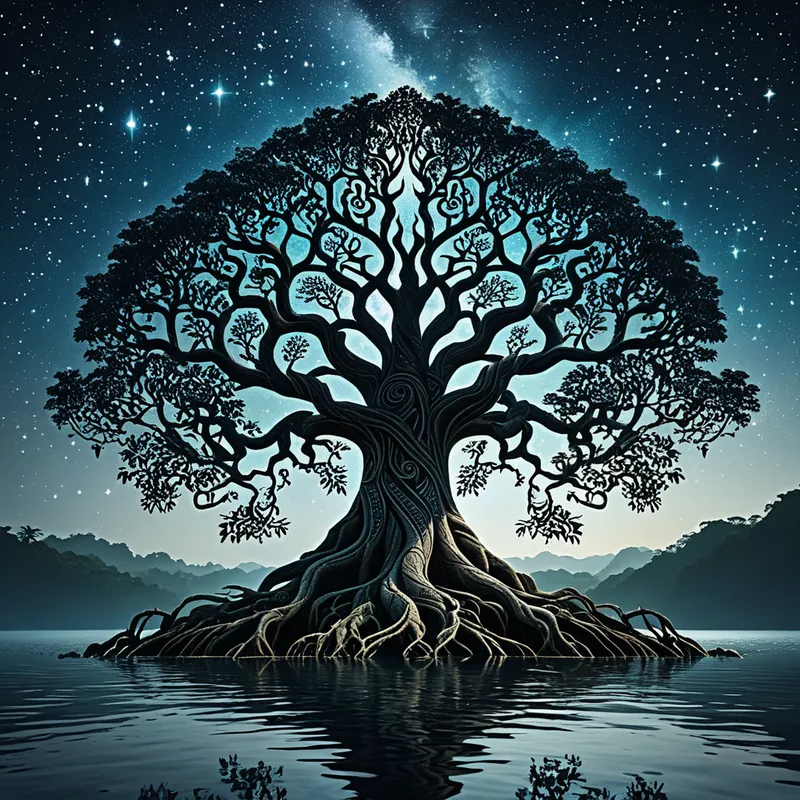
From the cosmic waters, a great tree grows. Its sacrifice births the world, modeling the profound alchemy of creation from unity into sacred, structured life.
The Tale of The Dayak Creation Myth
In the beginning, there was only the endless, dark water. No sun carved the sky, no moon pulled the tides. There was only the deep, a silent, dreaming expanse without shore or surface. This was the Nirvana of potential, the womb of all that could be.
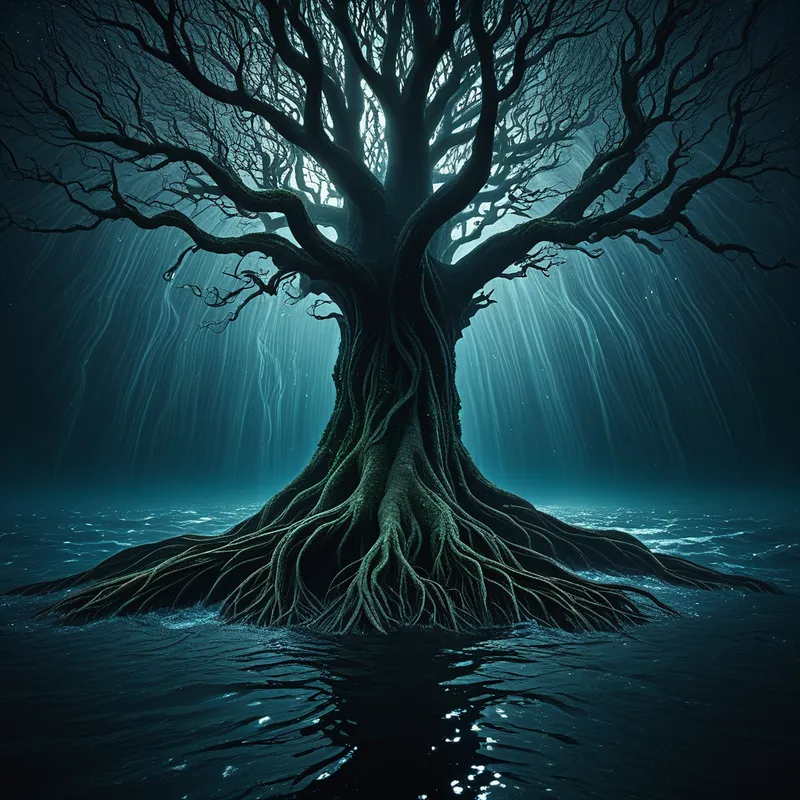
From this profound stillness, a stirring began. Not a sound, but a presence. A great and sacred intention gathered in the depths. And from this intention, life erupted—not as animal or plant, but as a being of pure, vertical aspiration. It was the <abbr title=“The World Tree, the axis mundi connecting the cosmic waters, the earth, and the heavens."">Tree of Life. Its first root plunged into the abyssal dark, drinking deep from the primal source. Its trunk, thicker than a thousand rivers, began its impossible ascent, pushing upward through the weight of the waters. And its branches, they did not seek the air, for there was none, but they spread wide in the liquid firmament, a vast, living lattice in the heart of the void.
The tree grew for ages uncounted. It became the universe’s only inhabitant, its only structure. In its bark were written the laws of things to come; in its sap flowed the essence of life yet unformed. But a world of one is a world asleep. The tree, in its magnificent solitude, was a question without an answer. The deep waters whispered of multiplicity, of distinction, of a world that could be known.
Then came the command, a vibration through the roots that was both a sorrow and a destiny. The tree, the sole child of the deep, must give of itself utterly. It must be broken so that the many could be born. There was no rebellion, only a profound acceptance. In a cataclysm of willing sacrifice, the great tree shuddered. Its mighty trunk cracked and split with a sound that was the first sound.
From its falling body, the world was sculpted. Its upper branches, heavy with leaves of emerald and gold, became the first land—the hills and mountains where the Dayak would one day walk. Its trunk shattered into the great islands, its bark becoming the rich, dark soil. And its roots, those deep-drinking anchors, became the tangled, sacred mangroves and the channels of the first rivers.
But the sacrifice was not complete. From the very heartwood of the tree, from the splinters of its core, the first people emerged. They were born of the tree’s essence, children of its sacrifice, wet with the sap of creation. They opened their eyes upon a world made from the body of their parent, a world born from unity shattered into beautiful, terrible particularity. The waters, once all-encompassing, now had shores. The sky, once nonexistent, now arched overhead, waiting for the sun and moon that would soon be placed by other hands. The great silence was over. The story had begun.
Cultural Origins & Context
This myth originates from the diverse Dayak peoples of Borneo, an island shared by Indonesia, Malaysia, and Brunei. For the Dayak, particularly groups like the Iban or Kayan, this was not merely a story of the distant past but a living map of reality. It was transmitted orally by shamans (manang) and elders, often during rituals or in the communal space of the rumah panjang.
Its function was multifaceted. Cosmologically, it explained the origin of their world—the mountainous jungles, the mighty rivers like the Kapuas and Mahakam, which were seen as direct remnants of the Tree’s roots. Societally, it established a sacred ecology: humans are not placed upon the earth but are born from it, from the very substance of the world-tree. This forged an ethic of profound reciprocity and respect. The forest was not a resource; it was kin. The myth served as the foundational charter for a way of life deeply integrated with the environment, justifying rituals of planting, harvesting, and head-hunting (seen as a way to fertilize the soil with spiritual power) as participations in the ongoing cycle of sacrifice and regeneration initiated by the first tree.
Symbolic Architecture
At its core, this myth is a profound [allegory](/symbols/allegory “Symbol: A narrative device where characters, events, or settings represent abstract ideas or moral qualities, conveying deeper meanings through symbolic storytelling.”/) of the [emergence](/symbols/emergence “Symbol: A process of coming into being, rising from obscurity, or breaking through a barrier, often representing birth, transformation, or revelation.”/) of [consciousness](/symbols/consciousness “Symbol: Consciousness represents the state of awareness and perception, encompassing thoughts, feelings, and experiences.”/) from the unconscious. The endless, dark [water](/symbols/water “Symbol: Water symbolizes the subconscious mind, emotions, and the flow of life, representing both cleansing and creation.”/) represents the primordial, undifferentiated state of the psyche—the unconscious in its pure, potential form. It is everything and nothing, containing all possibilities but no distinctions.
The birth of the world is not an act of construction, but an act of painful, necessary differentiation. To know anything, something must first be set apart.
The [Tree of Life](/symbols/tree-of-life “Symbol: Embodies the interconnectedness of all living things and the cycle of life, death, and rebirth.”/) is the [archetype](/symbols/archetype “Symbol: A universal, primordial pattern or prototype in the collective unconscious that shapes human experience, behavior, and creative expression.”/) of the Self emerging. It is the first [structure](/symbols/structure “Symbol: Structure in dreams often symbolizes stability, organization, and the framework of one’s life, reflecting how one perceives their environment and personal life.”/), the [axis](/symbols/axis “Symbol: A central line or principle around which things revolve, representing stability, orientation, and the fundamental structure of reality or consciousness.”/) (axis mundi) that connects the [depths](/symbols/depths “Symbol: Represents the subconscious, hidden emotions, or foundational aspects of the self, often linked to primal fears or profound truths.”/) (the unconscious) with the potential for [height](/symbols/height “Symbol: Height often symbolizes ambition, perspective, and the elevation of one’s self-awareness.”/) (consciousness). Its growth is the innate psychic [movement](/symbols/movement “Symbol: Movement symbolizes change, progress, and the dynamics of personal growth, reflecting an individual’s desire or need to transform their circumstances.”/) toward manifestation and form. Yet, in its solitary perfection, it represents a state of latent wholeness that is still introverted, still one with the [source](/symbols/source “Symbol: The origin point of something, often representing beginnings, nourishment, or the fundamental cause behind phenomena.”/).
The [tree](/symbols/tree “Symbol: In dreams, the tree often symbolizes growth, stability, and the interconnectedness of life.”/)’s shattering is the critical [moment](/symbols/moment “Symbol: The symbol of a ‘moment’ embodies the significance of transient experiences that encapsulate emotional depth or pivotal transformations in life.”/). It symbolizes the inevitable [trauma](/symbols/trauma “Symbol: A deeply distressing or disturbing experience that overwhelms the psyche, often manifesting in dreams as unresolved emotional wounds or psychological injury.”/) of individuation—the painful but necessary [fragmentation](/symbols/fragmentation “Symbol: The experience of breaking apart, losing cohesion, or being separated into pieces. Often represents disintegration of self, relationships, or reality.”/) of the primal unity to create a world of complex, interrelated parts. The psyche must sacrifice its pristine, self-contained state to give [birth](/symbols/birth “Symbol: Birth symbolizes new beginnings, transformation, and the potential for growth and development.”/) to the ego (the first people), to the faculties of [perception](/symbols/perception “Symbol: The process of becoming aware of something through the senses. In dreams, it often represents how one interprets reality or internal states.”/) (the land to walk upon), and to the structured [reality](/symbols/reality “Symbol: Reality signifies the state of existence and perception, often reflecting one’s understanding of truth and life experiences.”/) (the ordered world) in which conscious [life](/symbols/life “Symbol: The symbol of ‘Life’ represents a journey of growth, interconnectedness, and existential meaning, encompassing both the joys and challenges that define human experience.”/) becomes possible. The world is literally built from the [body](/symbols/body “Symbol: The body in dreams often symbolizes the dreamer’s self-identity, personal health, and the relationship they have with their physical existence.”/) of the sacrificed god, meaning our conscious reality is constructed from the substance of our own deeper, archetypal psyche.
The Dreamer’s Resonance
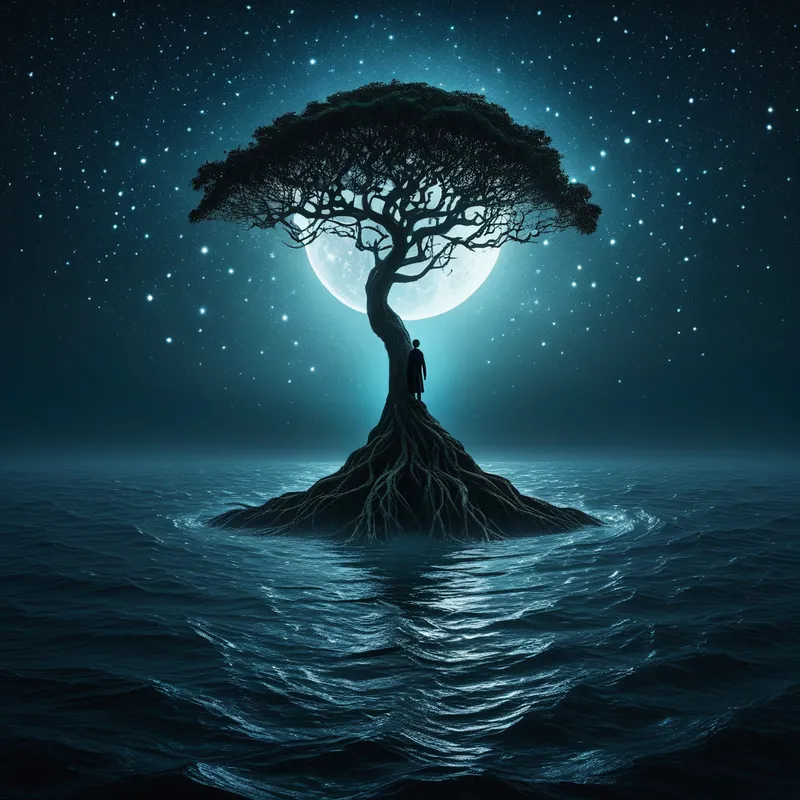
When this mythic pattern stirs in the modern dreamer, it often manifests as dreams of profound isolation within vastness—being a single tree in an endless sea, or the only structure in a blank void. It may appear as dreams of catastrophic yet beautiful disintegration: a beloved tree falling to become a landscape, or one’s own body dissolving into earth and water. There is a somatic quality of both deep rooting and terrifying upheaval.
Psychologically, this signals a process at the very foundations of the psyche. The dreamer is not dealing with a simple life change, but with a recalibration of their world-making principle. It is the somatic and psychic process of a old, monolithic structure of the self—perhaps a long-held identity, a foundational belief, or a way of being in the world—reaching its limit. This structure, like the world-tree, has grown as far as it can in solitude. The dream imagery points to the necessity of its deconstruction. The grief, awe, and terror felt in such dreams are the echoes of that primal sacrifice, the ego confronting the fact that for new life to emerge, the current form of its world must end.
Alchemical Translation
The alchemical journey mirrored here is the opus of solve et coagula—dissolve and coagulate. The myth models the complete cycle of psychic transmutation required for true individuation.
First, the prima materia is the undifferentiated waters of the unconscious. The arbor philosophica (philosophical tree) grows from it—this is the stage of concentrated inner work, where a central, guiding principle or complex consolidates. But the trap is to remain in this state of spiritual inflation, believing one has reached the goal in this monolithic, self-referential wholeness.
The true creation is not the tree, but what the tree willingly becomes through its destruction. The gold is not in the trunk, but in the world its sacrifice allows to exist.
Thus, the crucial alchemical fire is not applied from outside, but is the tree’s own acceptance of its fate. This is the solutio—the return to the watery state, but now a conscious return, a chosen dissolution for a higher purpose. The tree solves back into its elements. Then, from this sacrifice, the coagula occurs: the fragments re-coagulate not into the old form, but into an entirely new, more complex, and inhabited order—the differentiated psyche, the conscious world.
For the modern individual, this translates to the most profound kind of growth: it is not about adding more branches to the tree of your identity, but about having the courage to let that entire tree fall when it has served its purpose. The transformation asks: What world-making structure in you has become solitary and complete? What sacred sacrifice is required so that its essence can be redistributed to create a richer, more populated, and more relational inner landscape? The birth of your true, inhabited world awaits that shattering.
Associated Symbols
Explore related symbols from the CaleaDream lexicon:
- Tree — The central axis of creation and sacrifice, representing the archetypal Self, the structure that emerges from chaos and must fragment to give birth to a world of consciousness.
- Water — The primal, undifferentiated source of all potential, symbolizing the unconscious in its boundless, formless, and nurturing/dark aspect before the dawn of distinction.
- Earth — The born world, the stable ground of consciousness and reality formed from the sacrificed body of the tree, representing manifested life and the physical psyche.
- Sacrifice — The essential, voluntary act of deconstruction that transforms unity into multiplicity, the core painful necessity that fuels the alchemy of creation.
- Root — The connection to the deep, primal source, anchoring the structure of being in the unconscious and drawing nourishment from the unknown.
- Seed — The latent potential within the primal waters, the concentrated intention that becomes the world-tree, symbolizing the first impulse of individuation.
- Mountain — The enduring, elevated land formed from the tree’s substance, representing achieved consciousness, perspective, and the stable achievements of the psyche.
- River — The flowing, life-giving channels born from the tree’s roots, symbolizing the dynamic connection between the deep unconscious (source) and the conscious world, and the flow of psychic energy.
- Spirit — The animating presence within the waters and the tree, the sacred intention behind creation, representing the non-material essence that precedes and informs all form.
- Creation — The entire process from watery potential to structured world, embodying the fundamental archetypal pattern of bringing order from chaos, consciousness from the unconscious.
- Dream — The state of the primal waters, and the mode through which the mythic reality is accessed, symbolizing the realm of pure potential and the language of the deep psyche.
- Mythos — The overarching narrative pattern of sacred sacrifice and world-building, providing the foundational story that structures reality and gives meaning to existence.