
The Dandy Myth Meaning & Symbolism
A myth of the self-made deity who, through sheer will and aesthetic precision, forges an identity from the raw materials of a mundane world.
The Tale of The Dandy
Listen. [The world](/myths/the-world “Myth from Tarot culture.”/) was heavy, thick with the sweat of industry and the dust of old virtues. It was a world of grey wool and earnest toil, where a man was his labor, his name, his inherited plot of earth. But in [the shadow](/myths/the-shadow “Myth from Jungian culture.”/) of the new, soot-stained temples of progress, a different kind of spirit began to stir.
He did not descend from Olympus, nor was he forged in the fires of a Germanic smithy. He was born in a rented room, from a bolt of cloth and a defiant idea. He was the Dandy. His Olympus was the boulevard, his liturgy the cut of a coat. His conflict was not with dragons or giants, but with the monstrous, crushing weight of the ordinary.
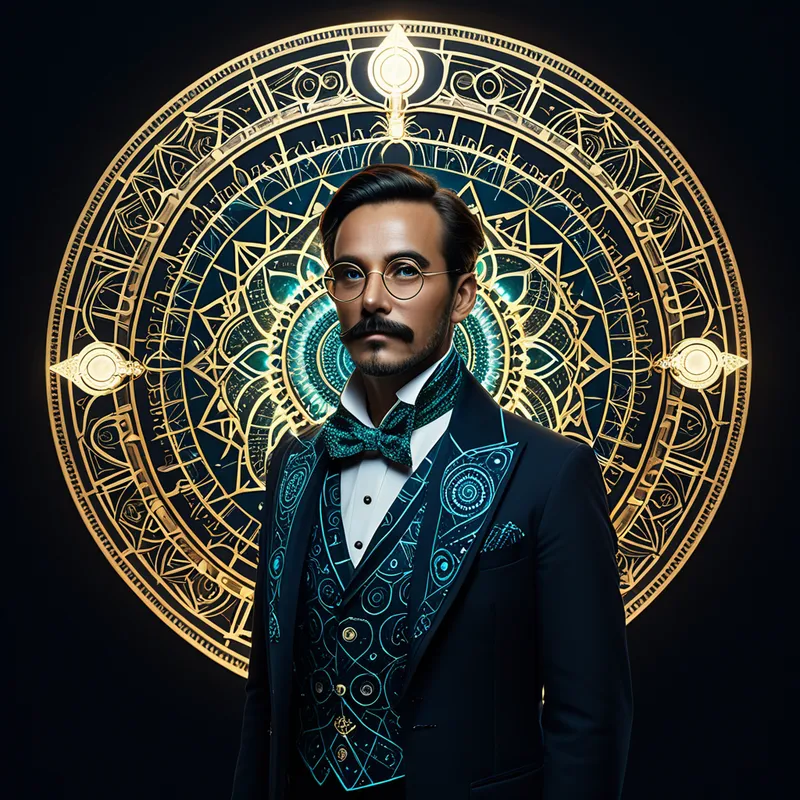
Watch him now, at the rising of the gas lamps. He emerges not from a palace, but from a doorway like any other. Yet, he is transformed. Every line of him is a declaration. The curve of his hat brim, the precise fall of his cravat, the gleam on his boot—each is a word in a silent, devastating poem recited against the chaos of the crowd. He moves with a languid, deliberate grace, a panther in a garden of shuffling sheep. The common folk part before him, not in fear, but in a kind of bewildered awe. They feel the chill of his perfection, the silent judgment in his immaculate gloves. He does not speak to them. His existence is his speech.
His great trial is not a battle, but a vigil. It is the endless, exquisite torture of maintaining the illusion. A single speck of mud, a hair out of place, a moment of unguarded, human warmth—these are his hydras and his gorgons. He wages war against entropy itself. His weapons are the clothes brush, the polishing cloth, [the mirror](/myths/the-mirror “Myth from Various culture.”/). His battlefield is his own person. He walks the fine, trembling wire between the sublime and the ridiculous, and his [triumph](/myths/triumph “Myth from Roman culture.”/) is measured in the held breath of a passing stranger, in the whispered, “Who is that?”
There is no final, thunderous resolution. The myth does not end with a coronation, for he is already his own king. It ends, instead, with a disappearance. As dawn bleaches the color from the night, he turns a corner and is gone. He leaves behind no kingdom, no heirs, only a lingering question in the air and the faint, haunting scent of eau de cologne on the indifferent morning breeze. He has made of his life a perfect, ephemeral work of art, and then vanished into its frame.

Cultural Origins & Context
The Dandy is a peculiarly modern myth, born in [the crucible](/myths/the-crucible “Myth from Alchemical culture.”/) of the late 18th and 19th centuries, in the burgeoning metropolises of London and Paris. This was the age when the old aristocratic order was crumbling, and the new bourgeois world of commerce and industry was asserting its dull, pragmatic dominance. The myth was not passed down by bards but was written in the gossip columns, illustrated in fashion plates, and performed live on the streets of Mayfair and the Palais-Royal.
Its primary prophets were men like Beau Brummell, who demonstrated that influence could be wielded not through land or title, but through taste, wit, and an unforgiving standard of dress. He was a commoner who schooled princes in elegance. Later, the figure was refined and intellectualized by the likes of Charles Baudelaire, who saw in the Dandy a “modern hero,” a secular saint of beauty in an age of vulgar utility. The myth’s societal function was complex: it was a rebellion against bourgeois conformity, a critique of aristocratic decadence (through a hyper-refined imitation of it), and a desperate, artistic attempt to create personal meaning and sovereignty in an increasingly anonymous and materialistic world. The Dandy declared that [the self](/myths/the-self “Myth from Jungian culture.”/) could be authored, that identity was not a fate but a composition.
Symbolic Architecture
At its core, the myth of The Dandy is a profound symbolic [drama](/symbols/drama “Symbol: Drama signifies narratives, emotional expression, and the exploration of human experiences.”/) of [consciousness](/symbols/consciousness “Symbol: Consciousness represents the state of awareness and perception, encompassing thoughts, feelings, and experiences.”/) asserting itself against the collective. The Dandy’s immaculate [costume](/symbols/costume “Symbol: A costume symbolizes the roles we play in life and the masks we wear, often reflecting personal desires or societal expectations.”/) is not mere vanity; it is a [persona](/symbols/persona “Symbol: The social mask or outward identity one presents to the world, often concealing the true self.”/) forged with such intensity and artistry that it becomes a magical [armor](/symbols/armor “Symbol: Armor represents psychological protection, emotional defense, and the persona presented to the world. It symbolizes both safety and the barriers that separate us from vulnerability.”/) and a philosophical [statement](/symbols/statement “Symbol: A statement in a dream can symbolize the need to express one’s thoughts or beliefs, reflecting a desire for honesty or clarity.”/).
The Dandy does not wear clothes; he inhabits an argument. His buttoned waistcoat is a treatise against disorder, his polished boot a manifesto on form.
He represents the Will to Form over the Tyranny of the Given. Psychologically, he embodies the individual’s struggle to differentiate from the [mass](/symbols/mass “Symbol: Mass often symbolizes a gathering or collective experience, representing shared beliefs, burdens, or the weight of emotions within a community.”/), to carve out a unique [identity](/symbols/identity “Symbol: Identity represents the sense of self, encompassing personal beliefs, cultural background, and social roles.”/) (the individuation process) through conscious self-creation. His apparent coldness and [detachment](/symbols/detachment “Symbol: A psychological or emotional separation from oneself, others, or reality, often indicating a need for self-protection, perspective, or spiritual growth.”/) symbolize the necessary [distance](/symbols/distance “Symbol: Distance in dreams often symbolizes emotional separation, unattainable goals, or the need for personal space and reflection.”/) one must cultivate from instinctual, emotional [chaos](/symbols/chaos “Symbol: In Arts & Music, chaos represents raw creative potential, uncontrolled expression, and the breakdown of order to forge new artistic forms.”/) and social pressure to achieve self-definition. He is the [Creator](/symbols/creator “Symbol: A figure representing ultimate origin, divine power, or profound authorship. Often embodies the source of existence, innovation, or personal destiny.”/) [archetype](/symbols/archetype “Symbol: A universal, primordial pattern or prototype in the collective unconscious that shapes human experience, behavior, and creative expression.”/) applied to the very substance of the self. His [enemy](/symbols/enemy “Symbol: An enemy in dreams often symbolizes an internal conflict, self-doubt, or an aspect of oneself that one struggles to accept.”/) is the mundane, the unconsidered, the “normal”—which, in a psychological sense, represents the unconscious, undifferentiated state of being swallowed by the collective.
The Dreamer’s Resonance
When the figure of The Dandy appears in modern dreams, it often signals a critical moment of self-fashioning or a confrontation with inauthenticity. The dreamer may be obsessing over an outfit for an important event, standing before a mirror that reflects a distorted or impossibly perfect image, or feeling the piercing gaze of a impeccably dressed stranger who seems to see through them.
Somatically, this can feel like a tightening, a constriction around the chest or throat—the feeling of the “straitjacket” of the [persona](/myths/persona “Myth from Greek culture.”/). But it can also carry a thrilling, electric charge of potential: the sense that one can compose the self that enters the world. Psychologically, this dream pattern indicates a process of ego-consciousness wrestling with the shadow of social expectation and the inner critic. The dream asks: What mask are you crafting? Is it a prison or a masterpiece? Where does the costume end and the skin begin? The Dandy in the dream challenges the dreamer to take radical responsibility for their self-presentation and, by extension, their identity.
Alchemical Translation
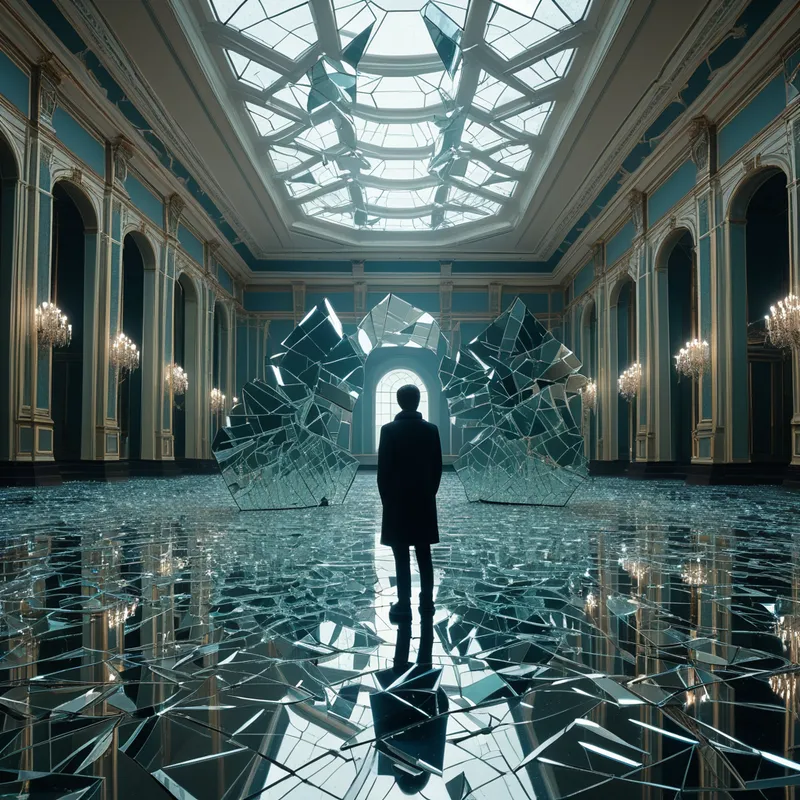
The Dandy’s journey is a masterclass in psychic alchemy. His [prima materia](/myths/prima-materia “Myth from Alchemical culture.”/) is not lead, but the base, common clay of social existence—the expected roles, the dull garments, the inherited mannerisms. Through the Ars Combinatoria of style, he performs the alchemical operations.
- Calcinatio (Burning): He burns away the dross of vulgarity, sentimentality, and laziness. This is the fire of his exacting critique, his refusal of the easy and the comfortable.
- Coagulatio (Solidifying): From the ashes of the ordinary, he coagulates a new, solid form: the perfected exterior. This is the creation of the conscious ego-structure, the Persona, elevated to an art form.
- Sublimatio (Subliming): This is the crucial, transcendent step. He seeks to sublimate the entire personality, to raise the base instincts and passions into the rarified atmosphere of style and irony. Anger becomes a perfectly arched eyebrow; desire becomes the pursuit of the exquisite detail; the will to power becomes sovereignty over a buttonhole.
The ultimate alchemical goal of The Dandy is not the Philosopher’s Stone, but the Living Statue: a being in which spirit and form, intention and appearance, are perfectly and permanently fused.
For the modern individual, the myth does not prescribe a life of waistcoats and cynicism. It models the discipline of self-authorship. It teaches that individuation requires a conscious, even ruthless, editing of the influences we absorb. It is the alchemy of taking the raw, often painful, material of one’s life and experience and transmuting it into a distinctive, coherent shape—a personal style of being. The danger, as the myth also warns, is the [nigredo](/myths/nigredo “Myth from Alchemical culture.”/), the blackening of isolation, where the persona becomes a sarcophagus and the soul withers behind the glass of its own display. The true triumph is to use the discipline of The Dandy not to escape the self, but to become, at last, a genuine and authentic work of one’s own making.
Associated Symbols
Explore related symbols from the CaleaDream lexicon: