The Danaides Myth Meaning & Symbolism
Forty-nine sisters, forced into marriage, murder their husbands on the wedding night and are condemned in Hades to eternally fill a leaking vessel.
The Tale of The Danaides
Hear now a tale not of glorious heroes, but of haunted women, a story that begins in the salt-scorched air of Libya and ends in the echoing silence of the deepest dark.
King Danaus had fifty daughters, the Danaides, as numerous as the waves that crashed upon his shores. Their uncle, Aegyptus, had fifty sons, and with the arrogance of the sun that beats upon the Nile, he demanded they be wed to their cousins, binding the two lines into one empire. Danaus, smelling the stench of usurpation beneath the perfume of alliance, fled with his daughters across the wine-dark sea to the ancient city of Argos. They arrived as suppliants, clutching the statues of the gods, their pleas a chorus of fear that moved the Argive people to grant them sanctuary.
But the sons of Aegyptus were a relentless tide. They came with ships and spears, laying siege to Argos until the city, weary of war, forced the marriage. On the eve of the wedding, beneath a moon that offered no comfort, Danaus gathered his daughters. Into each hand he pressed not a blessing, but a sharpened hairpin, forged in secret and cold as a serpent’s tooth. “Let no man of that line possess you,” he whispered, his voice the dry rustle of dead leaves. “When they sleep, you must act.”
The wedding feast was a cacophony of forced merrity. The halls reeked of wine and sweat, the laughter was too loud, the smiles did not reach the eyes. One by one, the brides led their drunken husbands to the bridal chambers. One by one, as the men sank into a wine-heavy slumber, forty-nine hands raised their tiny, deadly blades. The night was pierced not with cries of passion, but with brief, wet gasps. Forty-nine streams of dark blood seeped into the marriage beds, staining the promise of union with the indelible ink of slaughter.
Only one sister, Hypermnestra, looked upon her husband Lynceus and saw not a tyrant, but a man. She stayed her hand. For her mercy, she was cast into a prison of her father’s making, while her sisters, their white robes now forever shadowed, washed the evidence from their hands in the river of Argos.
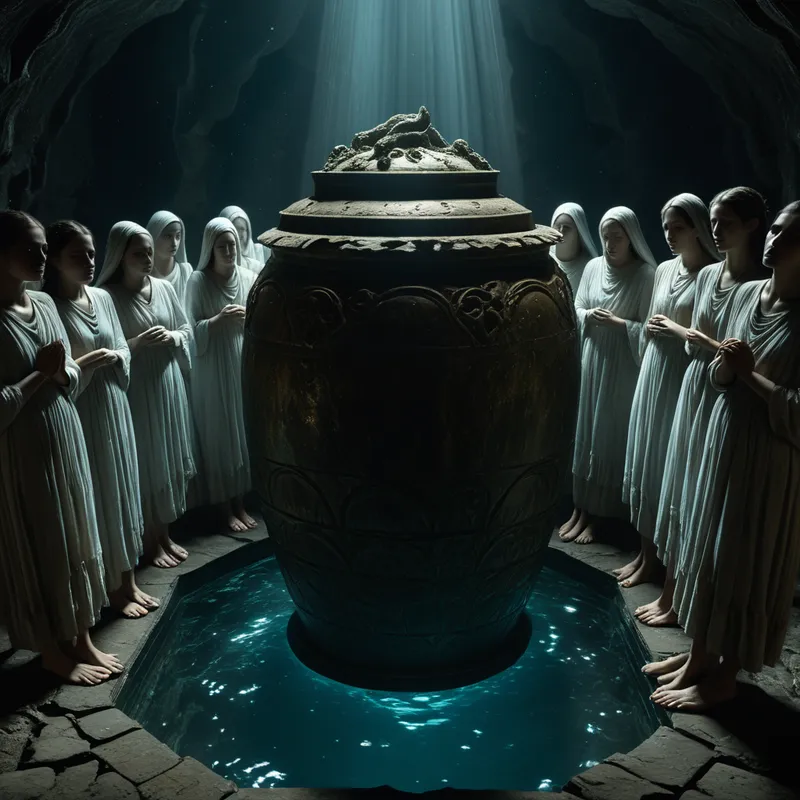
But the Furies, those ancient hounds of conscience, do not sleep. They pursued the forty-nine, their whispers becoming shrieks in the mind, until death finally offered a refuge that was no refuge at all. In the sunless realm of Hades, their judgment awaited. The wise king of the dead, Hades himself, or some say the craftsmangod Hephaestus, devised their eternal task. He gave them great jars, pithoi, and pointed to a nearby pool. “Fill them,” he commanded. The sisters, desperate for any labor that might cleanse their stain, rushed to obey. But these vessels were no ordinary urns. Their bases were cracked, perforated, sieve-like. As they poured and poured, the life-giving water ran out as fast as it went in. An endless labor, a perfect metaphor for a soul trying to wash away what can never be washed away, in a kingdom where time itself has died.

Cultural Origins & Context
This harrowing myth comes to us primarily from the epic Danais, now lost, and was famously dramatized in Aeschylus’s surviving tragedy The Suppliants. It was a foundational Argive legend, explaining the origins of the Danaans (an ancient name for the Greeks) and establishing the royal lineage of Argos through Hypermnestra and Lynceus. The story was not mere entertainment; it was a societal nerve touched. Performed in the civic-religious space of the theater of Dionysus, it forced the Athenian polis to confront profound tensions: the conflict between patriarchal authority (Danaus, Aegyptus) and female agency (however horrific), the sacred duty of hospitality (xenia) versus political expediency, and the terrifying price of blood guilt. The myth served as a dire warning about the cyclical nature of violence and the inescapable justice of the cosmos, administered by the Erinyes to those who transgress the most primal laws, particularly kin-slaying.
Symbolic Architecture
The Danaides represent a profound psychic state of futile repetition, a punishment that is also a perfect mirror of the crime. They attempted to violently refuse a forced destiny (the marriage), an act of rebellion that immediately trapped them in a far worse, eternal fate. Their crime was one of negation—of life, of union, of the future. Their punishment is thus a negation of fulfillment, of completion, of rest.
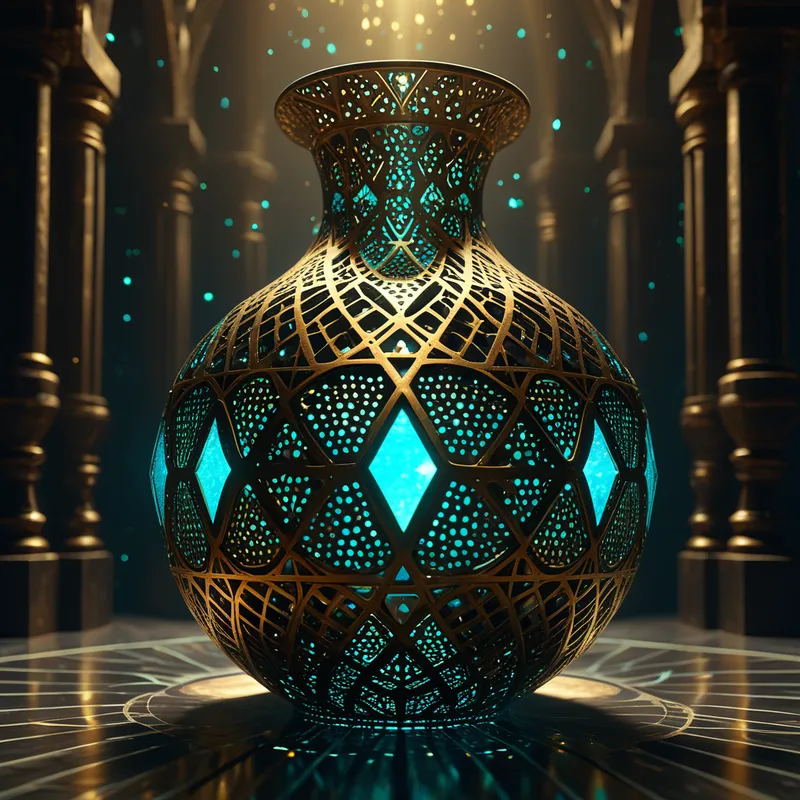
The leaking vessel is the ego’s attempt to solve a problem of the soul with the tools of action. One cannot fill a spiritual void with physical labor, nor cleanse a moral stain with literal water.
The water they carry is symbolic of life, emotion, and the feminine principle itself. Their endless pouring signifies a psyche stuck in a loop of attempting to integrate or expel a traumatic content—the murdered husbands, the forced choice, the paternal command—through sheer effort, an effort doomed because the container of the self has been fundamentally fractured by the act. The single spared vessel, Hypermnestra, symbolizes the one thread of relatedness, mercy, and conscious choice that breaks the cycle and allows for the continuation of life and lineage.
The Dreamer’s Resonance
When this myth stirs in the modern unconscious, it rarely appears as fifty women with jars. Its signature is the feeling of the task. To dream of endlessly filling a sink that never fills, of writing an email that endlessly deletes itself, of running toward a goal that perpetually recedes, is to brush against the Danaid complex. It is the somatic sensation of effort without progress, of labor that yields no fruit, of a leaky vitality.
Psychologically, this dream-pattern emerges when an individual is engaged in a life task or relationship that is fundamentally unsustainable or misaligned with their deeper nature, yet they feel compelled to continue by an internalized, punishing authority (the “Danaus” within). It speaks to a profound exhaustion of the life force, where one’s energy, creativity, or love is being poured into a container—a job, a role, a pattern of thinking—that cannot hold it. The dream is the psyche’s stark illustration of the burnout that the conscious mind may be rationalizing or ignoring.

Alchemical Translation
The alchemical journey modeled here is not one of glorious conquest, but of the grim, necessary work of confronting the “leak” in one’s own vessel. The first step is the horrifying realization of the task itself: I am in hell, and my work is futile. This is the beginning of consciousness. The Danaides, in their eternal punishment, are frozen in the act of doing, never reflecting.
Individuation requires one to stop pouring, to set down the jar, and to examine the crack. The transmutation begins not in adding more water, but in understanding the nature of the vessel.
For the modern soul, the alchemical translation involves several stages. First, one must identify the “forced marriage”—what obligation, trauma, or inherited script are you violently rejecting or complying with in a soul-murdering way? Second, one must find the “Hypermnestra function”—the part of the self capable of mercy, of seeing the “other” (whether an internal complex or an external person) not as a tyrant to be destroyed, but as a potential partner in a new story. Finally, one must undertake the repair of the vessel. This is not about patching the crack with more effort, but about a fundamental re-forging of the self-container through introspection, acceptance of shadow, and the slow, patient work of making the psyche whole. The goal is not to finally fill the jar, but to become a jar that can hold water—to become a self that can receive, contain, and transform experience without it all draining into the sands of meaningless repetition. The labor only ends when the laborer is remade.
Associated Symbols
Explore related symbols from the CaleaDream lexicon: