The Daghda's Cauldron Myth Meaning & Symbolism
The myth of the Daghda's magical cauldron, a vessel of endless bounty and rebirth, symbolizing the ultimate abundance of the cosmos and the soul's capacity for renewal.
The Tale of The Daghda’s Cauldron
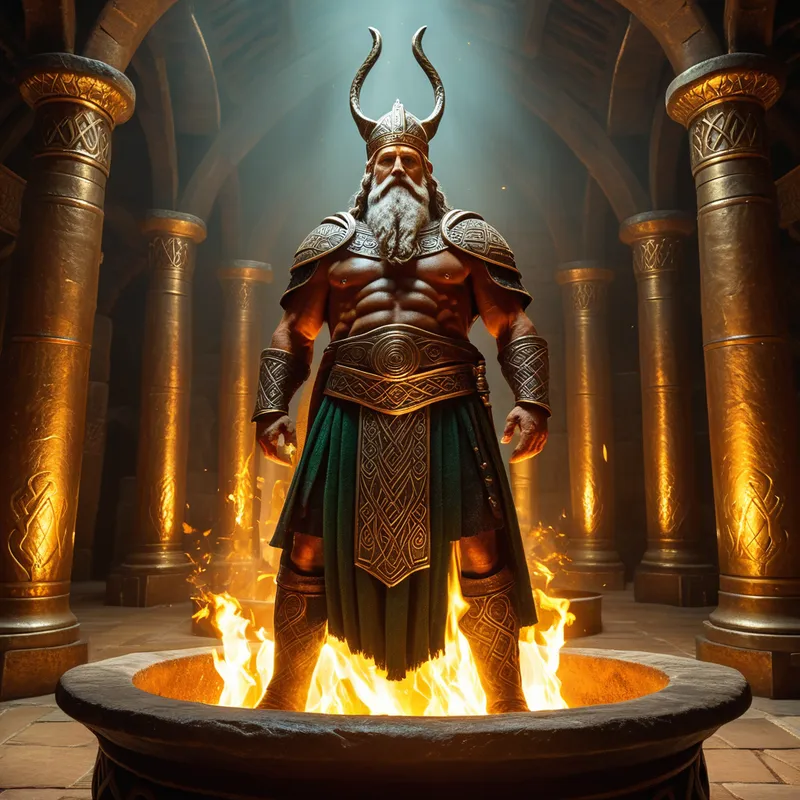
Hear now the tale of the Daghda, the Good God, he whose club could slay nine men with one end and restore them to life with the other. In [the mist](/myths/the-mist “Myth from Celtic culture.”/)-shrouded days after the Tuatha Dé Danann had won the land, a deeper hunger remained. Not a hunger of the belly, though winter was long, but a hunger of the spirit, a yearning for the certainty that [the world](/myths/the-world “Myth from Tarot culture.”/) would not turn barren, that the people would not be forsaken.
The Daghda, father of the tribe, keeper of the seasons, felt this yearning as a weight upon his broad shoulders. He was a lord of abundance, yet abundance must be made manifest. From the deep places of [the earth](/myths/the-earth “Myth from Hindu culture.”/), from the [Otherworld](/myths/otherworld “Myth from Celtic culture.”/) itself, he called forth his greatest treasure: the Cauldron of the Daghda.
It was no mere pot of iron, but a vessel of ancient bronze, etched with spirals that spoke of the turning stars and the winding roots of the world. It sat in the heart of his great hall, cold and silent. Then, the Daghda would take his ladle—a tool as long as a man’s arm and as deep as his hope—and begin.
He did not fill it with [water](/myths/water “Myth from Chinese culture.”/) or meat from the store. Instead, he stirred the empty air above it, his voice a low chant that vibrated in the stone of the floor. From his will alone, the cauldron began to simmer. A scent arose, not of one food, but of all foods: the richness of the autumn boar, the sweetness of summer berries, the earthy comfort of spring grains, the sustaining fat of the winter herd. It was the smell of the land itself, concentrated, promised.
Then came the feast. Not just for the warriors with their bright blades, but for all. The poet with his dry throat, [the child](/myths/the-child “Myth from Alchemy culture.”/) with thin limbs, the old one whose teeth could no longer tear tough meat—all approached the great cauldron. The Daghda, with a face both fierce and kind, would dip his enormous ladle. To each he gave a portion, and the miracle was this: no matter how many came, how deep the ladle plunged, the cauldron was never depleted. The stew within replenished itself from a source unseen, a wellspring of cosmic generosity.
The hall echoed not with the noise of gluttony, but with the profound silence of satisfaction, of fear dispelled. Men ate and were filled, yet the cauldron brimmed. It was a covenant made visible: so long as the Daghda tended the cauldron, the people would endure. It was the answer to the silent question hanging in the cold air: will there be enough? The cauldron thrummed with a single, resonant reply: Yes. There is always enough.
Cultural Origins & Context
This myth originates from the rich, oral tradition of the Insular Celts, primarily preserved in early medieval Irish manuscripts like the Lebor Gabála Érenn (The Book of Invasions) and the tales of the Mythological Cycle. The Daghda’s cauldron, known as the Coire Ansic (the “Uneven Cauldron” or “Cauldron of Plenty”), was counted among [the Four Treasures](/myths/the-four-treasures “Myth from Celtic culture.”/) of the Tuatha Dé Danann.
These stories were not mere entertainment; they were the sacred history and social charter of the people, recited by the filid (poet-seers) to affirm the cosmic order. In a society where chieftainship was intrinsically linked to the fertility of the land, the Daghda—as the ideal chief—embodied the responsibility of ensuring prosperity. His cauldron was the ultimate symbol of that sacred duty. Its magic guaranteed that the king’s rule was legitimate, for under a true sovereign, the land would not fail. The myth functioned as a psychological and social anchor, reinforcing the ideal of a leadership defined not by hoarding, but by boundless, regenerative distribution.
Symbolic Architecture
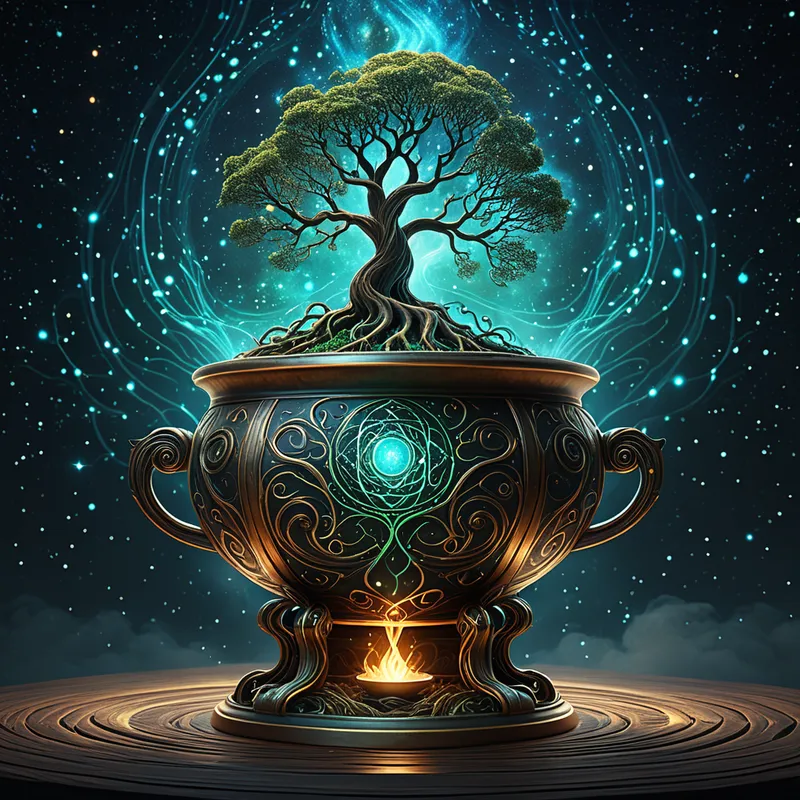
At its core, the [cauldron](/symbols/cauldron “Symbol: A large metal pot for cooking or brewing, symbolizing transformation, nourishment, and hidden potential.”/) is an archetypal [symbol](/symbols/symbol “Symbol: A symbol can represent an idea, concept, or belief, serving as a powerful tool for communication and understanding.”/) of the receptive [vessel](/symbols/vessel “Symbol: A container or structure that holds, transports, or protects something essential, representing the self, emotions, or life journey.”/). It is the [womb](/symbols/womb “Symbol: A symbol of origin, potential, and profound transformation, representing the beginning of life’s journey and the unconscious source of creation.”/) of the world, the [crucible](/symbols/crucible “Symbol: A vessel for intense transformation through heat and pressure, symbolizing spiritual purification, testing, and alchemical change.”/) of [life](/symbols/life “Symbol: The symbol of ‘Life’ represents a journey of growth, interconnectedness, and existential meaning, encompassing both the joys and challenges that define human experience.”/), and the container of all potential. Unlike a [weapon](/symbols/weapon “Symbol: A weapon in dreams often symbolizes power, aggression, and the need for protection or defense.”/) or a [crown](/symbols/crown “Symbol: A crown symbolizes authority, power, and achievement, often representing an individual’s aspirations, leadership, or societal role.”/), its power is passive yet infinite; it does not take, it provides.
The Cauldron of Plenty teaches that true abundance is not a stockpile to be defended, but a current to be channeled. It represents the psyche’s innate, often untapped, capacity for self-renewal and boundless creativity.
The Daghda himself symbolizes the conscious ego or the ruling principle that has access to this deep, nourishing unconscious. His [ladle](/symbols/ladle “Symbol: A ladle symbolizes nourishment and the sharing of sustenance, often reflecting relationships and communal bonds.”/) is the act of [intention](/symbols/intention “Symbol: Intention represents the clarity of purpose and direction in one’s life and can symbolize motivation and commitment within a dream context.”/), the [effort](/symbols/effort “Symbol: Effort signifies the physical, mental, and emotional energy invested toward achieving goals and personal growth.”/) required to draw sustenance from the formless potential within (the empty cauldron) and manifest it into tangible [reality](/symbols/reality “Symbol: Reality signifies the state of existence and perception, often reflecting one’s understanding of truth and life experiences.”/) (the nourishing stew). The myth presents a model of healthy [psyche](/myths/psyche “Myth from Greek culture.”/) and society: a strong, benevolent [consciousness](/symbols/consciousness “Symbol: Consciousness represents the state of awareness and perception, encompassing thoughts, feelings, and experiences.”/) (the Daghda) in constant, ritualized [relationship](/symbols/relationship “Symbol: A representation of connections we have with others in our lives, often reflecting our emotional state.”/) with an infinitely abundant unconscious (the cauldron), resulting in the nourishment and [stability](/symbols/stability “Symbol: A state of firmness, balance, and resistance to change, often represented by solid objects, foundations, or steady tools.”/) of the whole [community](/symbols/community “Symbol: Community in dreams symbolizes connection, support, and the need for belonging.”/) (the people).
The Dreamer’s Resonance
When this myth stirs in the modern dreamer, it often surfaces during periods of perceived scarcity—not necessarily financial, but emotional, creative, or spiritual. To dream of a cauldron, especially one that is empty, cold, or inaccessible, can point to a feeling of inner depletion, a fear that one’s resources (patience, love, ideas, energy) are running dry.
Conversely, dreaming of finding a cauldron, stirring a potent brew, or feeding many from a single source signals a profound somatic and psychological process: the reconnection with the inner wellspring. The body may feel a sense of warmth or fullness upon waking. Psychologically, it marks the beginning of trusting one’s own depths. The dream is the psyche’s reassurance, a message from the inner Daghda, that the capacity for self-renewal exists. The conflict in the dream is often between the dreamer’s conscious anxiety (“There is not enough”) and the unconscious archetypal truth (“The cauldron is inexhaustible”).

Alchemical Translation
The alchemical journey mirrored in this myth is the opus contra naturam—the work against one’s own base nature of fear and lack. The modern individual, identified with [the ego](/myths/the-ego “Myth from Jungian culture.”/), often lives at the periphery of the cauldron, feeling hungry and separate from the source. The process of individuation involves turning inward, taking up the ladle of attention and intention, and engaging with the contents of one’s own soul.
The first act of psychic alchemy is not to acquire, but to stir the void. One must face the seemingly empty cauldron of the self with faith, and through the heat of conscious engagement, summon the prima materia—the raw, unformed stuff of one’s experience and potential.
The Daghda’s ritual is the model for this inner work. We must learn to be both [the vessel](/myths/the-vessel “Myth from Alchemical culture.”/) (the receptive cauldron) and the nourisher (the active Daghda). The “stew” that results is the integrated personality—a unique blend of all one’s experiences, talents, and shadows, transformed into something that nourishes not only [the self](/myths/the-self “Myth from Jungian culture.”/) but also the wider world. The ultimate [triumph](/myths/triumph “Myth from Roman culture.”/) is the realization that one’s worth and creativity are not finite commodities, but qualities of an infinite source. To know the cauldron within is to know that you can never be truly impoverished, for you are connected to the endless fertility of the psyche itself. The myth concludes not with a battle won, but with a feast that never ends.
Associated Symbols
Explore related symbols from the CaleaDream lexicon: