The Curetes Myth Meaning & Symbolism
Divine warriors whose thunderous dance concealed the infant Zeus, protecting the future king of the gods from his devouring father, Cronus.
The Tale of The Curetes
Hear now a tale not of a hero’s quest, but of a secret kept by thunder. In the age when the sky was a prison of stone and time itself was swallowed, the Titan Cronus ruled with a paranoid grip. He had been told a prophecy: that one of his own offspring would overthrow him. And so, with a grimace that cracked the foundations of the earth, he consumed them. Hestia, Demeter, Poseidon, Hera, Hades—each divine child vanished into the dark, churning gullet of their father, trapped in a belly that was a tomb.
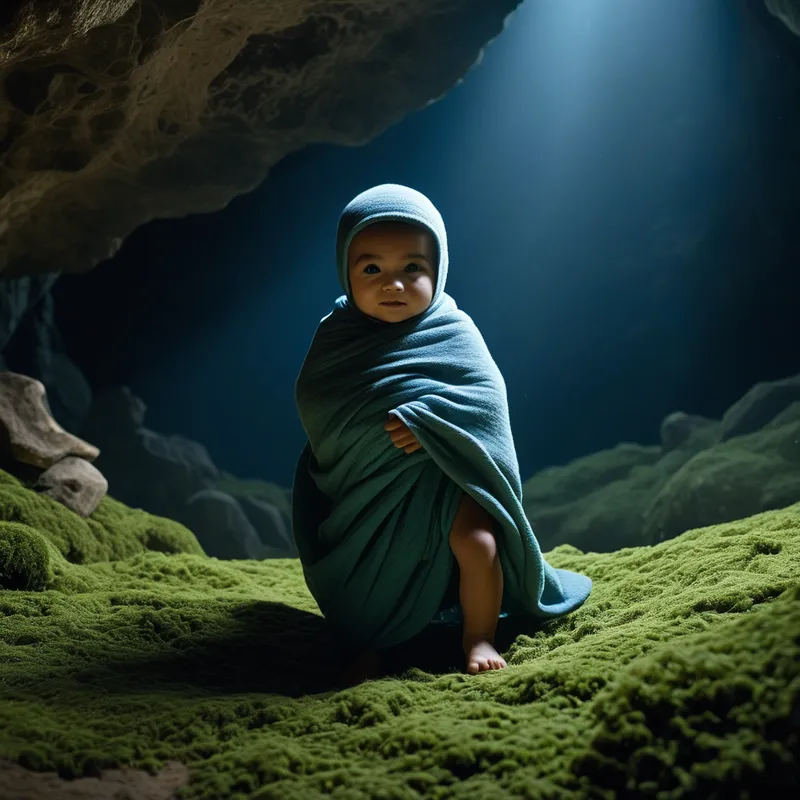
But Rhea, their mother, her heart a raw wound of grief and fury, could bear it no longer. When her sixth child quickened within her, she fled to the wild, primordial island of Crete. In the deep, hidden folds of the Diktaean Cave, where the air smelled of damp earth and the roots of the world, she gave birth. The child was Zeus. His cries were not whimpers, but the first, muffled crackles of a storm yet unborn.
Rhea knew Cronus would come. He would smell the divine scent of new power. So, she devised a desperate, cunning ruse. She wrapped a stone in swaddling clothes, an offering of cold deceit. And for her true son, she sought guardians. Not silent sentinels, but makers of glorious, deafening noise. From the mountainous spirit of Crete itself, she summoned the Curetes.
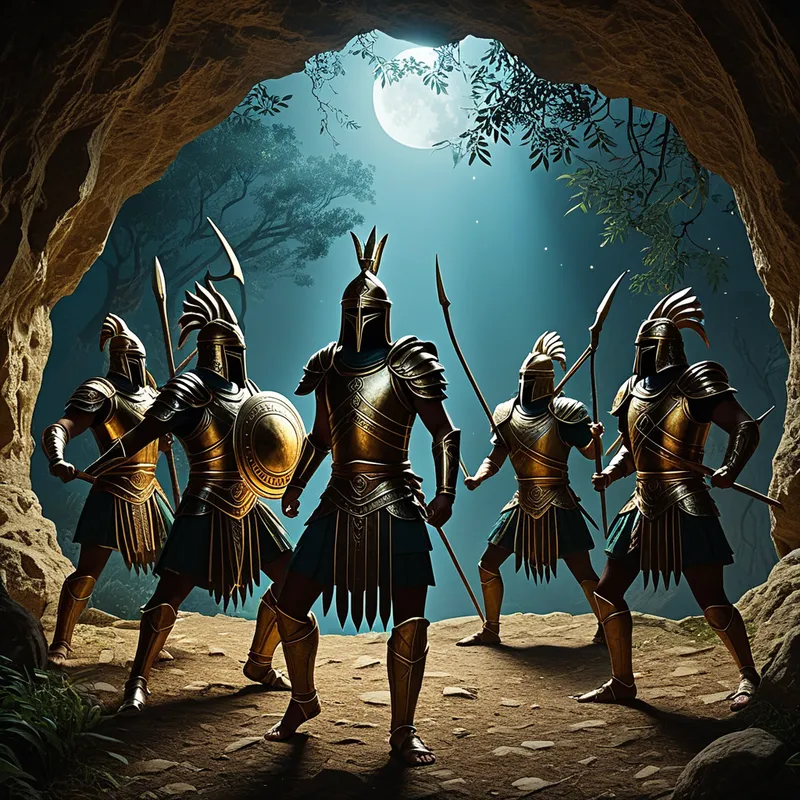
They were not men, but forces of nature given form—nine beings of divine energy, cladded in bronze that caught the fractured light of the cave. They took the infant god and laid him in a golden cradle, suspended from a tree so he would not be found on earth, sea, or sky. Then, they began their sacred work. They did not stand guard. They danced.
With spear clashing against shield, with foot stamping the rocky earth in furious rhythm, they created a wall of sound. It was not a melody, but a cacophony so immense, so all-consuming, that it swallowed the infant’s cries. It was the sound of the earth’s own heartbeat, amplified into a protective frenzy. They danced until the cave trembled, until the very air vibrated with their martial ecstasy. When Cronus, drawn by the distant rumor of birth, came seeking, all he heard was the overwhelming din of the Curetes’ dance. All he saw was Rhea’s offered stone, which he devoured without a second thought, his hunger and fear blinding him. And deep in the sacred cave, drowned in thunderous noise, the future king of Olympus slept, grew, and dreamed of lightning, kept safe by the dance that hid him.
Cultural Origins & Context
The myth of the Curetes is woven deeply into the pre-Olympian fabric of the Aegean world, with roots likely stretching into the Minoan civilization of Crete. They were not merely characters in a story but central to local cultic practice. In historical Crete, male warrior bands or initiation societies seem to have borne the name “Kouretes,” performing armed dances in rituals for the infant Zeus Kouros or for the Great Mother Goddess, Rhea-Cybele.
The myth was passed down through the oral tradition of epic poetry—Hesiod’s Theogony gives it its canonical form—and through local rites. Its societal function was multifaceted. For the Cretans, it was a foundational aition (origin story) explaining their unique, noisy rites of passage and their special connection to Zeus. For the wider Greek world, it served a crucial theological purpose: it explained the survival of the Olympian order. It answered the profound question of how the old, devouring order (Titanomachy) was overcome. The answer lay not initially in open battle, but in subterfuge, protection, and the sacred, disruptive noise that preserves a fragile new beginning.
Symbolic Architecture
At its core, the myth is a masterclass in the symbolism of necessary concealment. The infant Zeus represents any nascent, vulnerable potential—a new idea, a budding self-awareness, a creative spark, a psychological truth too tender to face the full glare of conscious scrutiny or the “devouring” patterns of the old order (Cronus).
The Curetes symbolize the active, dynamic forces required to protect this potential. They are not passive walls but enactors of creative noise.
The most precious becoming must often be hidden in a cacophony that looks like chaos, for the conscious mind, like Cronus, seeks to consume and assimilate all into its known structure.
Their dance is a furious, rhythmic disruption of the status quo. The clashing bronze is the sound of boundaries being asserted. They represent the psychic energy needed to drown out the inner critic, the parental complexes, or the societal expectations that would “swallow” an emerging individuality before it can gain strength. The cave is the womb of the unconscious, and the dance is the process that occurs at its threshold—not silent incubation, but active, fierce guarding.
The Dreamer’s Resonance
When this myth pattern stirs in the modern psyche, it may manifest in dreams of frantic activity or overwhelming noise that somehow feels protective. One might dream of being in a vulnerable state (a child, an animal, a secret) while loud construction, a pounding concert, or a violent storm rages outside, paradoxically creating a safe pocket of silence. The dream ego is the hidden infant; the noise is the Curetic function of the psyche at work.
Somatically, this can relate to periods of intense anxiety or hyperactivity that, upon deeper examination, are guarding a profound inner shift. The body’s “noise”—restlessness, insomnia, a racing heart—can be the somatic dance masking a deep, quiet process of psychic rebirth. The dream, or the waking feeling, asks: What nascent part of me is being protected by this turmoil? What old, devouring pattern am I hiding it from?

Alchemical Translation
The alchemical journey modeled here is the opus of incubation and protection, preceding the opus of confrontation and liberation (which comes later with Zeus’s war against the Titans). For the individual, it describes the early, critical stage of individuation where a new attitude or center of personality (the nascent Self) is forming.
The conscious ego (Rhea) recognizes the danger of the old, autocratic complex (Cronus, the devouring parent or rigid persona). Its first task is not to fight, but to hide the new growth. This is achieved by mobilizing lesser but potent psychic forces—instincts, passions, creative drives (the Curetes). One must learn to generate a “divine noise”: perhaps through immersion in art, through physical exertion, through engaging in projects that absorb attention, or through consciously cultivating a protective circle. This noise is not an avoidance, but a sacred, strategic operation.
The alchemy occurs in the tension between the silent, growing core and the furious, concealing dance around it. One transforms by being preserved long enough to become strong.
The triumph is not the dance itself, but what the dance allows to survive unseen. The individual learns that not all truths must be immediately exposed. Some must be nurtured in secret, guarded by the apparent chaos of transitional life, until they are strong enough to eventually wield their own lightning and reshape the world. The Curetes teach that protection is an active, ecstatic, and sometimes violent sacrament.
Associated Symbols
Explore related symbols from the CaleaDream lexicon: