The Cuckoo as timekeeper Myth Meaning & Symbolism
A myth where the first cuckoo's call in spring marks a sacred boundary, determining the year's fate and the king's symbolic marriage to the land.
The Tale of The Cuckoo as timekeeper
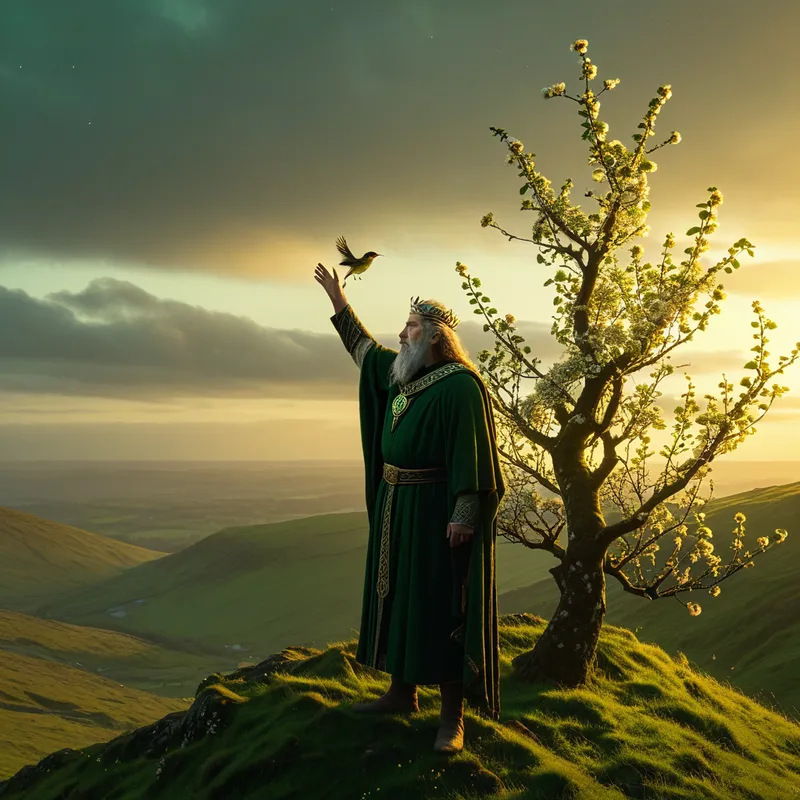
Listen. The world holds its breath in the grey hour before dawn, on the cusp between the dark half and the light. The great fire of Beltane has burned down to embers, but its promise hangs in the chill air like a vow. In his high hall, the king does not sleep. He is a young king, his brow still unlined by the full weight of the crown, but his soul feels the immense pressure of the turning year. His sovereignty is not a given; it is a fragile pact, renewed each spring with the very land he rules.
He walks from the hall, his cloak damp with dew, and climbs to the highest point of the hillfort. Below him, the world is a tapestry of shadow and potential. The forests are silent, the fields fallow, the rivers running cold and swift with the last of the winter rains. The people sleep, but their dreams are woven with threads of hope and fear. Will the summer be fertile? Will the herds grow fat? Will the king prove true?
The king stands, a sentinel between earth and sky. He is not alone. The spirit of the land, the Sovereignty Goddess, watches from every budding branch and sleeping seed. She is the bride, and he is the suitor whose worth is tested not by battle, but by listening.
Then, it comes.
Not a sound from the earth, but a note from the very fabric of time. A clear, two-toned call—cuck-oo—pierces the silence. It is the first call of the cuckoo. It rings out from a grove of ancient hawthorn, a tree of thresholds and fairy magic. The note is not loud, but it is immense, rippling across the hills like a stone cast into the still pool of the world.
In that moment, the year is decided. The boundary between Samhain and Beltane is irrevocably crossed. The king exhales a breath he did not know he was holding. The land seems to sigh with him. As if summoned by the bird’s decree, the sun’s first golden ray breaks over the eastern ridge. The light touches the king’s face, and in that touch, he feels the land’s acceptance. The cuckoo calls again, and now other birds join in—a chorus of affirmation. The summer is won. The king’s rule is confirmed. The goddess has spoken through the voice of a small, grey bird, and the great wheel of the year grinds forward into the light.
Cultural Origins & Context
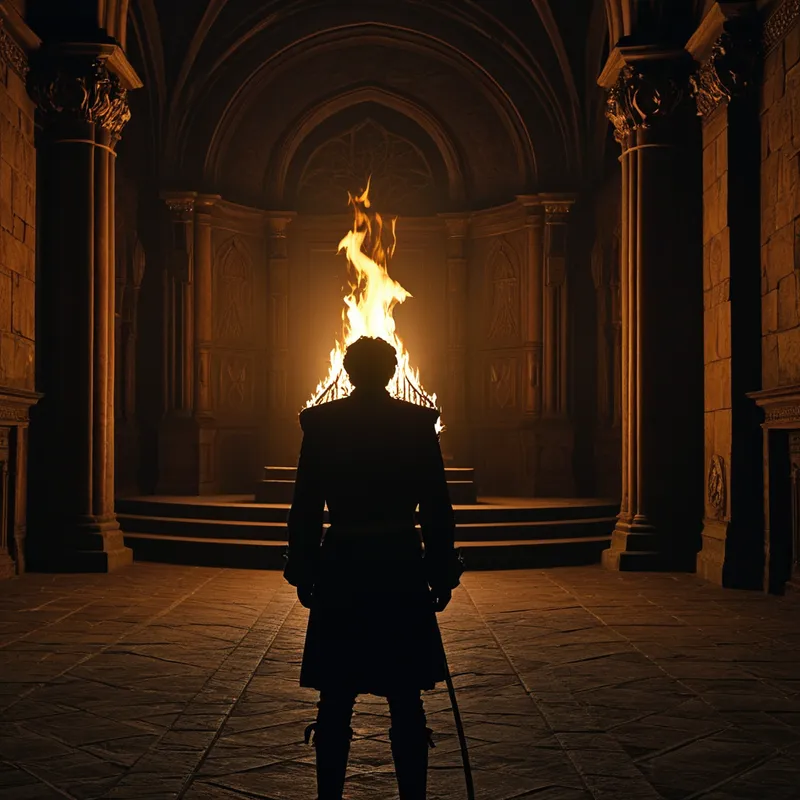
This mythic motif, while not belonging to a single, canonical narrative like those of the Mythological Cycle, is woven deeply into the Celtic understanding of time, kingship, and the natural world. It is a folk belief elevated to a sacred principle, found in traces across Ireland, Scotland, and Wales. The tellers were the people themselves—farmers, herders, and bards—for whom the cuckoo’s arrival was not merely a sign of spring, but a critical divinatory event.
Its societal function was profoundly practical and cosmological. It anchored the fluid, seasonally-driven Celtic calendar to an unmistakable natural event. The king’s ritual listening was a public drama of festival observance, demonstrating his harmony with the rhythms of nature, upon which all survival depended. A king who “missed” the cuckoo, or under whose reign its call was ill-omened (perhaps late or absent), was a king out of sync with the genius loci, and thus a danger to the tribe’s prosperity. The myth reinforced the idea that true sovereignty is a dialogue, a marriage where the human ruler must prove his attentiveness to the non-human world.
Symbolic Architecture
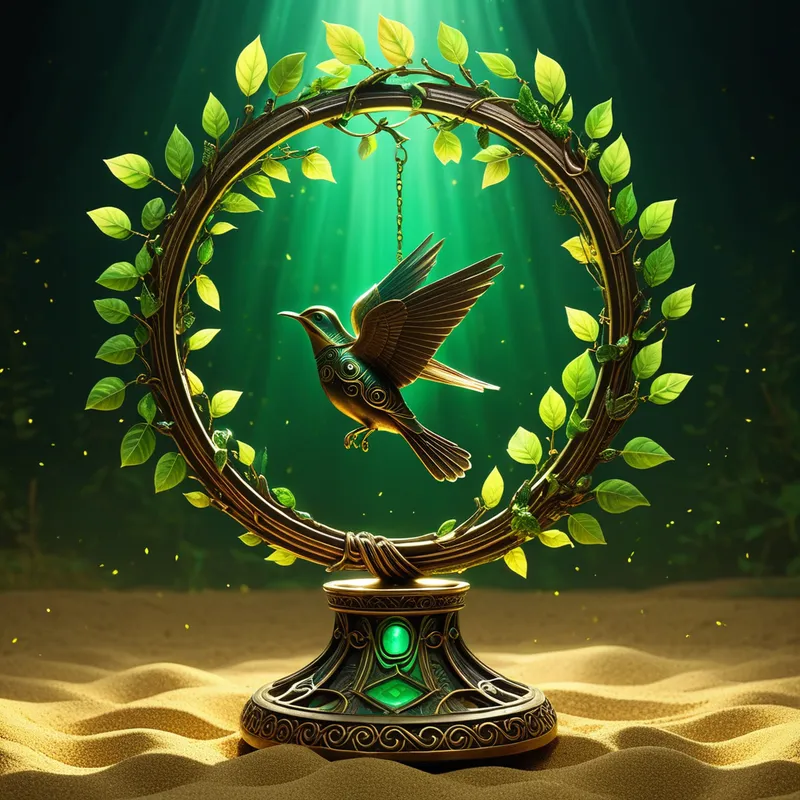
At its core, the cuckoo is the herald of the liminal, the living marker of the threshold. It does not create time but announces its qualitative shift. Its symbolism is triune.
First, it is the Voice of the Land. The cuckoo is the chosen mouthpiece of the Sovereignty Goddess. Its call is her verdict, a non-human intelligence delivering a judgment upon human order. The king’s power is derivative, granted only through this ecological concordat.
The true ruler does not command nature, but listens for its command.
Second, it is the Arrow of Seasonal Time. Unlike the cyclical, repetitive ticking of a clock, the cuckoo marks kairos—the opportune, decisive moment—within chronos, the passing sequence. Its first call is a singularity, an irreversible pivot from decay to growth, from contraction to expansion. It represents the point of no return in any natural or psychological process.
Third, it is the Emissary of the Otherworld. The cuckoo’s mysterious migration—disappearing in winter, returning from an unknown elsewhere—linked it to the Sídhe. Its call was a sound from beyond the veil, making the supernatural imminent and audible. It collapses distance between the mundane and the magical, insisting that the sacred is present in the seasonal event.
The Dreamer’s Resonance
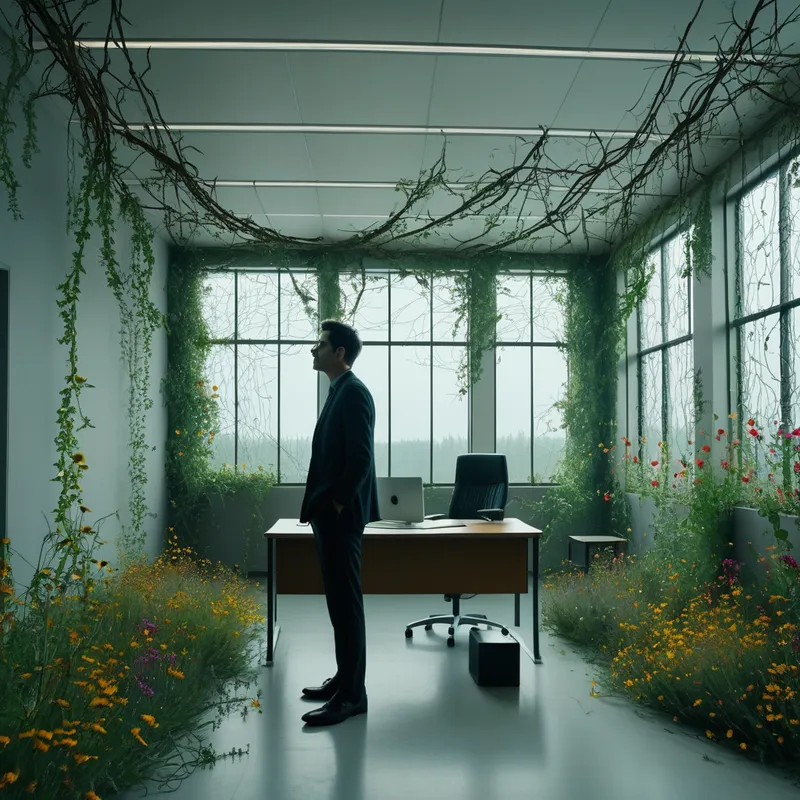
When this mythic pattern stirs in the modern unconscious, it often manifests in dreams of awaiting a sign. The dreamer might be poised at a life threshold—a career change, the end of a relationship, a creative beginning—feeling a tense, king-like anticipation. The somatic feeling is one of suspended animation, of holding one’s breath.
The cuckoo’s call in a dream is rarely the bird itself. It transposes into a phone ringing at a significant moment, a specific word spoken by a dream figure, a sudden change in light, or an unmistakable symbolic image that arrives with the force of a decree. This is the psyche’s own timing mechanism announcing, “The period of waiting is over. The internal season has changed.” The conflict in the dream mirrors the king’s vigil: a struggle between anxious ego-control and the need to surrender to a larger, organic timing. To ignore this dream-call is to feel oneself become the “unworthy king,” stuck in a psychological winter, out of sync with one’s own potential for growth.
Alchemical Translation
The myth models the alchemical stage of Nigredo giving way to Albedo—the putrefaction of winter yielding to the dawning light of new consciousness. The king’s lonely vigil is the ego’s necessary confrontation with the void, the dark night of the soul where old identities and patterns are dissolved. He must stand in the “not-knowing.”
The cuckoo’s call is the spontaneous, autonomous intervention of the Self (the total, archetypal psyche). It is not willed by the ego but received by it. The process of individuation requires these moments of grace, where a deep, timing intelligence within the psyche announces a shift that the conscious mind could not orchestrate.
Individuation is less about heroic journeying and more about attentive listening at the threshold.
The modern individual’s “alchemical translation” lies in cultivating the king’s posture: the courage to stand at the personal hillfort in a state of open, anxious receptivity. It is to cease forcing growth and instead learn to discern the authentic inner call—the psychic cuckoo—that signals when to act, when to move from incubation to manifestation. The triumph is not one of conquest, but of attunement. By honoring this inner timing, the individual marries their own conscious will to the deeper sovereignty of the Self, and their life enters a state of fertile alignment, ruled not by the clock, but by the authentic seasons of the soul.
Associated Symbols
Explore related symbols from the CaleaDream lexicon: