The Crossroads where Hecate pr Myth Meaning & Symbolism
A goddess of thresholds holds court where three roads meet, offering power to those who dare to face the choices that define a soul's destiny.
The Tale of The Crossroads where Hecate pr
Listen. The hour is neither day nor night. The light is the color of old bone and forgotten promises. This is the hour of the in-between, the breath held between heartbeats. And in this hour, all roads that wander must, eventually, find their end—or their beginning—at a place of three ways.
Here, where the dust of one path meets the gravel of another and the cobbles of a third, the air grows still and thick with potential. The scent of upturned earth, night-blooming jasmine, and cold iron hangs in the silence. This is no mere junction for carts and travelers. This is a seam in the world, a place where the veil between what is, what was, and what could be wears thin as a moth’s wing.
And here, she waits.
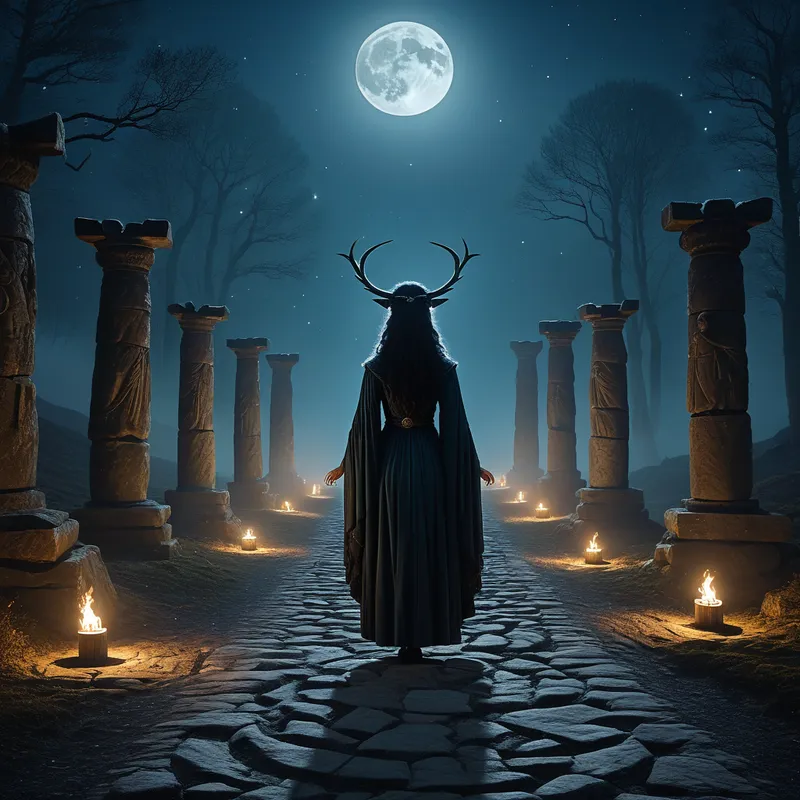
She is not one, but three. Or perhaps she is one who contains three. Her form shifts in the gloaming—a maiden with eyes like deep wells, a mother whose hands know both cradle and grave, a crone whose smile holds the patience of turning stars. She is Hecate. At her feet curl hounds of shadow and spirit, their eyes gleaming like distant lamps. In her hands, she bears torches that burn with a cold, blue-white flame, casting light that reveals truths, not objects.
The tale is not of her journey, but of yours. Imagine the traveler, soul-weary, feet sore from a road that has led only in circles. They come upon the trivium, the three-fold way. To the left, a path descends into a fragrant, shadowed grove, whispering of rest and forgetting. To the right, a road climbs a stark hill toward a distant, brilliant citadel, promising glory and recognition. Straight ahead, the path vanishes into a deep, featureless mist, silent and utterly unknown.
Paralysis grips the heart. This is the moment of the pr—the moment of profound reckoning. The traveler looks up, and there she is. She offers no counsel, no map. Her torches illuminate only the traveler’s own face, reflected threefold in her ancient eyes. She is the witness to the choice. To petition her is to accept the consequences; to lay an offering at the base of the herm, the stacked stones that mark this spot, is to bind one’s fate to the roads of magic, mystery, and the underworld.
The conflict is not with a monster, but with the self. Which hunger will you feed? The desire for oblivion, for acclaim, or for the terrifying freedom of the unknown? The rising action is the internal storm—the memories that surface, the fears that shriek, the tiny, almost extinguished voice of deepest longing. The resolution comes not with a fanfare, but with a step. One foot placed on a chosen road. And as the step is taken, Hecate’s torches flare. The chosen path clarifies; the other two fade, not into nothingness, but into the periphery of the soul, forever present as roads not taken. The traveler walks on, now accompanied by a different silence—the silence of a pact made with the liminal itself.
Cultural Origins & Context
The figure of Hecate at the crossroads is a powerful strand of belief originating in the ancient Greek world, later adopted and expanded by the Romans. Unlike the Olympian gods who governed clear domains of sky, sea, and civic life, Hecate’s power resided in the margins: thresholds, doorways, graves, and, most famously, the crossroads where three roads meet (a trivium). Her worship was deeply personal and often private. Small household shrines and monthly offerings of food (known as Hecate’s Suppers) were left at crossroads to gain her favor for protection, prosperity, or magical efficacy.
This myth was not passed down in a single, canonical epic but was woven through hymns, fragmentary poems, magical papyri, and local cult practices. It was a story told in actions—in the act of placing a meal at a lonely junction at dusk, in the whispered invocations of those who practiced the magical arts (pharmakeia), and in the collective understanding that certain spaces held inherent, ambivalent power. Societally, the myth functioned as a container for anxiety about transitions, choices, and the unknown. It provided a ritualized way to interface with the “shadow” aspects of life—ghosts, magic, fateful decisions—by acknowledging a deity who ruled them, thereby making the uncontrollable somewhat negotiable.
Symbolic Architecture
The Crossroads is the ultimate symbol of liminality—the critical, transformative space between one state of being and another. It is not a destination, but a moment of pure potential. The three roads represent the fundamental trichotomy of human possibility: the regressive path (back into the unconscious, the womb, oblivion), the progressive path (toward collective ideals, egoic achievement, the “should”), and the transcendent path (into the genuine unknown of the individuated Self).
The true choice at the crossroads is not between good and evil, but between the known death of stagnation and the unknown death required for rebirth.
Hecate herself is the archetypal personification of this liminal space. Her triplicity mirrors the three roads, embodying the complete lifecycle and the three faces of time (past, present, future). She is the shadow goddess who holds the keys to the underworld of the psyche. She does not choose for us but forces consciousness of the choice itself. Her torches symbolize the light of discriminating awareness that must be turned inward, illuminating the inner conflict before any outer step can have meaning. The offering is the sacrifice of our naivete, the acknowledgment that power and wisdom come with a price paid to the depths of our own nature.
The Dreamer’s Resonance
When this myth pattern surfaces in modern dreams, the dreamer is standing at a critical juncture in their psychological or emotional life. The somatic feeling is often one of paralysis, vertigo, or profound anxiety—the body sensing a systemic change. Dreaming of a fork or intersection where all choices seem equally weighted or obscure signals that the conscious ego has reached the limit of its navigational capacity.
The figure of Hecate may appear in myriad forms: a mysterious woman at a junction, three identical strangers, a silent animal that blocks all paths, or simply an overwhelming atmosphere of sacred dread at a mundane intersection. The dream is an expression of the Self (the total psyche) presenting the ego with a non-negotiable moment of decision. The psychological process underway is the confrontation with the shadow—the repressed aspects of the personality that must be acknowledged and integrated for growth to proceed. The dream is the psyche’s way of saying, “You can no longer proceed unconsciously. You must choose, and in choosing, you will define who you become.”
Alchemical Translation
In the alchemical journey of individuation, the Crossroads where Hecate presides corresponds to the crucial stage of mortificatio or nigredo—the blackening, the dissolution of the old, rigid ego structure. The traveler’s paralysis is the ego’s resistance to this necessary death. The three roads are the false solutions offered by the psyche: regression to childish dependency (the grove), inflation through persona identification (the citadel), or the genuine, terrifying leap into the opus—the real work.
The alchemical gold is not found on any pre-existing road; it is forged in the act of choosing the road that creates the soul.
Hecate is the archetypal guide for this darkest phase. As the psychopomp of the inner world, she guards the gate to the unconscious. To gain her favor (to access the transformative power of the unconscious), one must make the offering—the sincere sacrifice of one’s old certainties, defenses, and self-image. The chosen path, often the mist-shrouded one, represents the journey of separatio and subsequent coniunctio—separating from collective values to later reunite with the world from a place of authentic, integrated Selfhood. The myth models that profound psychic transmutation begins not with a grand quest, but with a single, conscious step taken in full acknowledgment of the shadows that both guard and constitute the way.
Associated Symbols
Explore related symbols from the CaleaDream lexicon: