
The Crossroads Ghost Myth Meaning & Symbolism
A spectral guardian judges souls at the crossroads, a myth of justice, transition, and the alchemy of confronting one's shadow to find true direction.
The Tale of The Crossroads Ghost
The road does not end where the maps say it ends. It ends in the silence between heartbeats, in the breath held at a decision, in the place where three paths bleed into one another under a sky the color of forgotten ash. This is [the crossroads](/myths/the-crossroads “Myth from Celtic culture.”/) at [the world](/myths/the-world “Myth from Tarot culture.”/)’s edge, where the dust remembers every footfall and [the wind](/myths/the-wind “Myth from Various culture.”/) carries whispers not meant for the living.
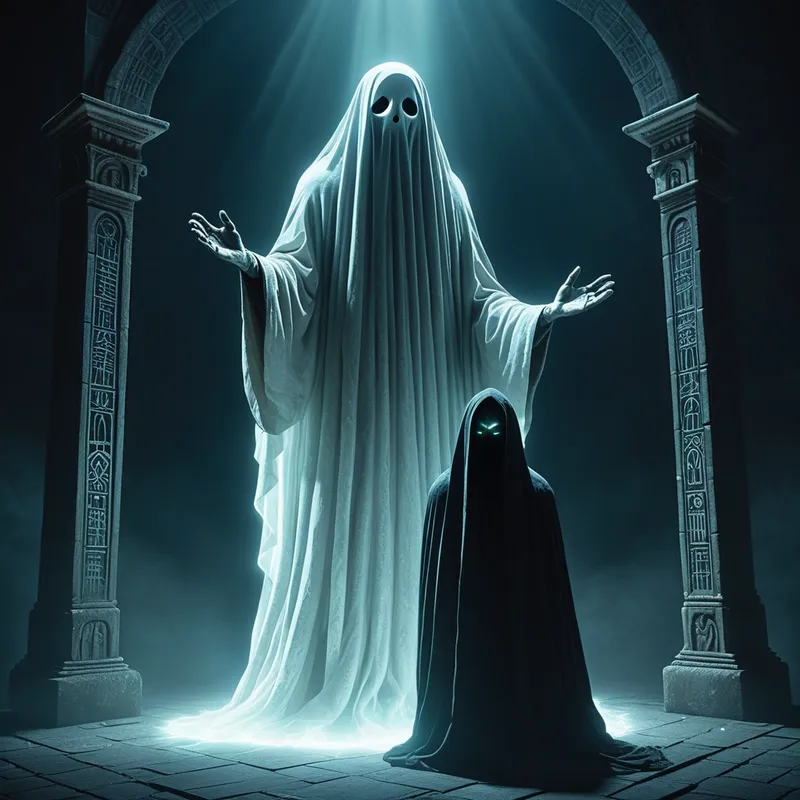
Here, beneath the skeletal branches of a lone, ancient tree, a presence waits. It is not a man, though it wears the tattered robes of a magistrate. It is not a beast, though its eyes hold a primordial depth. This is the Crossroads Ghost, the arbiter of the in-between. His form is woven from twilight and memory, his face stern with the gravity of ten thousand judgments. In one hand, he holds a ledger whose pages are not paper, but shifting mist inscribed with the glowing script of deeds. In the other, he holds nothing, but that hand feels heavier than stone.
One by one, they come. The newly departed, their souls still echoing with the last sounds of life—a final gasp, a weeping daughter, the slam of a coffin lid. They are drawn to this junction as rivers are drawn to [the sea](/myths/the-sea “Myth from Greek culture.”/). They arrive confused, trailing the psychic residue of their lives like torn shrouds.
A merchant arrives, his soul clinking with the ghost-sound of coins. He speaks first, boasting of his wealth, offering promises of tribute. The Crossroads Ghost does not speak. He merely opens the ledger. The pages flutter, and there, glowing with a cold fire, are not the merchant’s profits, but the faces of those he ruined—the farmer whose land he seized, the porter he broke with endless labor. The merchant’s spectral form trembles, his boasts turning to ash in his throat. The Ghost points—not down a road, but into [the earth](/myths/the-earth “Myth from Hindu culture.”/) itself, and the merchant’s soul is pulled downward, weighted by the gold that was never truly his.
Next comes a scholar, proud of his intellect and scrolls of poetry. He recites verses on virtue. The Ghost opens the ledger. There, the scholar sees the words he plagiarized, the rivals he slandered in secret letters, the cold neglect of his family in pursuit of empty fame. His elegant verses crumble. The Ghost points to a path that looks straight and bright, but as the scholar takes it, it becomes a hall of mirrors, reflecting only his own vanity back at him for an eternity of introspection.
Then comes a woman whose soul hums with a simple, weary kindness. She is afraid. She speaks of a life of little note—mending clothes, feeding neighbors in a famine, holding the hand of a dying stranger with no one else to comfort them. She expects judgment. The Ghost opens the ledger. The pages show small, warm lights: a bowl of rice given, a tear wiped away, a truth told gently. The Ghost’s stern visage does not soften, but his pointing finger indicates a different path. It is not wide or glorious. It is a narrow, moonlit trail that winds upward through fragrant cassia trees, toward a gentle, gathering dawn. She takes it, and her weariness falls away like an old cloak.
The Ghost closes his ledger. The crossroads are empty again, save for the sighing wind. He resumes his vigil, a solitary monument to the truth that every journey, in life or death, must pass through [the gauntlet](/myths/the-gauntlet “Myth from Arthurian culture.”/) of what was truly lived.
Cultural Origins & Context
The myth of the Crossroads Ghost is not the product of a single text or dynasty, but a folk belief that seeped into the Chinese cultural bedrock from the deep well of Taoist cosmology and ancestor veneration. It belongs to the vast and complex bureaucracy of the afterlife imagined in Chinese folk religion, a realm mirroring the imperial courts of the living, complete with judges, clerks, and detailed record-keeping.
This myth was primarily an oral tradition, told by village elders and daoshi not as mere entertainment, but as a moral and cosmological guide. Its societal function was profound. In a culture where social harmony and familial duty (xiao) were paramount, the Crossroads Ghost served as a psychic guarantor of [justice](/myths/justice “Myth from Tarot culture.”/). The imperial courts might be corrupt, the powerful might evade earthly consequences, but no soul could bypass this spectral magistrate. The myth reinforced the idea that one’s actions were eternally recorded and would be weighed with perfect, dispassionate accuracy. It gave psychological weight to everyday ethics, transforming the abstract concept of “judgment” into a vivid, imminent encounter at a literal and metaphorical junction.
Symbolic Architecture
The [crossroads](/symbols/crossroads “Symbol: A powerful spiritual symbol representing a critical decision point where paths diverge, often associated with fate, transformation, and life-altering choices.”/) is the master [symbol](/symbols/symbol “Symbol: A symbol can represent an idea, concept, or belief, serving as a powerful tool for communication and understanding.”/) here—a place of [convergence](/symbols/convergence “Symbol: The merging of separate elements into a unified whole, representing synthesis, destiny, or resolution.”/), [choice](/symbols/choice “Symbol: The concept of choice often embodies decision-making, freedom, and the multitude of paths available in life.”/), and ultimate exposure. It is the [limen](/myths/limen “Myth from Roman culture.”/) where directions dissolve and the [soul](/symbols/soul “Symbol: The soul represents the essence of a person, encompassing their spirit, identity, and connection to the universe.”/) stands naked before its own essence.
The Crossroads Ghost is not an external punisher, but the embodied conscience of the cosmos, the objective mirror in which the subjective self must finally gaze.
The Ghost himself symbolizes [the principle](/symbols/the-principle “Symbol: A fundamental truth, law, or doctrine that serves as a foundation for a system of belief, behavior, or reasoning, often representing moral or ethical standards.”/) of impartial judgment. He is devoid of mercy or malice; he is the function of [karma](/myths/karma “Myth from Hindu culture.”/) made manifest. His [ledger](/symbols/ledger “Symbol: A symbolic record of accounts, debts, and balances, representing life’s moral, emotional, and transactional reckonings.”/) is the Self-record, the unedited [story](/symbols/story “Symbol: The symbol of ‘Story’ represents the narrative woven through our lives, embodying experiences, lessons, and emotions that shape our identities.”/) of a [life](/symbols/life “Symbol: The symbol of ‘Life’ represents a journey of growth, interconnectedness, and existential meaning, encompassing both the joys and challenges that define human experience.”/). The different paths—down into the [earth](/symbols/earth “Symbol: The symbol of Earth often represents grounding, stability, and the physical realm, embodying a connection to nature and the innate support it provides.”/), into the hall of mirrors, up the cassia-lined trail—are not arbitrary punishments or rewards. They are the natural, inevitable destinations of a soul’s own [gravity](/symbols/gravity “Symbol: The fundamental force that pulls objects toward each other, representing attraction, inevitability, and the weight of existence.”/), determined by the [density](/symbols/density “Symbol: Represents the concentration of matter, energy, or meaning in a given space, often symbolizing complexity, weight, or substance.”/) and quality of its accumulated deeds. The myth posits that we are, ultimately, sentenced not by a god, but by the sum of our own being.
The Dreamer’s Resonance
When this myth pattern erupts in the modern dreamscape, the dreamer is at a profound psychological crossroads. The dream may not feature a traditional ghost, but rather a stern authority figure (a judge, a parent, a former teacher), a blocked intersection, or a feeling of being irrevocably judged in a vast, empty space.
Somatically, this often accompanies feelings of being “weighed down,” chest tightness, or a literal inability to choose a direction upon waking. Psychologically, it signals a moment where [the ego](/myths/the-ego “Myth from Jungian culture.”/)’s self-justifications are failing. The ledger is opening. The dreamer is being confronted by the shadow—those aspects of themselves they have denied, repressed, or disguised. The terror in the dream is the terror of self-recognition. The dream is a psychic ritual, forcing a review of one’s “accounts” before the inner, objective authority of [the Self](/myths/the-self “Myth from Jungian culture.”/). It is a call to stop running down well-worn paths of habit and illusion, and to stand still, in the uncomfortable silence of the junction, and truly see what one has built.

Alchemical Translation
The process modeled by the myth is the alchemy of psychic distillation. The soul’s journey to the crossroads is the journey of life itself, a compounding of experiences. The confrontation with the Ghost is the crucial [nigredo](/myths/nigredo “Myth from Alchemical culture.”/) phase—the facing of [the shadow](/myths/the-shadow “Myth from Jungian culture.”/), the blackening of the ego’s precious metals in the fire of truth.
The triumph is not in escaping judgment, but in undergoing it fully, for in that scorching honesty, the base lead of the persona is transmuted into the gold of authentic character.
For the modern individual, the “alchemical translation” is the practice of radical self-honesty at life’s thresholds. It is the willingness, when faced with a major decision or a crisis of meaning, to open our own inner ledger. We must ask: What path have I truly walked? Not the curated story for resumes and social media, but the raw data of actions, impacts, and avoided truths. The Ghost’s pointing finger is our own deepest intuition, which can only guide us rightly once the ledger has been acknowledged. The narrow, upward path is the path of individuation—it is not easy or popular, but it is aligned with the essence of the soul that has been clarified through its own courageous judgment. We become, in the end, both the soul arriving at the crossroads and the Ghost who presides over it, learning to judge ourselves with the same impersonal rigor, so that our choices may finally lead us home.
Associated Symbols
Explore related symbols from the CaleaDream lexicon: