The Creation of Japan
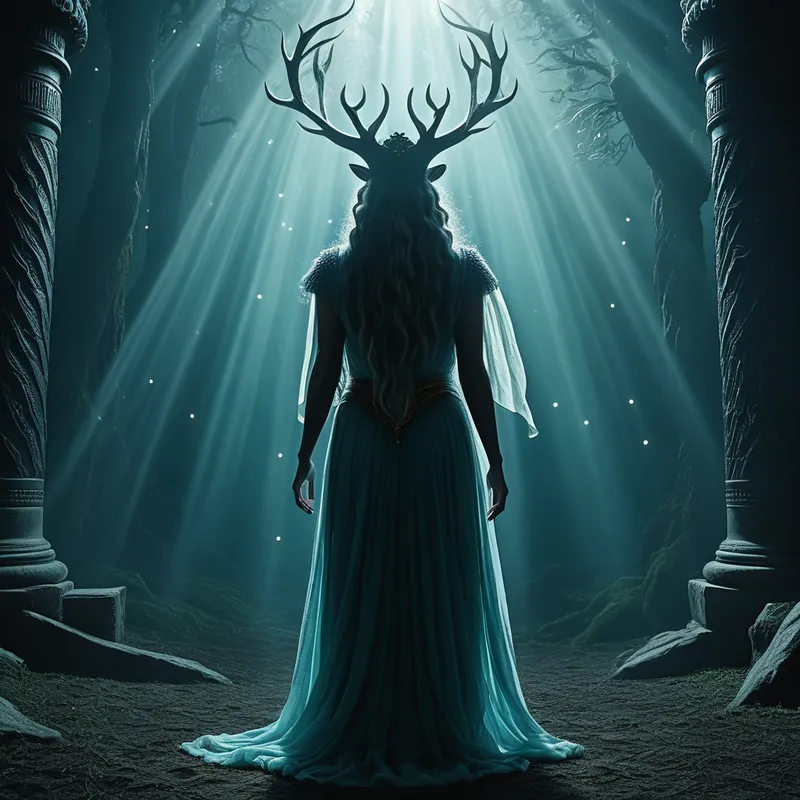
The Shinto myth of how the kami Izanagi and Izanami birthed the Japanese archipelago from primordial waters, establishing the sacred origins of the land.
The Tale of The Creation of Japan
In the beginning, when heaven and earth were not yet separate, there existed a formless, drifting [chaos](/myths/chaos “Myth from Greek culture.”/), like oil upon a sea. From this primordial broth, the first kami emerged. Among these divine beings were two, appointed by the older heavenly kami to a sacred task: to solidify the floating earth and give it form. These were Izanagi-no-Mikoto and Izanami-no-Mikoto.
Standing upon the Floating Bridge of Heaven, they looked down into the swirling brine below. Izanagi thrust his jeweled spear, Ame-no-nuboko, into the waters. As he stirred, the brine thickened and coalesced. When he withdrew the spear, drops of salty brine fell from its tip and hardened into an island—Onogoro, the first land, “self-curdling.” The divine couple descended to this newborn earth.
Upon Onogoro, they erected a great pillar, Ame-no-mihashira (the Heavenly August Pillar), and built a palace around it. Recognizing their difference, they decided to unite to give birth to the lands. They circled the pillar from opposite directions; when they met, Izanami, the female, spoke first: “What a fair and lovely youth!” They joined, but their first offspring was a leech-child, Hiruko, and the island of Awashima, both deemed failures. Distressed, they consulted the heavenly kami, who revealed the flaw: the woman had spoken first, violating the natural order. The male must initiate.
They returned to the pillar and circled once more. This time, when they met, Izanagi spoke first: “What a fair and lovely maiden!” They joined again, and this union was fruitful. From them were born the eight great islands of Japan: Awaji, Shikoku, Oki, Kyushu, Iki, Tsushima, Sado, and finally, Honshu. They then birthed the [kami of the sea](/myths/kami-of-the-sea “Myth from Japanese culture.”/), the rivers, the mountains, the winds, the trees, and the plains—populating [the world](/myths/the-world “Myth from Tarot culture.”/) with the spirits of nature itself.
Yet, in giving birth to the kami of fire, Kagutsuchi, Izanami was grievously burned. As she lay dying, she vomited, defecated, and urinated, and from these substances were born more kami. Izanagi, in a rage of grief, slew the fire-child Kagutsuchi, and from the blood and body parts of the slain kami sprang forth yet more deities. But he could not save his beloved. Izanami descended to [the land of Yomi](/myths/the-land-of-yomi “Myth from Shinto culture.”/), the shadowy [underworld](/myths/underworld “Myth from Greek culture.”/) of the dead.
Mad with sorrow, Izanagi pursued her. In the gloom, he heard her voice and pleaded for her return. Izanami warned him not to look upon her, for she had eaten the food of Yomi and was changed. She begged him to wait while she petitioned the kami of [the underworld](/myths/the-underworld “Myth from Greek culture.”/), but he, impatient, broke off a tooth from his comb, lit it as a torch, and entered her chamber. The flame revealed a horrifying sight: his beautiful wife was now a rotting, maggot-swarmed corpse, with eight Thunder kami roaring upon her putrefying form.
Terrified, Izanagi fled. Humiliated and enraged, Izanami, now a goddess of [death](/myths/death “Myth from Tarot culture.”/), sent the Yomotsu-shikome (the Ugly Women of Yomi) and later the Thunder kami to pursue him. He flung his headdress, which became grapes to delay them, then his comb, which became bamboo shoots. Finally, at the boundary of Yomi, Izanami herself gave chase. Izanagi rolled a massive boulder to block the pass, forever separating the land of the living from the land of the dead. Through the barrier, they spoke their final words, pronouncing a divorce of [death](/myths/death “Myth from Tarot culture.”/).
Profaned by his contact with the underworld, Izanagi went to purify himself in a river. As he disrobed and washed, each item of clothing and each part of his body he cleansed gave birth to new kami. From the washing of his left eye was born [Amaterasu](/myths/amaterasu “Myth from Japanese Shinto culture.”/)-Ōmikami. From his right eye was born [Tsukuyomi-no-Mikoto](/myths/tsukuyomi-no-mikoto “Myth from Japanese culture.”/). And from washing his nose was born [Susanoo](/myths/susanoo “Myth from Japanese culture.”/)-no-Mikoto. Charging these three noble children with the rule of the cosmos, Izanagi retreated from the world, his creative and tragic work complete.
Cultural Origins & Context
This myth is the foundational narrative of the Shinto tradition, primarily recorded in Japan’s oldest extant texts, the Kojiki (712 CE) and the Nihon Shoki (720 CE). Compiled under imperial auspices, these texts sought to codify and legitimize the origins of the Japanese archipelago, the imperial lineage (which traces itself directly to Amaterasu), and the native spiritual worldview.
The story exists at the intersection of cosmology, politics, and pure animism. It is not a philosophical treatise on ex nihilo creation, but a narrative of generation, of bringing order (kami) from primal chaos through divine action and relationship. The land itself is not merely created; it is born, making Japan intrinsically sacred (kami itself) and familial. Every mountain, river, and grove is a sibling, born of the same divine parents. This establishes the core Shinto sensibility of profound reverence for nature and specific place.
The tragic second act—the death of Izanami and the descent into Yomi—grounds this sacredness in a reality of loss, pollution (kegare), and the necessity of purification (harae). Death is not evil in Shinto, but it is a potent source of defilement that must be ritually separated from the world of life and order. [Izanagi’s purification](/myths/izanagis-purification “Myth from Shinto culture.”/), which creates the most important kami, institutionalizes the ritual practices of cleansing that remain central to Shinto worship today.
Symbolic Architecture
The myth’s [structure](/symbols/structure “Symbol: Structure in dreams often symbolizes stability, organization, and the framework of one’s life, reflecting how one perceives their environment and personal life.”/) is a profound map of [consciousness](/symbols/consciousness “Symbol: Consciousness represents the state of awareness and perception, encompassing thoughts, feelings, and experiences.”/) moving from potential into manifest form, and then confronting the [shadow](/symbols/shadow “Symbol: The ‘shadow’ embodies the unconscious, repressed aspects of the self and often represents fears or hidden emotions.”/) of that manifestation.
The Heavenly Pillar is the world axis (axis mundi), the fixed point around which chaos is organized and differentiated. It is the first principle, the vertical connection between heaven and the nascent earth, around which the dance of masculine and feminine, speech and silence, order and error, unfolds.
The spear, Ame-no-nuboko, is not a weapon but an instrument of churning. Its action mirrors the stirring of the cosmic sea found in other traditions, a phallic symbol of active intervention that coagulates the potential of the feminine waters, initiating the process of solidification and form.
Izanami’s transformation in Yomi reveals a fundamental psychological and cosmological truth: that which is desired, when pursued into the unconscious (the underworld), appears in its terrible aspect. The beautiful, life-giving mother becomes the horrifying, death-bound corpse. This is not a moral judgment but a depiction of the raw, unmediated face of the archetypal Great Mother in her full cycle—creator, sustainer, and destroyer.
The [flight](/symbols/flight “Symbol: Flight symbolizes freedom, escape, and the pursuit of one’s aspirations, reflecting a desire to transcend limitations.”/) and [pursuit](/symbols/pursuit “Symbol: A chase or being chased in dreams often reflects unresolved anxieties, unfulfilled desires, or internal conflicts demanding attention.”/) establish the critical Shinto concept of boundaries (shimenawa, the sacred rope). The boulder blocking the pass to Yomi is the ultimate [boundary](/symbols/boundary “Symbol: A conceptual or physical limit defining separation, protection, or identity between entities, spaces, or states of being.”/), maintaining the necessary [separation](/symbols/separation “Symbol: A spiritual or mythic division between realms, states of being, or consciousness, often marking a transition or loss of connection.”/) between the pure, [life](/symbols/life “Symbol: The symbol of ‘Life’ represents a journey of growth, interconnectedness, and existential meaning, encompassing both the joys and challenges that define human experience.”/)-affirming world of the kami and the polluting [realm](/symbols/realm “Symbol: The symbol of ‘Realm’ often signifies the boundaries of one’s consciousness, experiences, or emotional states, suggesting aspects of reality that are either explored or ignored.”/) of decay. This act creates the existential [condition](/symbols/condition “Symbol: Condition reflects the state of being, often focusing on physical, emotional, or situational aspects of life.”/) for [life](/symbols/life “Symbol: The symbol of ‘Life’ represents a journey of growth, interconnectedness, and existential meaning, encompassing both the joys and challenges that define human experience.”/): it is defined by its limit.
The Dreamer’s Resonance
To dream of this myth is to dream of origins and their inherent cost. It speaks to the dreamer engaged in any act of profound creation—be it a relationship, a work of art, a family, or a new phase of self. The initial, idyllic generation of islands mirrors the joyful, fertile beginning of any venture. The birth of the fire-child and the subsequent death is the inevitable moment of trauma, the “creative burn” that wounds the creator. Something must be sacrificed for creation to continue; the new (fire) injures the source (the mother).
Izanagi’s descent into the underworld resonates with any journey into grief, depression, or the repressed past in an attempt to reclaim what was lost. The dream warns of the danger of seeing this lost beloved with the “light of day”—of applying conscious, rational expectation to the contents of the unconscious. What we seek there is forever changed by the medium of the underworld itself. The frantic flight and purification that follow are the [psyche](/myths/psyche “Myth from Greek culture.”/)‘s necessary recoil and cleansing after such a traumatic confrontation, leading to a rebirth of new faculties (the three noble children: the solar consciousness, the lunar reflection, and the stormy passion).
Alchemical Translation
In the alchemy of the soul, the myth describes the opus of individuation. [The prima materia](/myths/the-prima-materia “Myth from Alchemical culture.”/) is the chaotic, undifferentiated sea of the unconscious. The [coniunctio](/myths/coniunctio “Myth from Alchemical culture.”/), [the sacred marriage](/myths/the-sacred-marriage “Myth from Various culture.”/), is the conscious engagement of masculine and feminine principles within the psyche, oriented around the central pillar of [the Self](/myths/the-self “Myth from Jungian culture.”/).
The first, flawed union, where the feminine speaks first, represents an initial, naive attempt at integration that fails because the guiding, discriminating, active principle (the masculine) is not in the lead. Order precedes fertility.
The successful union births the “islands” of the personality—the solid, defined territories of the ego-complex emerging from the sea of the unconscious. But the process is not complete until it confronts its own shadow. The birth of Fire is the ignition of passionate, transformative energy that inevitably “burns” the naive state of being.
The descent into Yomi is the [nigredo](/myths/nigredo “Myth from Alchemical culture.”/), the blackening, the confrontation with [the shadow](/myths/the-shadow “Myth from Jungian culture.”/) and the rotting, mortal aspect of one’s own nature. Izanagi’s flight is the painful but necessary act of separation from identification with this decay. The purification in [the river](/myths/the-river “Myth from Buddhist culture.”/) is the [albedo](/myths/albedo “Myth from Alchemical culture.”/), the whitening, the cleansing that follows insight. From this washing are born the transcendent functions: Amaterasu (the illuminating consciousness, the “I” that sees), [Tsukuyomi](/myths/tsukuyomi “Myth from Japanese culture.”/) (the reflective, introspective function), and Susanoo (the chaotic, emotional, creative-destructive energy). The Self (Izanagi) retreats, having facilitated the birth of a ruling triad capable of managing the created world.
Associated Symbols
Explore related symbols from the CaleaDream lexicon:
- Ocean — The primordial, undifferentiated chaos from which all form is born, representing the boundless potential and terrifying formlessness of the unconscious.
- Spear — An instrument of divine intervention that stirs potential into being, symbolizing the focused, penetrating action required to initiate creation from chaos.
- Pillar — The central axis around which creation revolves, representing order, stability, and the sacred connection between heaven and earth.
- Fire — The transformative element of creation that also brings destruction, symbolizing the passionate energy that forges new realities but can wound its source.
- Door — [The threshold](/myths/the-threshold “Myth from Folklore culture.”/) between realms, most potently the stone blocking the pass to Yomi, representing the necessary boundaries that separate life from death, purity from pollution.
- River — The flowing waters of purification where defilement is washed away and new life is born, symbolizing cleansing, renewal, and the transition to a higher state.
- Mother — The life-giving feminine principle who becomes the face of decay, embodying the full archetypal cycle of creation, nourishment, death, and transformation.
- Mountain — The solidified land born from the divine couple, representing the enduring, sacred presence of the earthly realm and the manifestation of spirit in form.
- Shadow — The realm of Yomi and the transformed Izanami, representing the repressed, mortal, and terrifying aspects of existence that must be confronted and bounded.
- Ritual — The act of purification following contact with death, symbolizing the structured practices that restore order and harmony after an encounter with chaos or defilement.
- Japanese — The specific cultural and spiritual landscape born from this myth, representing a worldview where nature is inherently sacred and every element is kin.
- Cyclic Nature — The endless rhythm of creation, death, and rebirth illustrated by the myth, from the birth of islands to the descent to Yomi and the subsequent purification.