The Creation at Lake Titicaca Myth Meaning & Symbolism
From the primordial waters of Lake Titicaca, the god Viracocha emerges to banish primordial darkness and sculpt the first humans from stone.
The Tale of The Creation at Lake Titicaca
In the time before time, there was only Chaos and a great, silent darkness. The world was a formless, empty void, a deep and endless night. But in the heart of the highest mountains, where the air is thin and the stars feel close enough to touch, there lay a body of water so vast it was called a sea upon the roof of the world. This was Lake Titicaca, a sheet of obsidian under a dead sky.
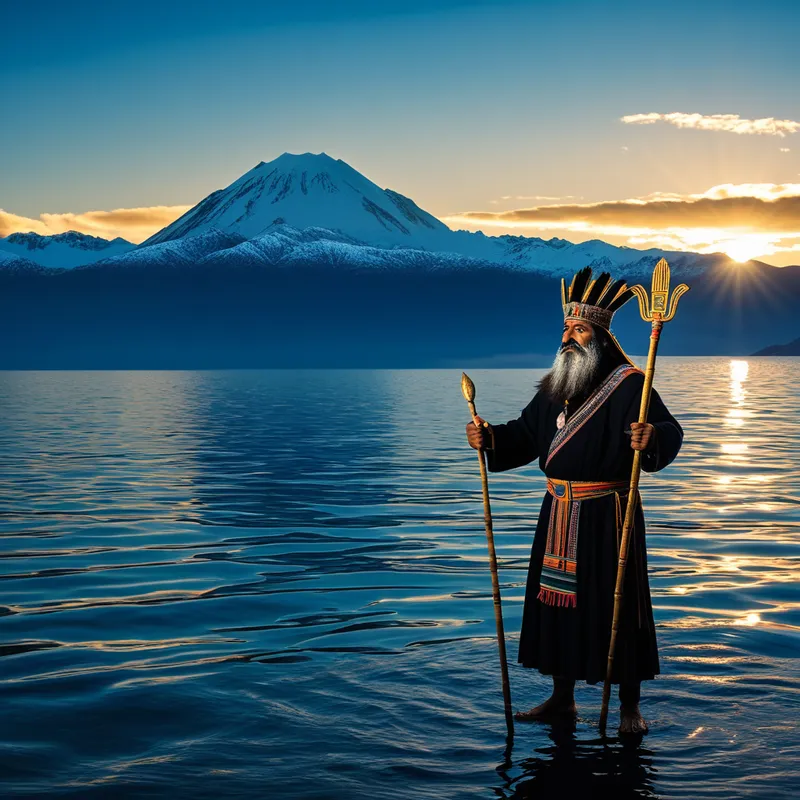
From the profound depths of this dark lake, a stirring began. Not a ripple, but a gathering of intention. The waters, cold and ancient, began to churn with a light that had no source. And then, he emerged. [Viracocha](/myths/viracocha “Myth from Incan culture.”/), the Lord, the Ancient One, the Foundation of All. He rose from the sacred waters, his form radiating a soft, dawn-like luminescence, a beard of wisdom upon his face, and in his hand, a staff of ultimate authority. His first act was to speak light into being. He commanded the sun, Inti, to rise from the islands of the lake—from the Isla del Sol and the Isla de la Luna. And it did. A golden, blazing orb tore through the perpetual night, flooding the barren Altiplano with warmth and revealing, for the first time, the stark, magnificent bones of the Earth: the towering mountains, the vast lake, the empty land.
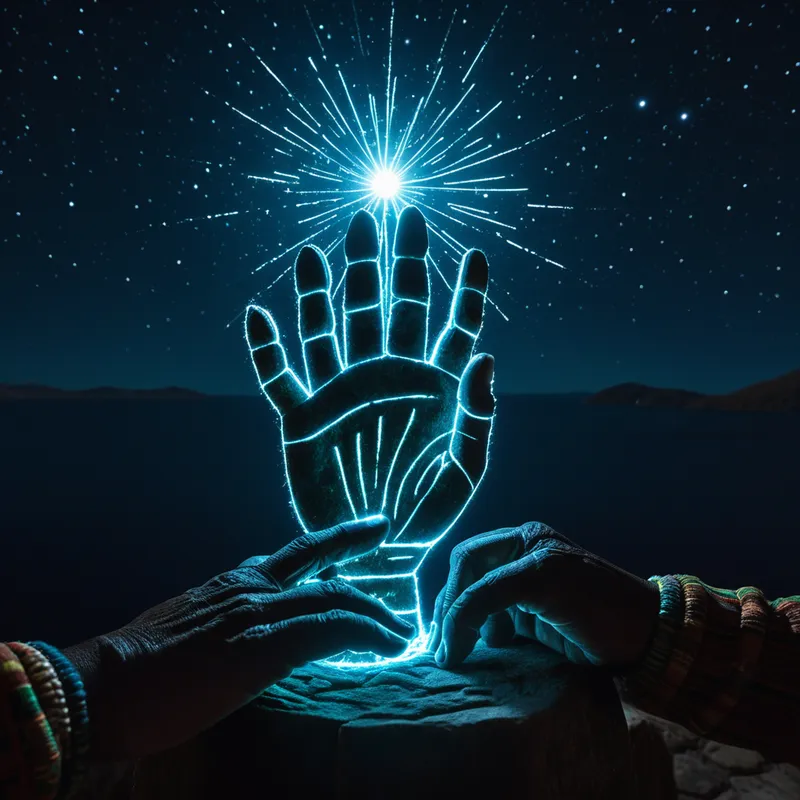
But the world was empty of life. Silence reigned, save for the wind and water. So Viracocha set to work. He walked the shores and the islands, gathering the very stone of the Earth. With his divine breath and his will, he began to sculpt. From the dark, fertile clay and rock, he shaped figures. He carved the first humans, giving them form, feature, and essence. He breathed into them the spark of life, the camaquen. These first beings were giants, molded from the land itself. He painted them with the colors of their future tribes and gave them languages, songs, and laws. He instructed them in the ways of civilization—how to build, how to farm the terraced mountainsides, how to worship.
Yet, these first creations were flawed. They were powerful but unruly, forgetting their creator and his commands. A great sadness, or perhaps a righteous fury, came upon Viracocha. He summoned a great flood, a Uno Pachacuti, to wash the world clean of this first, failed experiment. The waters of Titicaca rose and swallowed the giants, returning them to the primordial mud from which they came.
But creation is not a single act; it is a process of refinement. From the aftermath, Viracocha began again. This time, he worked with more care, more subtlety. He journeyed forth from the lake, traveling in disguise as a wise, wandering old man. At sacred places—springs, caves, and mountain passes—he called forth new generations of humans from the very earth and water. These were the ancestors of all the Andean peoples. He taught them, guided them, and then, his work complete, he walked westward across the Pacific Ocean, disappearing into the horizon, promising one day to return. He left behind a world ordered, illuminated, and populated, its sacred origin forever imprinted upon the deep, blue waters of Lake Titicaca.
Cultural Origins & Context
This creation narrative was the foundational myth of the Tawantinsuyu, the Incan Empire. It was not merely a story of the past but a living charter of political and spiritual legitimacy. The myth was preserved and transmitted by the Amautas and the Acllas, and recited during state rituals and imperial ceremonies. Its primary function was to center the Incan worldview geographically and theologically. By claiming direct descent from the sun, Inti, birthed at Lake Titicaca, the Sapa Inca established his divine right to rule. The lake was not just a location; it was the Pacarina, the place of emergence for the gods and, by extension, for the civilized order the Incas imposed. The myth justified Incan expansion as a divine mandate to bring Viracocha’s order to the chaotic world, mirroring the god’s own creative journey.
Symbolic Architecture
At its core, this myth is a profound map of the psyche moving from undifferentiated potential into conscious, structured existence. The dark, silent [lake](/symbols/lake “Symbol: A lake often symbolizes a place of reflection, emotional depth, and the subconscious mind, representing both tranquility and potential turmoil.”/) represents the unconscious itself—the fertile, chaotic, and boundless [realm](/symbols/realm “Symbol: The symbol of ‘Realm’ often signifies the boundaries of one’s consciousness, experiences, or emotional states, suggesting aspects of reality that are either explored or ignored.”/) of all possibility.
The first act of consciousness is not to find light, but to command it into being from within the depths.
Viracocha is the archetypal principle of ordering [consciousness](/symbols/consciousness “Symbol: Consciousness represents the state of awareness and perception, encompassing thoughts, feelings, and experiences.”/). His [emergence](/symbols/emergence “Symbol: A process of coming into being, rising from obscurity, or breaking through a barrier, often representing birth, transformation, or revelation.”/) from the [water](/symbols/water “Symbol: Water symbolizes the subconscious mind, emotions, and the flow of life, representing both cleansing and creation.”/) is the [birth](/symbols/birth “Symbol: Birth symbolizes new beginnings, transformation, and the potential for growth and development.”/) of the ego from the unconscious, the first [moment](/symbols/moment “Symbol: The symbol of a ‘moment’ embodies the significance of transient experiences that encapsulate emotional depth or pivotal transformations in life.”/) of self-[awareness](/symbols/awareness “Symbol: Conscious perception of self, surroundings, or internal states. Often signifies awakening, insight, or heightened sensitivity.”/) that illuminates the inner world. The first creation of the giants symbolizes a primal, unintegrated psychic [energy](/symbols/energy “Symbol: Energy symbolizes vitality, motivation, and the drive that fuels actions and ambitions.”/)—raw power without discipline or reverence, which must be dissolved back into the unconscious (the flood) for a more refined consciousness to be possible. The second creation, from specific places in the [landscape](/symbols/landscape “Symbol: Landscapes in dreams are powerful symbols representing the dreamer’s emotional state, personal journey, and the broader context of life situations.”/), represents the conscious cultivation of different aspects of the self (instincts, emotions, thoughts) from the raw [material](/symbols/material “Symbol: Material signifies the tangible aspects of life, often representing physical resources, desires, and the physical world’s influence on our existence.”/) of the psyche, guided by the now-wandering, internalized [creator](/symbols/creator “Symbol: A figure representing ultimate origin, divine power, or profound authorship. Often embodies the source of existence, innovation, or personal destiny.”/) principle. Viracocha’s eventual [departure](/symbols/departure “Symbol: A transition from one state to another, often representing change, growth, or leaving behind the familiar.”/) signifies that the work of conscious individuation must be taken up by the individual; the inner god provides the [blueprint](/symbols/blueprint “Symbol: A blueprint represents the foundational plan or design for something, often symbolizing potential, structure, and the mapping of one’s inner self or future.”/) but does not remain to govern daily [life](/symbols/life “Symbol: The symbol of ‘Life’ represents a journey of growth, interconnectedness, and existential meaning, encompassing both the joys and challenges that define human experience.”/).
The Dreamer’s Resonance
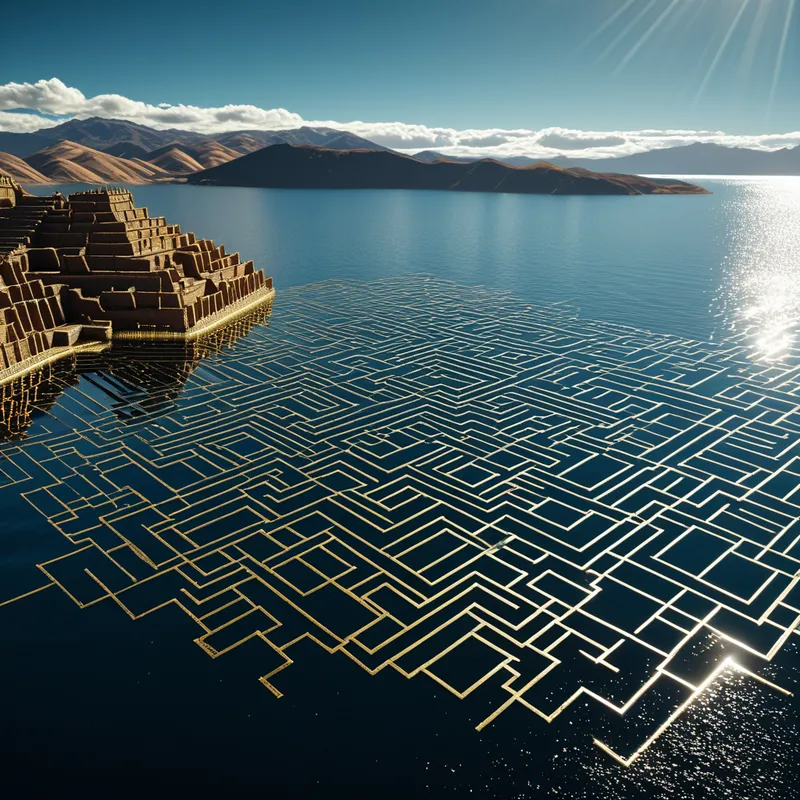
When this mythic pattern stirs in modern dreams, it often manifests as dreams of profound emergence or urgent creation. One might dream of rising from deep, dark water into blinding light, feeling a sense of immense purpose or revelation. Alternatively, one may dream of desperately trying to shape formless material—clay, sand, light—into a coherent shape, often with a pressing but unclear deadline. These dreams point to a critical phase of psychological gestation ending in a “birth” of new consciousness. The somatic feeling is often one of pressure in the chest or head, a literal feeling of something coming up from the depths. Psychologically, this is the process of a complex, a long-buried talent, a new understanding, or a core aspect of identity struggling to be formed and brought into the light of day. The dream may also contain the shadow of the myth: dreams of a great flood or returning to murky waters, signaling a necessary dissolution of an old, rigid, or arrogant structure of the self (the “giants”) to make way for a more authentic creation.
Alchemical Translation
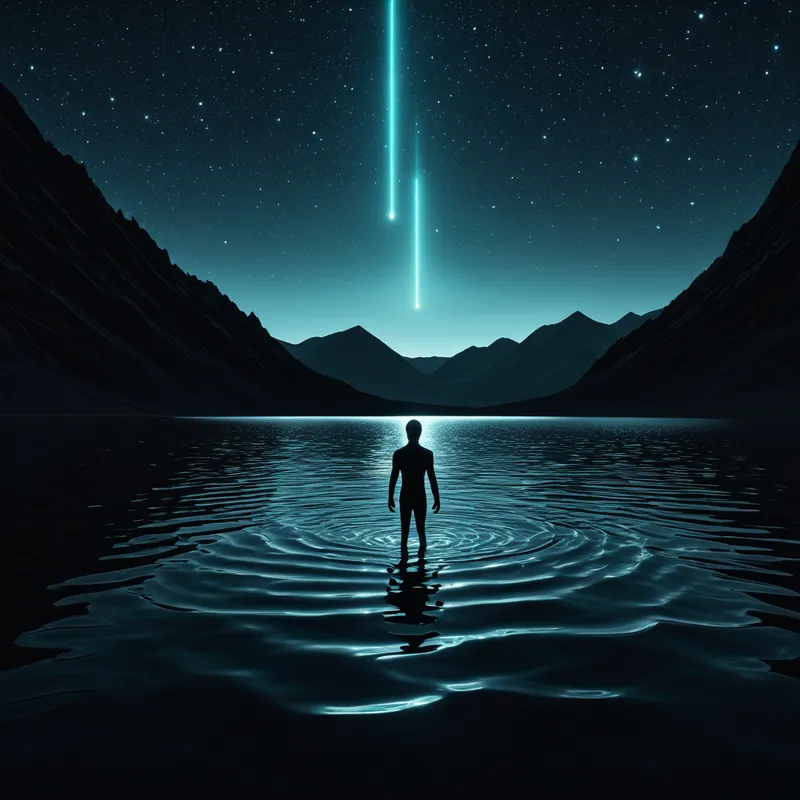
The alchemical journey mirrored here is the Opus Magnum itself: taking the prima materia—the chaotic, dark waters of the unexamined life—and through the divine spark of awareness (Viracocha’s emergence), transmuting it into the gold of a realized self. The process is not clean or linear. It requires the nigredo, the blackening, represented by the initial darkness and the destructive flood—the necessary despair and deconstruction of outdated selves.
The flood is not a punishment, but a ruthless mercy. It clears the ground so the true form can be sculpted.
The traveler on this path must first confront their own inner “Lake Titicaca”—the deep, often frightening reservoir of their unconscious potential. From it, they must call forth their own inner sun, the guiding light of consciousness (Inti). Then begins the patient, often frustrating work of the laboratorium: sculpting the raw stone of one’s instincts, traumas, and gifts into a coherent human form. This is the second creation: no longer a giant of inflated self-image, but a humble, earth-born being connected to specific, sacred places within one’s own soul landscape. The ultimate goal is Viracocha’s departure: to internalize the creator function so completely that one becomes the conscious author of one’s own life, walking one’s own path with the staff of self-authority in hand, until one merges again with the horizon of the transcendent.
Associated Symbols
Explore related symbols from the CaleaDream lexicon:
- Lake — The primordial womb of the unconscious, the source of all potential and the dark waters from which consciousness and form first emerge.
- Sun — The illuminating force of consciousness, born from the depths, representing clarity, order, divine authority, and the active principle of life.
- God — The archetypal creator principle, Viracocha, representing the psyche’s inherent drive to bring order, meaning, and form out of inner chaos.
- Stone — The raw, foundational material of the self and the world, which must be consciously shaped and animated by the breath of spirit to become alive.
- Mountain — The stable, enduring framework of consciousness and the lofty realm where the divine interfaces with the earthly, surrounding the sacred source.
- Water — The element of the formless unconscious, of emotion and potential, which both gives birth and cleanses through the purifying flood.
- Journey — The path of creation and individuation, from emergence at the source to wandering guidance and eventual reintegration with the transcendent.
- Chaos — The necessary primordial state of undifferentiated potential, the dark silence that precedes and makes possible all acts of creation.
- Order — The divine mandate and achieved state of a structured, harmonious psyche and world, imposed by the creative will upon chaos.
- Rebirth — The core cycle of the myth: the emergence of the god, the creation of life, its dissolution, and the more refined second creation.
- Shadow — Represented by the dark, silent waters and the flawed first giants, it is the unintegrated psychic material that must be confronted and transformed.
- Light — The first creation of Viracocha, symbolizing the dawn of awareness, revelation, and the power to see and shape what was previously hidden.