The Crannog Myth Meaning & Symbolism
A myth of a sacred, man-made island, a threshold between worlds, where sovereignty is tested and the soul finds sanctuary before its final voyage.
The Tale of The Crannog
Listen now, by the peat-fire’s glow, to the tale that is not of stone, but of water and wood. In the time when the mist clung low to the land and the hills whispered with the voices of the genius loci, there was a king whose heart was a dry riverbed. His name was Eochaid, and he ruled a prosperous, yet restless, tribe. They had cattle, they had bronze, but their spirit was adrift, for they had forgotten the pact with the land itself.
A great unrest settled upon the people, a murmuring that rose from the very soil. Crops grew stunted, and children were born with a distant look in their eyes, as if listening for a song from beyond the lake. The druids gathered, their faces grim in the oak-grove’s shadow. They spoke of a fractured covenant. The king, they said, must seek the Otherworld, not to conquer it, but to remember it. And the path to that realm was not a road, but a reflection.
Guided by the oldest among them, a druidess whose eyes held the depth of the deepest tarn, Eochaid was led to the shore of Loch Dá Dhá. “Build not upon the earth,” she intoned, her voice like wind through reeds. “Build upon the boundary. Where water meets land, where sky touches reflection, there you must raise your hall.”
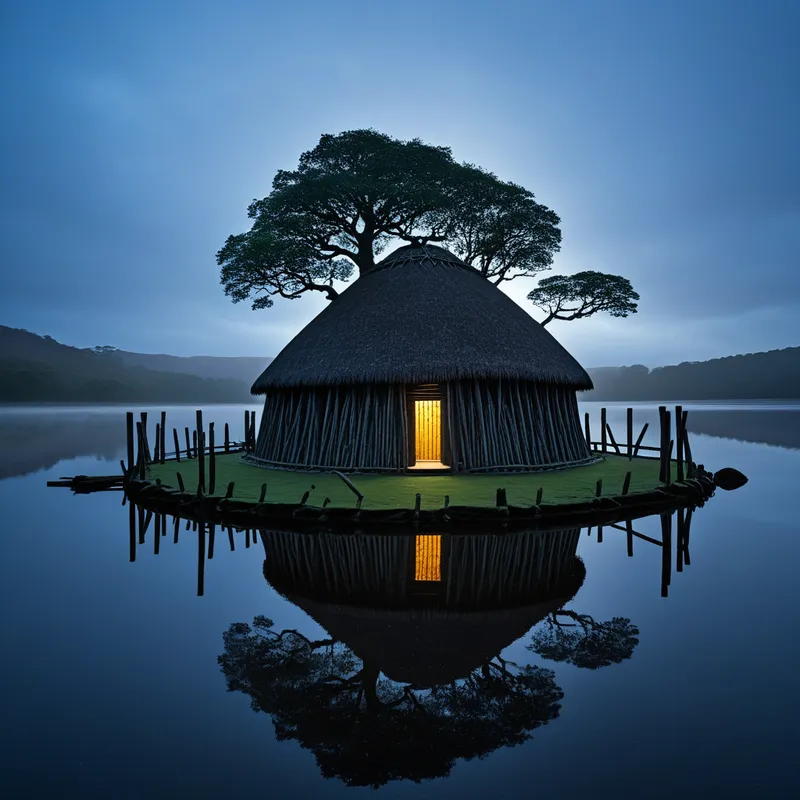
And so the tribe labied. They drove great pilings of alder and oak deep into the soft lakebed, beyond the reach of the shore. They wove walls of wattle, strong and resilient. They thatched a roof with reeds that whispered constantly of the water below. They built a circular walkway, a perfect ring separating the sanctuary from the world. This was the crannog: an island born of human will, yet cradled by the ancient, untamed water. It was a question made of timber.
On the night of Samhain, when the veil was a mere sigh, Eochaid crossed the walkway alone. He carried no sword, no trophy. He carried only a bowl of hazelwood and a handful of earth from his own hill-fort. Inside the roundhouse, a fire of rowan wood burned with a blue-green flame. He waited.
She came not through the door, but from the very center of the hearth-smoke. She was the Sovereignty. Her robe was the green of summer moss, her hair the black of winter soil, and her eyes held the shifting greys of the lake under storm. She said nothing. She simply extended a hand, palm up, empty.
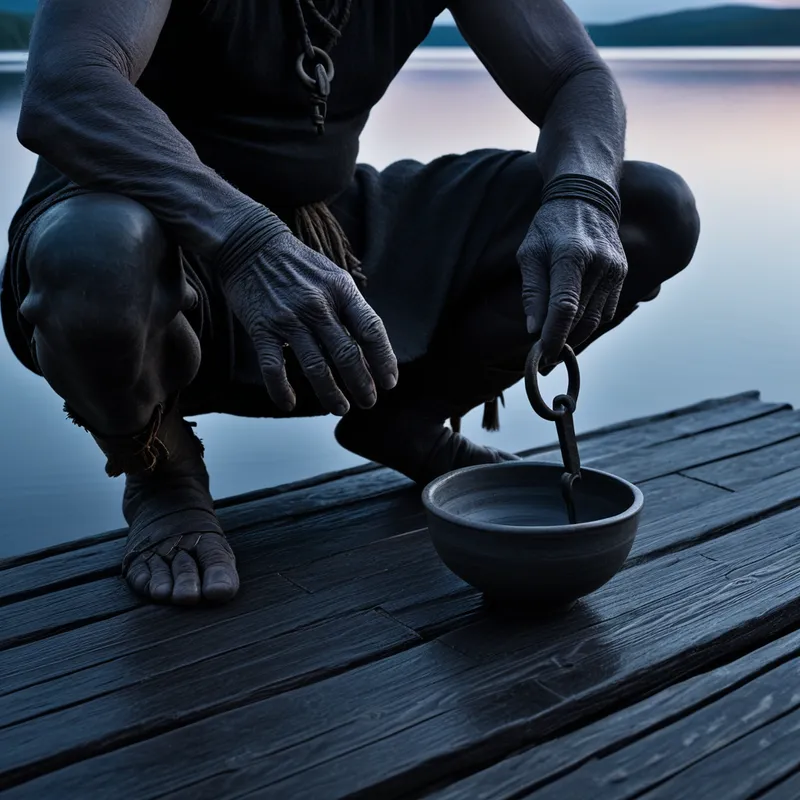
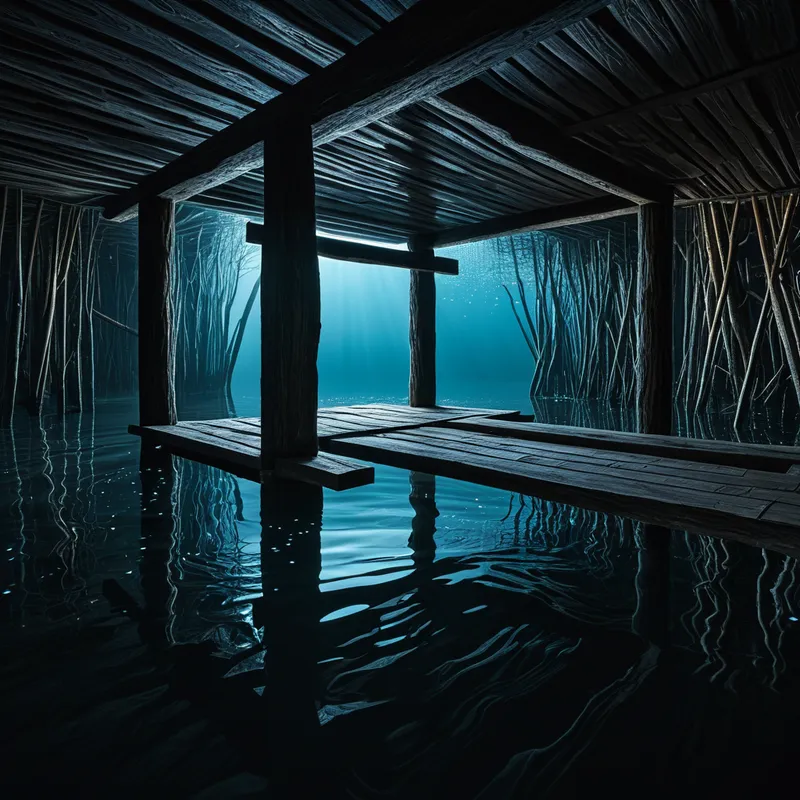
Eochaid, his kingly pride ash in his mouth, understood. He placed the bowl in her hand. He took the earth from his pouch and let it fall into the water of the bowl, where it dissolved into darkness. Then, he knelt. He placed his forehead upon the cool, damp planks of the crannog floor—this man-made ground over primordial deep. In that act of submission, not to a person, but to the place, to the threshold itself, he heard it: a low, resonant hum from the lake depths, a sound of approval.
The Sovereignty touched his shoulder. “The key is not to possess the island,” her voice echoed in his bones. “The key is to become the bridge. You are the pilings. Your people are the thatch. Your breath is the mist that guards it.” As dawn’s first light pierced the smoke-hole, she was gone. Eochaid emerged, not as a king who had ventured to the Otherworld, but as one in whom the Otherworld now resided. The murmuring of the land ceased. The waters of the lake grew calm and clear, holding the perfect, inverted reflection of the crannog—a twin sanctuary in the world below.
Cultural Origins & Context
The crannog was no mere mythic fancy, but a vivid reflection of tangible Iron Age life. These artificial, fortified island dwellings were common across Scotland, Ireland, and parts of Wales from the Neolithic period well into the medieval era. They were feats of communal engineering, requiring immense labor to construct and maintain. This very real, physical reality—a sanctuary painstakingly built in the landscape but not entirely of it—provided the perfect literal foundation for a profound metaphysical idea.
The myth likely emerged from the bardic and druidic traditions, told not as a simple history of construction, but as an aetiological narrative for the soul of a people. It served a crucial societal function: to encode the principles of liminality, community, and sacred kingship. The crannog was a physical manifestation of the Celtic world-view, which saw the natural world as interpenetrated by the supernatural. Lakes, in particular, were seen as portals to the Sídhe. By building their homes upon these thresholds, communities literally placed themselves at the interface of worlds, a constant, living reminder of their relationship with the unseen.
The story of a king journeying to such a place for a rite of sovereignty would have been told during festivals or royal inaugurations, reinforcing the idea that true leadership was not domination, but a sacred stewardship earned through humility and correct relationship with the spiritual essence of the land itself.
Symbolic Architecture
The crannog is a master symbol of the liminal. It is not land, not water, but a third thing born of their marriage. Psychologically, it represents the constructed sanctuary of the self—the conscious ego-structure we build over the depths of the unconscious.
The ego is a crannog: a fragile, noble construction that keeps the soul from drowning in the unconscious, yet must remain connected to those dark, nourishing waters to have any meaning at all.
The pilings driven into the soft lakebed symbolize the necessary, often uncomfortable, penetration of consciousness into the unconscious to find solid footing. The circular walkway is the boundary of the persona, the defined self. The central hearth is the inner flame of awareness and spirit. The visiting Sovereignty is the anima figure, or the soul of the world itself, who cannot be claimed, only recognized and honored. The king’s kneeling is the critical dissolution of arrogant, isolated consciousness (the dry riverbed) into a posture of receptive listening. The myth teaches that wholeness is not found in conquering the mysterious depths, but in building a respectful dwelling place at its very edge.
The Dreamer’s Resonance
To dream of a crannog is to dream of a psyche in a state of active reorganization, building a new structure for consciousness. The somatic feeling is often one of slight instability—the feeling of walking on wooden planks over deep water—coupled with a profound sense of purpose and sanctuary.
If the crannog in the dream is sturdy and whole, with a warm light within, it indicates the dreamer is successfully integrating difficult unconscious material, creating a stable inner refuge during a time of external turmoil. If the crannog is dilapidated, half-sunk, or under attack, it speaks to a fragile ego-structure, a self that feels besieged by emotions or circumstances it cannot control, and a need to repair one’s psychological boundaries. Dreaming of building a crannog is a powerful sign of active individuation—the conscious, effortful work of creating a cohesive self that can navigate the depths of one’s own inner world. The water level around the crannog is always instructive: calm waters suggest integration; stormy or rising waters point to powerful unconscious contents seeking recognition.
Alchemical Translation
The alchemical process mirrored in the Crannog myth is that of solutio followed by coagulatio. The king’s arid heart (the dry riverbed) is the initial, flawed state of consciousness—brittle and disconnected. His journey to the lake and his submission on its floor is the solutio: the dissolution of the old, rigid ego in the waters of the unconscious.
The sacred key is not an object to be found, but a posture to be assumed: the humility to kneel upon one’s own constructed ground and listen to the deep.
From this dissolved state, however, arises not chaos, but a new, more resonant form. The crannog itself is the product of coagulatio—the conscious, willed re-formation of the personality after its encounter with the numinous. This new structure is different from the old hill-fort of isolated pride. It is built with the environment, not against it. It accepts its dependence on the deep, dark waters (the unconscious) as its source of stability and mystery. For the modern individual, the myth models the transformation from an ego that seeks to dominate its inner and outer world, to an ego that understands itself as a steward, a guardian of a threshold. The goal is not to live permanently in the unconscious (the lake), nor to flee it entirely (the barren land), but to dwell skillfully at the point of connection, where the soul’s deep waters can reflect the fires of consciousness, and vice versa. One becomes, in essence, the living bridge between worlds.
Associated Symbols
Explore related symbols from the CaleaDream lexicon: