The Crack in Dionysus's Floor Myth Meaning & Symbolism
A fissure opens in the god of ecstasy's sacred hall, unleashing the raw, forgotten chaos of the world before the gods, challenging all order.
The Tale of The Crack in Dionysus’s Floor
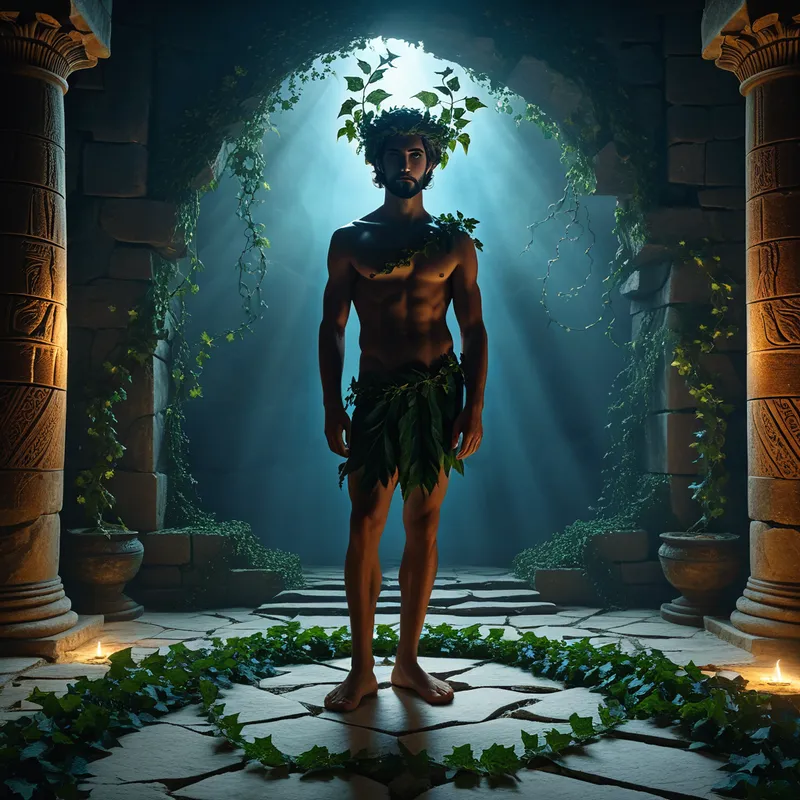
Listen. There is a hall that is not a hall, a palace that is a wilderness of stone and vine. It belongs to Dionysus, the twice-born, the stranger-god. His floor is polished marble, cool underfoot, a mirror for the flickering torchlight and the swirling feet of his devotees, the Maenads. Here, the air is thick with the smell of crushed grapes, of pine resin, of human sweat and divine promise. The rhythm of the tympanon is the world’s heartbeat.
But on a night when the moon was a sliver—a nail-paring of silver—the rhythm faltered. A sound tore through the music, not of drum or flute, but of the earth itself groaning in its sleep. It was a dry, sharp crack, like the breaking of a giant’s bone.
In the very center of the hall, the flawless floor split. No clean line, but a jagged, hungry maw of darkness. The polished stone peeled back like a wound. From the abyss rose a breath—not the cool air of caverns, but the hot, damp exhalation of a time before time. It smelled of raw clay, of deep roots, of blood not yet spilled. The torchlight recoiled from the edge, dancing wildly.
The Maenads’ ecstatic cries turned to shrieks of a different pitch. Their thyrsus-staves, tipped with pine cones, now pointed not in joyful frenzy but in terror at the void. Wine spilled from overturned kylixes, pooling at the crack’s lip before being swallowed by the dark.
And Dionysus stood. He did not startle. His eyes, which could be as gentle as a fawn’s or as mad as a storm, grew still and deep. He approached the fissure. He saw not emptiness, but a seething, formless potential. He saw the Chaos that existed before his father Zeus imposed order. It was the world’s raw, dreaming substrate, the antithesis of the Olympian Cosmos he was both part of and eternally outside.
He did not command it closed. He did not summon his divine kin. Instead, he reached into the crack. Not with his hand, but with his essence—the wild, untamable sparagmos of his own nature. The chaos recognized its kin. The fissure did not widen, nor did it heal. It stabilized. Its edges grew soft with moss and tiny, night-blooming flowers. It became a feature of the hall, a permanent scar, a wellspring of that which cannot be ordered. The music began again, but now it held within it the deep, rhythmic pulse from below the floor. The dance now circled the crack, incorporating its presence. The god had not conquered the rupture; he had married it.
Cultural Origins & Context
This myth does not appear in the grand epics of Homer or the systematized theogonies of Hesiod. It is a fragment, a cult story whispered in the torch-lit mysteries of Dionysus. It belongs to the periphery, told not by court poets but by the god’s own itinerant priests and the throats of the possessed. Its function was not to explain the cosmos’ origin, but to model a radical form of acceptance.
In a culture that venerated the ideal of the Kalos Kagathos—the balanced, beautiful, and good—and built city-states on principles of order (cosmos) versus chaos, Dionysus was the necessary, terrifying exception. His myths often involve boundaries being violated: the individual’s mind, the city’s walls, the body’s integrity. The Crack in the Floor is the ultimate domestic violation. The oikos (household) and the temenos (sacred precinct) are one in his hall, and its very foundation is shown to be an illusion resting atop the abyss. This story served as a theological grounding for the Dionysian rites: ecstasy was not an escape from reality, but a plunging into its truer, more terrifying foundation. It gave a mythic shape to the experience of the initiate—the cracking open of the conscious self to the unconscious depths.
Symbolic Architecture
The crack is not a problem to be solved, but a truth to be acknowledged. It represents the irrepressible return of the repressed, the foundational chaos that undergirds all personal and cultural order.
The floor of the psyche is always a temporary construction. The crack is its memory of bedrock.
Dionysus himself is the archetype of the paradoxical integrator. He is the god of cultivated wine and animalistic frenzy, of joyful liberation and horrific dismemberment. His hall, therefore, is not a place of pure, safe order. It is the liminal space where order and chaos consciously meet. The polished marble signifies the civilized, artistic, structured aspect of the self and society. The primal chaos beneath is the undifferentiated potential, the instinctual drives, the traumatic memories, the raw creative force that exists before language and form.
The myth’s resolution is the key. Dionysus does not seal the crack with Olympian authority (a repression that would only cause a later, more violent eruption). He communizes with it. He allows it a place at the heart of his domain. This is the symbolic act of acknowledging the shadow, the chaos, the madness within, not as an enemy to be destroyed, but as a source of potency and truth that must be given a sacred, bounded space.
The Dreamer’s Resonance
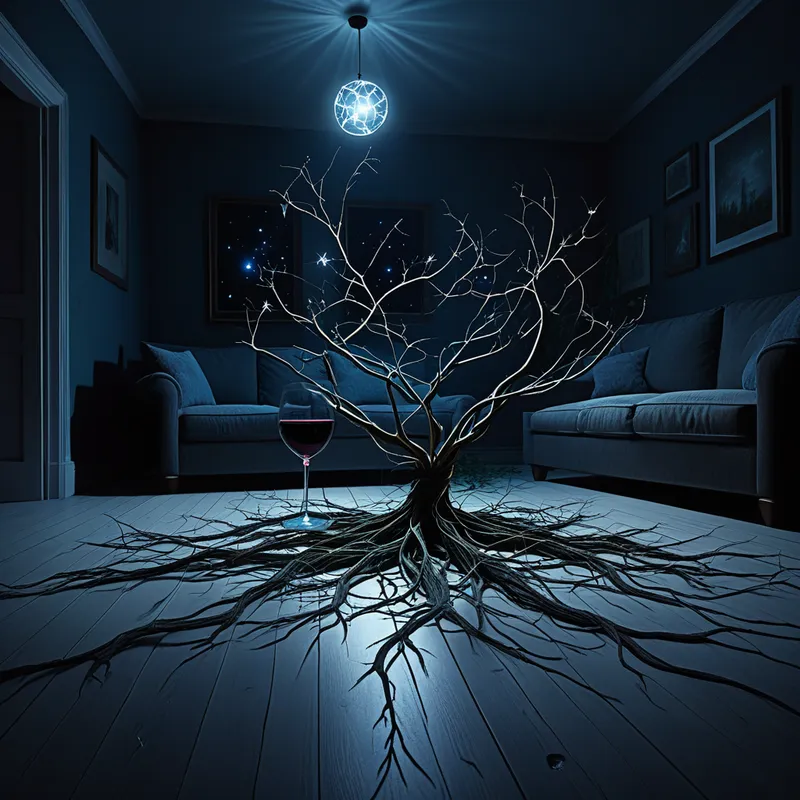
When this myth pattern stirs in the modern dreamer, it signals a profound somatic and psychological rupture. To dream of a crack opening in the floor of one’s home, office, or any familiar, “secure” interior space is to experience the felt sense of a foundational worldview or self-concept breaking apart.
The somatic experience is often one of visceral dread—a lurch in the stomach, a cold sweat upon waking. This is the body registering the tremor of a paradigm shift. The dreamer may be undergoing a crisis of faith, the collapse of a long-held career identity, the unsettling upwelling of a forgotten trauma, or the terrifying, exhilarating onset of a creative impulse that threatens to dismantle their neat life. The “chaos” that rises is personalized: it may appear as black water, tangled roots, insects, a dark mist, or simply a void that exerts a gravitational pull. The dream ego’s reaction mirrors the myth’s options: frantic attempts to “fix” the floor (repression), fleeing in terror (avoidance), or, in the most transformative dreams, approaching the edge and looking in (curiosity, the beginning of integration).
Alchemical Translation
The alchemical process mirrored here is the Nigredo, not as an end, but as a revelation of the Prima Materia. In the work of individuation, we build a conscious personality—a “floor” of habits, values, and identities. The crisis of the crack is the discovery that this floor is not the ground. The goal is not to rebuild the old floor more stoutly, but to consciously relocate one’s dwelling to acknowledge the abyss.
Individuation is not the construction of a flawless edifice, but the art of dwelling poetically with the fissure.
Dionysus models the rebel archetype in its most profound sense. He rebels against the tyranny of false wholeness. His “triumph” is a triumph of inclusivity over purity. For the modern individual, the alchemical translation is this: the symptoms, the breakdowns, the irrational angers, the depressive voids—these are not foreign invaders. They are the crack in your floor. They are messengers from the foundational chaos of your own being, the source of both your creativity and your destruction.
The work is to do as Dionysus did: to approach, to recognize, and to ritualize a relationship with what emerges. This might mean creating a bounded space for expression (art, journaling, therapy), allowing the “chaotic” emotion to be fully felt in the body without immediate action, or simply holding the conscious awareness that one’s orderly self is a beautiful, necessary fiction built over an infinite, creative dark. The transformed self is not a perfectly healed being, but one who has made the crack part of the sacred architecture of their life, from which a deeper, more authentic vitality can flow.
Associated Symbols
Explore related symbols from the CaleaDream lexicon: