The Cosmic Elk Khanty Myth Meaning & Symbolism
A Siberian creation myth where the Cosmic Elk, hunted by celestial gods, becomes the world, its body forming the land, rivers, and sky for humanity.
The Tale of The Cosmic Elk Khanty
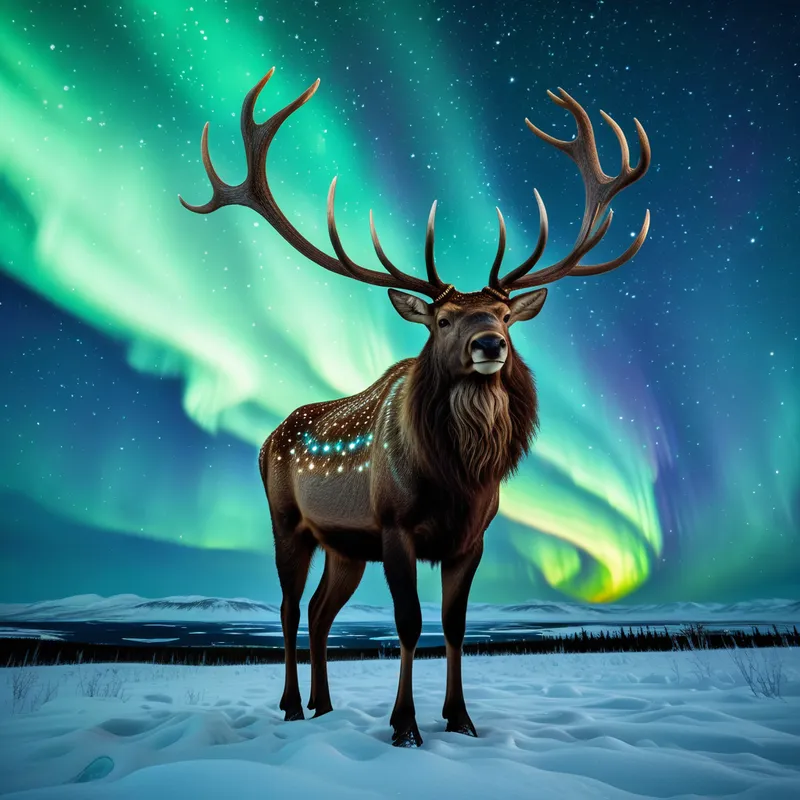
In the time before time, when the sky was a dark hide stretched tight and the earth was a formless dream, there walked the Great One, the Cosmic Elk Khanty. Its coat was the deep blue of the midnight heavens, speckled with the shimmering white of unborn stars. Its antlers were not of bone, but of living wood, reaching up to cradle the very fabric of the upper world, each tine holding a potential season, a future river, a song of wind. It moved in silence across the void-steppe, and where its hooves touched, a soft moss of possibility began to grow.
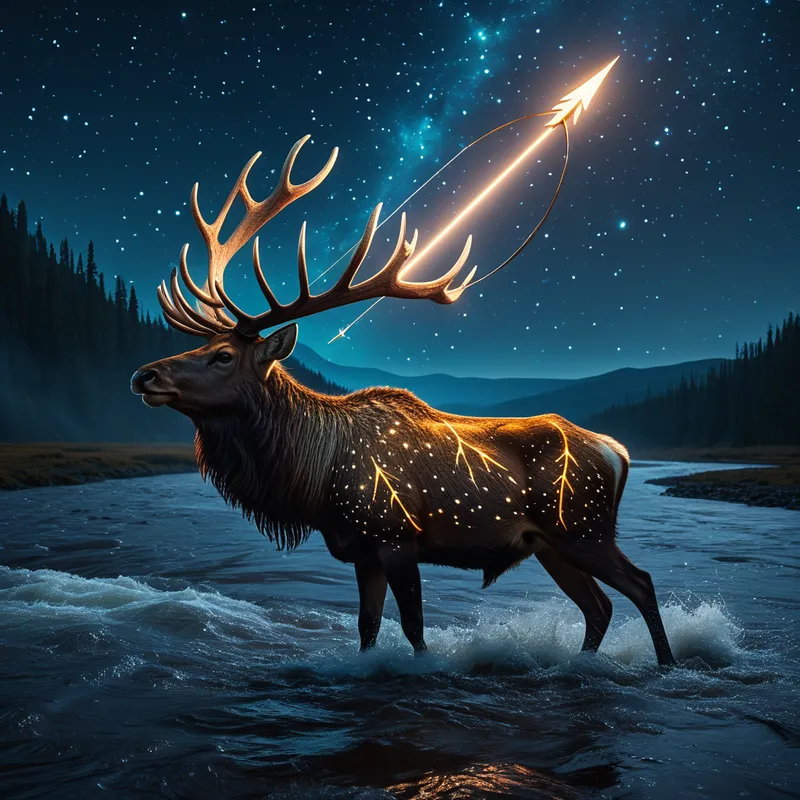
But the world was empty. The celestial gods, the Numi-Torum, looked down from their bright dwellings and saw only the beautiful, wandering Elk. They desired to create a home for their children, for the people who were yet whispers in their thoughts. And so, they took up their bows of sunlight and moonlight. The greatest of them, the World-Surveyor God, drew back the string. The air hummed with the tension of impending creation.
The arrow flew—a streak of fate woven from divine intention. It found the flank of the Cosmic Elk. Not a cry of pain, but a deep, resonant sigh echoed through the void, a sound that became the first wind. The Elk did not fall, not yet. It began to run, a great, loping gallop that shook the foundations of reality. From the wound in its side flowed not blood, but a torrent of water—clear, cold, and life-giving. This was the first of the great rivers, carving its path with the Elk’s fading strength.
It ran for seven days and seven nights. Where its hooves struck the ground, hills and mountains rose. Where its breath labored, mists gathered and fell as the first rain. The hairs from its coat, loosened by the journey, took root and became the vast, whispering taiga. Its antlers, scraping the sky-dome, scattered their star-seeds, which caught and began to glow—the constellations were born from its crown.
Finally, its strength spent, the Cosmic Elk Khanty knelt upon the earth it had forged from its own substance. Its body sank into the land. Its ribs became the ridges of the Ural Mountains. Its great heart became a warm, fiery lake at the world’s core. Its eyes, closing for the last time, became two deep, still pools that reflected the sky it once carried—the first sacred lakes where the spirits would dwell. From its final breath, warm upon the new moss, rose the first human, made of earth, water, and that sacred breath. The world was complete. The Elk was gone, yet it was everywhere.
Cultural Origins & Context
This myth originates from the Khanty people, whose world is the vast coniferous forest and river networks of the Ob River basin. For them, mythology is not mere story but a living map of reality, an oral scripture that encodes survival, ethics, and identity. The tale of the Cosmic Elk was not told for entertainment alone; it was recited by shamans during seasonal rituals and by elders to initiate the young into the fundamental truth of their existence.
Its societal function was foundational. It established a cosmology of sacred reciprocity: the world is not a given, but a gift born from a supreme sacrifice. It forbids wanton exploitation, for to harm the forest, the river, or the land is to desecrate the living body of the Elk-Creator. The hunt, a central aspect of Khanty life, was thereby transformed from a simple act of taking into a solemn ritual of remembrance and gratitude, a re-enactment of the original, world-making hunt by the gods. The myth wove the people, the animals, and the landscape into a single, animate tapestry of kinship.
Symbolic Architecture
At its core, the Cosmic Elk Khanty is the archetype of the Anima Mundi, the World Soul. It represents the primordial unity of all matter and spirit before the emergence of duality. Its dismemberment is not a murder, but a sacred dissemination—the One becoming the Many for the sake of creation.
The greatest giving is not of what one has, but of what one is. The cosmos is the body of a willing sacrifice.
The Elk’s flight is the archetypal Divine Journey, where movement itself becomes an act of creation. The pursuing gods represent the necessary, often painful, forces of differentiation and order that must act upon undifferentiated potential to bring forth a manifest world. The myth encodes a non-anthropocentric creation: humanity is not the goal, but a late and gentle afterthought, born from the Creator’s final exhalation, forever indebted and intimately connected.
Psychologically, the Elk symbolizes the totality of the psyche—the Self in Jungian terms. Its willing “hunt” and transformation mirror the process where the integrated psyche must often be “broken down” or differentiated (by the arrows of insight, crisis, or fate) so that its potential can be actualized into the lived reality of an individual’s world—their relationships, creativity, and conscious life.
The Dreamer’s Resonance
When this myth stirs in the modern unconscious, it often manifests in dreams of profound somatic connection or transformation. One might dream of becoming a large, peaceful animal, feeling the earth solid and real beneath one’s feet, or of a guiding animal that leads the dreamer to a water source or a place of immense natural beauty. Conversely, dreams of being hunted, not with terror but with a strange sense of purpose or inevitability, can echo the Elk’s fate.
These dreams signal a psychological process of grounding and embodiment. In an age of digital abstraction and disconnection, the psyche calls for a return to its “animal” base—the instinctual, bodily wisdom. The wounding in the dream is rarely literal violence; it is the puncture of a limiting ego-structure, allowing the deeper, life-giving waters of the unconscious (the Elk’s blood-rivers) to flow into conscious life. The dreamer is undergoing a process of becoming more real, more substantial, and more ecologically integrated within their own psychic landscape.
Alchemical Translation
The alchemy of this myth models the ultimate act of psychic transmutation: the sacrifice of the ego’s illusion of separateness for the creation of a genuine, embodied Self. The modern individual often lives in a “formless void”—a state of potential plagued by anxiety, fragmentation, or meaninglessness. The Numi-Torum’s arrow is that catalytic event—a crisis, a loss, a calling—that forces a flight from old, barren ground.
Individuation is the hunt where you are both the pursued animal and the celestial hunter. The wound is the opening through which the world-soul enters.
The “running” is the active engagement with life that this crisis demands. It is the hard, often painful work of building a life: forming habits (mountains), expressing emotion (rivers), developing thought (forests). The final “kneeling” is the surrender of the ego’s central command, allowing the psyche to become the world it inhabits. One’s talents, memories, and experiences are no longer possessions, but the very geography of one’s being. The “human born from the breath” is the new, humble consciousness that arises from this process—aware that it is not the owner of its world, but its grateful inhabitant, born from and sustained by a sacrifice greater than itself.
Associated Symbols
Explore related symbols from the CaleaDream lexicon:
- Sacrifice — The central, voluntary offering of the Cosmic Elk’s form to create the manifest world, representing the foundational act of giving that precedes all life and structure.
- Journey — The Elk’s transformative flight across the void, where its movement itself sculpts the landscape, symbolizing the creative power of purposeful action and passage.
- River — The first creation from the Elk’s wound, representing the flow of life-force, emotion, and time from a sacred source into the world.
- Forest — The taiga born from the Elk’s coat, symbolizing the complex, interconnected growth of the unconscious mind and the community of all living things.
- Mountain — The enduring bones and ribs of the Elk, representing stability, sacred structure, and the skeletal framework of reality or the psyche.
- Spirit — The animating presence of the Elk that disperses into all creation, denoting the immanent sacredness within every element of the natural world.
- Earth — The final, integrated form of the Elk’s body, symbolizing groundedness, the physical vessel of the soul, and the ultimate receiver of the sacrifice.
- Star — The seeds scattered from the Elk’s antlers, representing destiny, guidance, and the celestial origins of earthly patterns and potential.
- Blood — The primal, life-giving substance that becomes water, symbolizing the vital essence that must be spent or shared to fertilize and animate existence.
- Dream — The formless state of the world before the Elk’s journey, representing pure potential, the unconscious source from which all forms emerge.