The cosmic dance of Shiva Nata Myth Meaning & Symbolism
The story of the primordial dance that simultaneously destroys the universe and seeds its rebirth, a cosmic cycle of chaos and order.
The Tale of The cosmic dance of Shiva Nata
Listen. Before time had a name, there was only the silent, infinite ocean of potential. No sun, no moon, no earth beneath, no sky above. Only the great, dark, formless waters of Brahman, deep and still. And within that stillness, a presence slept. Shiva, the timeless one, lay in the yogic trance of pure being, the universe a latent dream in his boundless consciousness.
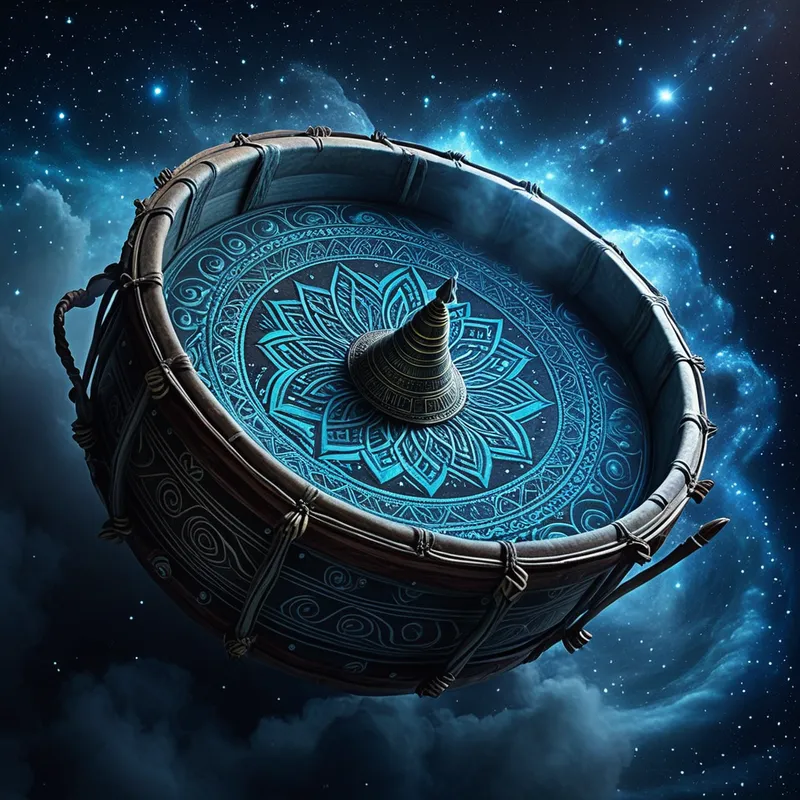
But a rhythm, faint as the memory of a first heartbeat, began to stir. It was not a sound, but the idea of sound. From the depths of that potential, a longing arose—a longing for expression, for form, for the play of existence itself. The rhythm found a focus within the sleeping god. A tremor passed through the great stillness. One of his four hands twitched, and in that motion, the first instrument was born: the damaru.
Thump-thump-thump-thump. The drumbeat began, slow and primordial. With each beat, a wave of vibration pulsed through the formless void. The waters of potential churned. Atoms of possibility began to spin, to collide, to seek union. The drum was the heartbeat of creation itself.
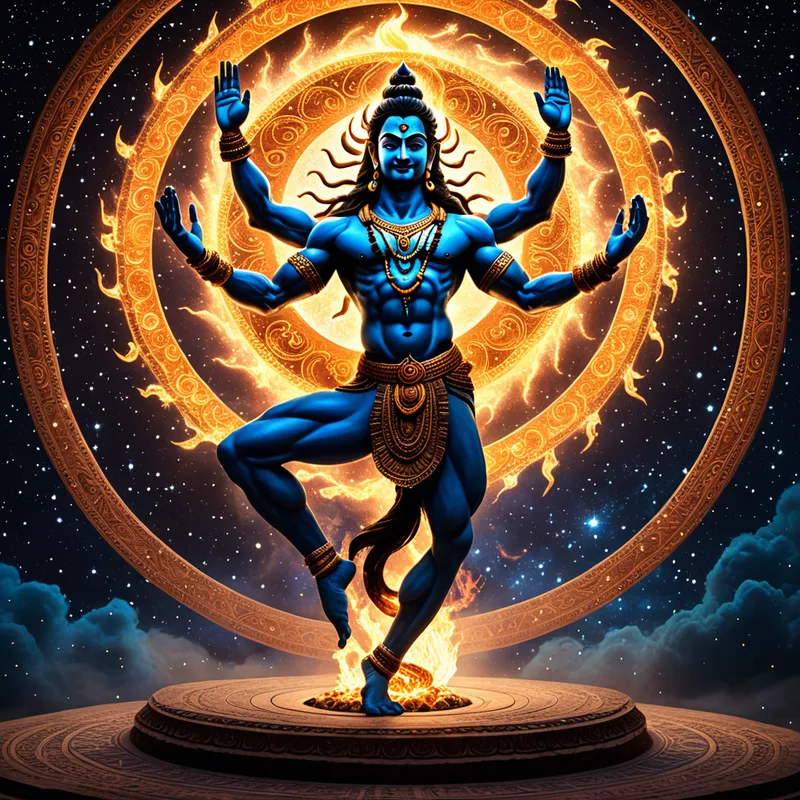
Shiva’s eyes opened. They were not eyes that saw light, but eyes that saw the very fabric of possibility and necessity. He rose from his slumber, and as he stood upon the body of the dwarf-demon Apasmara—the crushing of ignorance itself—his form began to move. It was not a step, but the first gesture of a dance that had always existed. His right foot lifted, a gesture of sublime release and grace. His left remained planted, the unwavering axis of the world.
His dance began in earnest. The Ananda Tandava. His flowing locks, matted with the ashes of countless universes, whirled out, catching the sparks now flying from the friction of creation. In his upper right hand, the damaru beat its relentless, joyful rhythm, the spanda, the divine throb that gives rise to all language, all music, all structure. In his upper left hand, the Agni blazed—the purifying flame of dissolution. Creation and destruction, held in perfect, simultaneous balance.
With his lower right hand, he made the abhaya mudra, a gesture of protection and reassurance to all emerging beings. “Do not fear this dance,” it whispered. With his lower left hand, pointed to his raised foot, he indicated the path of liberation, the way out of the very cycle his dance was generating.
He danced faster. The ring of fire, prabhamandala, erupted around him, the boundary of time and space, the burning away of illusion. Within that ring, the cosmos exploded into being. Galaxies spiraled from the sweep of his arms. Stars ignited in the wake of his flying hair. Planets coalesced under the stamp of his rhythm. Life, in its infinite, desperate, glorious variety, burst forth, each creature moving to the drumbeat only it could hear.
He danced for eons upon eons, the universe expanding with his joy. But the drumbeat, the flame, the dance—they are one cycle. The fire in his hand grew, fed by the very cosmos it had helped create. The dance of bliss became the dance of dissolution. The flame touched the edges of the manifested world. Galaxies cooled and darkened. Stars winked out. Forms melted back into the potential from which they came. All was drawn back into the silent, dark waters, into the body of the dancing god, who slowly, gracefully, brought his raised foot down. The drum fell silent. The flame was absorbed. He stood once more upon the demon of ignorance, and his eyes closed. The universe was a completed thought, a finished exhalation.
There was silence again. The deep, full silence not of absence, but of consummation. And within that silence, the damaru, against Shiva’s still hand, gave one faint, anticipatory thrum. The dream of a new universe began to stir.
Cultural Origins & Context
The myth of Shiva Nataraja finds its most refined and iconic expression in the theological poetry and bronze sculpture of the Chola dynasty in Southern India (c. 9th-13th centuries CE). However, its roots dig deep into the ancient soil of the Vedas and the esoteric Shaiva Tantra traditions. It is not merely a story but a metaphysical doctrine given form.
The myth was preserved and transmitted through multiple, interwoven channels: the ecstatic hymns of the Tamil Nayanars, the precise ritual manuals of temple priests, and the visionary hands of master sculptors. In the great temple complexes like Chidambaram—said to be the cosmic center of the dance itself—the myth was enacted daily through ritual, dance (Bharatanatyam), and philosophy. Its societal function was profound: to provide a complete cosmological model that explained the nature of a dynamic, cyclic, and ultimately illusory (maya) universe, while simultaneously mapping a path to transcendent liberation (moksha) through that very understanding.
Symbolic Architecture
The dance of Shiva Nataraja is a perfect symbolic engine, a mandala of cosmic process. Every element is a key to understanding the nature of reality and consciousness.
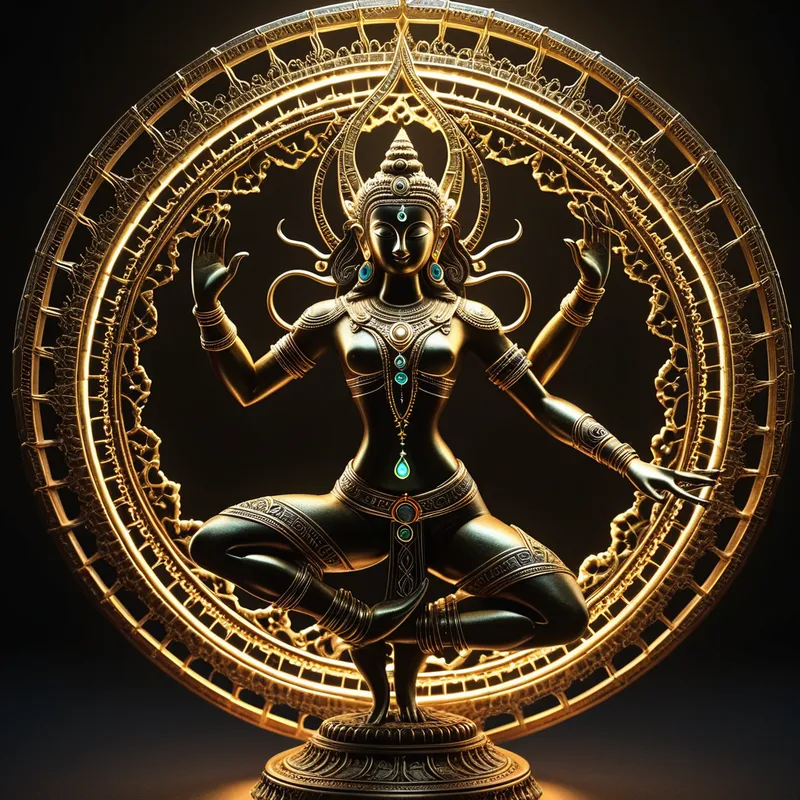
The dancing figure of Shiva represents the dynamic, oscillating principle of absolute reality—not a static god, but reality itself in motion. The prabhamandala is the boundary of phenomenal existence, the cycle of time (kalachakra), and the consuming process of transformation.
The drum and the flame are not sequential events, but simultaneous truths: every act of creation is an act of destruction of what came before, and every dissolution makes space for new creation.
The crushed demon Apasmara signifies that this divine play occurs upon the foundation of overcome ignorance; one must transcend petty ego and delusion to perceive the dance. The raised foot signifies release, the grace of transcendence, while the planted foot is the unwavering axis of the world, the immutable Self amidst the flux. Psychologically, this represents the core paradox of human existence: we are both the ephemeral, dancing ego (the created form) and the silent, witnessing consciousness (the dancer) that remains unmoved.
The Dreamer’s Resonance
When this myth stirs in the modern unconscious, it often manifests not as a literal dream of a dancing deity, but as dreams of overwhelming, beautiful chaos. One may dream of being in a storm of transforming objects, of buildings rising and crumbling to a rhythmic pulse, or of their own body moving in a dance that seems to rewrite the landscape around them.
Somatically, this can correlate with periods of intense life transition—the end of a career, a seismic shift in identity, the chaotic creativity of a new project, or the dissolution of a long-held belief system. The psyche is experiencing its own Ananda Tandava. The dreamer is processing the simultaneous terror and exhilaration of their personal cosmos being taken apart and reassembled. The rhythmic pulse felt in such dreams points to an instinctual, archetypal process at work, one that feels both personal and vastly impersonal, destructive and generative. It is the Self regulating the psyche, breaking down outworn complexes (the flame) to the rhythm of a new, emerging order (the drum).
Alchemical Translation
For the individual on the path of individuation, the myth of Nataraja provides the ultimate model for psychic alchemy. The goal is not to stop the dance—which is the dance of life itself—but to shift one’s identity from the created forms within the circle of fire to the consciousness of the dancer.
The initial stage is the confrontation with Apasmara: the crushing of naive identification with the persona and the conscious ego. This is a necessary “demon” to overcome. Then comes the engagement with the opposites: the creative impulse (the drum) and the destructive, purifying impulse (the flame). The alchemist must learn to hold and work with both, to create without attachment and to destroy without fear.
Individuation is the process of learning to dance with your own chaos, to find the still point within your turning world, and to recognize that the fire that terrifies you is the same force that forges your gold.
The raised foot of grace is the experience of moments of transcendence, where one glimpses the unity behind the dance. The pointing hand directs the seeker to that experience as the source of liberation. The final alchemical translation is the realization that one’s personal struggles, creations, and dissolutions are not errors or distractions, but the very movements of the cosmic dance happening in miniature within the human soul. To embody the Nataraja archetype is to become the magician of one’s own reality, capable of wielding the tools of creation and destruction with conscious, compassionate balance, all while standing firm in the unmovable center of the true Self.
Associated Symbols
Explore related symbols from the CaleaDream lexicon: