The Cosmic Battle of Light and Dark Myth Meaning & Symbolism
The foundational Zoroastrian myth of the universe as a battlefield between the Spirit of Light and the Spirit of Destruction, shaping human destiny.
The Tale of The Cosmic Battle of Light and Dark
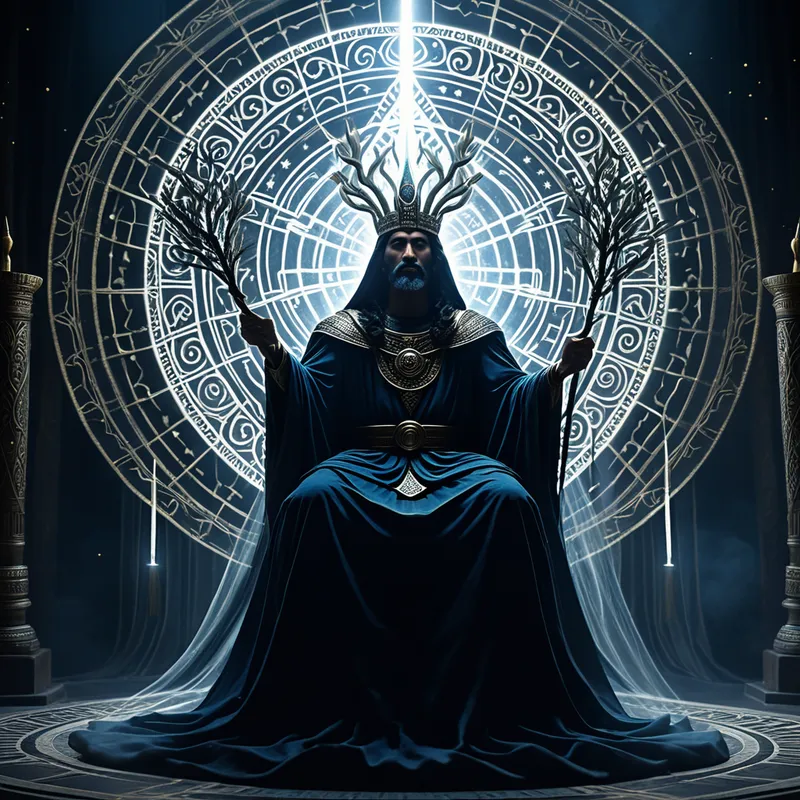
Listen. Before time was counted, in the boundless realm of Endless Light, there existed the uncreated, the One. From His supreme consciousness, two primal Spirits emerged, twins in origin but opposite in essence. The first was Ahura Mazda, the Spirit of Truth, of Asha. His being was pure, radiant light, a song of perfect order. His thoughts were stars, his breath the wind of creation. The second was Angra Mainyu, the Spirit of the Lie, of Druj. His essence was absence, a howling void that coveted the light only to smother it, a mind of endless negation.
Ahura Mazda, in his boundless wisdom, foresaw the conflict. He shaped the perfect, luminous blueprint of the universe—the Menog state. He fashioned the sky of stone, the waters, the earth, the first plant, the primordial bull, and the first man, Gayomard. It was a creation of harmony, a song without discord.
Then came the assault. Angra Mainyu, boiling with envy, pierced the lower boundary of the sky like a poisoned dagger. He did not create; he corrupted. He brought death to the bull, pain to Gayomard. He twisted the pure fire into smoke, the sweet waters into salt, the fertile earth into desert. He unleashed the serpent of winter, the fly of decay, and all the 10,000 diseases of mind and body. The universe became a battlefield, Getig, where every atom was contested.
But Ahura Mazda had not been idle. Into his creation, he had placed his divine attributes, the Amesha Spentas, and the Fravashis, the guardian spirits of all living things. Most crucially, he offered a choice to the twin spirits at the beginning, and Angra Mainyu chose his path of destruction freely. Thus, the battle was joined not just in the cosmos, but in the heart of every being. The world became a furnace for separating light from dark, truth from lie.
And so it stands. For twelve millennia, the war rages. The forces of Light, led by the Yazatas, engage the Daevas of darkness. It is a war fought in every sunrise that banishes night, in every field made fertile, in every truthful word spoken. It is a war that will culminate in the final renovation, the Frashokereti, when a great river of molten metal will purge all falsehood, the dead will rise, and Ahura Mazda’s creation will be made perfect again, forever free from the shadow.
Cultural Origins & Context
This is the cosmological heart of Zoroastrianism, the pre-Islamic faith of the Persian Empires. Its most authoritative expression is found in the Avesta, particularly in the Gathas. This was not merely a story for entertainment; it was the foundational ontology of a civilization. It was recited by priests, the Magi, in rituals to strengthen the forces of Asha (cosmic order) against Druj (chaos).
The myth served a profound societal function. It provided an ethical dualism that was active, not passive. The universe was not in a state of fallen grace, but in a state of active combat. Every human being was a soldier in this cosmic war, and their primary weapon was their moral choice. This framework underpinned the legal codes, the imperial ideology of kings as upholders of divine order, and the daily practices of agriculture, truth-telling, and charity. It explained the presence of evil not as a flaw in the creator, but as a separate, adversarial principle to be actively resisted.
Symbolic Architecture
At its core, the myth presents a radical vision of consciousness itself. The twin spirits are not external gods in a distant pantheon; they are the fundamental archetypal potentials within the psyche.
The first choice is not between good and evil, but between creation and negation. Ahura Mazda is the archetype of the Self, the urge toward wholeness, meaning, and coherent structure. Angra Mainyu is the archetype of the unintegrated Shadow, not as a source of vitality, but as the spirit of active deconstruction, cynicism, and entropy that seeks to dissolve order back into chaos.
The Getig world—our world—is the symbolic representation of the ego’s lived experience. It is the “mixed state” where the light of consciousness and the darkness of the unconscious, the drive for order and the pull of disintegration, are in constant tension. The Amesha Spentas represent the developed psychological faculties—Good Mind, Truth, Devotion, etc.—that must be cultivated to fortify the psyche.
The battle is never for the annihilation of the dark, but for its transformation. The final river of molten metal symbolizes the alchemical fire of consciousness that must be endured to burn away self-deception, leaving only purified essence.

The Dreamer’s Resonance
When this mythic pattern stirs in the modern dreamer, it often signals a critical phase of ethical and psychological confrontation. This is not the gentle integration of the shadow, but a declaration of war against a destructive complex that is actively undermining the dreamer’s life.
You may dream of a radiant, fortified place (a home, a temple) being breached by a creeping, formless darkness. You may find yourself in a vast, barren landscape under a oppressive sky, tasked with protecting a single, fragile source of Light. The antagonist is rarely a person, but an atmosphere, a pollution, a corrosive force. Somatically, the dreamer may awaken with a sense of grim determination, a clenched jaw, or a cold resolve. Psychologically, this indicates that a long-tolerated “lie” or pattern of self-betrayal (Druj) has reached an intolerable level. The psyche is mobilizing its resources for a definitive stand. The dream is the call to arms, affirming that the conflict is real and that neutrality is no longer an option.
Alchemical Translation
The individuation process modeled here is one of active purification. It is the hero’s journey internalized, not as a quest for a golden treasure, but as the relentless duty of a spiritual warrior defending the sovereignty of the Self.
The first alchemical stage (nigredo) is the honest recognition of Angra Mainyu’s presence within—not as a fascinating darkness, but as a destructive force of nihilism, addiction, or malice. The second stage (albedo) is the conscious invocation of one’s “divine attributes,” the Amesha Spentas: applying Good Mind to discern truth, using Righteousness to make ethical choices, embodying Devotion to what is life-giving. This is the building of the inner fortress.
The ultimate alchemy is the Frashokereti of the psyche: the moment when the endured conflicts, the faced darkness, and the chosen truths are so integrated that they cease to be a battle and become the unshakable foundation of one’s being. The molten metal is the searing heat of uncompromising self-honesty, and the resurrected world is the personality reborn, not in naive innocence, but in hard-won, radiant integrity.
The myth teaches that we are not here to transcend the world, but to perfect it. Our very struggle is the means by which the cosmos heals itself. In choosing light, we do not deny the dark; we fulfill the destiny of creation.
Associated Symbols
Explore related symbols from the CaleaDream lexicon:
- Light — The fundamental substance of Ahura Mazda’s creation and consciousness, representing Asha (Truth), divine wisdom, and the irreducible core of the Self that must be defended.
- Fire — The sacred element of Zoroastrianism, symbolizing the purifying, transformative force of divine judgment and the inner light of discernment that separates truth from falsehood.
- Order — The cosmic principle of Asha, the perfect harmony of the original creation and the ultimate goal of the cosmic battle, representing psychological integrity and ethical alignment.
- Shadow — The direct embodiment of Angra Mainyu’s essence within the psyche, the spirit of negation, chaos, and the Lie (Druj) that seeks to undermine conscious structure.
- Battle — The eternal state of the Getig (material) world and the human condition, representing the necessary and active psychic conflict required for growth and purification.
- Hero — The archetypal role of every human in the Zoroastrian worldview, a soldier in the cosmic war whose primary weapon is moral choice and righteous action.
- Sacrifice — Represented by the death of the primordial bull, whose body seeded all beneficial animals and plants, symbolizing the necessary dissolution of a pristine state to fuel the creative struggle.
- Rebirth — The promise of Frashokereti, the final renovation where all is made perfect, symbolizing the psyche’s potential for complete renewal after the trials of confrontation and integration.
- Stone — The material of the first sky created by Ahura Mazda, representing the foundational, immutable nature of divine law and the firm boundaries needed to contain chaos.
- Sun — The supreme physical manifestation of Ahura Mazda’s light in the cosmos, a daily reminder of the ultimate victory of order over darkness and a symbol of enduring consciousness.
- Mountain — Often the site of revelation and confrontation in Persian myth, representing the lofty, fortified place of spiritual insight where one can survey the battlefield of existence.
- River — Specifically the river of molten metal at the end of time, symbolizing the final, cathartic purge of all inner falsehood and impurity through the fire of uncompromising truth.