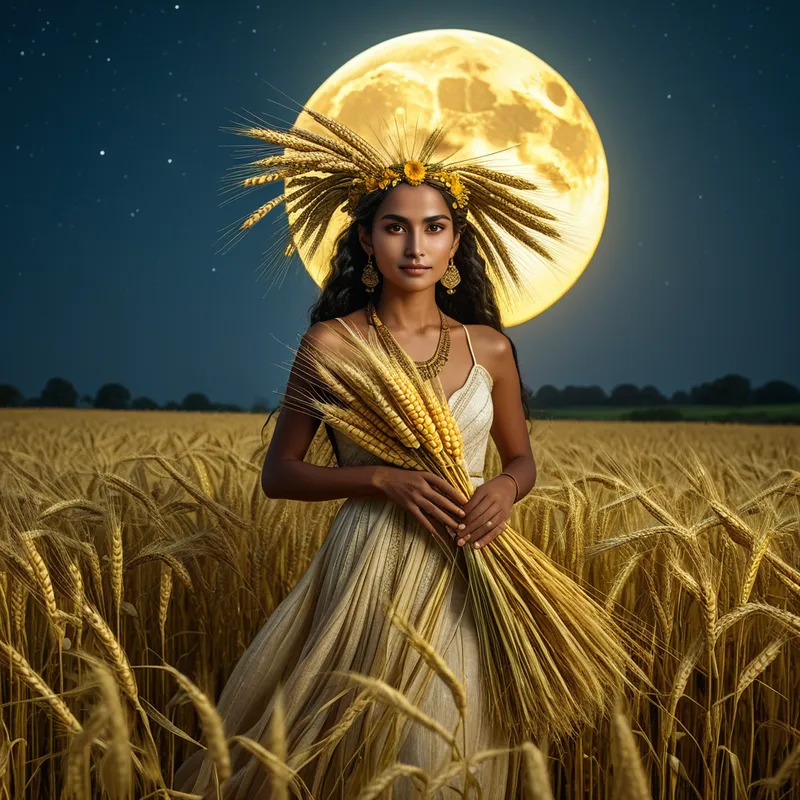
The Corn Mother / Grain Goddesses Myth Meaning & Symbolism
A global myth of a goddess who sacrifices herself to become the first grain, teaching humanity the sacred cycle of life, death, and nourishment.
The Tale of The Corn Mother / Grain Goddesses
Listen. In the time before time, when [the world](/myths/the-world “Myth from Tarot culture.”/) was young and humanity shivered in the cold, knowing only the hunger that gnawed at their bellies, there was a being of pure generosity. She was known by many names, but her essence was one: the Mother who walked among them. Her skin was the color of rich soil, her hair the tassels of the ripening stalk, her breath the warm wind that promises growth.
The people were her children, and their hunger was her sorrow. They gathered what meager roots and berries they could find, their lives a thin thread stretched between scarcity and despair. She saw their hollow cheeks, their weary eyes, and a resolve deeper than any mountain root took hold within her.
One day, as the sun hung heavy and golden in [the sky](/myths/the-sky “Myth from Persian culture.”/), she gathered the people. “My children,” she said, her voice like the rustle of a thousand leaves, “your hunger ends today. But you must listen, and you must be brave.” She led them to a wide, open field, [the earth](/myths/the-earth “Myth from Hindu culture.”/) dark and soft. She lay down upon it, her form stretching across the loam. “You must drag me across this field,” she instructed, her tone leaving no room for question.
Terrified, weeping, they refused. But her gaze was steady, a command of love so fierce it brooked no disobedience. With hearts breaking, they took hold of her. As they pulled her sacred body across the earth, a miracle and a horror unfolded. Where her flesh touched the soil, it began to change. Her hair became long, silken strands of golden grain. Her fingers and toes broke into clusters of rich, nourishing seeds. From the pores of her skin sprouted green shoots, rising swiftly toward the sun. Her final, loving sigh became [the wind](/myths/the-wind “Myth from Various culture.”/) that scattered her essence—now thousands of seeds—across the waiting field.
Where she had lain, only a verdant, whispering sea of green remained. The people, awestruck and grieving, tended the field. They watched as the green turned to gold. When the stalks were heavy and ripe, they harvested the first grain. They ground it, baked it, and ate. The bread was sweet and sustaining, filling them with a strength they had never known. It was her flesh. The life that had left her body now flowed into theirs. In their fullness, they understood the terrible, beautiful bargain. She was gone, yet she was everywhere—in every seed, every loaf, every full belly, and in the promise that when one life is given in love, countless others may live.
Cultural Origins & Context
This is not one story, but a profound pattern echoing across continents, spoken in the languages of soil and survival. We hear it in the [Three Sisters](/myths/three-sisters “Myth from Native American culture.”/) tradition of North America, where Onatah is stolen and must be rescued so the people may eat. We hear it in the Slavic tale of the Poludnica and the sacrifice that brings rye. We see it in the descent of the Sumerian Ashnan from heaven, and in the Greek Demeter, whose grief for her daughter [Persephone](/myths/persephone “Myth from Greek culture.”/) mirrors the cycle of growth and dormancy.
These stories were the sacred textbooks of agricultural societies. They were not mere explanations for the origin of crops; they were the foundational ethics of civilization. Told by elders at planting and harvest, enacted in ritual and dance, the myth encoded the fundamental law of reciprocity: life feeds on life. It taught respect for the seed, gratitude for the harvest, and the sacred responsibility of stewardship. The Grain Goddess was the first and ultimate gift-giver, and her story bound the community to the land and to each other through a covenant of remembrance and care.
Symbolic Architecture
At its [heart](/symbols/heart “Symbol: The heart symbolizes love, emotion, and the core of one’s existence, representing deep connections with others and self.”/), this myth dismantles the illusion of a self-contained individual. The Corn [Mother](/symbols/mother “Symbol: The symbol of ‘Mother’ represents nurturing, protection, and the foundational aspect of one’s emotional being, often associated with comfort and unconditional love.”/) is the [archetype](/symbols/archetype “Symbol: A universal, primordial pattern or prototype in the collective unconscious that shapes human experience, behavior, and creative expression.”/) of the individuated [psyche](/myths/psyche “Myth from Greek culture.”/) that understands its [purpose](/symbols/purpose “Symbol: Purpose signifies direction, meaning, and intention in life, often reflecting personal ambitions and core values.”/) is to be broken open and shared.
The ultimate nourishment is always a form of dissolution. The seed must cease to be a seed to become the stalk; the stalk must be cut down to become bread; the self must be offered to become sustenance.
The act of being dragged across the field is the symbolic representation of the creative act itself—a painful, necessary scattering of one’s essence into the world. Her [body](/symbols/body “Symbol: The body in dreams often symbolizes the dreamer’s self-identity, personal health, and the relationship they have with their physical existence.”/) is the primal substance, the undifferentiated potential. The [grain](/symbols/grain “Symbol: Represents sustenance, growth cycles, and the foundation of civilization. Symbolizes life’s harvest, patience, and transformation from seed to nourishment.”/) is the differentiated creation, the tangible gift that carries her [life](/symbols/life “Symbol: The symbol of ‘Life’ represents a journey of growth, interconnectedness, and existential meaning, encompassing both the joys and challenges that define human experience.”/)-force. The myth presents a cosmology where [death](/symbols/death “Symbol: Symbolizes transformation, endings, and new beginnings; often associated with fear of the unknown.”/) is not an end, but a transformation into a more pervasive, sustainable form of [life](/symbols/life “Symbol: The symbol of ‘Life’ represents a journey of growth, interconnectedness, and existential meaning, encompassing both the joys and challenges that define human experience.”/). It symbolizes the psychological [truth](/symbols/truth “Symbol: Truth represents authenticity, honesty, and the quest for knowledge beyond mere appearances.”/) that our deepest gifts often feel like a kind of death—a sacrificing of a previous, whole form of ourselves to feed a new growth, whether in raising a [child](/symbols/child “Symbol: The child symbolizes innocence, vulnerability, and potential growth, often representing the dreamer’s inner child or unresolved issues from childhood.”/), creating art, or building [community](/symbols/community “Symbol: Community in dreams symbolizes connection, support, and the need for belonging.”/).
The Dreamer’s Resonance
When this myth stirs in the modern dreamer, it often manifests not as a literal goddess, but as profound somatic and symbolic experiences. You may dream of feeding others until you feel empty, or of finding a single, luminous seed in the palm of your hand that holds immense weight. You might dream of a field within your own body, or of cooking a meal that never runs out.
These dreams signal a crucial phase in the psyche’s development: the confrontation with the Life-Giving Mother archetype and its shadow, the Devouring Mother. The dreamer is processing the cost of nurture. Are you being drained, feeling your resources scattered without renewal? Or are you being called to a sacred, voluntary sacrifice—to give of your time, energy, or creativity in a way that transforms you and nourishes your world? The dream asks: What within you is ripe for harvest? What must die in its current form so that it may feed your future?

Alchemical Translation
The alchemical journey modeled by the Corn Mother is the [nigredo](/myths/nigredo “Myth from Alchemical culture.”/) and albedo made sacred. It is the path of the caregiver who must first care for [the self](/myths/the-self “Myth from Jungian culture.”/)-as-seed.
Individuation is not about becoming a perfect, unassailable whole. It is about becoming fertile ground for one’s own dissolution and regrowth, season after season.
The modern individual undergoes this transmutation whenever they move from hoarding potential to planting it. The “dragging across the field” is the often painful, public process of bringing an idea, a project, or a vulnerable part of oneself into the world to be scrutinized and broken apart. The “harvest” is the integration of the results—the lessons learned, the connections made, the tangible outcomes. You are both the sacrificer and the sacrificed, the sower and the reaper. The myth teaches that psychic wholeness is found not in perpetual self-preservation, but in the courageous, cyclical offering of one’s specific gifts. In doing so, you cease to be merely a consumer of life and become, like her, a participant in the eternal, nourishing exchange between death and life, self and other, seed and boundless field.
Associated Symbols
Explore related symbols from the CaleaDream lexicon: